The Bello

3.4K posts

The Bello banner
The Bello

The Bello

@mrbluesnow

(-_-)

Nigeria Katılım Temmuz 2015
124 Takip Edilen108 Takipçiler
The Bello retweetledi
Crypto Senko
Crypto Senko@keanxley·
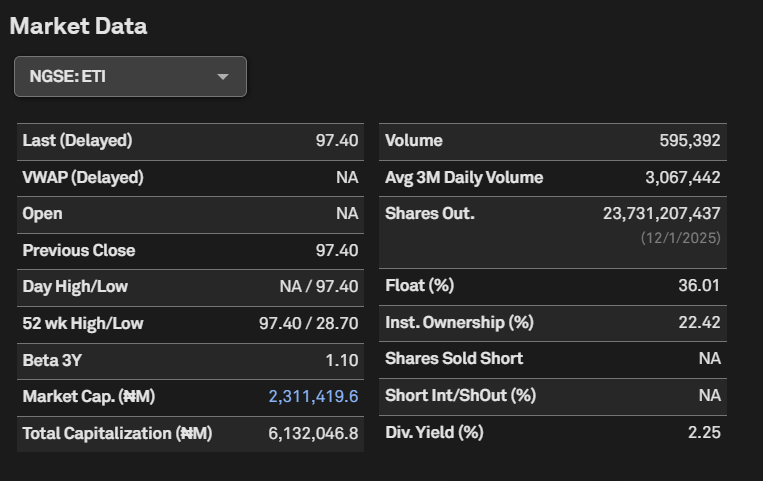
NGX vs Ecobank: A ₦627 Billion Market Cap Discrepancy Investors Cannot Ignore So, I was discussing with the TG members during our usual Sunday session, something we have consistently hosted every Sunday since 2021, free of charge. One of the topics we discussed was why continuous dilution should never be ignored when building long-term positions in companies. As we started breaking down the banking sector, we got to @GroupEcobank. We noticed major discrepancies in the reporting of its outstanding shares compared to what @ngxgrp currently displays on its platform, which, ideally, should be the go-to and most reliable source for investors. So, I decided to do a deeper dive. The first screenshot is from the @ngxgrp platform, which currently shows Ecobank’s total outstanding shares at 18,155,073,977. Multiplying that by Friday’s closing price of ₦97.4/share gives a market capitalization of ₦1,768,304,205,359.80. The second screenshot is from S&P Capital IQ, which reports Ecobank’s outstanding shares at 23,731,207,437 shares. Interestingly, the last update there was dated 1 December 2025. Using the same closing price of ₦97.4/share gives a market capitalization of ₦2,311,419,604,363.80. The final screenshot is extracted directly from Ecobank’s Q1 2026 financial statement under Note 14, page 29. The company itself reported outstanding shares of 24,592,619,000 shares. Multiplying this by ₦97.4/share gives a market capitalization of ₦2,395,321,090,600. What shocked me even more was that the same outstanding shares figure was also reported in Q1 2025. Now, today is a weekend, so I do not currently have access to the Bloomberg Terminal to cross-check further, but working with these three data points raises serious questions. So, who exactly should investors believe here? Personally, I would naturally rely on the company’s own financial statements because they are the primary source, and I should know their actual outstanding shares. NGXGROUP Market Cap for ETI = ₦1,768,304,205,359.80 Ecobank Q1 2026 Financial Statement Market Cap = ₦2,395,321,090,600 Difference = ₦627,016,885,240.20 That difference is highly material and honestly quite alarming. Even if we compare S&P Capital IQ with Ecobank’s reported figures, we still get a discrepancy of about ₦83.9 billion, which remains very material. Meaning even S&P Capital IQ appears to be underreporting Ecobank’s market capitalization. Now, this becomes a serious issue if @ngxgrp is not accurately reporting something as fundamental as outstanding shares. Market capitalization is one of the most basic valuation metrics investors rely on daily. If discrepancies of this magnitude exist, then it raises broader questions around data integrity and market transparency. What does this mean for the future of our market if basic company information is either underreported or overstated? This is 2026; these are issues we should have moved past long ago. It honestly breaks my heart because these were part of the same structural issues that contributed to market inefficiencies during the 2007/2008 era. And Ecobank is not even the only example. Even @ngxgrp previously had issues with the reporting of its own outstanding shares at some point (although I do not know if that has now been rectified). This is why I always encourage investors to scrutinize everything. It is not just about making money. It is also about ensuring our market institutions uphold accuracy, transparency, and investor confidence. I drop my pen here.
Crypto Senko tweet mediaCrypto Senko tweet mediaCrypto Senko tweet media
English
14
34
72
6.9K
The Bello retweetledi
Anish Moonka
Anish Moonka@anishmoonka·
The research behind this is wild. A baby is born and doesn't breathe. The window to fix it is 60 seconds. Doctors call this window the Golden Minute. And the first rule on the protocol is don't rush, because rushing actively breaks the technique. Roughly 1 in every 10 babies needs help breathing right after they're born. The American Heart Association and American Academy of Pediatrics worked out the exact sequence years ago, and it's the playbook used in hospitals around the world. Step one is the simple part: dry the baby, keep them warm, tilt the head a little to open the airway, rub the back, flick the soles of the feet. About 10% of newborns just need that small nudge to start breathing on their own. If 60 seconds go by and the baby still isn't breathing, or the heart is going slower than 100 beats a minute, you grab a bag and mask. The bag is a rubber bulb. You squeeze it, and air pushes through the mask into the baby's lungs. You can see this in the second clip. Around 5% of all newborns need it. If it's working, the baby's heart speeds up. About 30 seconds later, you check again. If the heart is still under 60 beats a minute, you start chest compressions. Only about 1 to 3 babies out of every 1,000 ever reach that stage. The bag and mask has one weak point. It only works if the mask seals tight against the baby's face, with no gaps at the rim. If air escapes around the edges, none of it reaches the lungs. The whole effort is just for show. A 2014 study at Leiden University in the Netherlands had medical staff try the technique on a training dummy. Inexperienced people leaked 51% of the air on their first attempt. After two minutes of focused practice, that number dropped to 11%. The seal is the whole thing, and shaky hands wreck it. The calm in that video is what lets the hands stay steady. A steady hand keeps the seal tight, while a shaky one breaks it. Cochrane is the body that writes the most authoritative medical reviews in this field. Their review on this calls getting the air in cleanly the single most important step in saving a non-breathing baby. A panicking person with a bad seal might as well not be in the room. Training does the rest. The NIH cites a study from Zambia where they trained midwives and nurses in this exact protocol. Out of every 1,000 babies born, the number who died in their first week dropped from 11.5 to 6.8. About a 41% drop, just from people learning to follow the steps in the right order without freaking out. Around 900,000 babies a year die from not starting to breathe at birth, per the WHO. Most of those deaths come down to two things: no trained person on hand, or someone trained who rushed. The slow walk in the video is the technique. Slow hands and a steady mask save more babies than any other thing on the checklist.
N𝕖𝕙𝕕𝕦𝕞@onlyCFrancisco

Baby back to life, no panic no rush, a professional who is aware of his duties. Remarkable

English
170
1.7K
19.6K
4.2M
The Bello
The Bello@mrbluesnow·
@ngx_wolf I saw your analysis in February, that was the period I started my stock journey, I got in around 90 naira. You were on point. Thank you.
English
1
1
3
532
The Bello retweetledi
Número Unø
Número Unø@nx_Anon·
There’s no version of reality I don’t come out on top, I will draw success from the fabrics of existence, I will commandeer the host of heaven to fight on my behalf. I WILL WIN, it’s inevitable IMPOSSIBLE IS NOTHING.
English
2
7
25
3.7K
The Bello retweetledi
Robert Greene
Robert Greene@RobertGreene·
Act before it becomes impossible to disentangle one strand of misery from another, or to see how the whole thing started.
English
32
125
1K
26.8K
The Bello
The Bello@mrbluesnow·
Not keeping to time is so annoying.
English
0
0
0
5
The Bello
The Bello@mrbluesnow·
@Morris_Monye This man gives me update steady. Gave me vfd share update, now this. 👌
English
0
0
0
1.6K
The Bello retweetledi
Holy Bible
Holy Bible@Holy__Bible1·
“𝙃𝙚 𝙙𝙞𝙚𝙙 𝙨𝙤 𝙬𝙚 𝙘𝙤𝙪𝙡𝙙 𝙡𝙞𝙫𝙚.”
English
333
18K
84.7K
1.2M
The Bello
The Bello@mrbluesnow·
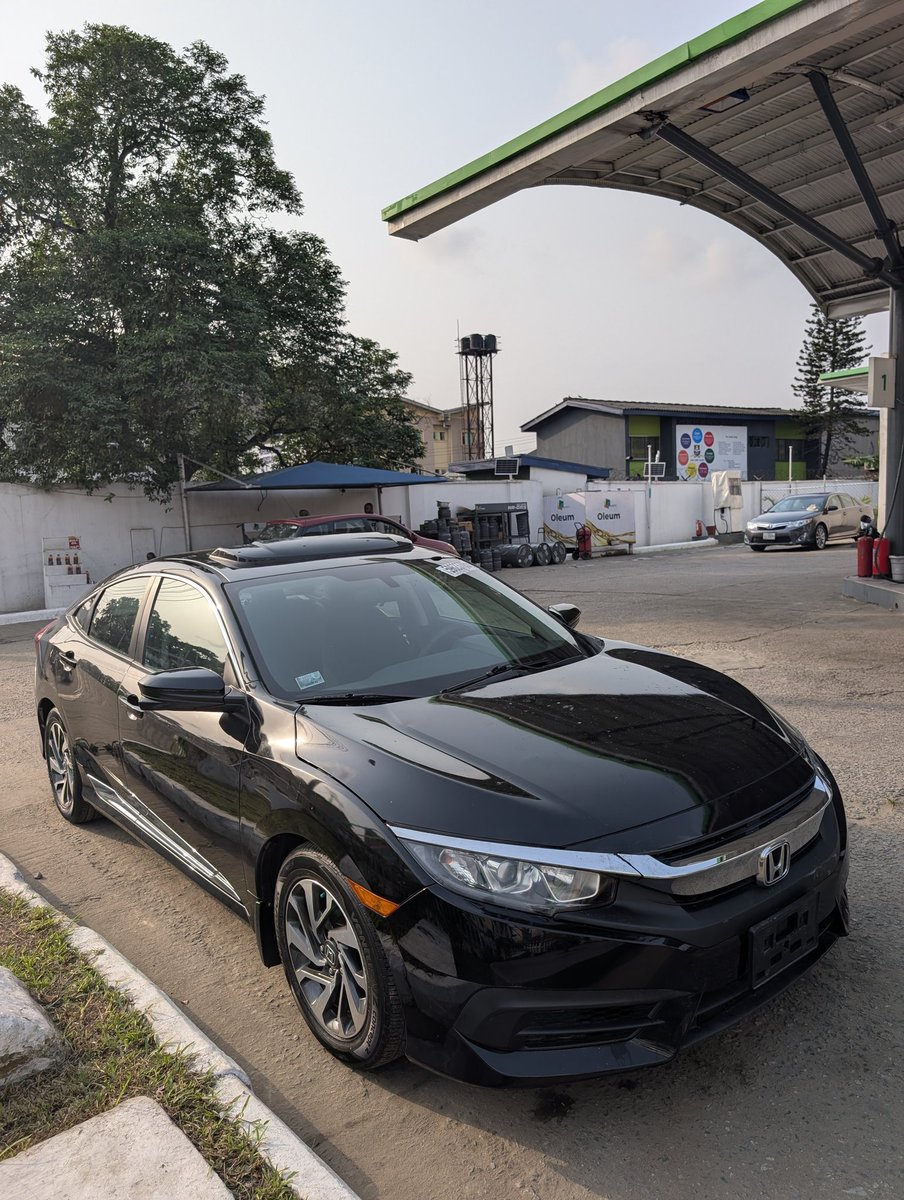
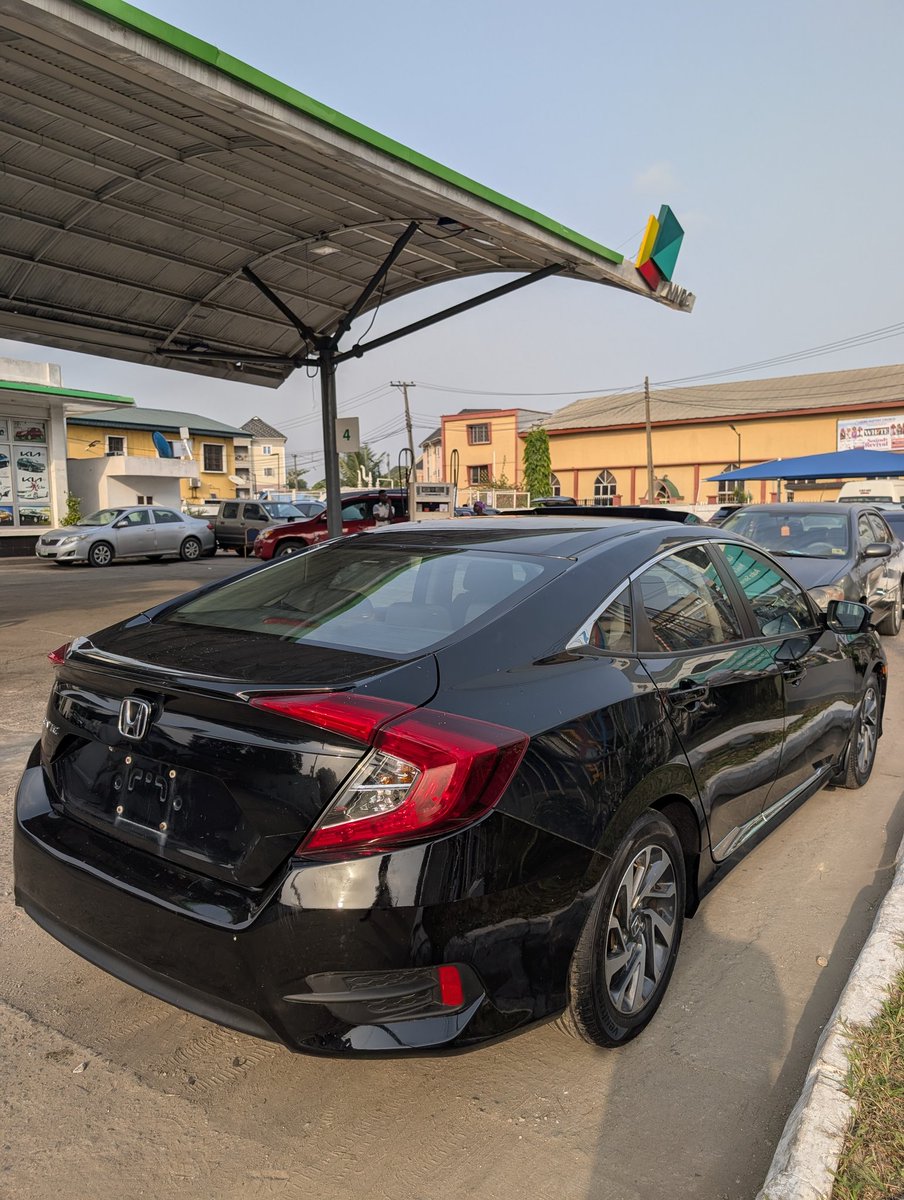
@Ol0ye I will buy this car soon. I dont know how soon, but I will.
English
0
0
0
214
The Bello retweetledi
charles bivins
charles bivins@bivins1·
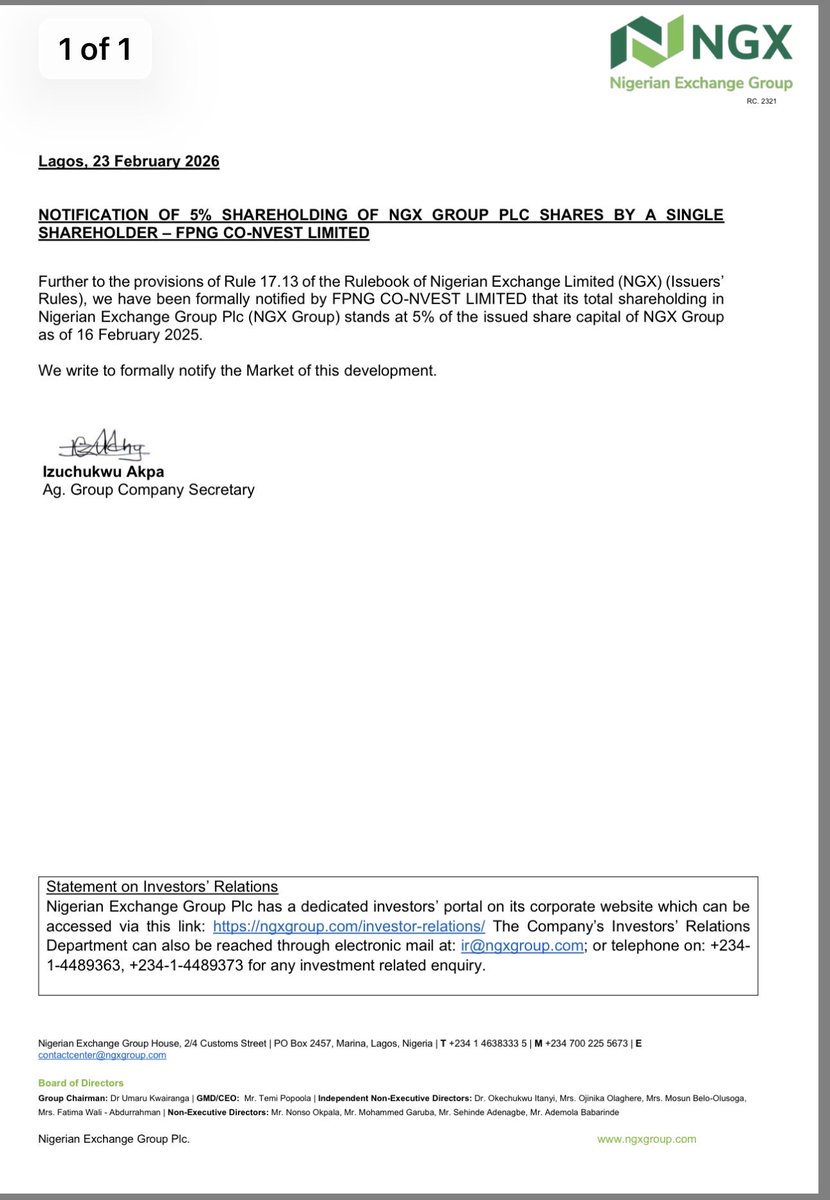
@ngxgrp informed the investing public of this company FPNG CO-NVEST LTD as having taken a 5 percent shareholding position of the @ngxgrp . While we commend the @ngxgrp for this timely disclosure, we would appreciate as shareholders if we have disclosure more about this company
charles bivins tweet media
English
1
12
23
3.2K
The Bello
The Bello@mrbluesnow·
I don't know.
English
0
0
0
3
The Bello
The Bello@mrbluesnow·
@greentickertale Good evening. Can we please talk about the over 4% administrative fees charged when selling shares? After the deductions profit is almost non existent and these fees are paid whether you make profit or not.
English
1
1
1
168
The Bello retweetledi
Oluwaseun Alaka
Oluwaseun Alaka@oluwaseun_alaka·
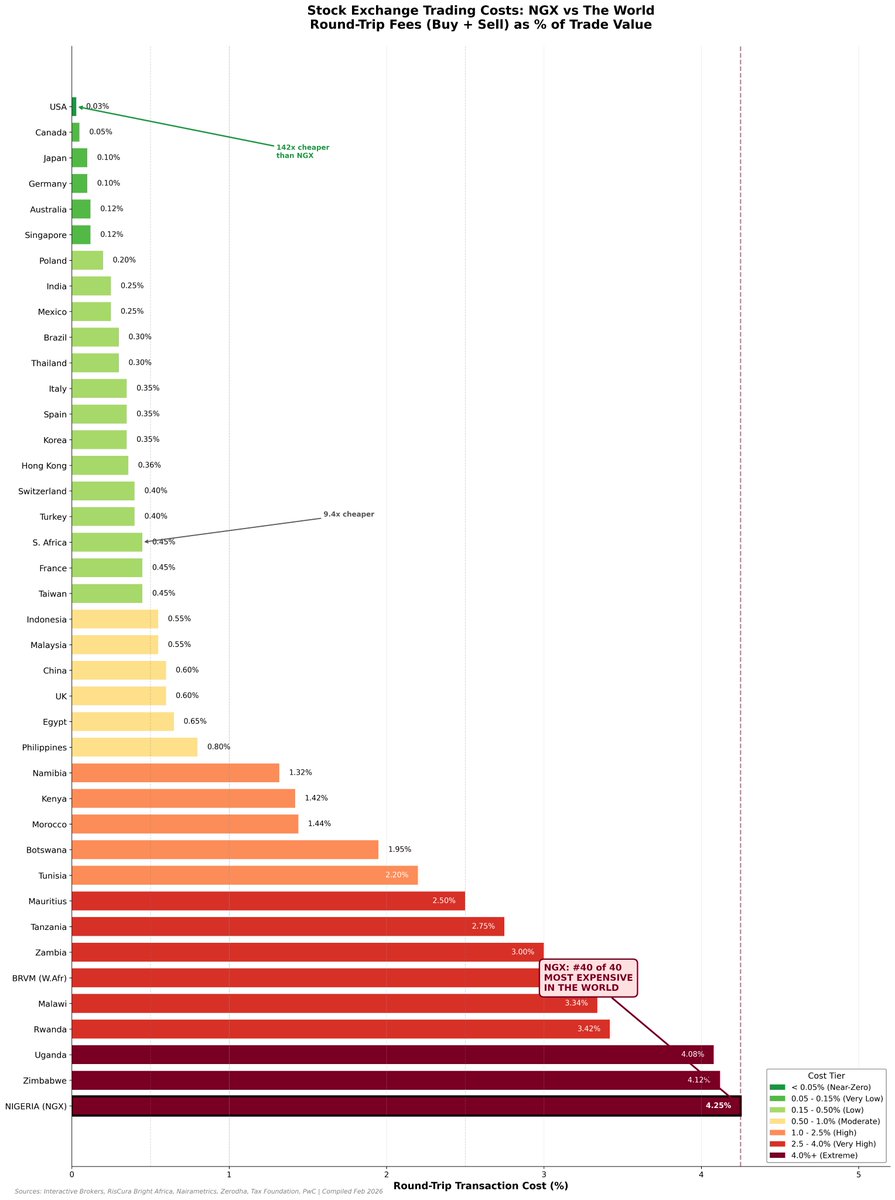
I asked @claudeai to compare trading costs for the major stock exchanges around the world. Why is it so expensive to trade equities in Nigeria? Why? @ngxgrp @SECNigeria
Oluwaseun Alaka tweet media
English
4
16
28
8.3K
The Bello retweetledi
Dekhola™
Dekhola™@Dekhola·
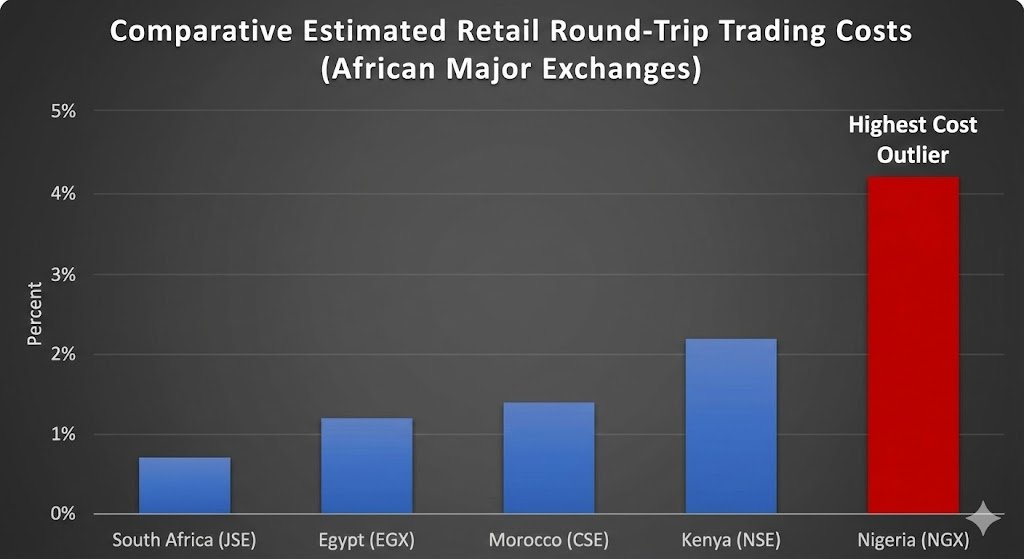
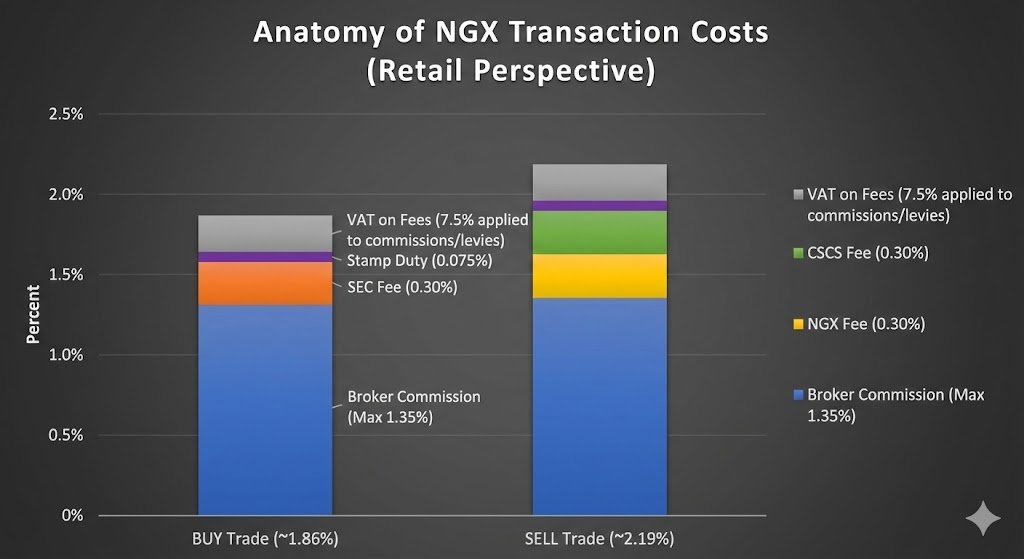
The NGX Tollgate Economics: Paying Rolls-Royce Prices for a Camry Ride Let us be honest. We Nigerians love a good hustle. We love the idea of making our money work for us while we sleep. It is the capitalist dream, isn't it? You save some Naira, identify a solid company like Dangote Cement, SEPLAT, MTNN, Aradel, Vitafoam, FBN or Zenith Bank, et al, buy a slice of ownership, and watch it grow. It sounds simple. It should be simple. However, there is a silent friction in our financial machinery that is grinding retail investment to a halt. It is not market volatility. It is not the exchange rate (though that is a headache for another day). It is the exorbitant, confusing, and frankly, punitive cost of simply buying and selling shares on the Nigerian Exchange (NGX). If you are an average Nigerian trying to build wealth through stocks, you are starting every race five meters behind the starting line, carrying a backpack full of rocks. It is time we unpack this backpack and ask the hard questions of the folks who put the rocks there. The Global Context: A Game of Inches vs A Game of Yards To understand how absurd our current situation is, we need to look outside our borders. Over the last decade, a revolution in global finance occurred. In the United States, the world's largest capital market, trading costs for average investors effectively went to zero. Giants like Fidelity, Schwab, and the disruptor Robinhood realised that charging people $10 to buy a stock was obsolete. They eliminated commissions. Today, if a plumber in Ohio wants to buy $1,000 worth of Apple stock, it costs him essentially $1,000. Maybe a few cents in regulatory fees, but it'ss negligible. The friction is gone. Now, let us look at Nigeria. If a plumber in Surulere decides to buy ₦100,000 worth of MTN Nigeria stock, and then decides a month later to sell it, that "round trip" transaction is not free. It is not cheap. It will cost him, on average, over 4% of his capital. Let that sink in. Four percent. Just for the privilege of moving your money in and out of the market. Before the stock price moves up by one Kobo, you are already down significantly. You need the stock to rally by at least 4.5% to break even. In a world where an 8-10% annual return is considered decent, giving away half of that to pay the "gatekeepers" is a tough pill to swallow. The African Peers: Even the Neighbours Are Cheaper "But wait," the apologists might say, "Nigeria is an emerging market. We have infrastructure costs. You cannot compare us to Wall Street." Fair enough. Let us compare ourselves to our peers. If you trade on the Johannesburg Stock Exchange (JSE) in South Africa—the most sophisticated market on the continent—your total round-trip costs as a retail investor are likely between 0.6% and 1%. In Egypt or Morocco, you are looking at perhaps 1% to 1.5%. Even in Kenya, which has its own bureaucratic hurdles, the costs are significantly lower than ours. Nigeria, the self-proclaimed "Giant of Africa," has achieved the dubious distinction of having some of the highest equity trading costs not just on the continent, but in the investable world. We are trying to attract foreign portfolio investment and encourage domestic retail participation. However, we have erected a tollgate at the market's entrance that charges Rolls-Royce prices for a Camry. Why is it so expensive here? The Autopsy: Dissecting the Nigerian "Layer Cake" of Fees If you ask an average investor what they pay to trade, they might say, "Oh, my broker charges me about 1.3 %." That is true, but it is a dangerous half-truth. The broker's commission is just the icing on a very dense, very expensive cake. The problem with the Nigerian cost structure is that it is a multi-layered stack of statutory fees, levies, and taxes, all calculated as a percentage of your transaction value. It is not one big fee; it is death by a thousand cuts. Let us break down this "layer cake" so everyone—from the seasoned trader to the university student opening their first investment app—can understand where the money vanishes. When you click "Buy" or "Sell" on the NGX, here are the hands that dip into your pocket: 1. The Stockbroker (The Agent) This is the person or firm executing your trade. The regulators have capped their maximum fee at 1.35% of the trade value. Most brokers charge close to this maximum for retail clients because, frankly, the other costs they face are high too. 2. The SEC (The Referee) The Securities and Exchange Commission is the apex regulator. They ensure the rules are followed. To fund their operations, they take a slice of your trade. This is currently set at 0.30% (usually on the buy side). 3. The NGX (The Marketplace) This is the exchange itself, the platform where the buyer meets the seller. Like renting a stall in Balogun market, you have to pay the market owner. The NGX Group charges a 0.30% fee (usually on the sell side). 4. The CSCS (The Vault Keeper) The Central Securities Clearing System is the engine room. They make sure that when you pay cash, you actually receive the electronic shares in your account, and vice versa. They are the custodians of trust. For this vital service, they charge a fee, also around 0.30% (usually on the sell side), plus smaller transaction alert charges. 5. The NRS (The Taxman) - The Double Whammy Here is where it gets really painful. The government needs its share, and they take it in two ways: ✅ Stamp Duty: A federal tax on financial instruments. That is another 0.075% (approx.) shaved off your contract note. ✅VAT (The Tax on the Tax): This is the kicker. The standard 7.5% Value Added Tax is applied to all service fees mentioned above: the broker commission, the SEC fee, the NGX fee, and the CSCS fee. You are paying tax on the fees you pay to trade The "Sticker Shock" Math 🧑‍🔬 When you add all these percentages up—the broker, the regulator, the exchange, the clearer, the stamp duty, and the VAT on top of everything—the math is brutal. Buying shares costs you roughly 1.8% to 1.9% in fees. Selling those same shares costs you roughly 2.1% to 2.2% in fees. Total Round Trip: Over 4%. Imagine you are buying ₦1,000,000 worth of stock. Before you even own the shares, almost ₦19,000 in fees has evaporated. When you decide to sell that N1,000,000 position, another N22,000 vanishes. That is ₦41,000 of friction on a ₦1 million investment. That is real money. That is school fees. That is a rent supplement. Furthermore, it has gone regardless of whether you made a profit or a loss on the stock itself. The Consequences: Why This Hurts Us All Why should the average Nigerian, or even the regulators, care about this? Isn't this just rich people's problems? Absolutely not. A vibrant stock market is essential for national wealth creation. The current fee structure is actively damaging that goal in three critical ways. ✅1. It Kills Liquidity and Encourages Hoarding Liquidity is the lifeblood of a market. It is the ability to easily buy or sell without causing wild price swings. When it costs over 4% to enter and exit a position, investors become paralysed. If you buy a stock and it goes up 3%, you should be happy. Nevertheless, in Nigeria, you cannot sell it to lock in that profit because the transaction costs would turn your 3% gain into a 1% loss. So, you hold. You wait. The market becomes stagnant. We do not have a "trading" market; we have a "buy and pray it doubles over five years so the fees do not matter" market. ✅2. It Fuels Capital Flight to Crypto and Foreign Apps Nature abhors a vacuum, and capital abhors friction. Young Nigerians are some of the most astute, tech-savvy financial actors globally. They know how to do the math. When a 21-year-old sees that they can trade Bitcoin on Binance for a 0.1% fee, or buy Tesla stock on a foreign app for zero commission, why on earth would they bring their liquidity to the NGX to pay 4%? We are driving the next generation of investors away from our national exchange because our pricing model is stuck in the 1990s. We are forcing them to export their capital to more efficient markets. ✅3. It Depresses Asset Prices High transaction costs act as a tax on investment. Basic economic theory tells us that if you tax something heavily, you get less of it. Because trading Nigerian stocks is so expensive, investors demand an "illiquidity discount." They are willing to pay less for the shares because they know how much it costs to get out of them. This keeps the valuations of our best companies artificially low. An Appeal to the Regulators This address is not meant to disparage the hardworking professionals at the SEC, NGX, or CSCS. We understand that market infrastructure costs money to run. We need a strong regulator, a robust exchange, and a secure clearing house. However, we must recognise that the current aggregate cost structure is unsustainable and counterproductive. We cannot tax our market into prosperity. It is a call for a coordinated, high-level review of equity trading costs in Nigeria by all stakeholders—the SEC, NGX Group, CSCS Plc, the Association of Securities Dealing Houses of Nigeria (ASHON), and, obviously, the tax authorities. We need to ask hard questions: 1⃣Can we cap the statutory fees? Instead of percentages that scale endlessly with trade size, can we introduce flat caps for regulatory charges on larger trades to encourage institutional volume? 2⃣Can we review the VAT application? Applying VAT to regulatory levies feels punitive. Is there room for a waiver or reduction for capital market activity to spur growth? 3⃣Can brokerage commissions become more competitive? While brokers need to survive, the current 1.35% maximum often becomes the default. How can technology be leveraged to reduce execution costs, enabling brokers to pass savings to clients? If we want the NGX to be the premier investment destination in Africa–if we want to achieve the Federal Government's goal of a $1 trillion economy–we need a capital market that is accessible, liquid, and efficient. Right now, our market is like a beautiful luxury store with a bouncer at the door charging a ₦5,000 entrance fee. People look through the window, admire the goods, then walk away to shop elsewhere. Let us lower the tollgate fees. Let the market breathe. Let Nigerians participate in their own economy without paying a penalty just for showing up. It is time to cut the cake. 🎂
Dekhola™ tweet mediaDekhola™ tweet media
English
26
129
218
16.9K
Toby
Toby@TomolaGroup·
I’m opening up my playbook. I’m looking for a few committed people to go through every phase of wealth-building with me. You’ll get the guidance, take the actions, and see the results, step by step. In 24 hours, this tweet will be muted. Only those who comment will be invited to the group. No exceptions. Comment “I’m in” below to secure your spot and join the journey.
English
476
23
322
30.6K