
pb

2.5K posts

pb banner
pb

pb

@msansnom

dei trust fund reality artist τ→0 Be kind. Do good. Dream big. I'll be 15 minutes late.

New York, NY Katılım Temmuz 2012
1.4K Takip Edilen194 Takipçiler
pb retweetledi
Jeffrey Currie 🆔++
Jeffrey Currie 🆔++@CommodMkt·
@robin_j_brooks your comments below reveal a profound lack of understanding of the oil market. Commodity futures price inventory, NOT expectations. That isn't ideology; it's a fact grounded in the economics of carry. The Brent price in your graph is not a risk anyone can actually hold — it's a spot contract stitched together at each expiry. In normal times that's a fair proxy; these are not normal times. Construct a series an investor could truly hold — a rolled BCOM index, or the USO ETF — and the picture inverts: it slopes hard up and to the right, consistent with the largest supply shock in history. USO keeps climbing because the shortage is showing up in the futures curve — not in the headline price on the screen. The carry pays an investor nearly 50% a year, even if the price of oil never moves. The SPR was drawn down before commercial inventories — when it is normally the other way round. Strategic stocks are meant to be the last line of defence, not the first, but this time Washington spent them first, managing headlines not risk. When you have no crude in storage, THEN and only then will the spot price move to a level to destroy demand. I have no idea if it is 150, or 200, or 250. The observed indication from Asia is ~200.
Jeffrey Currie 🆔++ tweet media
Robin Brooks@robin_j_brooks

Biggest story of 2026: we're 3 months into the biggest supply shock for oil ever and oil prices have NOT gone to $150 or $200. It's always the same commodity analysts making these kind of doom forecasts. Zero analysis. Zero content. Just fear-mongering... robinjbrooks.substack.com/p/pros-and-con…

English
76
297
1.6K
569.9K
pb retweetledi
calle
calle@callebtc·
shitcoiners love to dunk on bitcoin L2 issues when we discuss grownup topics like scaling issues, privacy, and decentralization. “just use zcash/monero/whatever” bro. blockchains don’t scale. the only reason you can pretend otherwise is because you have no users. nada. niente. you can play your stupid games and pretend like your coin is an alternative but if you’d every grow up, you’d face the same scaling pressure as bitcoin does. and then what? until then, we literally don’t give a fuck about your tech as long as only a dozen people can use it. if you had any meaningful adoption, you’d have zero ideas how to scale it beyond that. just stop. you’re not only not in the same league. you’re not even playing the same game as we do. you’re being ridiculous and you don’t sound as smart as you think you do. end of rant. fucking shitcoiners.
English
46
35
350
19K
pb retweetledi
Arnaud Bertrand
Arnaud Bertrand@RnaudBertrand·
There’s no overstating how extraordinary this Atlantic article is, given the author and the outlet. As a reminder Bob Kagan is: - The co-founder of Project for the New American Century, probably the single most imperialist Think Tank in Washington (which is quite a feat) - A man who spent his entire life advocating for American military interventions, especially in the Middle East, and a vocal advocate of the Iraq war. He started advocating for intervention in Iraq before 9/11, which speaks for itself... - The husband of Victoria Nuland, an extremely hawkish former senior U.S. official (a key architect of U.S. policy in Ukraine, with the consequences we all witness today) - The brother of Frederick Kagan, one of the key architects of the Iraq surge In other words, we ain’t exactly looking at some sort of anti-imperialist peacenik. This is quite literally the guy Dick Cheney called when he needed a pep talk. And the man is writing in The Atlantic, the most reliably pro-war mainstream media outlet in the U.S. (also quite a feat). So when HE writes that the U.S. “suffered a total defeat” in Iran that has no precedent in U.S. history and can “neither be repaired nor ignored,” it’s the functional equivalent of Ronald McDonald telling you the burgers aren’t great: it means the burgers really, really aren't great. Extraordinarily (and somewhat worryingly, for me), his arguments for why this is such a defeat are virtually the same as those I laid out in my article “The First Multipolar War” last month (open.substack.com/pub/arnaudbert…). Here they are 👇 1) Vietnam/Afghanistan were survivable, this isn't He agrees that this war - and the U.S. defeat - is fundamentally different in nature from previous U.S. interventions. Where I wrote that the wars in Vietnam and Afghanistan didn’t change the equation much in terms of power dynamics (“in the grand scheme of things, the giant walked away with little more than a bruised ego”), Kagan writes that “the defeats in Vietnam and Afghanistan were costly but did not do lasting damage to America's overall position in the world.” And when I wrote that “it’s painfully obvious that the Iran war is of a qualitatively different nature” from these, he writes that “defeat in the present confrontation with Iran will be of an entirely different character.” Same point. 2) Iran will never relinquish Hormuz and uses it as selective leverage When I wrote that Iran has turned “freedom of navigation” on its head by establishing “a permission-based regime” through the Strait of Hormuz, Kagan arrives at the same conclusion: “Iran will be able not only to demand tolls for passage, but to limit transit to those nations with which it has good relations.” He also agrees that “Iran has no interest in returning to the status quo ante,” when I myself cited Iran’s parliament speaker Ghalibaf in my article, saying: “The Strait of Hormuz situation won’t return to its pre-war status.” Same point and virtually the same words. 3) Gulf states will have to accommodate Iran He agrees that most Gulf states will have no choice but to accommodate Iran, effectively making Iran into a, if not THE, dominant regional power. Kagan writes “the United States will have proved itself a paper tiger, forcing the Gulf and other Arab states to accommodate Iran.” On my end, I wrote that “the Gulf monarchies will eventually have to choose between two security propositions. One where they stay aligned with a distant superpower that [can’t protect them]. The other proposition being: make peace with the regional power that just proved it can hit [them] whenever it wants.” Which is not much of a choice… 4) Military impossibility to reopen Hormuz Kagan writes that “if the United States with its mighty Navy can't or won't open the strait, no coalition of forces with just a fraction of the Americans' capability will be able to, either.” On my end, in my article I cited Germany’s defense minister Boris Pistorius: “What does Trump expect a handful of European frigates to do that the powerful US Navy cannot?” The exact same argument. 5) Global chain reaction Kagan agrees that this is a global strategic failure that fundamentally changes the U.S.’s position in the world. As he puts it: “America's once-dominant position in the Gulf is just the first of many casualties… America's allies in East Asia and Europe must wonder about American staying power in the event of future conflicts.” You’ll have guessed it, I wrote essentially the same thing: “Think about what it says if you’re Saudi Arabia, quietly watching your American-built defenses fail to protect your own refineries. Or any European country now facing the worst energy shock since 1973, caused not by your enemy but by your ally, and realizing that said ‘ally,’ supposedly in charge of ‘protecting’ you, couldn’t even protect Israel’s most strategic sites - when it’s the country with which it’s joined at the hip. I’m not even speaking about China or Russia who are seeing their worldview being validated on almost every axis simultaneously.” 6) Weapons stocks depleted, credibility shattered Kagan: “just a few weeks of war with a second-rank power have reduced American weapons stocks to perilously low levels, with no quick remedy in sight.” Me: “America’s most advanced weapons systems are much more vulnerable than previously thought - not theoretically, but in actual combat.” Kagan: “America's allies… must wonder about American staying power in the event of future conflicts.” Me: “The U.S. security guarantee has been empirically falsified in real time.” ----------- So, yup, Bob Kagan and I agree on nearly everything. I need a shower 🤢 Reassuringly though, we still differ on a few fundamental aspects. First of all, arguably the most important one, the moral aspect. In typical neocon fashion, his article contains not a word about the human cost of this war - not the 165 schoolgirls, not the devastation inflicted on Iranians during 37 days of bombing, not the toll this war is taking on the entire world through its devastating economic consequences (the economic devastation on ordinary people worldwide is referenced only as a political problem for Trump). For him, this is purely a strategic chess problem, morality and people don’t figure in his mental map. For me, the moral bankruptcy of this war isn't separate from the strategic failure - it is the strategic failure. Much like Gaza can only be a failure because of its sheer abjectness. Secondly, there is not an instant of reflection in the article on how we got there. Which is unsurprising because he personally, alongside his wife, his brother, and every co-signatory of every PNAC letter, spent a generation pushing for exactly this kind of confrontation. The man spend 30 years advocating for military dominance in the Middle East and hostility towards Iran, thereby forging them as an adversary and facilitating this very war that he now says has “checkmated” America. I know introspection has never been the neocon forte but at some point you have to stop setting houses on fire and then writing op-eds about how surprising the smoke is. Last but not least, we differ on what should be done. This is the funniest part of Kagan’s article - showing that the man is decidedly beyond salvation. On one hand he calls this a “checkmate” by Iran, and a U.S. defeat that can “neither be repaired nor ignored,” yet an the other hand his solution for it is… surprise, surprise… a bigger war still! He writes that what’s to be done is “engage in a full-scale ground and naval war to remove the current Iranian regime, and then to occupy Iran until a new government can take hold.” The arsonist's solution to the fire is a bigger fire ¯\_(ツ)_/¯ For my end, this was the conclusion of my previous article: "There is almost a Greek tragedy quality to U.S. actions lately where every move taken to escape one’s fate becomes the mechanism that delivers it. The U.S. went to war to reassert dominance - and proved it could no longer dominate. It demanded allies send warships - and revealed it had no real allies. It waged forty years of maximum pressure to break Iran before this moment came - and instead forged the very adversary now capable of meeting it. It started the war in part to have additional leverage over China - and handed the world the spectacle of begging China for help. The prophecy was multipolarity. Every American action to prevent it reveals it instead." I wouldn’t change a word. The only thing that's changed since I wrote it is that even the arsonists now smell the smoke. Src for the Atlantic article: theatlantic.com/international/…
Arnaud Bertrand tweet media
English
390
3K
10K
1.1M
pb retweetledi
calle
calle@callebtc·
middle management is not gonna make it
English
9
6
82
6K
pb retweetledi
Sivori
Sivori@sivori·
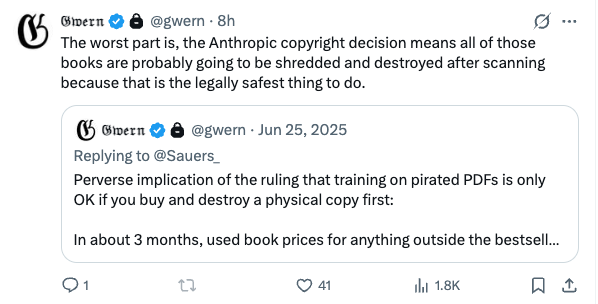
Anthropic is buying millions of rare books, scanning and destroying them because legally destruction is the safest option. This was a plot element in the Vernor Vinge novel, "The Rainbow's End", which I read 20 years ago.
Sivori tweet mediaSivori tweet media
English
354
5.7K
24.5K
1.3M
pb retweetledi
HFI Research
HFI Research@HFI_Research·
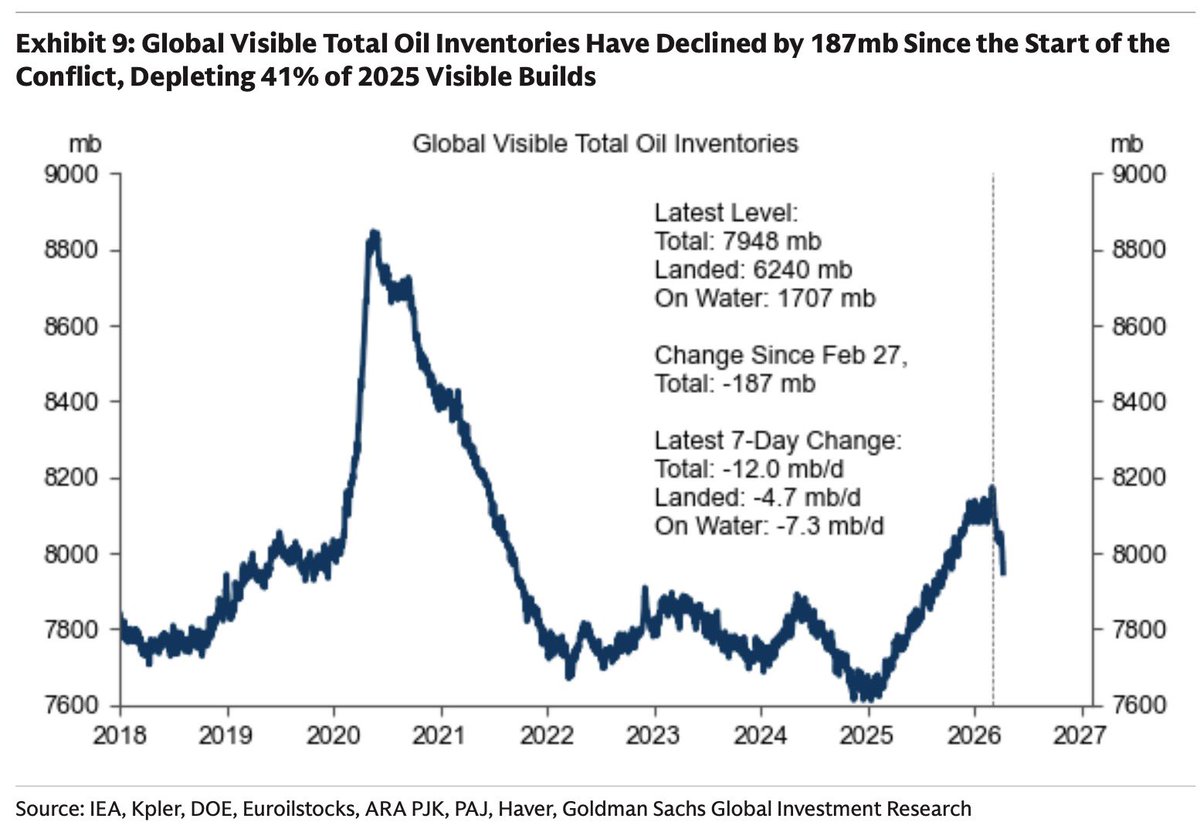
On April 12, we published a piece with a section titled, “Why aren’t oil prices higher?” Here’s what I wrote: Over the weekend, I had a subscriber express his frustration to me: “How can the oil market be so complacent?” Let me answer that question by first saying this: I’ve been neck deep in the oil market for the last 11 years. And oil prices almost always trade to extremes. Right before it does, it always gets “obvious” from a fundamental setup standpoint. I remember a great conversation I had with Nelson Wu of Open Square Capital about the oil market being analogous to toilet paper. You don’t realize how badly you need it until you run out of it. Oil prices trade on the margin. As long as there are onshore inventories to draw from, traders don’t panic. It’s when you run low on onshore inventories that panic starts to set in. Goldman published an update on Thursday that basically captured the storage math phenomenon that we are seeing: Global visible total oil inventories remain bloated relative to historical standards. If, for example, we had started the conflict with global oil inventories at the 2025 lows, WTI and Brent would already be above $200/bbl. The ~1.4 billion bbl cushion at the start of 2026 is what gave the US time to navigate the Iranian conflict without the oil market blowing up. It was also the same reason why at the beginning of the conflict, I wrote a piece titled, “Why Aren’t Oil Prices At $100?” But fast forwarding 6-weeks later, the facts have changed. The conflict is ongoing, and that onshore cushion you are seeing in storage is nothing but a mirage. Even if the conflict ends this very second and everything returns to normal, that oil inventory is gone. Vanished. No more. In essence, the oil market really should be pricing forward balances as if we are already near 7.6 billion bbls, but it’s not, and this creates the biggest mispricing trade since the COVID lockdown (short oil) trade. Oil traders, the physical guys, lack both the means and capabilities to drive financial prices higher. Financial markets are exponentially larger than the physical side, but there’s one quirk: expiry. As the futures market approaches expiry, people who continue to hold the contracts are obligated to deliver the goods (literally). This mechanism will be tested first at the May WTI expiry, where the physical market is already quoted at a +$20 premium to financial prices. It will be tested again in the Brent expiry at the end of the month. What will happen is that as we get closer to the expiry, market participants who are short have to cover because there’s no way in hell they can deliver the goods physically. We are literally going to run out of available commercial crude storage. This will force the prompt month higher, which will suck in financial flows into the June contracts. This inflection point will shock market participants awake. This is one of the main reasons why I’ve remained so calm over the past few weeks. The math is what it is. The Trump administration can jawbone oil prices all they want. Axios can publish whatever headlines it wants, but the reality will be swift and vicious. If you do not have the means to deliver the goods, you have to cover.
HFI Research tweet media
English
16
140
775
98.9K
pb retweetledi
Luke Gromen
Luke Gromen@LukeGromen·
OPEC is only needed to manage oil prices in a world where the reserve currency has no other anchor, because only a fool would sell finite oil reserves for infinite (non-gold-backed) dollars. IMO, this may be a big signal, but perhaps not the one some seem to think. Let’s watch.
GIF
English
71
83
803
53.2K
pb retweetledi
Whitney Baker
Whitney Baker@TotemMacro·
@LukeGromen @PauloMacro The dumb thing about all this is that the economy definitely *is* collapsing. There’s just a reporting lag. You can see that in the C&I lending. Companies drawing down lines virtually everywhere at the fastest pace since Covid.
English
15
23
272
45.7K
pb retweetledi
calle
calle@callebtc·
"the feds are now the main speakers at bitcoin conferences, we're winning"
calle@callebtc

@BitcoinPierre that's a very statist cuck thing of you to say

English
12
8
149
13.6K
pb
pb@msansnom·
pb tweet media
ZXX
0
0
0
10
pb retweetledi
harryhalpin
harryhalpin@harryhalpin·
Because I get asked a lot. Why we must fight Palantir, in brief. 1. Programmers working on the Internet have a moral responsibility to the entire world, not a single country. The Internet has been designed since its inception as a universal system for the sharing of knowledge without censorship. The Internet is not the property of any one government or nation. 2. The Internet enables mass surveillance at a scale unimaginable to the Gestapo and the Cheka. Far too many programmers have wasted their lives at building surveillance systems under the guise of Web advertising. Today, these web tracking systems are being used to monitor, control, and even kill humans by companies like Palantir that seek to combine state violence with corporate efficiency, and thus create a new form of technofascism. 3. Surveillance justified by external national security threats will be turned against citizens inside the nation-state. Mass surveillance was once the exclusive domain of the NSA, but today it has been privatized to corporations like Palantir that are unaccountable to any democratic process. What begins as fear of external foreign nation-states turns inwards to focus on immigrants, dissidents, and eventually to anyone that might challenge the status quo or try to exit an increasingly dysfunctional society. 4. Everyone is a target. The “enemy within” continually expands until it encompasses the entire population of a nation regardless of their status and beliefs, justifying evermore paranoid and totalizing surveillance. The line between policing and military operations blurs, with legal frameworks being replaced by technological violence operating with total impunity. 5. Surveillance can only be defeated by building software and hardware to defend ourselves. Meek calls for regulation or moralizing demands for human rights are useless in this era. Any rights must be enforced by the hard power of code. Code, not laws, can be used to uphold the right to privacy by making surveillance difficult, if not impossible, even by nation-state adversaries. 6. We are ruled by a senile gerontocracy. Unlike the generations that fought in the world wars, most of our current rulers are degenerate pedophiles who would sacrifice the well-being of the youth and the entire planet due to their infantile desire for wealth and power. Technology of surveillance and automated warfare reflects their increasingly desperate attempts to maintain archaic forms of domination. 7. The American Empire is unraveling. Once, the United States of America presided over a globe where it could enforce its rule via the status of the dollar as a global reserve currency and a network of equally global military bases, but new regional powers now directly challenge the United States as its empire dissolves in the face of internal economic stagnation, political corruption, and the inflation of the dollar. 8. In a real war, fantasies of total technological dominance always backfire. When a faceless drone kills a child’s father, that child will one day take revenge regardless of the cost, something forgotten by those raised in comfortable suburbs. Going beyond zero-sum games, one can only truly win a battle against a people by demonstrating your victory provides a better way of life, increased prosperity, and an inspiring philosophy. 9. Oddly enough, proponents of fully automated warfare support a universal draft. Deep-down, these keyboard warriors know that their technofascist fantasies are a paper tiger when up against determined opponents that engage in asymmetric warfare. They also know none of their children will fight in a war for their state but they would be happy to see other people’s children come home in body-bags. 10. The problem is not whether AI weapons will be built; we must hold responsible those who are building them. No matter which country is deploying automated killing machines, no one is absolved from the murder of civilians and the destruction of infrastructure due to the parlour-trick of shifting the blame to AI. 11. Atomic war is on the horizon. As various states descend into wars over increasingly scarce natural resources, the possibility of tactical nuclear strikes over Teheran, Kyiv, and other areas of conflict has returned to the historical stage. Increasingly geriatric and authoritarian rulers face less guardrails than before to deploying nuclear weapons, and may even be willing to sacrifice the survival of humanity to appease their own petty egos. 12. Our goal is a world of peace where every person can be empowered by the Internet. Modern war is the quintessential game of sending young people to the meat-grinder. Why die for the profit of corrupt rulers when one could build real wealth and power for yourself using the Internet? 13. We should fight for the world we want, and build the tools needed by future generations. Pacifism would be suicidal in this period of global turbulence and resource wars, but real hard power lies in technology: Programmers should be creating technologies to live a free life and prosper in a hostile society of surveillance and control, and decentralization is the only way these technologies will survive against the inevitable repression. 14. The State will not help us. The state is a dying pre-Internet institution that increasingly resembles nothing but a Ponzi scheme fueled by taxes and debt. None of the youth alive today will likely inherit any benefits, such as welfare and health care. 15. Centralized and opaque algorithms are a danger to free speech. Propaganda is the flip-side of surveillance, as continual propaganda prevents anyone from even thinking of challenging the system. Social media monopolies promote propaganda to create a generalized idiocy while silencing those that would dare to criticize the reigning order before they can organize against it. 16. Building new forms of social organization with each other is vital to survival. The traditional mediascape of politics and entertainment exists to distract us from building networked solidarity and distributed autonomous organizations across borders. The hierarchical state is as relevant to us as the medieval church and kings were to the formation of the joint-stock corporation and the labour union. 17. Digital identity is the next step in their system of control. Within the next few years, access to the Internet–including in Europe and the United States–will require biometric national identity cards, using the flimsy excuse of “protecting children.” The real goal is to gatekeep free access to subversive political content and halt cross-border communication in order to prevent new forms of self-organization and resistance from emerging. 18. Only when one can be anonymous is one truly free. The freedom to express oneself without censorship and surveillance is a vital precondition for both the autonomous use of reason and the democratic evolution of society. Technology must enable the freedom to selectively reveal ourselves to the world–so that we can become who we want to be–by preserving the right to privacy over the Internet, including not just individual privacy but the right to transact and form contracts privately. 19. America created the first global surveillance state, but it will not be the last. Too many have forgotten or perhaps taken for granted the revelations of Wikileaks and Snowden. States across the world from China to Russia are creating even more powerful global surveillance systems and propaganda machines. Leveraging private defense contracts in countries across the world, Palantir seeks to make itself the operating system of a cross-border global secret state while it pushes its own farcical version of ethno-nationalism. 20. Culture wars are a psyop. It is ironic that “Epstein class” virtue-signals about traditional morality and the superiority of forms of ethno-nationalism, while trying to return to the rule of hereditary elites, even in the United States. Rather than reverse the gains of the Enlightenment, we take the side of our ancestors who fought a centuries-long battle for individual liberty, scientific progress, decentralized markets, bottom-up democracy and the emancipation of humanity from feudal monarchs and their make-believe mythologies. 21. New forms of technology can reshape the world. Technology is not just a tool, but the world we live in and an extension of our cognitive capabilities. The co-operation of humans with the collective intelligence embedded in AI could accelerate human progress and overcome planetary crises such as climate change and atomic war that threatens the survival of our species. 22. Live free or die trying. We must bear eternal vigilance in the struggle against fascism, and the battlefield is technology. There is no middle ground: Technologists must choose whether to work for the enslavement of humanity or to create new spaces for freedom. These are my personal beliefs, not those of @nym. Yet as a philosopher that founded a tech startup, I have a responsibility to respond to this manifesto of Palantir and it's so-called "philosopher-CEO" Alex Karp.
English
94
1.1K
3.3K
347K
pb
pb@msansnom·
pb tweet media
ZXX
0
0
1
8
pb retweetledi
curb
curb@CryptoCurb·
"so you staked your ETH on the Ethereum blockchain to earn yield?" "yes, Dave" "except you didn't want your capital to be locked up so you actually staked it with a liquid staking protocol called Lido?" "that's correct, Dave" "and Lido gave you a liquid staking receipt token called stETH in return?" "yes, Dave" "and then you didn't think that was enough, so you juiced the yield even further by depositing your stETH receipt tokens into a restaking protocol called Eigenlayer?" "you are correct, Dave" "and now you didn't want to lock up your capital, so you actually restaked with a liquid restaking protocol called KelpDAO who provided you with a liquid restaking receipt token called rsETH?" "you got it, Dave" "and then that was surely not enough juice, so you then deposited your rsETH tokens into a lending protocol called AAVE so that you could open a leveraged looping position that borrows ETH against the rsETH collateral and restakes the ETH into rsETH which is then deposited as collateral, except it turns out rsETH used a cross-chain bridge called LayerZero whose security is held together by a 1/1 toothpick, which was obviously hacked by north koreans causing rsETH to become undercollateralized and now these looping positions are stuck and unprofitable, and everyone is pointing fingers at each other, and also DeFi is a very serious industry" "you are 100% correct, dave" jfc.
curb tweet media
English
405
1.1K
8.2K
746.1K
pb retweetledi
Luke Gromen
Luke Gromen@LukeGromen·
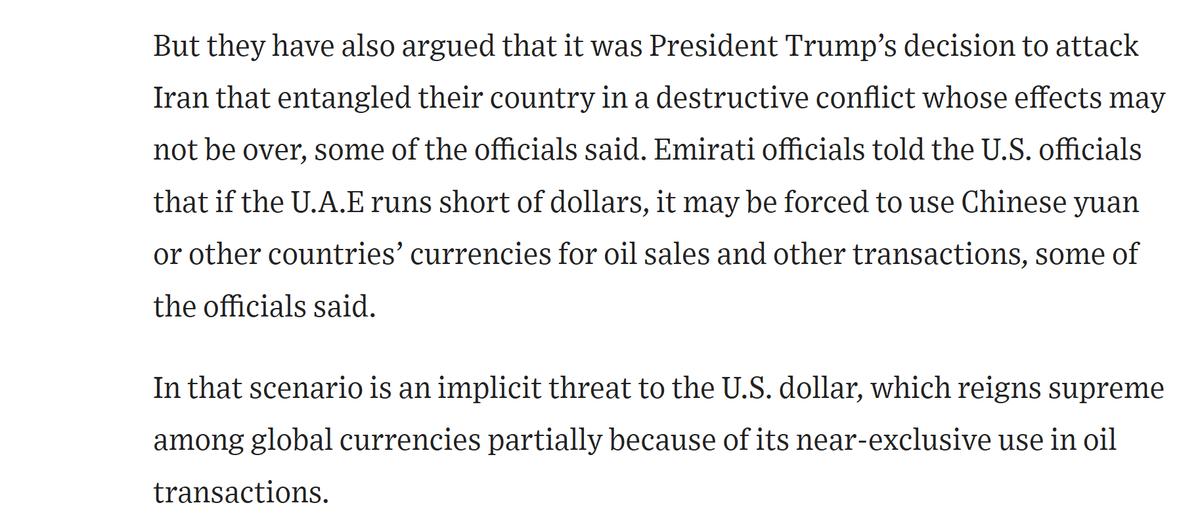
UAE to Trump Administration: "You started this war; if we run short of USDs as a result of it, either you will give us USD swap lines, or we will be forced to start transacting oil and gas in CNY and other currencies." -WSJ, just now Via @ces921
Luke Gromen tweet media
English
557
6.1K
21.7K
2M
pb retweetledi
Dan Shapiro
Dan Shapiro@DanielBShapiro·
Trump spent all day posting things on Truth Social that had not been agreed to, trying to will them to be true by saying them publicly. This is a crazy way to do diplomacy on something this consequential. And it has to be telling the Iranians that he is desperate for an off-ramp, which only increases their leverage.
English
36
61
270
46.2K