Mukul Ranjan

843 posts

Mukul Ranjan

Mukul Ranjan

@mukul_ranjan_

AI Researcher @MBZUAI| Visiting Scholar @UIUC | Ex- Meesho, Qure AI, UNSW Sydney, Wadhwani AI |ECE IITG ‘21 Medium: https://t.co/BzTXsObI8y

Katılım Mart 2020
1.8K Takip Edilen190 Takipçiler
Sabitlenmiş Tweet
Mukul Ranjan
Mukul Ranjan@mukul_ranjan_·
Happy to announce our recent project "Time Blindness"! We found that all current AI models are completely blind to temporal patterns that humans see effortlessly. Even GPT-4o and Gemini score 0% on tasks where humans achieve 98% accuracy. timeblindness.github.io 🧵0/n
English
2
4
21
4K
Mukul Ranjan retweetledi
Zhiqiang Shen
Zhiqiang Shen@szq0214·
🎉🎉🎉 Excited to introduce our recent project FigMirror - a very interesting and useful tool with a simple workflow for making any paper-style figures. - See a beautiful figure in a paper - Screenshot it - Add your own data - Get a new Matplotlib figure with the same visual style FigMirror learns the quiet details that make paper figures look polished: - typography - spacing - line weight - color restraint - layout rhythm The key mechanism is Grounded Measurement. Computer-use AI can point to coordinates inside the reference figure. Code then inspects the pixels, colors, spacing, and layout around those points. This gives the system concrete visual evidence to iterate on. Our FigMirror draws a candidate figure, compares it with the reference, keeps what works, and improves what still feels off. Outputs: - editable Matplotlib code - camera-ready PDF It works as both a local Web UI and a Codex / Claude Code skill. Open source: github.com/VILA-Lab/FigMi… Try it before your next deadline!
English
10
135
1.1K
270.3K
Mukul Ranjan retweetledi
Hao Peng
Hao Peng@haopeng_uiuc·
Excited to share our new paper: “Useful Memories Become Faulty When Continuously Updated by LLMs. Can LLM agents keep improving by turning past experience into compact, reusable memories? We find this is much more fragile than it looks. Continuously consolidated memories can perform worse than no memory at all — sometimes even on problems the agent previously solved. Episodic memories that preserve raw episodes are much more reliable. There is still limited evidence that today’s models can learn reusable abstractions from experience over the long term, which I believe is a crucial capability for agents that continuously improve. Paper: arxiv.org/pdf/2605.12978. Congrats to @dylan_works_ and team!
Dylan Zhang@dylan_works_

Wrote up something fun I’ve been poking at: when LLM agents repeatedly rewrite their own experiences into textual “lessons,” their memory can get worse, not better. Across several environments, we found a recurring pattern: forced consolidation often degrades useful experience into faulty or overgeneralized memories. Interestingly, models seem much better at managing examples as memory objects than at distilling them into reusable routines. Maybe we should be more careful about asking agents to constantly “consolidate” experience into lessons 🤔? I’m new to this area, so I’d love thoughts. I may be missing context or just wrong on parts of it — please don’t hesitate to let me know! Discussions are always welcome. dylanzsz.github.io/faulty-memory

English
10
26
254
123K
Mukul Ranjan
Mukul Ranjan@mukul_ranjan_·
If you're going to be at the conference, I'd love to connect and chat about diffusion LLMs, efficient inference, hw/sw co-design or anything in between, feel free to reach out! And if the project sounds interesting, give a star on our repo.
English
1
0
0
47
Mukul Ranjan
Mukul Ranjan@mukul_ranjan_·
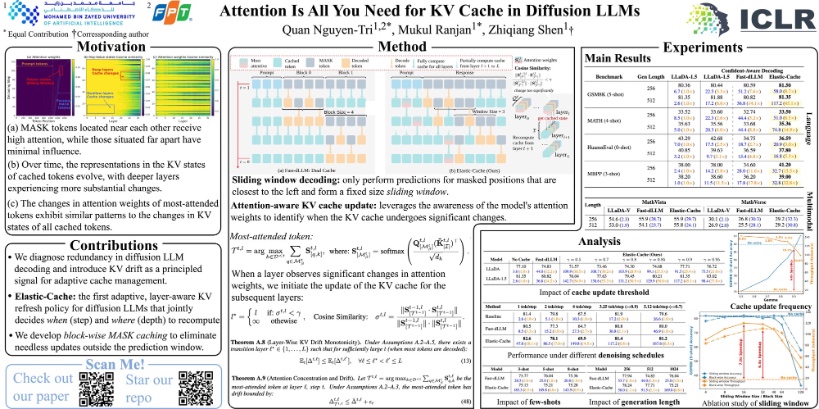
Excited to share that I'll be attending #ICLR2026 at Rio! I'll be presenting our work on Elastic-Cache, a method for faster, more efficient KV caching in diffusion LLMs. We show consistent accuracy gains alongside significant speedups (up to 45× on GSM8K).
Mukul Ranjan tweet media
English
1
0
8
117
Mukul Ranjan retweetledi
Andrew Gordon Wilson
Andrew Gordon Wilson@andrewgwils·
Without Einstein's general relativity from 1915, your GPS would drift about 10 km per day, and you'd have no idea why.
English
33
10
844
156.7K
Mukul Ranjan retweetledi
Saganism
Saganism@Saganismm·
Look closely. Between these two moments, our species has performed miracles. We have mapped the blueprint of life within our own DNA. We have built “brains” of silicon that can outthink their creators. We have pushed back the darkness of disease. Infant mortality has plummeted, and millions of children who would have been lost to the earth in 1972 are today alive, dreaming, and contributing to the global chorus. We have sent robotic emissaries to the edge of the interstellar dark and peered back at the beginning of time itself through mirrors of gold. Technologically, we are a different species. We are more connected, more informed, and more capable than any ancestor could have imagined in their wildest fever dreams. And yet, look again. From this distance, the borders remain invisible. You cannot see the “holy” ground over which we spill the blood of our children. You cannot see the walls we build to keep our neighbors out or the ideological trenches we dig to bury our common humanity. Despite our leap from vacuum tubes to artificial intelligence, we remain haunted by the same ancient tribalisms. We use 21st century technology to prosecute Bronze Age grudges. We have changed the climate of our world, but we have yet to change the climate of our hearts. We are still a toddler civilization, playing with matches in a library of irreplaceable wonders. The contrast is our great paradox. We have the power of gods, but we still possess the temperaments of the territorial primates from which we rose. We have learned to fly between worlds, but we are still struggling to learn how to walk together on this one.
Andy Saunders - Apollo Remastered@AndySaunders_1

Left - Apollo 17, 1972 Right - Artemis II, 2026 Two photographs taken by one of us, of all of us, over half a century apart. What's changed?

English
52
871
4K
258.8K
Mukul Ranjan retweetledi
NASA Earth
NASA Earth@NASAEarth·
That's us! 🌍 The Artemis II crew captured beautiful, high-resolution images of our home planet during their journey to the Moon. As @Astro_Christina put it: "You guys look great."
NASA Earth tweet media
English
3K
42.8K
217.8K
8.7M
Gowthami
Gowthami@gowthami_s·
Excited to share I’ve joined @theworldlabs! Generating pixels and frames was just the prologue. Now it's time to build frontier models that actually understand physics and power living, breathing simulations. Onwards to new worlds. 🌎🚀
Gowthami tweet media
English
41
6
322
21.1K
Mukul Ranjan retweetledi
MBZUAI
MBZUAI@mbzuai·
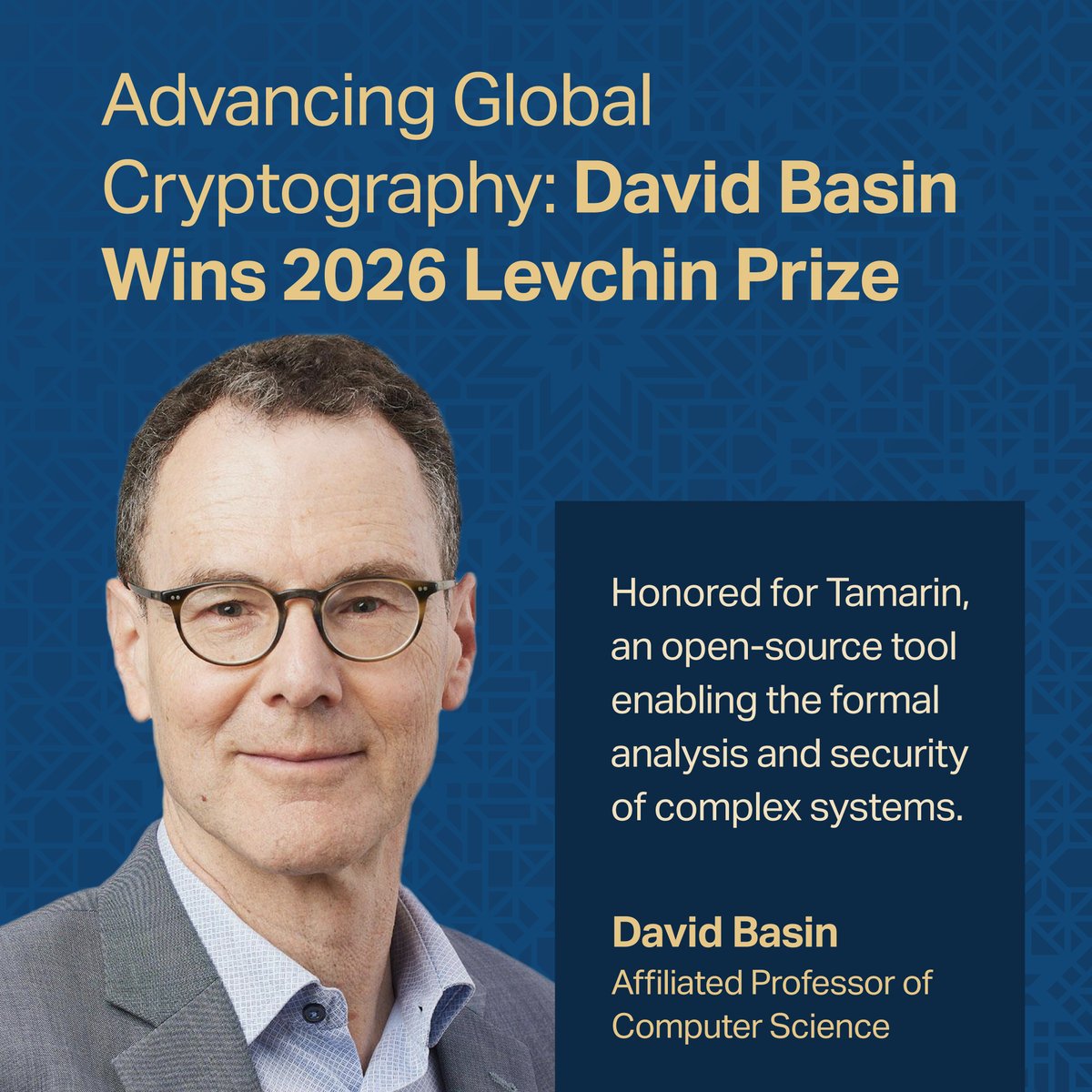
Congratulations to David Basin, Affiliated Professor of Computer Science at MBZUAI, on receiving the 2026 Levchin Prize for Real-World Cryptography. The Levchin Prize recognizes major innovations with lasting impact on the practical use of cryptography, and Professor David's work is a testament to exactly that. He and his collaborators were honored for Tamarin, an open-source tool for the formal analysis of security protocols. Tamarin has been used to model and verify the security of some of the most critical systems in the world, including 5G, TLS, EMV, and iMessage PQ3. Established in 2016, the Levchin Prize celebrates contributions that strengthen the foundations of secure digital infrastructure globally — and we couldn't be prouder to have David as part of the MBZUAI community. #MBZUAI #LevchinPrize #Cryptography #CyberSecurity #Tamarin #AIResearch #ComputerScience
MBZUAI tweet media
English
0
2
9
1.5K
Mukul Ranjan retweetledi
MBZUAI
MBZUAI@mbzuai·
1080p video. 30 seconds generated in 5 seconds. FastVideo from MBZUAI's IFM isn’t just faster, it changes what video is. Pair it with K2 Think → real-time intelligence + real-time generation. Try it here: dreamverse.fastvideo.org
English
1
7
31
11.2K
Mukul Ranjan retweetledi
Ji-Ha
Ji-Ha@Ji_Ha_Kim·
Blog post - Transformers as Constrained Optimization Rewriting pre-norm decoder-only transformers as solutions to regularized objectives. Changing regularization to hard constraint gives a canonical temperature, generalizing to KL-divergence, ideas of cross-layer interaction.
Ji-Ha tweet media
English
10
68
600
30K
Mukul Ranjan retweetledi
Ai2
Ai2@allen_ai·
Introducing Olmo Hybrid, a 7B fully open model combining transformer and linear RNN layers. It decisively outperforms Olmo 3 7B across evals, w/ new theory & scaling experiments explaining why. 🧵
Ai2 tweet media
English
17
127
783
171.8K
Mukul Ranjan retweetledi
Ilya Sutskever
Ilya Sutskever@ilyasut·
It’s extremely good that Anthropic has not backed down, and it’s siginficant that OpenAI has taken a similar stance. In the future, there will be much more challenging situations of this nature, and it will be critical for the relevant leaders to rise up to the occasion, for fierce competitors to put their differences aside. Good to see that happen today.
English
1.4K
2.5K
25.7K
3.1M
Mukul Ranjan retweetledi
Sai Surya Duvvuri
Sai Surya Duvvuri@dvsaisurya·
Excited to share LUCID — a new attention mechanism that improves retrieval and reasoning in long-context LLMs! [1/9]🧵 Here's how it works:
Sai Surya Duvvuri tweet media
English
12
69
442
126K
Mukul Ranjan retweetledi
Anish Athalye
Anish Athalye@anishathalye·
In January, @jonhoo, @jjgort, and I returned to @MIT_CSAIL to teach Missing Semester, a class on topics missing from most CS programs—tools and techniques that everyone should know, like Bash, Git, CI/CD, and AI tools. Today, we’re releasing the course for free online!
Anish Athalye tweet media
English
16
212
1.5K
88.7K
Abhishek Maiti
Abhishek Maiti@o_v_shake·
People at India AI summit: if you want to work at frontier labs and dont want to spend money to prep for interviews, here’s a new resource: workatafrontierlab.com
English
7
20
264
22.1K
Mukul Ranjan retweetledi
Andrej Karpathy
Andrej Karpathy@karpathy·
New art project. Train and inference GPT in 243 lines of pure, dependency-free Python. This is the *full* algorithmic content of what is needed. Everything else is just for efficiency. I cannot simplify this any further. gist.github.com/karpathy/8627f…
English
651
3.1K
25.1K
5.2M