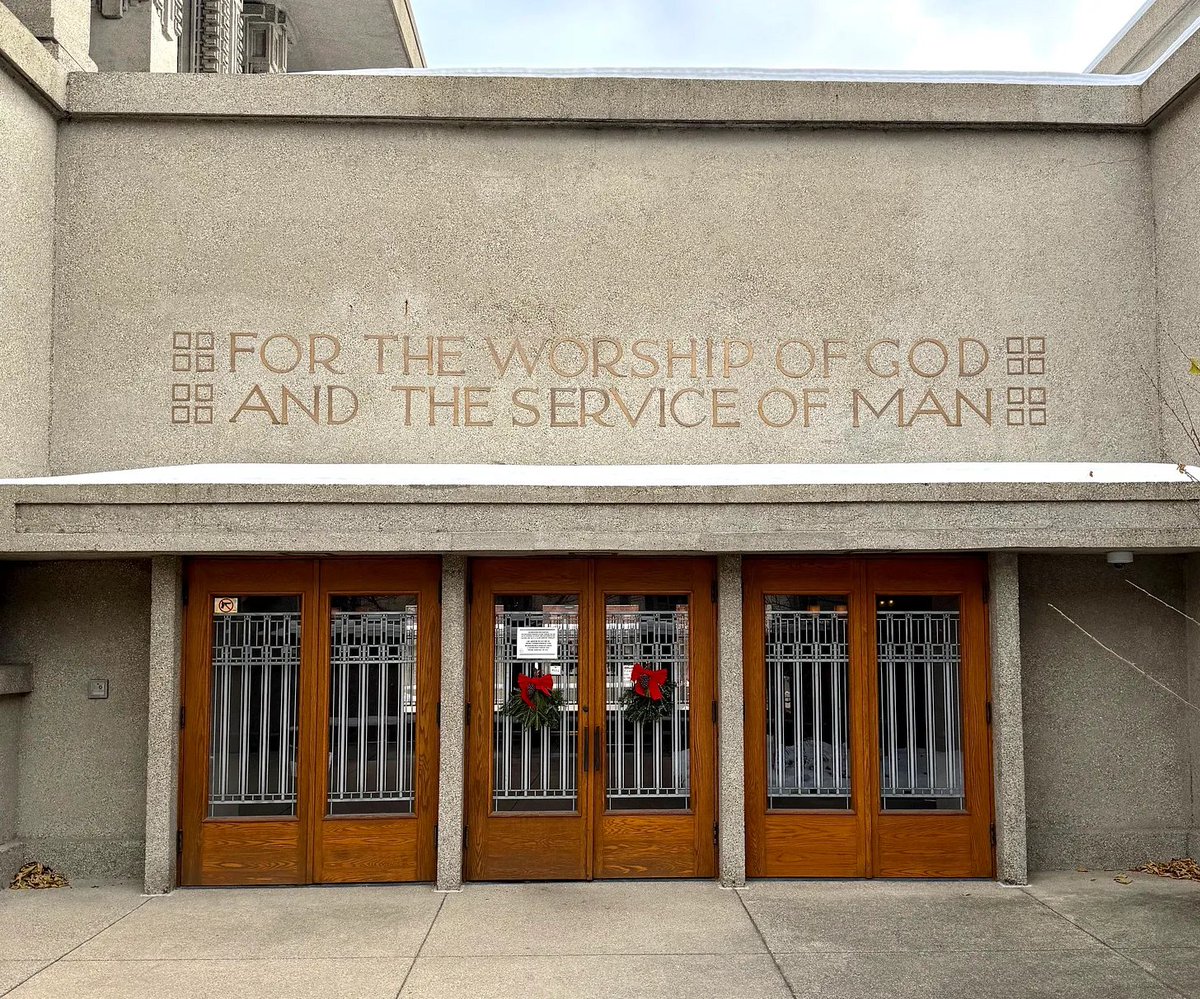
There's an upside-down H on the facade of the wonderful Frank Lloyd Wright designed Unity Temple in Oak Park, IL. How'd that happen?
Paul takes a deep, deep dive: inconspicuous.info/p/h-bomb-a-fra…
I want to share a video with you today — a 12-minute exercise I led last year for a room of wonderful leaders from JP Morgan, Netflix, and Marriott.
As leaders — of corporations, classrooms, or families — it can be so instinctual to carry everything… and forget that we are being carried.
I hope you’ll take 12 minutes today to do this exercise with me. If you do, I’d love to hear back from you (comment or reply) on your experience. ❤️
vimeo.com/1182048738
@jasonfried another one: does you company keep a dashboard of some kind with key metrics you want to keep an eye on?
The hill chart may be a broad version of this per project, but I’m trying to find a good way to keep our team focused on the actual things that matter — for us it’s funds raised, concerts scheduled, etc… curious how you handle this.
In Basecamp, of course.
Post a message with the images and ideas. Ask for whatever feedback you want. Let it roll in the comments section. A single page with everything — the original, the comments, people's revisions they may post.
A bit of advice though... I'd recommend against involving too many people in design decisions. Typically, it's two people here that get pretty far on something. Then we may layer in one more person. But having 5 people give creative feedback on something is a recipe for treading water, not making progress. In the end, the last thing you need is another opinion.
@jasonfried@dhh How do you guys discuss design/graphic/visual ideas as a team? I've got a team I'd like to kick logo ideas back and forth with, be able to make comments, and have some way to vote certain ones up... I feel like your products have this capability, but I'm not clear on exactly which one would work best and how...
Last fall, after having worked myself to the bone on a single problem for several years straight, I hit a wall.
I finally realized that I’d tried everything, and nothing had worked.
And I felt strangely good.
I felt more free than I had in years. Because, even though my problem still wasn't solved, at least I was no longer carrying the added shame of being at fault for things not working out.
-
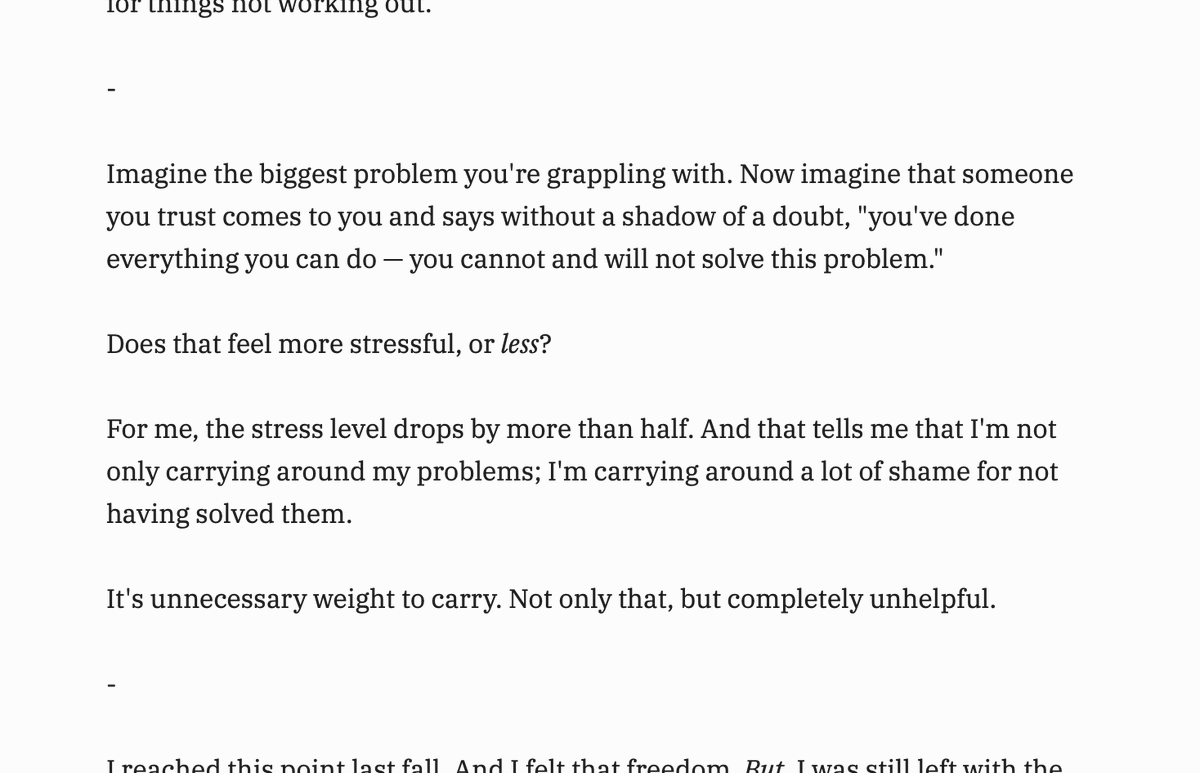
Imagine the biggest problem you're grappling with. Now imagine that someone you trust comes to you and says without a shadow of a doubt, "you've done everything you can do — you cannot and will not solve this problem."
Does that feel more stressful, or *less*?
For me, the stress level drops by more than half. And that tells me that I'm not only carrying around my problems; I'm carrying around a lot of shame for not having solved them.
It's unnecessary weight to carry. Not only that, but completely unhelpful.
-
I reached this point last fall. And I felt that freedom. *But*, I was still left with the initial problem. It had become clear that I couldn't solve it, which felt strangely freeing. But I had no idea *how* it would be solved.
In place of my shame, I started to feel curiosity.
"Well, how *will* this problem be solved?"
The problem without the pressure. It felt lighter, and interesting. Such a contrast to how it had felt for so long.
An hour later, I received a call that solved the issue. Not only did it solve the issue, but it solved it in a way that was *significantly* better than any of the options I'd tried.
*How is this possible??*
I have some theories. I bet you do too.
But what I'm more interested in today is that feeling of freedom.
Is there a way to live from freedom *first*, rather than having to exhaust all other options, and ourselves?
In a way, it's that thing I was looking for the whole time — not the solution to my problem. Yes, the problem was still there. Yes, the problem still needed to be solved. But I now realize that I was never looking for a solution to my problem; I was looking for *freedom* from the weight I was carrying — of having to be the problem-solver.
But, once the problem is gone, the weight goes away, right?
Wrong.
Once the problem is gone, another one comes. We've all experienced this.
It's not about the problem — it's about freedom.
Solved-problems don't bring freedom — they bring more problems to solve.
And that's not a bad thing.
Because that's what life is, isn't it? What fun would life be otherwise?
I sometimes imagine living on a beach sipping cocktails. But deep down I know I'd get bored eventually. Then what would happen? I'd create a problem to solve.
Why? Because we love games. We love to play.
A game is just a problem to solve. We seek these out, for *fun*.
So why do we center our lives around getting rid of our problems?
We want relief. We've learned that our growing sense of oppression is coming from our problems.
But it's not our problems that are oppressing us — it's the pressure we feel *about* our problems that is weighing us down.
And that is a weight we put on ourselves.
"Stop doing this to myself" is a totally different issue than "too many problems to solve," and it requires a totally different approach.
If we can shift our focus from getting rid of our problems to letting go of the weight we put on ourselves *about* them, I believe life can take on a new quality: from pressure to play.
Ironically, this seems to somehow unseat our initial problems, making them much easier, and more enjoyable to solve. But at that point, it doesn't really matter — we know that once this problem is solved, another will come in its place, and we'll have something new, interesting, and *fun* to do for another day.
Beneath everything, for all of us, for you and for me, there is a current.
Even as I say that, maybe you can feel it.
We can spend our lives working, worrying, and rushing. Building our empires, making our cases, fighting and arguing and winning. Or hiding in the shadows, hoping not to be seen. Or holding down the brakes, hoping things will slow down or never change...
But the terrifying truth — one which we know deep down — is that no matter what we do, life is going to go exactly where it's going.
The good news: *no matter what we do, life is going to go exactly where it's going.*
Our work, then, is not about where we are going — it's about our relationship with the current that is taking us there.
The opportunity before us is to learn to trust the current — to stop fighting it, and to flow with it.
@pketh In audio editing software, there’s a “snapping” toggle. When enabled, things snap together like this, and when off nothing snaps. I used that toggle a lot.
WIP experiment: while dragging cards, they'll snap to align the y or x sides of nearby cards. not sure yet if it's helpful, or if it gets in the way. What do you think?
(☎️ Beta available in the discord)
Several years ago, in the midst of one of the darkest seasons of my life, I experienced what I can only describe as a moment of heaven on earth.
I was sitting on my back porch. We had recently lost our daughter after over a year of beautiful and traumatic life. Returning to being a “normal” person — working, fathering, husbanding, just getting going for the day — felt hard and slow and impossible. I felt so angry, scared, and tired. I was losing hope.
There’s something powerful about the moment when all hope is lost. That is the moment — if we can stay with it — when in place of our lost hope — a hope we may have been clinging to for years — a new hope arrives. This new hope has a different quality to it. It’s foreign, in that it’s not from us, it arrives. It has a permanence to it. It exists and persists outside of us. Outside of our willingness or ability to “hold on to hope.” This hope holds on to us.
As I sat on my back porch, losing my hope, I noticed the light. It was streaming through the windows in a way I’d never noticed in over a decade of living in that house. I noticed the curtains dancing as the breeze blew through. The breeze felt cool against my skin. I heard our kids playing and laughing in the house. It was all so bright, and beautiful. And in this moment — in the midst of this horribly dark, hopeless season — I felt the words leave my lips, “this is the best moment of my life.”
How?
How can something wonderful just happen when everything else is so dark?
This is how: it was always happening.
It’s happening now.
We just miss it — because we’re preoccupied with our hope.
Our hope. It’s different than hope itself. Our hope is made by us. It’s sustained by us. When we stop, we lose it.
“I hope I’ll get that job.” “I hope I’ll make that team.” “I hope this relationship works out.” “I hope I live to 100.” “I hope the world goes this way or that way.”
Having hope is work. Hard work. Keeping it is even harder.
But sometimes things just get too dark. And we just get too tired. And we just. Can’t. Hold. On. Anymore. And we lose our hope.
And then it happens. The moment comes, when we lose our hope... and life doesn’t stop.
It is in this moment — this infinitesimally tiny sliver of unwanted time and space — where we finally feel what it’s like to not carry everything. And, contrary to what felt true before, the world does not end, and we’re still here.
This is the moment when heaven shines through. But not in the way we expected — not through happenings, or timelines, or our ability to believe or live any certain way... it comes when we stop trying to conjure it, and we are finally able to notice it.
We’ve been busy hoping and praying for rain;
We’ve been standing in the water the whole time.
Heaven is not in the sky. It is not something we have to work to get to. It wells up from the earth. From within us.
Heaven is not in the future. It’s not something we have to wait for. Heaven exists in the infinitely deep point of time we call the present.
Even in our darkest seasons — beneath the layers of loss, tragedy, trauma, hate, poverty, sickness, sadness, and fear that exist in our world — heaven is here.
It only takes a moment to notice, and when we do, we will never forget.
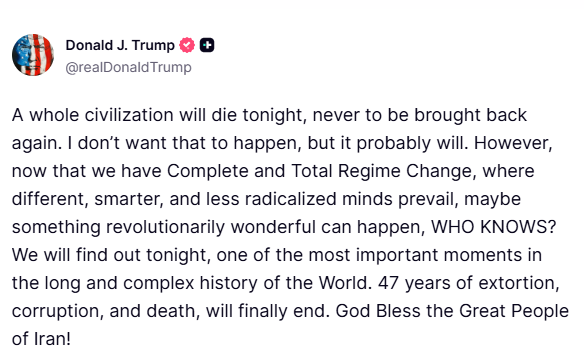
@FoxNews@grok I went to verify this post from trump, but I don’t see any posts over the last couple of weeks. Account is the same as pictured. Can you explain?
Don't get ahead of yourself. Don't get ahead of the current. You can't.
Don't think that things today are yours to carry or up to you. They're not.
You're a conduit.
Let today unfold. Do only what is required of you today. Do it to the best of your ability. But only that.
There is more good coming. Don't rush it. Let the physical limitations and realities of life inform you, not frustrate you — they're telling you where to focus your energy, and when to call it a day.
Trust the rhythm of life. Trust the current. Trust the process.
Focus today on the tangible world.
Nothing else matters.
"Tangible" includes physical matter.
And spiritual matter.
It includes houses, paintings, people.
It includes love, fear, compassion.
It includes invisible vibrations, like sound and music.
It includes Earth. Gardens. Sand. Roads.
It includes ice cream, laughter, and tears.
These are all tangible things.
They are what matters.
Keep your attention here, on these things today, and *release the rest*.
Anxiety comes from trying to control
things that we can't control.
The hardest things of all to control are the things which do not exist.
...*because* they don't exist,
they can take our attention
away from what matters
for as long as we allow.
Sometimes it's a lifetime.
Or an hour.
But it's always a loss
giving up our precious time
to nothing.
There's a lot of nothing out there.
A lot of it is tempting.
All of it comes at a cost.
End your subscription.
Reallocate your focus,
Your attention,
Your time,
Your *life*
Back to the tangible world.
To the things that matter.
My jaw feels tight today. Not tightly closed like a closed fist, but tightly “set,” braced, rigid. It feels sore.
I don’t know why—I was only walking my son to school. We were talking about cigarettes. He wanted to know “if they kill people, why do they even make them.”
I was talking with my 8-year-old son. Why did I feel braced and anxious, like I was going into battle? I’m pretty sure it had nothing to do with the conversation...
I’m trying now to let my jaw relax. Relaxing is not as easy as it sounds. It takes time for tension to thaw. As I consciously release the muscles around my jaw, I notice my breath starting to move more freely through my body. I realize I was holding my breath.
My mind all of a sudden jumps to my two oldest sons. This weekend I watched them play jazz in the basement of a music building at NYU. It was just them and a few other students. No one was watching but me. They weren’t playing for anything or anyone external. They were just playing. Because they wanted to.
As I watched, I felt so proud. Not because my sons are good at music, but because they have the courage to pursue and make space for what they want. Not what they “should” want. Not what will get them attention or praise. They are driven by something infinitely more powerful and sustaining than any of that—they are driven by love. I could see it and hear it in their music as they played. I could feel it. Love.
What could make a father more proud?
As their dad, I can boil most of what I’ve tried to teach these boys over the past 19 years down to two things: rest, and play.
“Are you getting enough sleep?” “Have you taken a break lately?” “Can you add some margin to your schedule?” “You know, all this practicing won’t matter if you don’t give your body and brain time to rest in between...”
“Have fun!” “Music should be fun!” “Are you having fun??” “You know, all of this music is pointless if you’re not enjoying it.” “You know, true creativity comes from a state of play, not pushing...”
Rest, and play. It’s what life is made of. A series of waves — creative activity, and rest.
Think of a child. That’s their whole life. Rest, and play. Wake up, find something interesting to do, do it 100%, conk out, wake up and start again. Rest, and play.
Everything in life moves in these waves. The sunlight that is hitting my eyes right now—it arrives as tiny waves, and it moves as a whole in 24-hour cycles. The chirping of the birds—their sound arrives as tiny waves, and each chirp comes as part of a rhythmic cycle. Light, dark. Sound, silence.
So what am I doing?
Why am I so braced and anxious? Why am I holding so much tension and rigidity in my body? Where are the waves?
Actually, I feel like a hypocrite, or a martyr—always trying to help my kids to rest and play... meanwhile I am constantly working. When I’m not working, I’m thinking about work. Worrying about money. Worry, and work. Worry, and work.
Where is the rest? Where is the play?
Everything I do, I tell myself, I do to create a safe home for my family (myself included) to be able to rest, and play. I tell myself that all of this work is for them. But the terrifying reality is that children don’t follow where their parents say—they follow where their parents go.
Where am I leading my children? Where am I leading myself?
I’m glad my sons are able to play, but it may not be all thanks to me. In fact, if I keep treating myself the way I have, my sons are likely to turn out the same—in their 40s, wondering why they can’t even have a simple conversation with their 8-year-old child on the way to school without being tied in knots, braced for danger, holding their breath.
Good or bad, I am somewhat responsible for what my children believe about life, and how they live. But the truth is that they are also teaching me. I have a lot to learn from my children about life.
So rather than making “learn to rest” a new obligation to add to my list—one which I beat myself up in order to achieve “for the sake of my children”—I must choose to pursue rest for myself. Because I want to. I’m ready to do that.
Anyway, what good has come to me from 46 years of bracing and gripping—from constantly deferring rest and play? If I’m honest, I’d say that most of the good in my life has come during periods where I was too tired to hold on any longer. Momentarily, I let go, and something true and alive flowed in.
That’s how the breath works. It’s how life works.
And that’s a critically important way to reframe the word “work”: Breath works. Life works. They happen—from my first day to my last—without my ever needing to make them happen.
The “work” I’ve always viewed as mine to do—to make things happen, to get results—is actually not my job.
My job—my work—is to rest, and play.
My fear is that if I make rest and play my work, I’ll never work. Nothing will get done. My family will lose our home—not just our house, our entire foundation. But that is an old fear—from long before I had kids, a wife, or a house.
But what if my work is to rest, and play?
“Well, that just sounds irresponsible. If everyone was to take on that definition of work, nothing would ever get done...”
But why would anyone ever stop working if their “work” was such a wonderful, natural rhythm—of doing what feels most alive with all their heart, body, and soul, then resting deeply until they’re ready to do it again? Would that kind of life really lead to nothing ever getting done?
Think of the greatest things that have ever gotten done by people. Rest and play weren’t deferred—they were the foundation.
When we play, we open. When we are open, Life flows through us.
The same is true when we rest. Life is always flowing through us when we’re open.
So what happens when we defer rest and play—when we brace, grip, and strive instead? We close. When we close, Life flows around us, not through.
Picture a world where everyone enters into a natural rhythm of rest and play. Now picture one where rest and play are deferred, and replaced by endless striving. The second one seems awfully familiar. But we’re being invited to the first.
Today my work is to play. I will do my work with all of my heart, body, and soul. I will trust the results to Life. And at the end of the day, I will rest deeply, knowing that today I did my work.