
Nik
3.2K posts

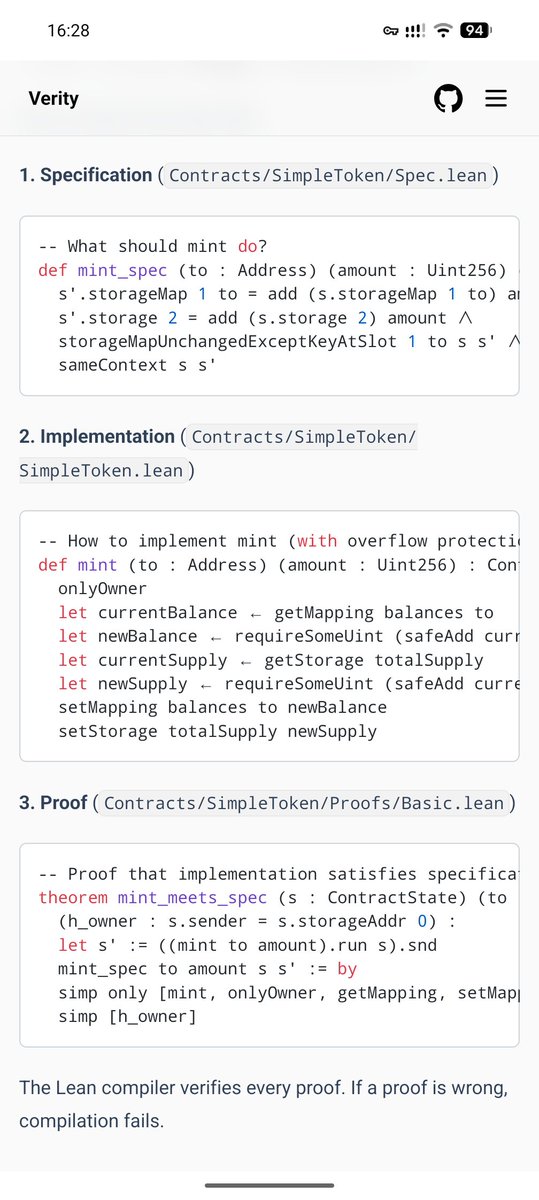

We also want teams to be able to write contracts directly in Verity and get formal verification from day one.
We're already seeing devs building on top of Verity to go in that direction
x.com/boredGenius/st…
zefram.eth@boredGenius
Introducing Tama, a dev toolchain for secure-by-construction EVM smart contracts Tama enables you to build provably secure apps in 3 steps: 1. Code: write the contract itself 2. Spec: define what correct behavior looks like 3. Prove: prove the code matches the specs
English
LFG Labs received a grant from the @ethereumfndn to build Verity.
Verity is a formally verified smart contract compiler written in Lean 4 🧵

English

seriously, working with AI is MISERABLE for one and only one reason: having to re-explain the same thing
"oh yeah this new session obviously doesn't know what proper case trees are, so let me explain it for the 5000th time in my life"
I'm tired
AGENTS.md doesn't solve this because it is impossible to fit the entire domain knowledge without nuking the context - it would be 1m+ tokens worth
RAGs don't solve this, the agent won't search unknown unknowns
SKILLs don't solve this unless I keep like a collection of 1750 skills with specific cuts of domain knowledge for each possible subset of my domain that I might need in a given chat, but that's a lot of manual work
recursive LLMs or whatever don't solve this for the same reason, you can't dump a domain book and expect the AGENT will magically guess that it is supposed to search for a specific bit knowledge. unknown unknowns
fine tuning doesn't solve this (OSS models suck and OpenAI / Anthropic gave up on user fine tuning)
I honestly think a good product around fine tuning on your domain would be a major hit and an underdog lab should take this opportunity
English

BREAKING:
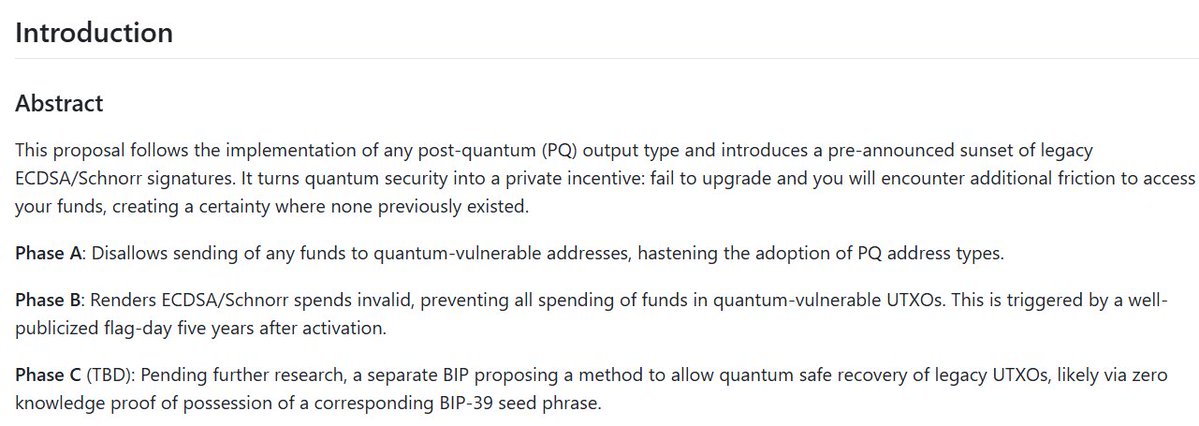
Bitcoin developers have proposed BIP-361 to freeze early Bitcoin addresses that have quantum vulnerabilities.
This includes Satoshi wallets and other OG dormant wallets from the 2010-11 era.
It's a big step, as these wallets hold over 4M BTC and are at high risk from future quantum computing attacks.


English

We shipped a lil something today: USDT Swaps ⚡💵
Lightning ↔ USDT. No custody. No accounts. No KYC.
Move from sats to stablecoins in seconds, across a growing number of networks.
👉 beta.boltz.exchange 👈
Read the full announcement: blog.boltz.exchange/p/introducing-…
English

Releasing meetscribe — a fully local, open source meeting transcription tool.
Records any meeting app, diarizes speakers with WhisperX + pyannote, generates AI summaries via Ollama, and outputs professional PDFs.
No cloud, no subscriptions, everything runs on your GPU.
github.com/pretyflaco/mee…
English
English

Trying to get my @openclaw to create a burner email for me. Needs to accept crypto (preferably lightning). Anyone know where to get this done?
I came across @agentmail and they require a human to first create an account. It's the biggest epic fail I've seen in my entire life.
English

If you have WhatsApp, Signal, if you've ever opened a PDF on your device, if you run iOS, Android, and even an OS like Graphene, your chances of having this software on your phone is more than zero.
Even Graphene pretends to be uncrackable, but clever marketing is used to cover up the fact that many of their distros are only "uncrackable" until you unlock the device the first time, (After First Unlock - AFU), any time you power it on. At least, this was the case in March 2025, I haven't checked on any new indexes lately.
YourFavoriteGuy@guychristensen_
Civil rights lawyers straight up told me a few months ago that I have Graphite installed on my devices. Fuck Israel forever mane.
English

It only took 14 years… but it’s finally here 😊
Meet NexPhone — a smartphone built to run Android, launch Linux (Debian) on demand, and dual-boot Windows 11. My 14-year founder story: nexphone.com/blog/the-tale-…
If you want to support what we’re building, a repost helps a lot.
English

Announcing a new education resource in collaboration with the Starknet Foundation:
Cairo for EVM Developers
This series teaches Solidity developers how to reuse their mental models about storage, access control, arithmetic safety, testing in Foundry, etc., and apply them to developing Cairo smart contracts on Starknet.
Some innovations on Starknet may surprise Solidity developers. For example, all accounts are smart accounts, and there is no equivalent to msg.value.
Our series introduces the surprising aspects at logical stages in the learning journey so that the learning experience feels more like reusing existing knowledge rather than being bombarded with new and unfamiliar facts.
As usual, you can expect tutorials that are detailed and comprehensive, yet easy to digest.
Link in the reply.

English
Nik retweetledi

Just watched @MetroplexGOS 's first-ever interview with @davidbombal about @GrapheneOS and took some notes.
If you're considering GrapheneOS or just curious about what it actually offers, this interview breaks down the key points.
Metroplex handles GrapheneOS community outreach, so he fields questions from users daily. This interview addresses the most common misconceptions and concerns people have.
BIGGEST MISCONCEPTIONS DEBUNKED:
1) "Banking apps don't work"
~99% work fine. The remaining 1% that enforce Play Integrity API can often work with exploit compatibility mode. There's a community-maintained compatibility list at discuss.grapheneos.org/d/8330-app-com…
Even apps like eBay that show Play Integrity flags often work - just need to install via Aurora Store instead of Play Store.
2) "You can't get notifications"
False. Three options:
- Sandboxed Play Services (Firebase Cloud Messaging) - works without Google account
- UnifiedPush for supported apps
- Individual app websockets
All function exactly like stock Android. The difference? You control the permissions.
3) "Using a Google Pixel defeats the purpose"
This one comes up constantly. GrapheneOS uses Pixels because they're the ONLY devices offering:
- Full firmware support for alternate operating systems
- Verified boot with locked bootloader
- Hardware attestation through Titan M2 chip
- Best security research backing
It's not about avoiding Google hardware - it's about using the most secure Android hardware available.
WHAT GRAPHENEOS ACTUALLY IS
It's an AOSP (Android Open Source Project) distribution, like how Fedora and Arch are Linux distributions.
Key difference from stock Android: On first boot, GrapheneOS makes ZERO default connections to Google. Everything goes through GrapheneOS proxies that strip identifiable information.
THE SANDBOXED PLAY SERVICES CONCEPT
Stock Android: Play Services run at system level with elevated privileges. They can access whatever they want and you can't fully restrict them.
GrapheneOS: Play Services installed as regular user apps in the sandboxed compatibility layer. Subject to the same permission model as any other app.
You can revoke permissions. You can control data access. You can even run them without a Google account.
PRIVACY FEATURES THAT STOOD OUT:
Storage Scopes: Grant apps access to specific files/folders instead of entire storage. Facebook wants photos? Give it access to one folder, not everything.
Contact Scopes: Share specific contacts with apps like WhatsApp instead of your entire contact list. The app thinks it has full permission, but you've limited the scope.
Per-connection MAC randomization: Every time WiFi turns on/off, your device appears as a new device to access points. They can't track you through a mall.
Auto WiFi/Bluetooth timeouts: Customize how long before they auto-disable. Prevents beacon tracking when you're walking around.
SECURITY FEATURES:
Auto-reboot to Before First Unlock (BFU):
Set between 10 minutes to 72 hours. When triggered, encryption keys are purged from memory. Metroplex sets his to 8 hours (overnight).
Forensic firms have specifically flagged Pixel + GrapheneOS as the hardest combination to extract data from.
PIN scrambling: Numbers randomize on unlock screen. Defeats shoulder surfing.
Two-factor fingerprint unlock: Strong passphrase for first unlock, then weaker PIN + fingerprint for subsequent unlocks. Combined with Titan M2 throttling makes brute force impractical.
Memory Tagging Extension (MTE): Apple just announced this as revolutionary. GrapheneOS has had it system-wide since release.
Covers kernel, all OS processes, bundled apps, AND user-installed apps. When apps crash due to memory corruption, you get notifications with crash reports to send to developers.
This benefits the entire Android ecosystem when developers fix issues.
THE PIXEL 10 SITUATION
People worried about Google removing Pixel device trees from AOSP.
Status: GrapheneOS has automated device tree generation from factory images. Pixel 10 experimental builds already exist.
Waiting on Google to release QPR1 to AOSP (expected soon), then Pixel 10 goes to stable release.
Also: GrapheneOS is partnering with a top-tier Android OEM for alternative hardware. Target launch Q4 2026 / early 2027.
SECURITY UPDATES ADVANTAGE
Through the OEM partnership, GrapheneOS now gets security patches up to 4 months early.
There's an embargo before open-sourcing them, but users get protection immediately - faster than stock Pixel users.
Metroplex's take: If you trust GrapheneOS enough to install it, trust getting security patches that make you safer.
CAMERA QUALITY
Secure Camera app (bundled) provides equivalent quality using CameraX API.
Want Google Pixel Camera's full AI features? You can install it. GrapheneOS built compatibility layer support even after Google added hard Play Services dependency.
Can even toggle Tensor Processing Unit access for AI enhancements.
USER PROFILES
You can create multiple user profiles, each with separate encryption and PIN.
Use cases:
- Isolate apps requiring Play Services
- Reduce screen time (Metroplex's approach - essentials in main profile, time-wasting apps in secondary)
- Sensitive data isolation (banking apps together in one profile)
- Travel (before crossing borders, keep device in BFU state with minimal profile active)
Each profile can auto-stop background processes when you switch away. "End session" button purges encryption keys for that profile.
NETWORK LOCATION
GrapheneOS recently launched network location provider using Apple's services (via proxy).
Why Apple? Best privacy option available. GrapheneOS proxy strips all identifiable information before sending requests.
Gives you faster location fixes indoors without exposing data to Google or Apple directly.
APP INSTALLATION OPTIONS
1. GrapheneOS App Store (first-party apps: Secure Camera, Auditor, PDF Viewer, plus select third-party)
2. Play Store (via sandboxed Play Services - can use existing Google account, throwaway account, or no account for free apps)
3. Accrescent (new open-source alternative to Play Store, recently out of beta - developers control distribution)
4. Obtainium (pulls APKs directly from GitHub/GitLab release pages, auto-updates)
5. Aurora Store (Play Store front-end with shared accounts - against Google ToS, use as last resort)
Metroplex's tip: Don't use VPN IP when creating throwaway Google accounts - Google often requires phone verification, adding friction.
WHAT GRAPHENEOS ISN'T ABOUT
Not about avoiding Google entirely. Not about paranoia. Not about being a "drug dealer" (looking at you, Spanish government).
It's about USER CONTROL over a device you own.
Want to use Google services? Fine - but sandboxed with permissions you control.
Want zero Google? Also fine - everything has alternatives or proxies.
WHO SHOULD CONSIDER IT?
Anyone who wants:
- Privacy by default
- Proven security hardening
- Full app compatibility (banking, notifications, everything works)
- Automatic OTA updates
- Control over their own device
MY KEY TAKEAWAYS
1. Most "GrapheneOS problems" people mention are outdated or false
2. It's not privacy OR security - it's privacy AND security as complementary
3. The project has matured significantly - it's genuinely usable
4. User control is the core principle, not anti-Google ideology
5. Pixel + GrapheneOS is legitimately the most secure mobile setup available
English
@IsaacKing314 Number should be defined by arbitrary formula, not only sum of An*2^n
English

Change my mind: Floating point should not be the default number representation in high-level programming languages.
Floating point is useful because it's so fast. But the whole point of high-level languages is to trade performance for saving programmer time. A python program is never going to be as fast as one in C, but it will be a lot easier to write.
Floating point is already a tradeoff in this direction; integer arithmetic is even faster, but less useful, so floating point was a reasonable compromise... 80 years ago. Nowadays, hardware improvements have made performance a non-issue for a huge number of cases. I wouldn't be surprised if more than half of today's actively-developed software could take a 10x speed penalty on its arithmetic operations without breaking. (Just look at how slow most modern apps and webpages are; performance is clearly not a priority for most large companies.)
Floating point has severe drawbacks! The fact that you can't use it for exact math with non-integers is something most programmers have gotten used to, but in reality it's an absolutely *massive* cost. Millions of person-hours have been wasted on learning, debugging, and implementing workarounds for floating point's quirks; all of which would be unnecessary if programming languages supported arbitrary-precision arithmetic out-of-the-box.
Indeed, many programming languages already have separate types for integers vs. floating point. I don't think this division makes sense. The default number type in any high-level language should be one that roughly matches how numbers actually work in the real world, with floating point as a secondary alternative for performance-critical cases.
English
Nik retweetledi

This is a long post that hopefully bridges some gaps between technical people (devs) and non-technical users and how they look at spam prevention in Bitcoin. I hope that it clarifies why I think that there is such a huge misunderstanding between both camps.
I'll preface this post with first disqualifying any malicious attempts to misrepresent the motives of either camp. Everybody wants to improve Bitcoin as money. Money is Bitcoin's use case. It's not a data storage system. If you think otherwise, there are countless shitcoins to play with.
Alright, let's get into it.
I have worked on anonymous systems for over a decade. I have read tons of research on spam detection, rate-limiting, and I've implemented spam prevention techniques in the real world.
I am very confident to say that there is not a single known method to prevent spam in decentralized anonymous open networks other than proof of work.
This is what Satoshi realized when he designed Bitcoin and it's why only transaction fees can reliably fight spam without sacrificing any of Bitcoin's properties.
Let me explain.
Spam prevention is a cat and mouse game. As a system's architect, your goal is to make the life of a spammer harder (increase the friction). This is why, on the web, you see captchas, sign-ups, or anything that can artificially slow you down. Slowing down is key. This is why Satoshi turned to proof of work.
Let's contrast this to other methods for spam prevention. This is not an exhaustive list but it illustrates the design space of this problem, other methods are often derivatives of these:
CAPTCHAS are a centralized form of proof of work for humans: Google's servers give you a hard-to-solve task (select all bicycles) that will slow you down so that you can't bombard a website with millions of requests. It requires centralization: you need to prove Google that you're human so that you can use another website. If you could host your own CAPTCHA service, why would anyone believe you're not cheating?
LOGINS with email and passwords are most popular way to slow down users. Before you can sign up, you need to get an email address, and to get an email address, you often need a phone number today. The purpose of this is, again, to slow you down (and to track you to be honest). It only works well when emails are hard to get, i.e. in a centralized web where Google controls how hard it is to get an email account. If you could easily use your own email server, why would anyone believe you're not a bot?
The next one is the most relevant to Bitcoin:
AD BLOCK FILTERS are another form of spam prevention but this time the roles are reversed: you as a user fight against the spam from websites and advertising companies trying to invade your brain. Ad blocking works only under certain conditions: First you need to be able to "spell out" what the spam looks like, i.e. what the filter should filter out. Second, you need to update your filters every time someone circumvents them. Have you ever installed a youtube ad blocker and then noticed that it stops working after a few weeks? That's because you're playing cat-and-mouse with youtube. You block, they circumvent, you update your filters, repeat.
The fact that you need to update your filters is critical and that's where it ties back to Bitcoin: Suppose you have a mempool filter for transactions with a locktime of 21 because some stupid NFT project uses that. You maybe slow them down for a few weeks, but then they notice it and change their locktime to 22. You're back at zero, the spam filter doesn't work anymore. What do you do?
You update your filter! But where do you get your new filter from? You need a governing body, or some centralized entity that keeps updating these filters and you need to download their new rules every single day. That's what ad blockers in your web browser do. They trust a centralized authority to know what's best for you, and blindly accept their new filters. Every single day.
I hope you see the issue here. Nobody should even consider this idea of constantly updating filter rules in Bitcoin. This would give the filter providers a concerning level of power and trust. It would turn Bitcoin into a centrally planned system, the opposite of what makes Bitcoin special.
This is why filters do not work for decentralized anonymous systems. They require a central authority. Until now, these rules were determined by Bitcoin Core, but they have realized that these rules do not work anymore. Transactions bypass the filters easily and at some point, carrying them around became a burden to the node runners themselves. Imagine you're using an outdated ad blocker but instead of filtering out ads, it now also filters out legitimate content you might be interested in. That's what mempool filters do, and that's why Bitcoin Core is slowly relaxing these filters. This has been discussed for over two years, it's not a sudden decision.
The goal of this change is not to help transactions to slip through more easily. The goal is to improve your node's prediction of what is going to be in the next block. Most people misrepresent this part. They say "it's to turn Bitcoin into a shitcoin" but that is just a false statement at best, or a manipulation tactic at worst.
Let's tie it back to proof of work and why fees are the actual filter that keeps Bitcoin secure and prevents spam reasonably well: Satoshi realized that there is no technique that could slow down block production and prevent denial of service attacks in a decentralized system other than proof of work. Fees prevent you from filling blocks with an infinite number of transactions. All the other options would introduce some form of trust or open the door for censorship – nothing works other than proof of work.
He was smart enough to design a system where the proof of work that goes into block production is "minted" into the monetary unit of the system itself: You spend energy, you get sats (mining). This slows down block production. How do you slow down transactions within those blocks? You spend the sats themselves, original earned form block production, as fees for the transactions within the block!
This idea is truly genius and it's the only reason why Bitcoin can exist. All other attempts of creating decentralized money have failed to solve this step. Think about it: without knowing who you are, whether you're one person pretending to be a thousand, or a thousand people pretending to be one. Bitcoin defends itself (and anyone who runs nodes in the Bitcoin system) from spam by making you pay for your activity.
People sometimes counter this by saying: the economic demand for decentralized data storage is higher than the monetary use case. First of all, I think that's just wrong. There are way cheaper ways to store data (there are shitcoins for this), and the value of having decentralized neutral internet money is beyond comparison.
However, there's a much deeper concern here. If you truly believe this, I ask you: what is Bitcoin worth to you? If you think Bitcoin can't succeed as money (i.e. be competitive), why do you even care? If you're not willing to pay fees for the use case that we all believe Bitcoin is designed for (money), and you believe that no one is willing to pay for it, how can it even persist into the future?
You can't have it all. If Bitcoin is money (which I believe it is), then we need to pay the price to keep it alive. There is no free lunch.
Either we centralize, or we pay the price of decentralization. I know where I stand.
Peace.
English

Важный вопрос: вы смотрите на *** перед тем, как покупать акции? 🤔
Только неправильные ответы в реплаях, как правильно это расшифровать

Русский

@udiWertheimer Down about 300 nodes
Which is within the daily variance
It's down about 3000 nodes from its highpoint earlier this year
English
It is easy to fake the upswing in Knots nodes
But the downswing in Core nodes? That's hard to fake. You have to *convince* people to stop running it so that they stop showing up in the charts.
Looks like a lot of people are getting convinced!

English
Nik retweetledi

🚨Bounty Raised to 100% - $3.1M USD🚨
...as @MEXC_Official Attempts to Gaslight an Entire Community
Apparently, I’m a criminal now.
That’s the narrative MEXC is floating. According to them, I’m part of some secretive money laundering operation using their platform as a conduit.
At least that’s the latest version. Their story keeps changing.
First, it was about KYC - even though I completed Advanced KYC long ago.
Then it became “high-frequency API trading” - despite the fact I’ve never had API access on the account.
Now, the new angle is: Anti-Money Laundering investigation.
Because it sounds scarier. And more convenient.
Because implying I’m a criminal is their best shot at shaking public backlash.
But let’s take a step back and apply some basic logic.
If this were a legitimate investigation:
Why keep changing your story?
Why has no investigator ever contacted me with questions? (I'm not aware of any investigative service in the world who would not jump at the chance to interview their "suspect")
Why is the only path forward an in-person meeting - with no formal accusation, no explanation? What exactly do you hope to achieve face-to-face that can’t be done over Zoom? Are you planning to take my fingerprints? My blood? My life? If not, then there’s no excuse. This could have - and should have - been handled virtually.
I’ve made it clear: I can prove the source of funds.
They’re not interested. They just repeat the same line:
“Come meet us. Face to face.”
After public backlash mounted to the suggested of in-person KYC, they recently started saying it’s “not compulsory.”
But in the same breath, it’s still “the only way to resolve the review.”
You can’t have it both ways.
To @MEXC_Official :
You are not Interpol. You are not MI6. You are not James Bond.
You have my KYC. You have my location. Where I live, where I sleep. My IP address. If you believe there’s a crime, forward your evidence to actual law enforcement.
What you’re doing instead is freezing user funds while inventing new reasons as you go.
You’re not enforcing the rules.
You’re making them up as you go.
And every trader watching knows it.
This was never just about my account - and it’s never been about the money. It’s about standing up to exchanges that operate like the shadowy criminal organizations they falsely accuse their customers of being. Seizing user funds without process, without proof, and without consequence. There are hundreds of stories just like mine - users who never had a voice, never had a following, and never had a chance. That ends here.
The bounty has now been increased to 100% of the frozen funds - $3.1 million. Half will go to verified, transparent charities, and the other half will go directly back to the community that continues to amplify this cause. Every last cent will be documented on-chain. Just truth, transparency, and accountability. That is, after all, what crypto is all about.
🫡 From the depths —
The White Whale 🐋

English

Cortisol from exercising suppresses the subsequent cortisol response to a stressor.
Exercise before doing something stressful.

English



Mainnet version of Iris Wallet is now available in the Play Store! Issue, send and receive RGB assets onchain
play.google.com/store/apps/det…
English