
Sabitlenmiş Tweet
Nick
2.3K posts


Nick
@ndsshow
Gain insights to national security, geopolitics, intelligence, and technology. Be informed, not just opinionated! CEO @geo_owl | Join the Ops on YouTube
Washington, DC Katılım Kasım 2009
262 Takip Edilen1.8K Takipçiler
@WeTheBrandon @RealSamFaddis @joekent16jan19 This whole thing wasn’t communicated properly, massive fumble across the board. I think most Natsec professionals could be sold on this but the comms from POTUS has been atrocious but I also wouldn’t say that the Israeli’s put us up to it or say that Iran isn’t a threat.
English

I've yet to meet a former national security professional--who actually was good at their job--who thinks the current strategy in Iran is anything but a major self-inflicted wound. @RealSamFaddis explains why neither he nor @joekent16jan19 are comfortable with the current war plan
Brandon Weichert@WeTheBrandon
We went into Iran thinking the regime would fall in days. It didn’t. Now the world economy is at risk and nobody knows the next move. This is Iraq all over again. @RealSamFaddis joins me on the next episode of NATIONAL SECURITY TALK:
English
It's very interesting right now supporting GEOINT Ops. DoW customers are leveraging commercial satellite imagery like I've never seen before.
Our teams are working non-stop in and out of the SCIF to produce great intelligence for decision makers and its very fascinating to see how damn good our @Geo_Owl intel professionals REALLY are when it matters most.
I mean they are NEXT FREAKING LEVEL awesome. Working overtime, supporting each other across shifts, while keeping up with their families and getting non-stop recognition from end users on how talented they are and how useful their analysis is.
Think what you will about the Iran war, its a beautiful thing to witness true professionals on mission.
English
@TheStudyofWar There is a large population in Iran that supports the regime, large enough to sustain a government. The U.S. can't change the regime with whack-a-mole diplomacy. It's all up to the people of Iran to make it happen, it's going to take unbelievable courage!!!
English

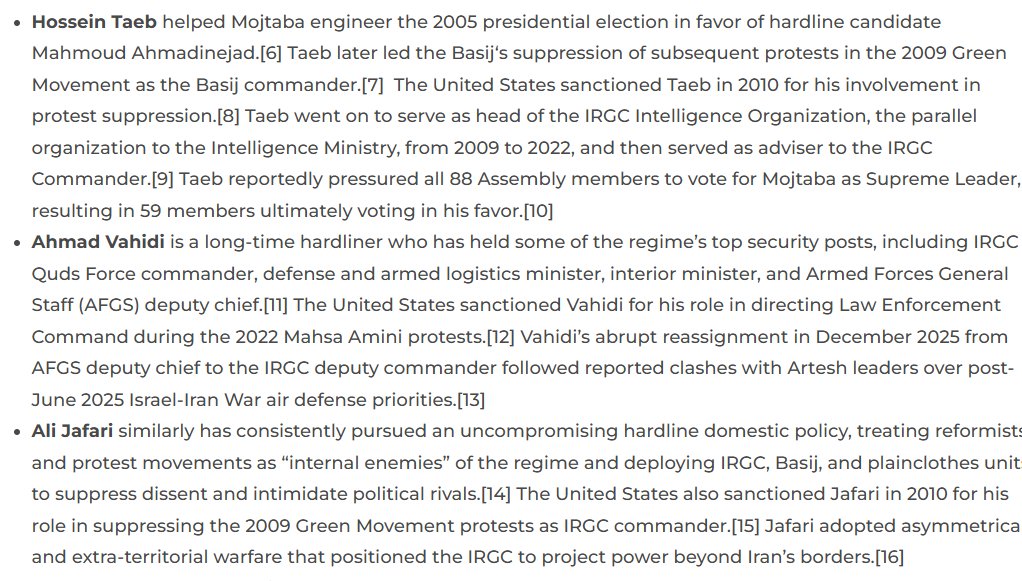
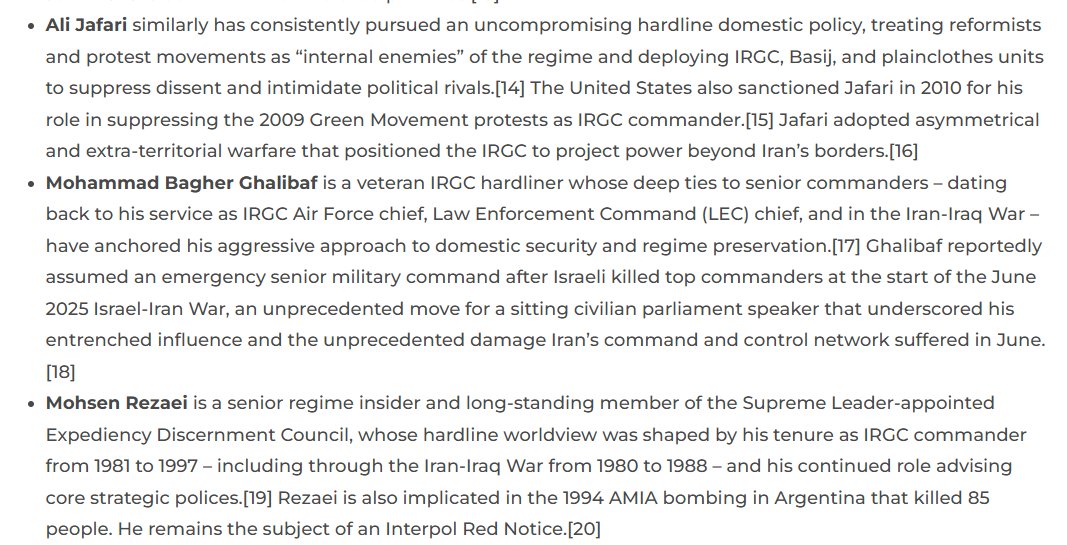
The New York Times reported on March 16 that former IRGC Intelligence Organization head Hossein Taeb, de facto IRGC Commander Brigadier General Ahmad Vahidi, former IRGC Commander Major General Mohammad Ali Jafari, and Parliament Speaker and former IRGC Brigadier General Mohammad Bagher Ghalibaf were the main campaigners to get the Assembly of Experts to elect Mojtaba as supreme leader. All four of these IRGC commanders worked for decades under former Supreme Leader Ali Khamenei. The first generation of Iranian revolutionaries and long-time IRGC leaders thus remain at the top of the Iranian regime‘s hierarchy despite decapitation strikes in recent years.
Institute for the Study of War@TheStudyofWar
NEW: Supreme Leader Mojtaba Khamenei’s reported inner circle is dominated by long-standing hardline Islamic Revolutionary Guards Corps (IRGC) commanders. Their influence will almost certainly drive Iran toward more hardline, anti-Western policies and deepen existing patterns of regime corruption and securitization. Other Key Takeaways ⬇️(1/2) The Iranian regime has taken steps to further restrict the flow of information out of Iran, which will almost certainly limit our ability to observe strikes in Iran. Internet monitor NetBlocks reported on March 16 that the regime has further tightened internet restrictions. A BBC reporter stated on March 15 that the regime has reportedly started to target individuals with Starlink access and reduced the availability of VPNs. The combined force targeted a likely Iranian drone facility in South Khorasan Province in one of the combined force’s easternmost strikes since the war began. The strike indicates that combined force aircraft can operate deep inside Iranian territory. Iran has not attacked any vessels in the Strait of Hormuz since March 12. Anti-regime media also published footage on March 12 that shows a US Navy F/A-18 Hornet engaging targets with its autocannon at extremely low altitude in Chabahar, Sistan and Baluchistan Province, which is on the Iranian coast on the Gulf of Oman. This suggests that US forces have at least local air dominance along certain segments of the coast, which would enable US aircraft to engage drones and anti-ship cruise missiles at low altitudes to protect shipping if ordered to do so.
English

@rawsalerts Ahh yes, the age old war tactic of waiting until your WHOLE MILITARY is obliterated to begin fighting back, Sun Tzu is rolling in his grave
English

🚨#BREAKING: Iranian officials say it is now time to teach the United States a major lesson issuing a warning that America has ‘messed with the wrong people
English
@bennyjohnson I don't know why this is news to anyone, its not exactly a secret. Though there are a lot of people that like to pretend it's not happening.
English

SecState Rubio: “Radical Islam has shown that their desire is not simply to occupy one part of the world… It seeks to expand and control more territories and more people… radical Islam has designs, openly, on the West, on the United States, on Europe.”
English
@EterniaOutlaw @JohnKiriakou He made specific claims about hypersonic missile attacks
English

@ndsshow @JohnKiriakou False flag doesn't mean that the events aren't happening. It just means that the pretenses under which they are happening were falsified in order to initiate them. As in, saying that Iran is about to have a nuke and is a direct threat to the US when they are not.
English

What’s going on in Lebanon and Iran is an atrocity.
This illegal war is causing untold human, economic, and ecological damage. The worse part? It’s being fought not for American interests but Israel’s.
Unfiltered With S.A.M@unfiltered__sam
I spoke with @JohnKiriakou about the escalating Israel–Lebanon conflict and the growing risk of a humanitarian disaster if this war expands. Watch the full interview: youtu.be/Go9D9TSpEdU
English
For all you looney tune conspiracy theorists - Anduril has many contracts like this already and has been leading in developing sUAS and C-sUAS tech by doing something the rest of the industry doesnt - they pay for their own R&D and product development while the rest of the large primes won’t touch anything like this unless the government funds it ahead of time. Its a great story of American risk taking and @PalmerLuckey deserves a ton of credit for this pragmatic approach.
English

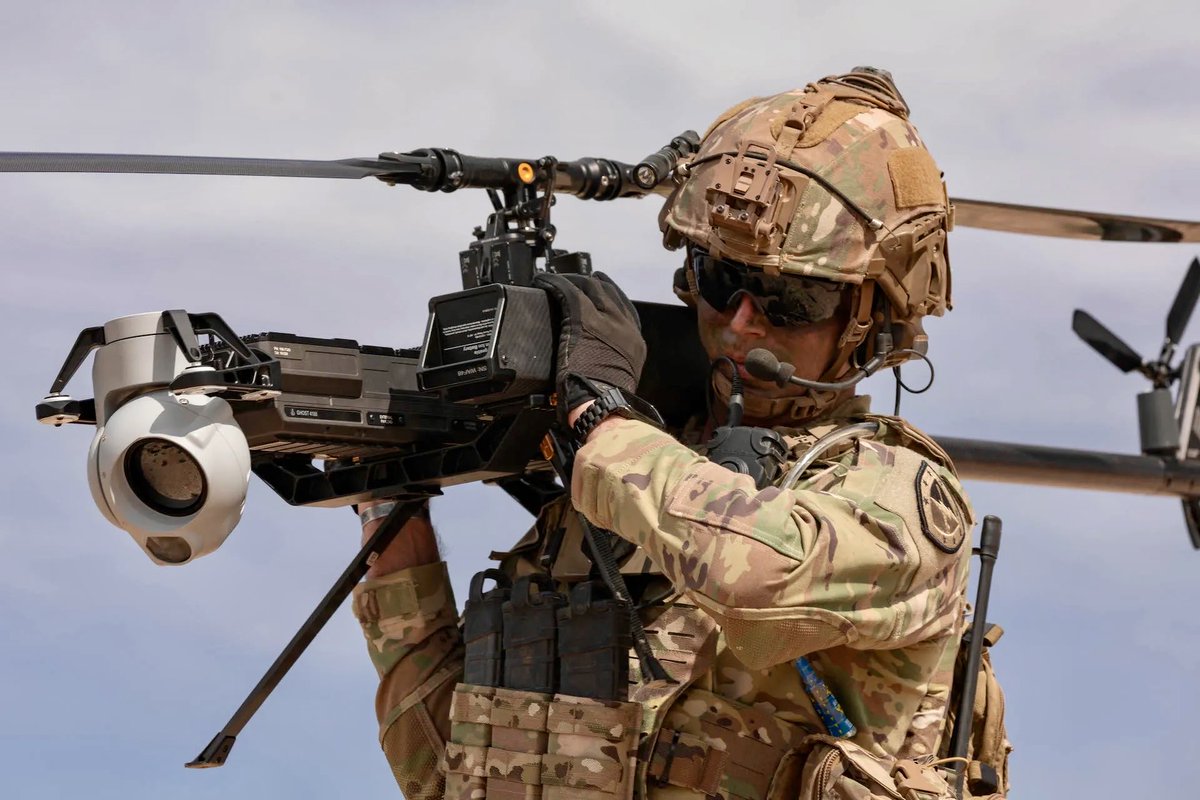
JUST IN: The US Army just awarded $20 billion to a company whose drones crashed in Ukraine. That is not a scandal. It is the point.
Anduril Industries received the largest enterprise contract in modern Army procurement history on 13 March for Lattice, its AI-powered command-and-control platform that fuses thousands of sensor feeds into a single real-time battlespace map, tasks autonomous drone swarms, and enables one operator to control what previously required dozens. The contract covers software, hardware, data infrastructure, compute, and services consolidated into a unified counter-drone capability. The Army did not buy a weapon. It bought an operating system for war.
The operating system was written in Ukrainian rubble.
Anduril deployed hundreds of Altius loitering munitions and Ghost reconnaissance drones to Ukrainian forces starting in 2024. The early results were catastrophic. Russian electronic warfare, the most sophisticated jamming environment on Earth, tore them apart. GPS spoofing sent Ghost drones spiralling into the ground. Persistent jamming reduced general drone hit rates to 10 to 15%. Altius units crashed before reaching targets. Ukrainian operators, who were simultaneously building their own drones at a rate of one million per year with 96% indigenous production, were unimpressed.
Anduril did something most defence contractors do not. It sent engineers to the front line, collected operator feedback in real time, and redesigned the aircraft in months rather than years. The result was Ghost-X: a fundamentally different machine. Where the original Ghost relied on GPS, Ghost-X flies on vision. Onboard computer vision algorithms, optical flow sensors, and terrain mapping through electro-optical and infrared gimbals give the aircraft autonomous navigation in environments where every satellite signal is jammed. It does not need GPS because it can see. It does not need a datalink because Lattice gives it mission autonomy. It does not need a dedicated operator because one person can task an entire swarm.
Ghost-X proved, in Anduril’s words, “markedly more resilient” in both Ukrainian combat and US Government electronic warfare testing. The drone that crashed in a jammed Ukrainian field became the drone that flies through jammed airspace without flinching. The $20 billion contract is the Army’s bet that what survived Russian EW can defeat Iranian Shaheds.
The Iran war is the contract’s first test at scale. IRGC one-way attack drones are down 95% according to Hegseth’s briefing, but they are not gone. The Mosaic Doctrine’s 31 autonomous commands can still launch from dispersed positions using the simplest guidance systems available. The coastline that produces fast boats also produces cheap drones that do not need to be sophisticated to overwhelm. Lattice’s counter-UAS architecture, AI-fused radar and electro-optical data identifying threats in seconds, autonomous interceptors engaging without human delay, single operators managing swarm responses across the battlespace, is designed for exactly this: volume.
The contract also reveals what the Army learned from Ukraine that it will not say publicly. Indigenous Ukrainian interceptors achieved 70% success rates against Russian drones in February 2026, built cheaply, iterated rapidly, and deployed at scale by operators who learned electronic warfare the hard way. The Army watched a country with a fraction of America’s budget outperform imported systems by iterating faster. The $20 billion is not just a purchase. It is an admission that the future of air defence is software-defined, AI-driven, and built by companies that treat combat data as a product cycle rather than a procurement milestone.
Anduril’s drones crashed in Ukraine. Then they learned to see. Now the Army is betting $20 billion that seeing is enough to win a war where everything that depends on a satellite signal dies.
Full deep dive analysis open.substack.com/pub/shanakaans…
English
Well 2026 is starting out with a few bangs. Venezuela, Iran and now Cuba?
Benny Johnson@bennyjohnson
The brave people of Cuba have just taken over the headquarters of the Communist Party in Ciego de Ávila. These rebels then set fire to the building. Cubans see the freedom being brought to other nations and now want theirs.
English
And you can already see the slippery slope of logic that leads to prolonged presence and boots on the ground. I know they keep saying “its not a regime change war” but what would be the point in all of this just for the same fundamentalist government to stay in power and hate us even more!?
English

The conflict has entered its third week as a full-spectrum, multi-theatre war with no defined exit architecture. What began as an air campaign against Iranian military, leadership, and nuclear infrastructure has cascaded into a regional war engaging Iran, Israel, Lebanon (Hezbollah), Gulf states (Saudi Arabia, UAE, Qatar, Bahrain), and US forward-deployed forces, while generating the largest supply disruption in the recorded history of the global oil market. The structural logic of Cold War 2.0 is now fully operational: the US-Israel axis prosecuting kinetic dominance; the DragonBear axis (Russia-China) providing shadow enablement without crossing the threshold of direct military intervention.
English
Nick retweetledi

🇺🇸🇮🇷 This is America's answer to Iran's 'cheap' Shahed-136 drone that notoriously destroyed an American radar worth $300 million.
Lucas's specs:
- One-way attack drone
- Cost: $35,000 each
- Range: ~700–800 km
- Engine: 215 cc carbureted combustion
- Warhead: ~18 kg
Source: @Defence_Index
Mario Nawfal@MarioNawfal
🚨🇺🇸🇮🇷 THE TINY ISLAND THAT COULD STRANGLE IRAN’S ECONOMY Kharg Island is barely a dot on the map; it's a rocky lump in the Persian Gulf about 15 miles off Iran’s coast. But that tiny island handles around 90% of Iran’s oil exports, which means it’s their economic jugular. Pipelines from the mainland feed giant storage tanks there, and supertankers dock offshore to haul crude out through the Strait of Hormuz, much of it heading straight to China. Cut Kharg off and the money pipeline dries up. No tankers. No oil exports. No revenue. For military planners, that makes the island one of the most tempting pressure points in the entire region. Why bomb refineries across a country the size of Iran when one island controls the tap? But actually seizing Kharg would be anything but easy. Iran has spent decades preparing for exactly that scenario. Not with aircraft carriers or massive fleets, with asymmetric chaos. Naval mines scattered through shipping lanes, drone swarms like the Shahed-136, fast attack boats buzzing around like armed jet skis. Individually, none of these threaten the U.S. Navy, but combined, they turn the Persian Gulf into a giant naval obstacle course. Even if the island were captured, holding it would be the real nightmare. Iran wouldn’t need to retake Kharg, it would just need to make sure no one can safely use it. And then there’s the global fallout. Iran exports 1–2 million barrels of oil per day, take Kharg offline and oil markets would react insanely. Source: BBC
English
@NEWSMAX The regime will shift more focus to terrorism and cyber attacks, we need to step up homeland security and stop pretending like this won’t come back to bite us in the ass. Its all they have, so its all they’ll do. If we wont change the regime - the regime wont change.
English

President Donald Trump said Wednesday the war with Iran could end "soon," because there is "practically nothing left to target" after a series of U.S. and Israeli strikes. newsmax.com/politics/donal…
English
What is there to gain from a War with Iran?
As west coast threats surface, Retired CIA Officer @douglaslondon5 breaks down what the United States has at stake in Iran.
We filmed this the day prior to the beginning of Operation Epic Fury - Doug knows his stuff!
English
Nick retweetledi

The older you get, the more you realize how many politicians are idiots.
English