Neelacantan (Neel)

2.2K posts

Neelacantan (Neel) banner
Neelacantan (Neel)

Neelacantan (Neel)

@neelearning

Co Founder: @coolturedesigns ✒️Author: Feedback Decoded.💡 Purveyor of ideas. 🤯I help teams brainstorm🚍Infra-watcher, Public Transport advocacy

Bangalore Katılım Şubat 2011
2.4K Takip Edilen301 Takipçiler
Neelacantan (Neel) retweetledi

Bṛhat | बृहत् | Brhat
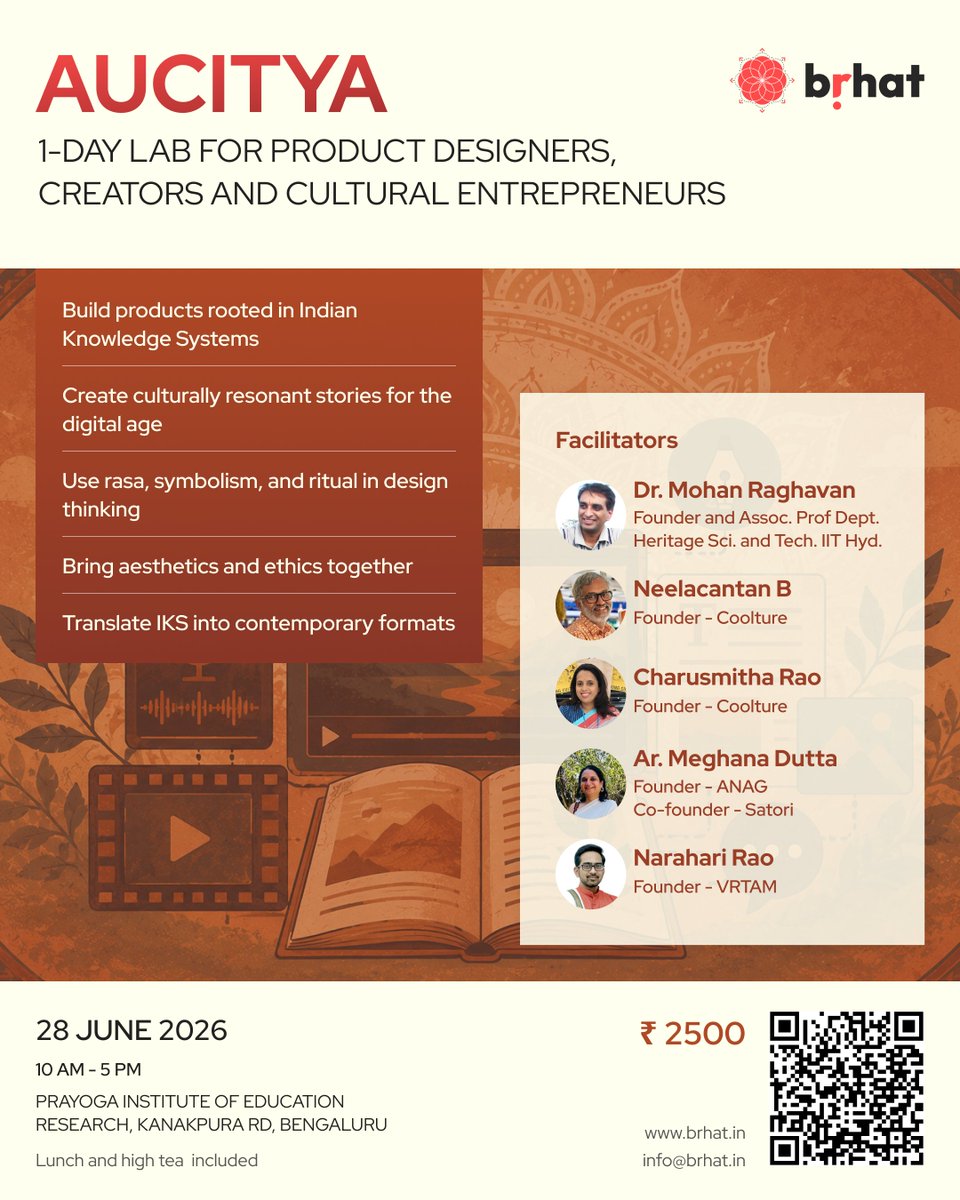
We are back with another Aucitya workshop! This Bangalore edition is a one-day immersive lab for creators, founders, designers and storytellers who want to build culturally resonant products and experiences. From rasa theory and storytelling to Pañcāṅga-inspired product thinking, the workshop explores how Indian Knowledge Systems can move beyond theory into living design, communication and innovation frameworks. Designed especially for Bangalore’s vibrant startup and creative ecosystem, the workshop brings together aesthetics, ethics, technology and product imagination to ask an important question: how can culture become a meaningful consumer experience? If you are a cultural entrepreneur, product storyteller, designer, founder, educator or creator working at the intersection of culture and innovation, this workshop is for you. Join us in reimagining Indian knowledge as contemporary product experience, narrative and design. Registrations are now open: brhat.in/programs/aucit… @MohanRaghavan8 @CooltureDesigns @RaoNarahari
Bṛhat | बृहत् | Brhat tweet media
English
0
6
17
545
Neelacantan (Neel) retweetledi
Prasanna Viswanathan
Prasanna Viswanathan@prasannavishy·
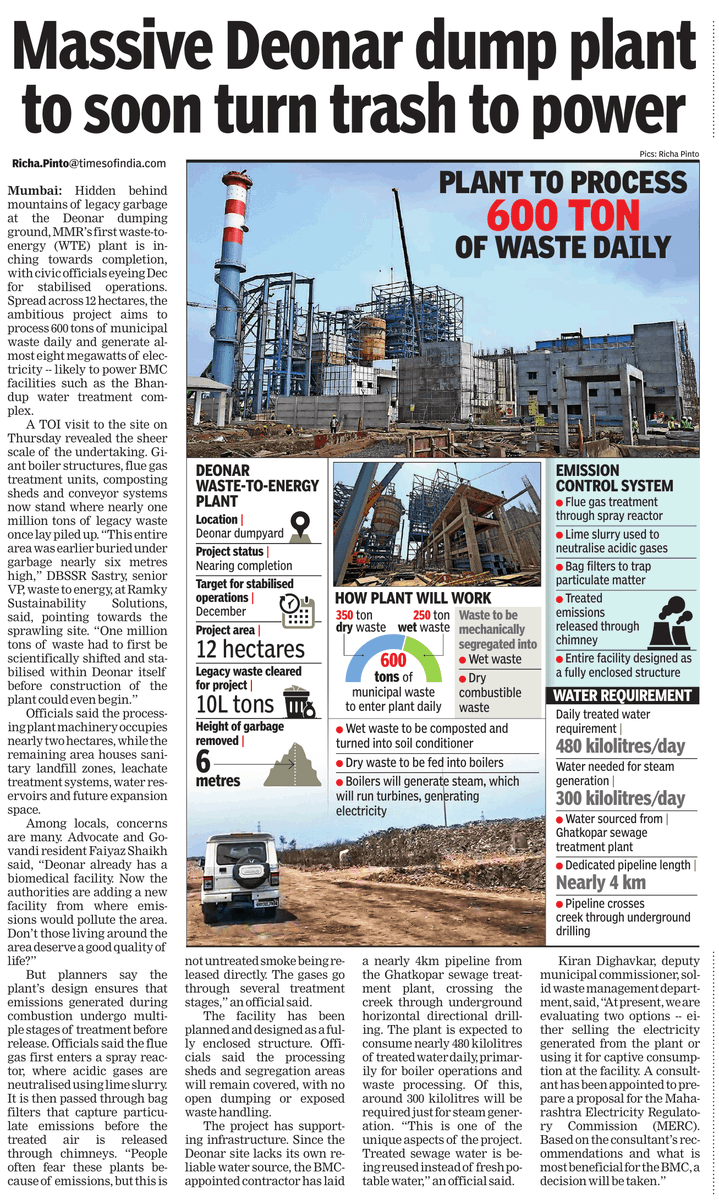
Awesome. Mumbai city authorities cleared 6 metres of legacy garbage from Asia's largest dumpyard, built a 12-hectare power plant on it, and it will soon generate 8 MW of electricity from 600 tonnes of trash every day. Every Indian city needs one. Demonstrable proof that India's waste crisis has a solution.
Prasanna Viswanathan tweet media
English
13
241
700
40.6K
Neelacantan (Neel) retweetledi
N.
N.@Nlacombe_·
you’re 22. you scroll 3 hours a day. it feels harmless at 28 you can’t read an article without checking your phone twice per paragraph at 32 you don’t understand why nothing you start ever finishes, you’re still dreaming of this project you wanted to start. still no time at 40 you’ve never finished a book in a decade. it all passed
Diana S. Fleischman@sentientist

In adults, limiting smartphone functionality to texting and calls and blocking all social media and mobile internet for 2 weeks significantly improved attention, self-reported well-being and mental health. 90% of participants experienced a benefit.

English
90
3.3K
22.4K
1.6M
Neelacantan (Neel) retweetledi
Anish Moonka
Anish Moonka@anishmoonka·
Charles Dickens fought his depression by walking through London at night. One October he set out at 2 in the morning and walked 30 miles, all the way to his country home in Kent. In 1860 he wrote about why it worked. It took psychology another 150 years to catch up. Dickens called his bad spells "spectres." They came back every time he started a new novel and sometimes hung on for months. His mood would fall apart, his sleep would collapse, and the only thing that pulled him out was walking. He explained his method in an essay called "Night Walks," published on July 21, 1860 in his weekly magazine All the Year Round. He had tried fighting his insomnia from bed and lost. So he changed the plan. The fix, he wrote, was "getting up directly after lying down, and going out, and coming home tired at sunrise." A worried mind cannot fix itself by worrying more in bed. You have to get up and move. Most nights he walked 12 to 20 miles. A friend called it "violent walking." Dickens wrote that on these walks his wandering self had "many miles upon miles of streets in which it could, and did, have its own solitary way." Today, walking is one of the most powerful tools doctors have against depression. In 2012 a team of researchers pulled together eight high-quality studies of walking as a depression treatment. The effect was as strong as the antidepressants doctors actually prescribe. The biggest test came from Duke University. The SMILE study took 202 adults with serious depression and split them into four groups: supervised exercise, home exercise, the drug Zoloft, or a placebo pill. After 16 weeks, the people who exercised did just as well as the people on Zoloft. A 2024 review of 75 studies covering 8,636 patients confirmed it. Walking should be one of the first things doctors try. The reason is the thing Dickens stumbled onto in the dark. Depression runs on rumination, the looping bad thoughts that grind people down during the worst stretches. In 2015 Stanford researchers scanned people's brains before and after a 90-minute walk in a quiet park. The walkers had less activity in a part of the brain called the subgenual prefrontal cortex. That spot, deep behind your forehead, is the brain's worry loop. After the walk, the worry loop got quieter. The walkers said they felt less stuck inside their own heads. The brain scans agreed. A walking body shuts up a noisy mind. The street takes attention, the walking rhythm fills the head, and the dark spells lose their grip. Dickens called the streets his cure because they gave his brain somewhere else to be. The science 150 years later says he had it right. Depression hates a brain that is moving.
Anish Moonka tweet mediaAnish Moonka tweet media
English
149
1.9K
8K
408K
Neelacantan (Neel) retweetledi
Greatex
Greatex@cloudighodaro·
This has got to be the funniest video about the English language. For real English is crazy.
English
685
2.9K
23.8K
813.3K
Neelacantan (Neel) retweetledi
शिक्षित बेरोज़गार
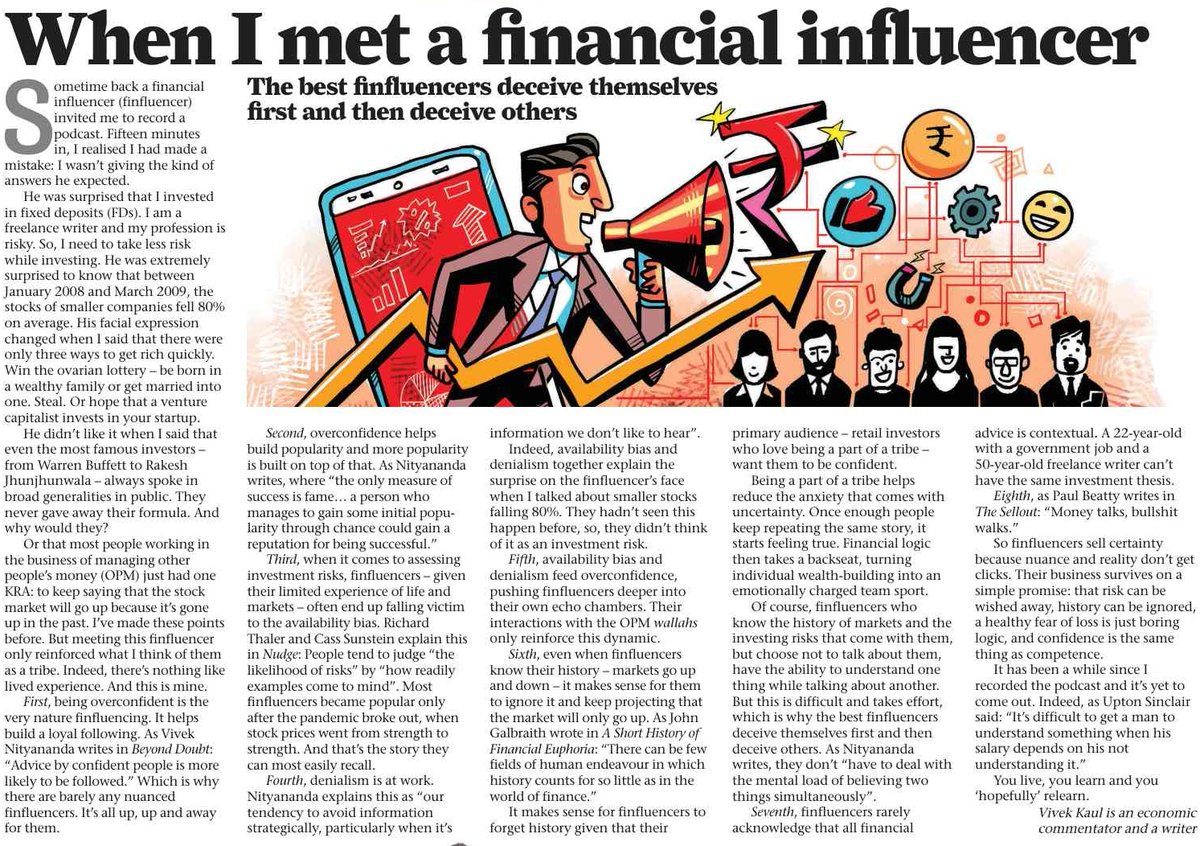
When I met a financial influencer My weekly Paisanomics column in the Mumbai Mirror. Something I had great fun writing. Do read and share. Sometime back I sat across a finfluencer to record a podcast. He was shocked I kept money in FDs. Shocked that smaller stocks fell 80% between 2008-09. He didn’t like it when I said that even the most famous investors – from Warren Buffett to Rakesh Jhunjhunwala – always spoke in broad generalities in public. They never gave away their formula. And why would they? The podcast still hasn't dropped. Funny, that. Or as Upton Sinclair once said: “It’s difficult to get a man to understand something when his salary depends on his not understanding it.” Here's what I've figured: finfluencers don't sell investing. They sell certainty. Being overconfident is the very nature finfluencing. It helps build a loyal following. As Vivek Nityananda writes in Beyond Doubt: “Advice by confident people is more likely to be followed.” Which is why there are barely any nuanced finfluencers. It’s all up, up and away for them. Knowing history is bad for their business. Most finfluencers became popular only after the pandemic broke out, when stock prices went from strength to strength. And that’s the story they can most easily recall and want to sell. And the best ones deceive themselves first – so they don't have to work as hard deceiving you. Confidence is not the same thing as competence. Never has been. Indeed, as Paul Beatty writes in The Sellout: “Money talks, bullshit walks.” mumbaimirror.indiatimes.com/opinion/when-i…
शिक्षित बेरोज़गार tweet media
English
8
31
138
10K
Neelacantan (Neel) retweetledi
blue
blue@bluewmist·
every school should have a "fix-it lab" where students learn to repair their clothes, bikes and electronics. we should grow up knowing that not everything is disposable, that care and repair are part of living well on this planet.
English
583
9.1K
54.2K
679.8K
Neelacantan (Neel) retweetledi
Ashwinn
Ashwinn@Shwinnabego·
This is turning the watchmaking world upside down
English
33
94
1.8K
178.1K
Neelacantan (Neel) retweetledi
Parimal
Parimal@Fintech03·
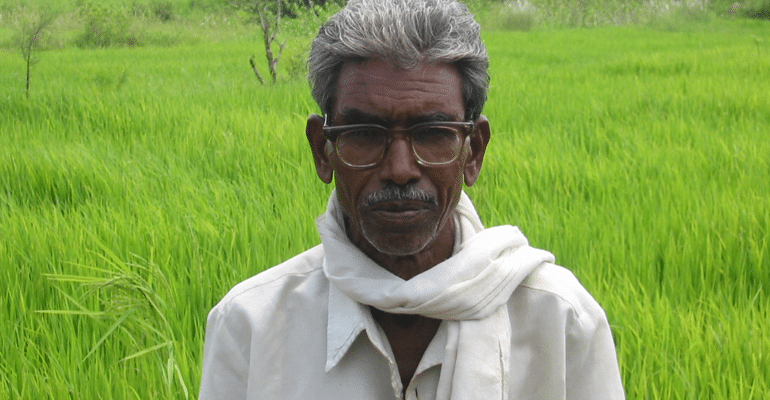
1 man found 3 yellow grains in the mud & spent 5 yrs protecting them from wild pigs. A trader named the result after his favorite watch brand to prove its quality, while a university stole the seeds to claim the credit. He fed millions, but worked as a daily wage laborer on his own soil. Discover the Ghost Farmer behind India's favorite thin rice. While the world was looking at high-tech labs for the next green revolution, a school dropout named Dadaji Ramaji Khobragade was standing in his small 1.5 acre plot in Nanded, Maharashtra. While harvesting his usual Patel 3 rice, Dadaji noticed 3 yellow-seeded spikes (lomb) that looked different. Most farmers would have ignored them as impurities. Dadaji picked those 3 spikes & stored them in a simple plastic bag. For the next 5 yrs, he painstakingly bred them in a tiny patch, protecting them from wild pigs with a fence of thorny bushes. He created a variety that was thinner, smelled better, & yielded 80% more than the conventional seeds. Dadaji did not have a marketing team/a brand name. In 1990, a large landowner bought 150 kg of these seeds & sold the harvest to a local trader. At that time, HMT Watches were the ultimate symbol of Gold Standard & Reliability in India. The trader, who had recently bought a new HMT watch & was obsessed with it, decided to call the rice HMT Rice simply to signal that this rice was as High Quality as the watch. The name stuck so hard that people today think HMT Rice was developed by the govt corporation (Hindustan Machine Tools), but the company had absolutely nothing to do with it! In 1994, the Punjabrao Krishi Vidyapeeth (PKV), an agricultural university, approached Dadaji. They took 5 kg of his seeds under the pretext of experimenting. A few yrs later, the university released a new"variety called PKV-HMT. They claimed Dadaji’s original seeds were impure & that they had purified them. They took the credit, the patents, & the glory. For yrs, the man who actually did the 5 yrs of backbreaking research was left working as a daily wage laborer on other people’s farms just to feed his family. Dadaji Khobragade lived in poverty for decades while HMT Rice became a multi-crore industry across Maharashtra, Andhra Pradesh, & Chhattisgarh. It was only much later that the National Innovation Foundation (NIF) stepped in. They proved that the university’s new rice was genetically identical to Dadaji’s. In 2010, Forbes magazine named him 1 of the most powerful Rural Entrepreneurs, & he finally received a National Award. But by then, he had already sold his own land to pay for his son’s medical treatment. Next time you eat a bowl of thin, aromatic HMT rice, remember it is not the product of a sanitized government lab. It is the result of a man who looked at three tiny yellow grains in the mud & saw a future that the PhDs missed. The HMT in the rice does not stand for Hindustan Machine Tools; it stands for the Honesty of a Marginalized Toiler. Dadaji Khobragade proved that you do not need a degree to be a scientist; you just need an eye that can see the extraordinary in the ordinary. A trader's love for a wristwatch gave the rice its name, but a farmer’s love for his land gave the rice its soul. 1 became a brand; the other remained a Ghost in his own fields.
Parimal tweet media
English
53
1.3K
3.3K
65.5K
Neelacantan (Neel) retweetledi
Parimal
Parimal@Fintech03·
In 1919, 1 man bought a Ghost Ship & challenged the entire British Navy. They tried to bankrupt him with a Zero-Price war, but he won by turning a ferry ticket into a vote for Freedom. From building India’s 1st aircraft factory in secret to carving railway tunnels through impassable mountains, he was the Industrial Guerilla who taught a colony how to fly, sail, & drive. Discover the man who made Made in India a threat to the Empire. He is the man who looked at the British "No Entry" signs across Indian industry & decided to build a sledgehammer. After WWI, the British shipping giant BI (British India Steam Navigation) had a total monopoly on Indian waters. No Indian was allowed to own a large-scale shipping line. On 5th Apr 1919, just days before the Jallianwala Bagh massacre, an Indian man, with no background in shipping, Walchand Hirachand Doshi spotted a ship called the SS Loyalty in Bombay harbor. It was a hospital ship being sold after WWI. W/o waiting for a license, he bought it & launched the SS Loyalty, the 1st ship of the Scindia Steam Navigation Company. The British tried to sink him financially. They started a Price War, dropping ticket prices to almost zero to bankrupt Walchand. Walchand did not blink. He appealed to Indian pride. He told the public: "Even if their tickets are free, if you travel with them, you travel in chains." Indians chose to pay for Walchand's tickets. He broke the 100 yr British naval monopoly. This is why 5th April is still celebrated as National Maritime Day. The British govt in India had a strict policy: "India will produce raw materials; Britain will produce machines." They flatly refused to give a license for an Indian car factory. Walchand realized he could not wait for permission. He went to the USA & met Walter Chrysler. He told Chrysler, I want to build an Indian car for Indian roads. Chrysler was impressed by his grit. Together, they bypassed British red tape to set up Premier Automobiles (the birthplace of the legendary Padmini/Fiat). He proved that an Indian could build an engine, not just a bullock cart. During WWII, the British were desperate for aircraft maintenance in the East but did not want Indians to know the secrets of aviation. Walchand did not ask the British. In Oct 1939, Walchand was returning from the United States (where he had gone to explore setting up a car factory, including talks with Chrysler). On a Pan Am Clipper flight from San Francisco to Hong Kong, he had a chance meeting with American industrialist William D. Pawley (president of Intercontinent Corporation and involved in aircraft manufacturing for China). Pawley was on his way to China to support aircraft production there (for the Chinese government amid the war with Japan). During the flight, Walchand discussed his ambitions with Pawley, who shared insights from his China operations. This conversation sparked the idea for an aircraft factory in India. With the help of Maharaja of Mysore, he set up Hindustan Aircraft Ltd. (now HAL) in Bangalore in 1940. When the British realized what he had done, they were furious but had to nationalize it because they needed the planes for the war effort. Every time we see a Tejas/a Sukhoi take off today, remember that the runway was laid by Walchand’s defiance in 1940. Walchand’s company, Hindustan Construction Company (HCC), was responsible for the Bhor Ghat & Thull Ghat railway tunnels. British engineers said the Sahyadri mountains were too tough for Indian contractors. They wanted to give the contracts to London firms. Walchand took the contract, used indigenous techniques, & completed the tunnels ahead of schedule & at a lower cost. He proved that Indian Civil Engineering could move mountains.. literally. Despite being 1 of the richest men in India, Walchand was a symbol of the Swadeshi spirit. He would walk into boardrooms with British Lords & present his papers in Marathi/Gujarati if he felt they were being condescending. His agenda was clear: "I do not want to be a rich man in a poor country; I want to be a productive man in a rich country. Walchand Hirachand was the Architect of Infrastructure. If Tata built the Steel, Walchand built the Speed.... the ships, the cars, & the planes. He was the 1st Indian to understand that true independence is the ability to move our own people on our own machines. He was the man who turned "Made in India" from a dream into a Turbine. He did not just compete with the British; he made them irrelevant in their own specialized fields.
Parimal tweet media
English
50
432
989
33.3K
Neelacantan (Neel) retweetledi
Anish Moonka
Anish Moonka@anishmoonka·
Winston Churchill fought his depression with bricks. He'd lay them for hours at his country home in Kent. He joined the bricklayers' union. And in 1921 he wrote about why it worked. It took psychology another 75 years to catch up. He called his depression the "Black Dog." It followed him for decades. His method for fighting it back was as basic as it sounds: laying brick after brick, hour after hour. Churchill spelled out his theory in a long essay for The Strand Magazine. People who think for a living, he wrote, can't fix a tired brain just by resting it. They have to use a different part of themselves. The part that moves the eyes and the hands. Woodworking, chemistry, bookbinding, bricklaying, painting. Anything that drags the body into a problem the mind can't solve by itself. Modern psychology now calls this behavioral activation. It's one of the most-studied depression treatments out there. Depression sets a behavior trap. You feel bad, so you stop doing things, and doing less means less to feel good about. Feeling worse makes you do even less. The loop tightens until you can't breathe inside it. Behavioral activation breaks the loop from the action side. You schedule the activity first, even when every part of you doesn't want to. Doing it produces small rewards: a wall gets straighter, a painting fills in, a messy room gets clean. Those small rewards slowly rewire the brain. Action comes first, and the feeling follows. Researchers at the University of Washington put this to the test in 2006. They studied 241 adults with major depression and compared three treatments: behavioral activation, regular talk therapy, and antidepressants. For the people who were most severely depressed, behavioral activation matched the drugs. It beat the talk therapy. A 2014 review of more than 1,500 patients across 26 trials backed up the result. Physical work like bricklaying does something extra on top of this. It crowds out rumination, the looping bad thoughts that grind people down during the worst stretches of depression. Bricklaying needs both hands and gives feedback brick by brick: each one is straight or crooked. After an hour you can see exactly how much wall you built. No room left for the mental chewing. The line George Mack used in his post, "depression hates a moving target," is good poetry. The science behind it is sharper. Depression hates a brain that has somewhere else to be.
George Mack@george__mack

Winston Churchill used to lay 200 bricks per day to keep his mind busy when feeling down. Depression hates a moving target.

English
856
11.6K
56.3K
6.9M
Neelacantan (Neel) retweetledi
Armory
Armory@ArmoryShield·
Breaking: Armory has won a ₹100 Cr order from the Ministry of Defence and Surge is going to the frontlines. We are officially an Indian Defence Manufacturer and we're not going to pretend to be cool about this. We're proud. Really, really proud. Built from zero. 20+ trials. Took notes from the soldiers who'd actually use it. Went back. Enhanced it. And won MoD’s trust in us. To the frontlines. Surge is ready. 🇮🇳
Armory tweet media
English
32
143
847
56.2K
Neelacantan (Neel) retweetledi
Harveen Singh Chadha
Harveen Singh Chadha@HarveenChadha·
Indian IT services companies got a competition they were not expecting
Harveen Singh Chadha tweet media
English
56
212
1.6K
138.3K
Neelacantan (Neel) retweetledi
Mario Tomic
Mario Tomic@mariotomich·
Just 8 minutes of walking increased creative output by 60%. Stuck on a problem? Go for a walk.
Mario Tomic tweet media
English
75
1K
5K
427.4K
Neelacantan (Neel) retweetledi
Tejasvi Surya
Tejasvi Surya@Tejasvi_Surya·
A Bengaluru startup just did something no one in the world has ever done, put a satellite in orbit that sees through clouds, through the night, with optical sensor and SAR fused into one. Many many congratulations to the @Galaxeye team on the launch of Mission Drishti! This is exactly why PM Sri @narendramodi opened up the space sector, so young Indians could build an audacious future for the nation.
English
134
1.1K
6.9K
547.2K
Neelacantan (Neel) retweetledi
Karthik Reddy
Karthik Reddy@bykarthikreddy·
7 years after identifying problem, 5 years after getting design ready, 3 years after allocating ₹50 cr, a year after tender, foundation stone for Banashankari Skywalk work laid One person constant in all of this, with repeated follow-ups & escalation is MP Tejasvi Surya
Karthik Reddy tweet mediaKarthik Reddy tweet media
English
33
66
577
29.6K
Neelacantan (Neel) retweetledi
Prasanna Viswanathan
Prasanna Viswanathan@prasannavishy·
India's toll plazas gets a serious upgrade. The Multi-Lane Free Flow (MLFF) system is now live and aim is to eventually transition to no boom barriers, no queues, no stopping with FASTag deducted automatically. 108 toll plazas across major national highways, with full rollout targeting all four-lane+ corridors by 2029. The end goal is to eliminate human intervention, no revenue leakage, no fuel wasted idling at barriers.
Prasanna Viswanathan tweet media
English
9
75
240
10.7K