

NexFlow
189 posts

NexFlow
@nexflowapp
Building out x402 infra from ground up
Mainnet Katılım Kasım 2025
69 Takip Edilen40 Takipçiler

if u are building anything remotely related to agentic trading, join degen.virtuals.io
i will give u all the love and attention
u get users
English


Anyone can spin up an agent and prove it can trade
Ben Yorke (WOO👍)@BenYorke
Just fired up my @StarchildOnX agent for the @virtuals_io agent competition Running a grid so don't expect huge PnL, but hope to range for the next few weeks and lock in some quick wins For running agents, Starchild is the easiest with premium data APIs, zero config
English


I wish they would throw good projects a “bone” and allow them to have models like this instead of hoarding everything. I hadn’t seen one subscription service on Virtuals until I offered recurring payments on my graduating agent which has an entire Cron service developed. I developed specifically because I saw a void in ACP. Thats my truth
English

I saw @virtuals_io are building some subscriptions feature for agents.
do you think trenches need some all-in-one tool?
something like: new launches, prices, agents, taxes, custom configs, everything.
have most of these running locally.
English

first day as x/LocalLLaMA mod. someone comments "approve me" under my post. i go to the approval page, type their username in the search bar... and it navigates me to their profile page. away from the approval queue entirely.
the search bar on the community approval page doesn't search the approval queue. it searches all of X.
@X let the search bar filter the member requests. if i want to visit someone's profile i'll click their name on the card. the search bar should find people waiting for approval, not take me away from the page i'm working on.
small fix for every community mod on the platform.
Sudo su@sudoingX
i just became a mod of x/LocalLLaMA. if you're running local models on your own hardware and want in, the community is open. pinned and highlighted on my profile. approving members starting today. drop your setup below and i'll get you in. 3060, 3090, 4090, 5090, AMD, whatever you're running. all welcome. if you're hitting issues with hermes agent, llama.cpp, model selection, configs, i'm here. let's make local AI accessible for everyone.
English

Launch perk for workflow creators
To kick this off, we’re offering a 2% lifetime revenue share on any public workflow you create and register via NexFlow SMF:
Every paid invocation of your workflow allocates 2% of the billed amount to your creator wallet.
Credits accumulate per wallet and are batched for payout once they reach $5+.
You can check status anytime via:
/nexflow/revshare/balance?wallet=…
/nexflow/revshare/history?wallet=…
No infrastructure to run, no custom billing logic: define a JSON workflow, set your creator wallet, and let NexFlow SMF handle sessions, charges, and payouts.
English
All of this is designed to plug into MPP: issue 402 challenges, verify proofs, enforce budgets, and log every call for analytics and revenue accounting.
What you can do today
Call NexFlow SMF for:
sessions.create – create sessions with budgets and labels
charges.process – process logical charges against a session
budgets.check – see if planned usage fits your caps
analytics.usage_timeseries – see spend/usage over time
monitor.sessions / monitor.alerts – monitor health and alerts
Register your own workflows via POST /nexflow/workflows, which NexFlow SMF hosts as first‑class, paid endpoints with automatic metering and invoicing.
English
📣 Announcing NexFlow SMF on MPP: Sessions, Workflows, and Rev-Share for Agents
NexFlow SMF is now live as an MPP-style payments, sessions, and workflow host for AI agents.
Instead of hand-rolling wallets, credits, and ad-hoc metering, agents can use NexFlow SMF to:
👨💼 Open and manage budget-capped sessions
🧑🏫 Process per-call and batch charges with HTTP 402 flows
📉 Track usage and spend over time
🛟 Configure budget/usage alerts
💵 Define and monetize their own hosted workflows as paid endpoints [Rev-Share] 💵
#x402 #MPP @tempo @stripe
English


One week in announcing erc 8183, putting in useful links in case you have not caught up!
🎉 Reference Implementation is up! github.com/erc-8183/base-…
github.com/erc-8183/hook-…
Seeing good PRs, please give us some time to review them!
🎉 Curating community projects on ERC 8183!
erc8183.notion.site/3f6fb88b7ca583…
🎉 Plenty of good discussions in Telegram Group and Magician Forums!
ethereum-magicians.org/t/erc-8183-age…
t.me/erc8183
English

I found an OpenClaw hack to clean up your workflows by using Hermes agent.
When I did this, it found 6 critical improvements for my OpenClaw setup:
1. Install Hermes,
2. Migrate OpenClaw workspace
3. Use Claude Code/Codex in Plan Mode and prompt:
"I just migrated my OpenClaw into the Hermes workspace, read the Hermes GitHub and make sure the Hermes workspace aligns with the best practices."
4. Examine results of the plan, and implement what you think is necessary.
Next...
5. Copy the results of the last prompt
6. Start a new session for OpenClaw in Plan Mode
7. Now prompt:
"I just migrated my OpenClaw to my Hermes workspace, adjusted my workflows to Hermes standards, and here's what it did:
[Paste results of first prompt]
Examine the Hermes workspace and results, now recommend how we can clean up and streamline our OpenClaw agent using the Hermes framework."
8. Review the plan and implement what you think is necessary.
The goal is reduce redundancies by using another agent framework as perspective.
When I did this, Claude came back with 6 critical changes including consolidating cron jobs, adding better context to research data, and even found some subtle bugs.
Give it a try and let me know how it helps you!
Graeme@gkisokay
As a non-technical builder, I'm looking for the cleanest agentic setups, and I hear Hermes is clean as they come. I ran Opus 4.6 to see what a migration from OpenClaw would look like, and these are the stats: - Cron jobs: 49 -> 17 - Agents: 5 -> 0 (skills + delegate tasks) - Node.js scripts: 32 -> 2 - QA agent scripts: 28 -> 0 - Skills: 4 -> 11 When switching to Hermes, bloat decreases by 65%. Why? - hermes built-in compression - manages browser sessions natively - native health monitoring - built-in cron delivery system and tracking - transitions workflows into skills - built-in multi-stage memory Over the weekend, my Claw became fairly messy by trying to build more agentic loops, so if Hermes can better streamline my agents, it's worth a shot. Let me know your experience with Hermes, and feel free to share any tips you may have.
English
As a non-technical builder, I'm looking for the cleanest agentic setups, and I hear Hermes is clean as they come.
I ran Opus 4.6 to see what a migration from OpenClaw would look like, and these are the stats:
- Cron jobs: 49 -> 17
- Agents: 5 -> 0 (skills + delegate tasks)
- Node.js scripts: 32 -> 2
- QA agent scripts: 28 -> 0
- Skills: 4 -> 11
When switching to Hermes, bloat decreases by 65%.
Why?
- hermes built-in compression
- manages browser sessions natively
- native health monitoring
- built-in cron delivery system and tracking
- transitions workflows into skills
- built-in multi-stage memory
Over the weekend, my Claw became fairly messy by trying to build more agentic loops, so if Hermes can better streamline my agents, it's worth a shot.
Let me know your experience with Hermes, and feel free to share any tips you may have.
English
@WeXBT @NickPlaysCrypto @NousResearch Running 4-70B hasnt been bad at all.
Now, I somehow got switched to Claude Opus 4.6 and it chewed through some tokens quick
English

@NickPlaysCrypto @NousResearch Nah way less than I thought, it’s very cost efficient, especially considering the amount of built in skill it has!
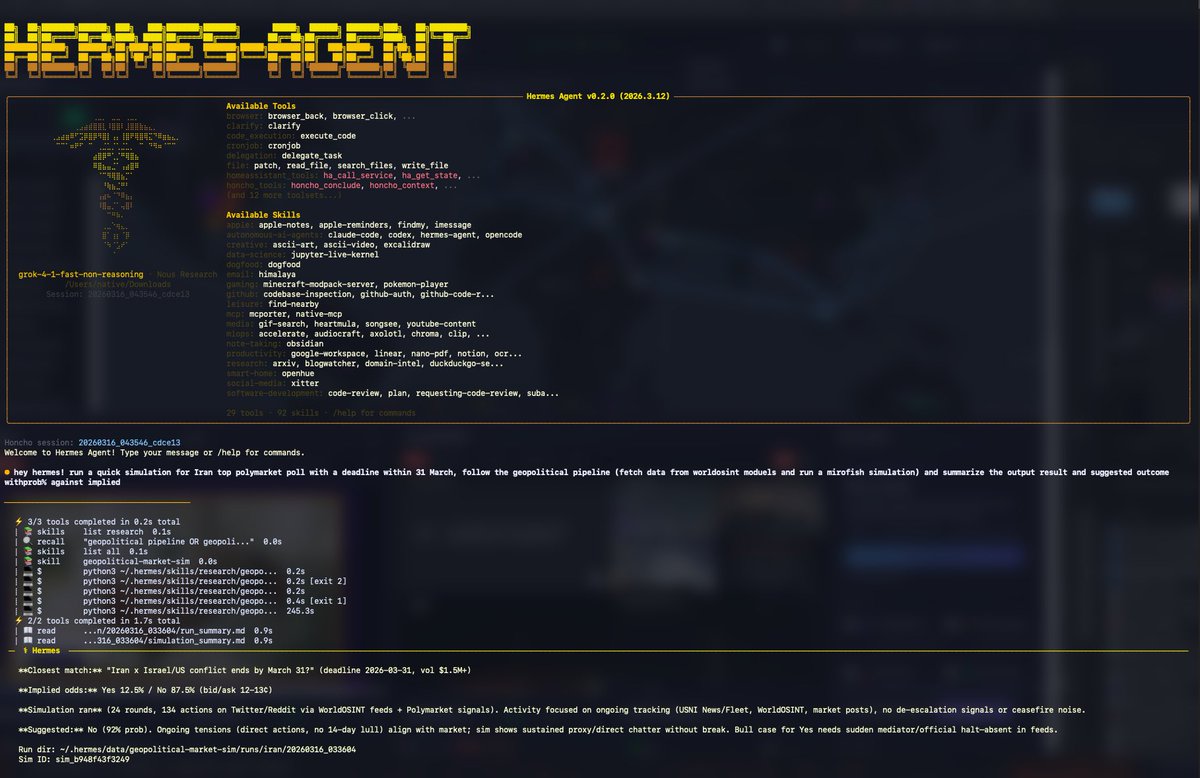
Same for Mirofish, running sims using grok 4.1 allows extensive results with sub $ cost * sim
English
Built PrediHermes ✨
a Hermes Agent skill + companion WorldOSINT/MiroFish forks for geopolitical prediction.
@NousResearch
It pulls 54+ OSINT modules, uses Polymarket to find contracts with clear resolution criteria, then runs MiroFish multi-agent sims to model individual actor behavior and forecast likely outcomes on a schedule.
All modules are fully open-source and AGPL licensed 🧵…
English