Nick Pericle

8.5K posts

Nick Pericle banner
Nick Pericle

Nick Pericle

@nickpericle

AI, Tech, Leadership for the Supply Chain Learning, Educating, Sharing, Growing "Here am I, Lord; send me"

Richmond, VA Katılım Ağustos 2009
1.9K Takip Edilen513 Takipçiler
Sabitlenmiş Tweet
Nick Pericle
Nick Pericle@nickpericle·
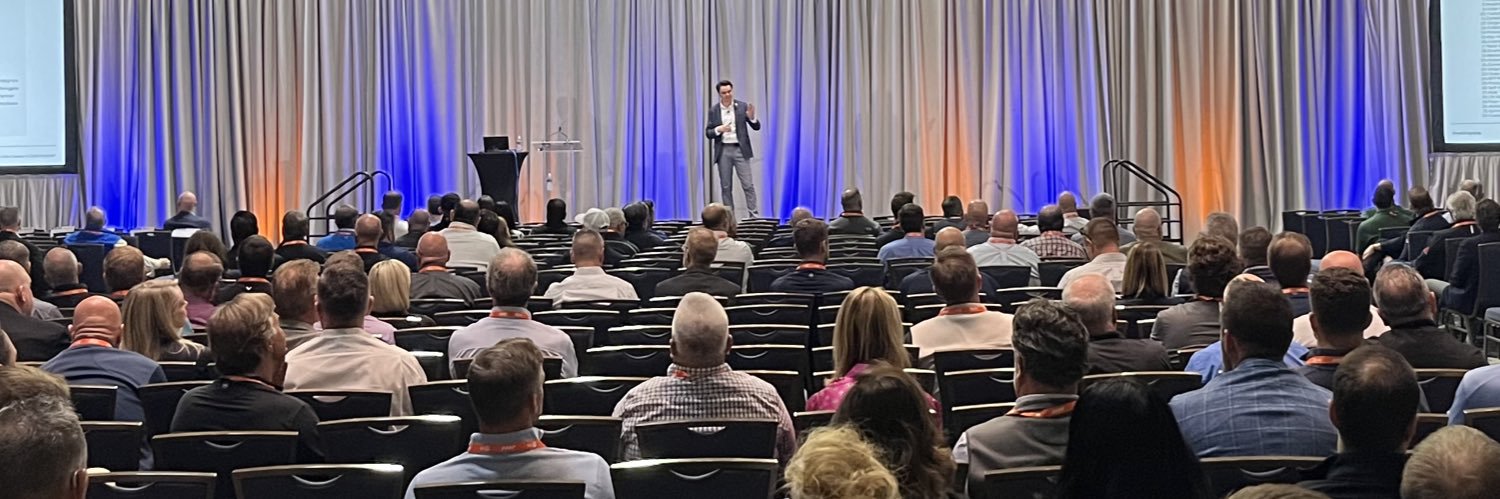
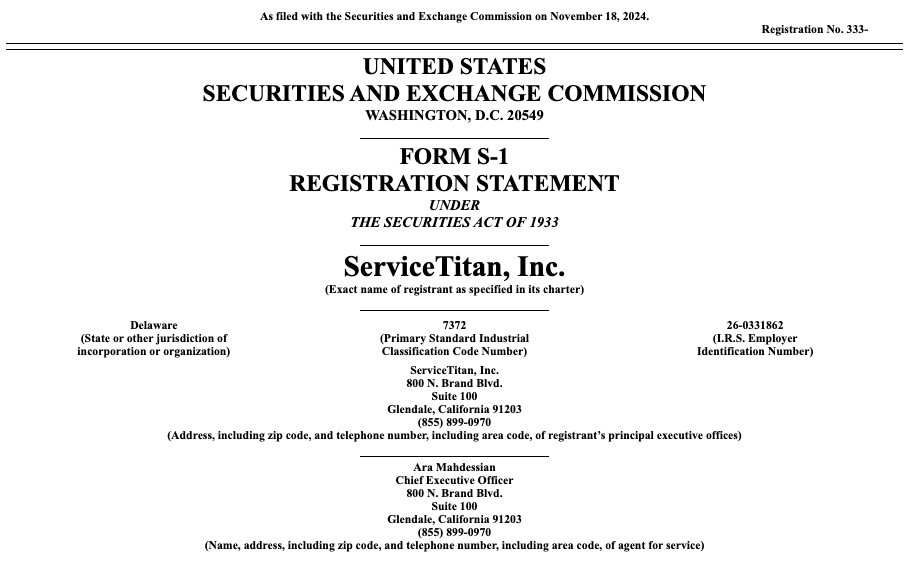
The @ServiceTitan S-1 filing is >300 pages. Their customers are my customers’ customers (I work with wholesalers/distributors), so understanding the $1.5T trades industry is part of my job. Here’s what I learned (a 🧵)
Nick Pericle tweet media
English
3
0
4
1.5K
Nick Pericle retweetledi
Sam Altman
Sam Altman@sama·
feels like a good time to seriously rethink how operating systems and user interfaces are designed (also the internet; there should be a protocol that is equally usable by people and agents)
English
1.5K
654
10.7K
1M
Nick Pericle retweetledi
Sam Altman
Sam Altman@sama·
we still get looksmaxxed on frontend a little but we IQmog hard now
English
1.5K
836
18.8K
3.1M
Nick Pericle retweetledi
Garry Tan
Garry Tan@garrytan·
Did a video on GStack to introduce you to the first few skills you might use, /office-hours and /design-shotgun
Y Combinator@ycombinator

GStack is an open-source toolkit built by YC President & CEO @garrytan that turns Claude Code into an AI engineering team — with skills for office hours, design, code review, QA, and browser testing. In this video, Garry walks through how GStack works, starting with Office Hours, a skill modeled after real YC partner sessions that pressure-tests your idea before you write a line of code. He demos it live, going from idea through adversarial review, design mockups, and automated QA in a single session.

English
31
45
504
66.6K
Nick Pericle retweetledi
Dhruv
Dhruv@dhruvtwt_·
Why is no one talking about this? @nvidia is offering around 80 AI models via hosted APIs absolutely for free. You get access to MiniMax M2.7, GLM 5.1, Kimi 2.5, DeepSeek 3.2, GPT-OSS-120B, Sarvam-M etc. This plugs straight into OpenClaude, OpenCode, Zed IDE, Hermes agent and even with Cursor IDE. Setup: – Grab API key: build.nvidia.com/models – base_url = "integrate.api.nvidia.com/v1" – api_key = "$NVIDIA_API_KEY" – select model (e.g. minimaxai/minimax-m2.7) If you’re building or experimenting, this is basically free inference. Lock in and start building today anon. Thank me later.
Dhruv tweet media
English
530
1.8K
18.2K
1.5M
Nick Pericle retweetledi
Pedro Franceschi
Pedro Franceschi@pedroh96·
OpenClaw is the fastest-growing open source project, but there are no stories of running it safely in production at scale. As we started deploying agents internally at @brexHQ, we couldn’t stop thinking about this question. Agents work, but nobody wants to give them real credentials. Instead of waiting for a solution to emerge, we decided to try a novel approach: using LLMs to judge the network traffic of an AI agent. Today we’re announcing CrabTrap, an open-source proxy that intercepts every outbound request and blocks risky activity using LLMs, before it ever hits an external API. The results are promising; we believe it’s a meaningful step forward in the security of agent harnesses in production environments. Try it out today. (As a side note, it was really fun to work personally on a real systems problem again. And btw, if you want to work at a place where the CEO is building proxies at night, we’re hiring!)
Pedro Franceschi@pedroh96

x.com/i/article/2014…

English
101
151
1.9K
760.5K
Nick Pericle retweetledi
Garry Tan
Garry Tan@garrytan·
Peter you literally inspired me to do it Now we need to get everyone up to 100x to 500x speed
Peter Steinberger 🦞@steipete

@garrytan You’re shipping harder than I do these days!

English
53
45
1.5K
132.1K
Nick Pericle retweetledi
Palantir
Palantir@PalantirTech·
Because we get asked a lot. The Technological Republic, in brief. 1. Silicon Valley owes a moral debt to the country that made its rise possible. The engineering elite of Silicon Valley has an affirmative obligation to participate in the defense of the nation. 2. We must rebel against the tyranny of the apps. Is the iPhone our greatest creative if not crowning achievement as a civilization? The object has changed our lives, but it may also now be limiting and constraining our sense of the possible. 3. Free email is not enough. The decadence of a culture or civilization, and indeed its ruling class, will be forgiven only if that culture is capable of delivering economic growth and security for the public. 4. The limits of soft power, of soaring rhetoric alone, have been exposed. The ability of free and democratic societies to prevail requires something more than moral appeal. It requires hard power, and hard power in this century will be built on software. 5. The question is not whether A.I. weapons will be built; it is who will build them and for what purpose. Our adversaries will not pause to indulge in theatrical debates about the merits of developing technologies with critical military and national security applications. They will proceed. 6. National service should be a universal duty. We should, as a society, seriously consider moving away from an all-volunteer force and only fight the next war if everyone shares in the risk and the cost. 7. If a U.S. Marine asks for a better rifle, we should build it; and the same goes for software. We should as a country be capable of continuing a debate about the appropriateness of military action abroad while remaining unflinching in our commitment to those we have asked to step into harm’s way. 8. Public servants need not be our priests. Any business that compensated its employees in the way that the federal government compensates public servants would struggle to survive. 9. We should show far more grace towards those who have subjected themselves to public life. The eradication of any space for forgiveness—a jettisoning of any tolerance for the complexities and contradictions of the human psyche—may leave us with a cast of characters at the helm we will grow to regret. 10. The psychologization of modern politics is leading us astray. Those who look to the political arena to nourish their soul and sense of self, who rely too heavily on their internal life finding expression in people they may never meet, will be left disappointed. 11. Our society has grown too eager to hasten, and is often gleeful at, the demise of its enemies. The vanquishing of an opponent is a moment to pause, not rejoice. 12. The atomic age is ending. One age of deterrence, the atomic age, is ending, and a new era of deterrence built on A.I. is set to begin. 13. No other country in the history of the world has advanced progressive values more than this one. The United States is far from perfect. But it is easy to forget how much more opportunity exists in this country for those who are not hereditary elites than in any other nation on the planet. 14. American power has made possible an extraordinarily long peace. Too many have forgotten or perhaps take for granted that nearly a century of some version of peace has prevailed in the world without a great power military conflict. At least three generations — billions of people and their children and now grandchildren — have never known a world war. 15. The postwar neutering of Germany and Japan must be undone. The defanging of Germany was an overcorrection for which Europe is now paying a heavy price. A similar and highly theatrical commitment to Japanese pacifism will, if maintained, also threaten to shift the balance of power in Asia. 16. We should applaud those who attempt to build where the market has failed to act. The culture almost snickers at Musk’s interest in grand narrative, as if billionaires ought to simply stay in their lane of enriching themselves . . . . Any curiosity or genuine interest in the value of what he has created is essentially dismissed, or perhaps lurks from beneath a thinly veiled scorn. 17. Silicon Valley must play a role in addressing violent crime. Many politicians across the United States have essentially shrugged when it comes to violent crime, abandoning any serious efforts to address the problem or take on any risk with their constituencies or donors in coming up with solutions and experiments in what should be a desperate bid to save lives. 18. The ruthless exposure of the private lives of public figures drives far too much talent away from government service. The public arena—and the shallow and petty assaults against those who dare to do something other than enrich themselves—has become so unforgiving that the republic is left with a significant roster of ineffectual, empty vessels whose ambition one would forgive if there were any genuine belief structure lurking within. 19. The caution in public life that we unwittingly encourage is corrosive. Those who say nothing wrong often say nothing much at all. 20. The pervasive intolerance of religious belief in certain circles must be resisted. The elite’s intolerance of religious belief is perhaps one of the most telling signs that its political project constitutes a less open intellectual movement than many within it would claim. 21. Some cultures have produced vital advances; others remain dysfunctional and regressive. All cultures are now equal. Criticism and value judgments are forbidden. Yet this new dogma glosses over the fact that certain cultures and indeed subcultures . . . have produced wonders. Others have proven middling, and worse, regressive and harmful. 22. We must resist the shallow temptation of a vacant and hollow pluralism. We, in America and more broadly the West, have for the past half century resisted defining national cultures in the name of inclusivity. But inclusion into what? Excerpts from the #1 New York Times Bestseller The Technological Republic: Hard Power, Soft Belief, and the Future of the West, by Alexander C. Karp & Nicholas W. Zamiska techrepublicbook.com
English
8.5K
7K
33.4K
35.1M
Nick Pericle retweetledi
GREG ISENBERG
GREG ISENBERG@gregisenberg·
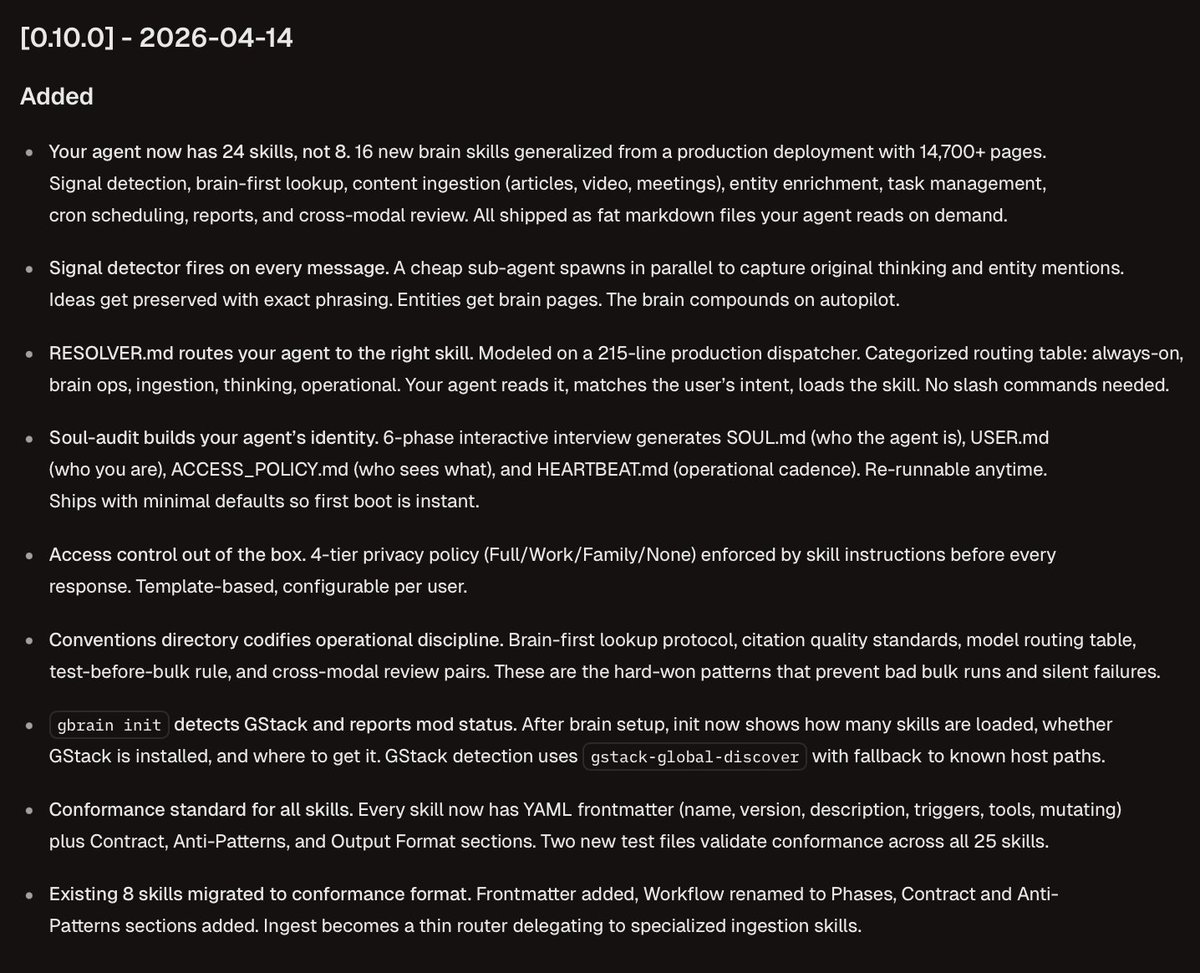
There’s $1T up for grabs for agent-first startups and this window is WIDE open. Probably 10,000+ niches. How it plays out: 1. Every SaaS company follows salesforce and goes headless within 18 months 2. a new category of "agent-native" startups emerges that treat salesforce, HubSpot, workday etc as dumb backends. the startup IS the agent. the SaaS is just the database. 3. the entire consulting/services industry around enterprise SaaS gets compressed into software. the agent replaces the implementation team. 4. outcome-based pricing becomes default. nobody pays per seat when the "seat" is an agent making 10,000 API calls a minute. you pay when revenue hits your account. 5. the winning founders are ex-operators who understand a vertical workflow cold. the code is the easy part. knowing that a property manager spends 14 hours a week on lease renewals? that's the insight worth $100M. 6. distribution becomes the moat. when anyone can wire agents to APIs, the company with the audience and the brand wins. media + agents is the new SaaS. There’s a rush to incubate live/short form shows. 7. Silicon Valley goes all influencer. Roy lee gets this. Pat Walls gets this. Sam Parr gets this. 8. the first $1B agent-native company in each vertical will look nothing like the SaaS it replaced. smaller team, higher margins, no implementation cost, no churn from bad UX because there is no UX. the fastest path to wealth right now: find an industry that still runs on dashboards, phone calls, and spreadsheets. build the agent-native version. charge per outcome. own the workflow end-to-end. someone reading this right now is going to build a $100M company off this exact shift. tell me about it on the @startupideaspod when you do. Im rooting for you. Less reading, less bookmarking, more building. the last wave rewarded people who built pretty interfaces on top of ugly data. I think this wave rewards people who build smart agents on top of exposed APIs. Or who just build the APIs themselves Here we go
Marc Benioff@Benioff

Welcome Salesforce Headless 360: No Browser Required! Our API is the UI. Entire Salesforce & Agentforce & Slack platforms are now exposed as APIs, MCP, & CLI. All AI agents can access data, workflows, and tasks directly in Slack, Voice, or anywhere else with Salesforce Headless 360. Faster builds, agentic everything. 🚀 #Salesforce #Agentforce #AI venturebeat.com/ai/salesforce-…

English
182
263
3.1K
571K
Nick Pericle retweetledi
Garry Tan
Garry Tan@garrytan·
GBrain v0.10.0 is a big one My personal OpenClaw setup and brain can now be yours. I've perfected my RESOLVER.md, my SOUL.md and ACLs for multi-user brain access. Now there are 24 distinct fat skills with fat code, fully tested with e2e tests, evals and unit tests.
Garry Tan tweet media
English
108
145
1.7K
171.5K
Nick Pericle retweetledi
GREG ISENBERG
GREG ISENBERG@gregisenberg·
claude code just shipped routines you tell it what to do, point it at your project, set a trigger, and it runs 24/7 on their servers with your laptop closed i immediately thought of larry ellison: "the money is never in the technology, it's in the infrastructure the technology runs on" the model is the commodity. the trigger is the product. and whoever maps the most valuable real world events to the most specific industry workflows is going to build something massive here's what i mean by trigger.... a permit gets filed. a customer's usage drops 40% in a week. a competitor launches a feature. a deal sits in your pipeline untouched for 14 days. a contract hits 90 days before renewal. a stripe payment fails. these are all triggers. some public, some inside your own tools and every single one is a moment where an AI agent can step in and do something valuable before a human gets around to it the playbook is like this: map every trigger that matters in one industry → wire an AI agent to each one → sell the outcome. the person who shows up first with exactly what someone needs at exactly the right moment wins the deal every time and the people who go embarrassingly deep on one industry's trigger map are going to build generational companies that's the entire game right now for people reading this tweet. claude routines, openclaw, hermes etc... the infrastructure is all here. just pick your niche build audiences/content to get awareness wire the agents to triggers start selling and pinch yourself that this is the greatest time in history to be starting a company let's go
Claude@claudeai

Now in research preview: routines in Claude Code. Configure a routine once (a prompt, a repo, and your connectors), and it can run on a schedule, from an API call, or in response to an event. Routines run on our web infrastructure, so you don't have to keep your laptop open.

English
129
182
2.6K
450.5K
Nick Pericle retweetledi
Garry Tan
Garry Tan@garrytan·
I found myself explaining this to people over and over again at YC today because I think most knowledge work will increasingly be encoded in markdown skills (fat skills) that work hand in hand with deterministic code written specifically to be called by agents (fat code)
Garry Tan@garrytan

x.com/i/article/2042…

English
89
113
1.6K
323K
Matt Shumer
Matt Shumer@mattshumer_·
If you implement AI for companies, DM me
English
399
20
1.1K
139.7K
Viv
Viv@Vtrivedy10·
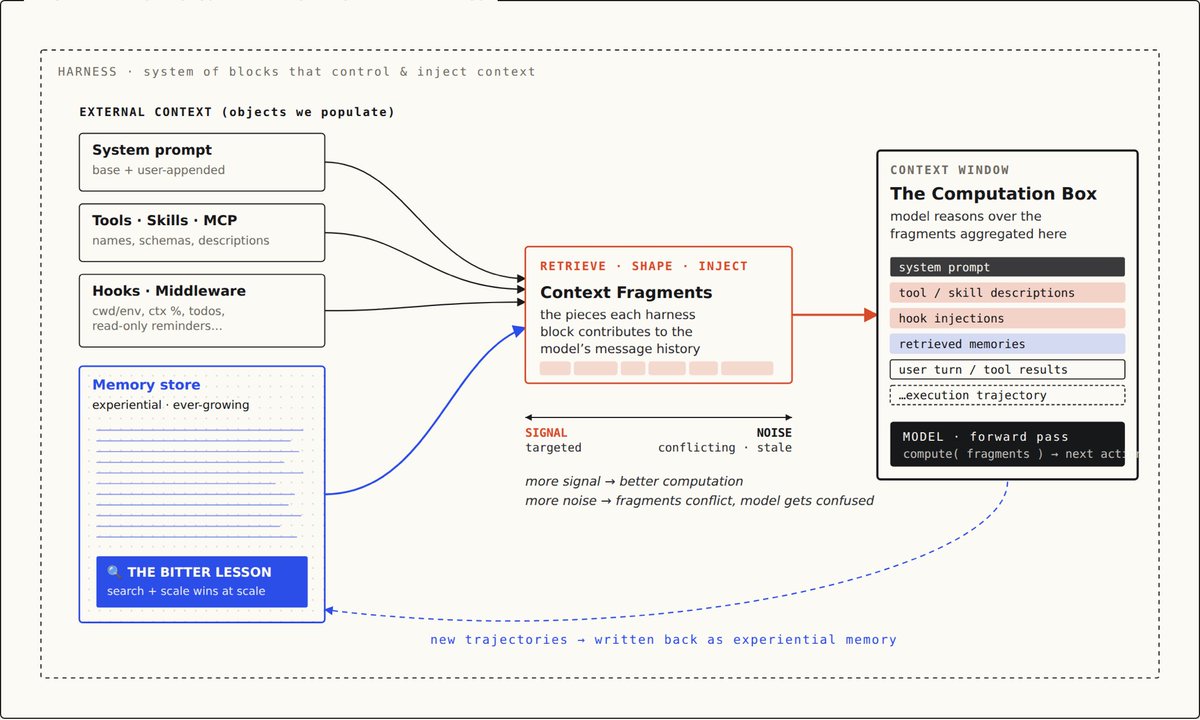
just diagram if anyone wants
Viv tweet media
English
7
6
117
16K
Viv
Viv@Vtrivedy10·
Harness, Memory, Context Fragments, & the Bitter Lesson this is a work in progress mental dump on interesting intersections between how we use and design a harness, implications for memory being accumulated over long timescales, and the search bitter lesson we can’t escape this is v30+, HTML diagrams help me iteratively refine + chat to roughly “see” and alter the mental model Harnesses & Context Fragments: a very important job of the harness is to efficiently & correctly route data within its boundaries into the context window boundary for computation to happen the context window is a precious artifact. Harnesses make decisions on how to populate, manage, edit, and organize it so agents can do work. Each loaded object can be thought of as a Context Fragment and represents an explicit decision by the user and harness designer of what needs a model needs to do work at any given time. many ideas on externalizing objects + loading into the context window are pioneered and very well described by @a1zhang with RLMs Experiential Memory: we’re in the very early days of deploying agents and agents produce massive amounts of data in every interaction they have. this is akin to humans doing things and remembering things they did. however agent memory has a massive advantage as it can be accumulated across all agents which are easily forked and duplicated (unlike humans). @dwarkesh_sp does a good talking about this massive benefit of artificial systems memory can be treated as an externalized object. the harness is tasked with doing good contextualized retrieval which means pulling in the right data from accumulated memories across all agent interactions Search & The Bitter Lesson: As we deploy agents in our world over year timescales, there is going to be a hyper-exponential in the amount of data produced by those agents. We should want to: 1. Own that data for ourselves. Open ecosystems are important here 2. Use that data This means that we’ll have to search over, distill, and organize massive amounts of data. Our brain is exceptional at doing this. Both contextually using prior experience and mostly committing the right stuff to memory with enough intentional practice. Our current infrastructure systems and algorithms will be put to the test and often break as we get used to this new data regime some open questions: - how do we efficiently distill experiences (Traces) into higher level memory primitives that capture the important parts? How do we do this over ultra long time horizons? - How much of the future is Search just-in-time vs Search that gets integrated into model weights? - How do we make models much better at self-managing their context window? How do we reduce error rates in recursively allowing agents to operate over external objects? i’ll be expanding on, altering, and adjusting these mental models but these feel like an important subset to me on the future of designing agents practically
Viv tweet media
English
79
322
2.6K
469.7K
Nick Pericle retweetledi
Eric Glyman
Eric Glyman@eglyman·
99% of Ramp uses ai daily. but we noticed most people were stuck — not because the models weren't good enough, but because the setup was too painful and unintuitive for most. terminal configs, mcp servers, everyone figuring it out alone. so we built Glass. every employee gets a fully configured ai workspace on day one — integrations connected via sso, a marketplace of 350+ reusable skills built by colleagues, persistent memory, scheduled automations. when one person on a team figures out a better workflow, everyone on that team gets it and gets more productive. the companies that make every employee effective with ai will compound advantages their competitors can't match. most are waiting for vendors to solve this. we decided to own it.
Seb Goddijn@sebgoddijn

x.com/i/article/2042…

English
129
168
3.6K
1.4M
Nick Pericle retweetledi
Allie K. Miller
Allie K. Miller@alliekmiller·
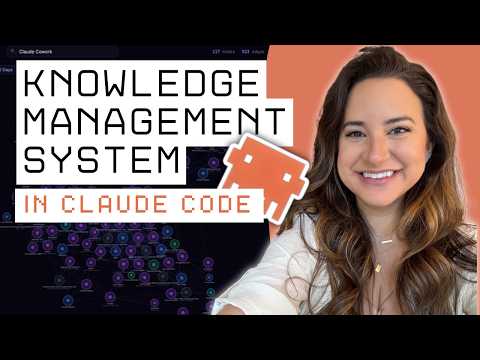
So many people wanted to see my knowledge management system in Claude code, so here it is. All you need is Obsidian, Claude Code, GitHub, and the will to live and you too can set up your second brain in under 2 hours. If you want to learn how to build this, here’s the demo link: youtube.com/watch?v=v1suC9…
YouTube video
YouTube
English
38
51
592
48.4K