Nico Cserepy

154 posts

Nico Cserepy banner
Nico Cserepy

Nico Cserepy

@nicocserepy

💭 🪵

Katılım Temmuz 2021
628 Takip Edilen173 Takipçiler
Nico Cserepy
Nico Cserepy@nicocserepy·
microsoft showed bundles can convert and retain rfq / intent-based trading is promising i trust cowork to parlay my logs into a bundle that optimally matches my intents and constraints across all my projects
English
0
0
0
13
Nico Cserepy
Nico Cserepy@nicocserepy·
hey saas companies i pay for who also pay anthropic! what if i gave you my spare anthropic limit and you gave me your service for free claude already decides which tools i use, why not bundle the bill too first service to offer my cowork a deal gets 100% of my leftover limit i'd happily go to $200/month for an AI-native Office bundle agents are making saas pricing harder and tokens more valuable if your expenses are denominated in tokens why not sell your services for token
English
1
0
0
23
Nico Cserepy
Nico Cserepy@nicocserepy·
entrepreneurship feels like survivalism but playing against society rather than nature interpreting rules, setting win conditions, and calling the end while playing the game is bound to uncover your preferences
English
0
0
0
13
Nico Cserepy
Nico Cserepy@nicocserepy·
Cities haven’t figured out housing but people also not living underground yet
English
0
0
0
16
Nico Cserepy
Nico Cserepy@nicocserepy·
Olympic champions should have the option if not expectation to karaoke their anthem
English
0
0
1
136
Nico Cserepy
Nico Cserepy@nicocserepy·
When you start a car, you pick Drive or Reverse. Tesla's optional Auto Shift uses cameras to guess for you. Works great for backing out of your garage, but when you're in the middle of the street blocking traffic, you still have to pray you don't miss the tiny drive mode strip to get back into Drive. Unlike ICE cars where the brake holds you against idle creep, the brake pedal does nothing on an EV at standstill. It's vestigial. Nico Mode: accelerator = velocity up, brake = velocity down, regardless of direction. No Drive or Reverse needed.
English
10
3
56
117.2K
Nico Cserepy
Nico Cserepy@nicocserepy·
The serenity of @Tesla Auto Shift is ruined when you keep missing the flick back into Drive. 2 pedals, one degree of freedom, delete Reverse! @elonmusk Nico Mode?
English
4
0
65
109K
Nico Cserepy
Nico Cserepy@nicocserepy·
Davidovits' method makes sense for sedimentary limestone. Your waterglass + lime catalyst method is compelling for amorphous silica. Marble is metamorphic CaCO₃ - same chemistry as limestone, different crystal structure. How do you think the Propylaea blocks fit into the casting hypothesis? Separate method, or not actually Pentelic marble?
English
1
0
1
17
Marcell Fóti 🪨
Marcell Fóti 🪨@FoMaHun·
Hi! Good questions/observations! XRF: I don’t pretend to be a scientist. I’m not. So I measured what my instincts/universe/god suggested to me. Propylaea: I think those were cast nub down then rotated into this position. Yes, you’re absolutely right that stones directly on the ground don’t need leakage points. Dolmens and menhirs gave no nubs, it was not necessary. Next time you write this much dm me instead because I was a miracle I found it in the flood of comments!
Marcell Fóti 🪨 tweet media
English
1
0
2
59
Marcell Fóti 🪨
Marcell Fóti 🪨@FoMaHun·
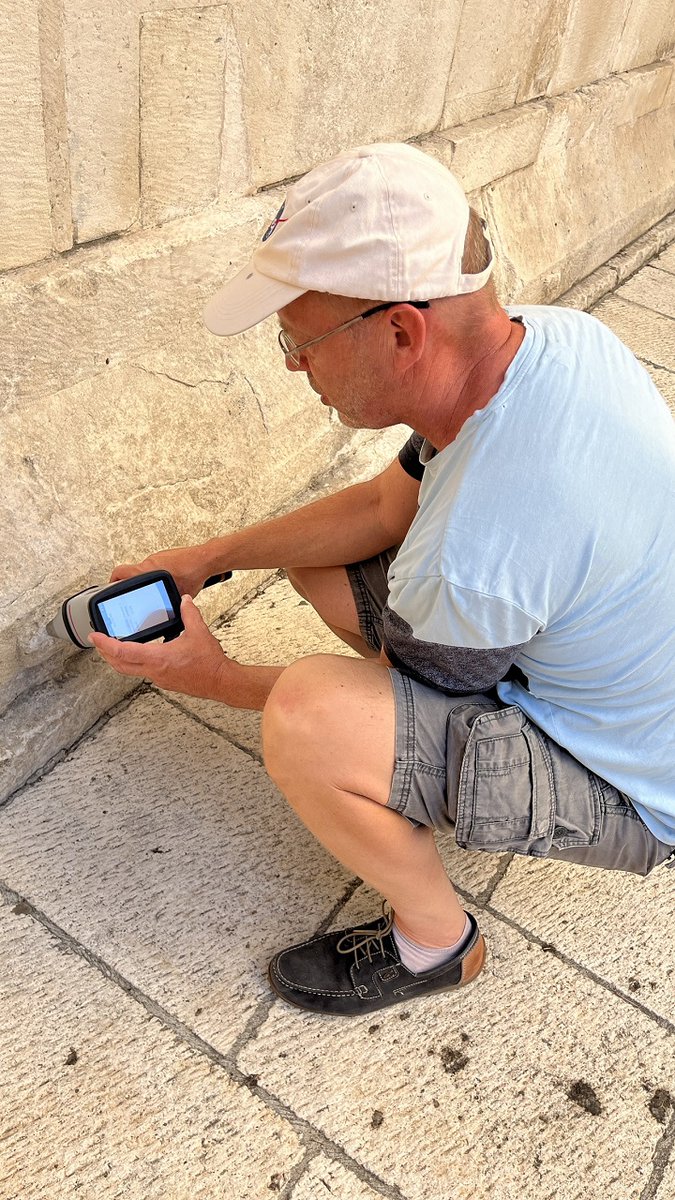
The Split Trap. A 🧵 1. The Mission In July 2025, armed with an XRF device, I traveled to Croatia to find out whether the limestone blocks with nubs contain any foreign material — in other words, whether they’re natural or man-made. This device can determine which atoms are present in a thin surface layer of a material by analyzing its X-ray backscatter. Since my artificial stone mixture contains potassium, that’s exactly what I was looking for in the ancient stones.
Marcell Fóti 🪨 tweet media
English
16
27
343
21K
Nico Cserepy
Nico Cserepy@nicocserepy·
One more morphological test: if nubs formed by material bulging through fabric-covered drainage holes, the curves should follow what you'd expect from a membrane under hydrostatic pressure and gravity - rounded, organic, maybe even showing fabric weave texture at the surface. The Greek bosses have an entirely different character: straight lines, sharp angles, flat faces projecting cleanly from the ashlar plane.
English
0
0
0
15
Nico Cserepy
Nico Cserepy@nicocserepy·
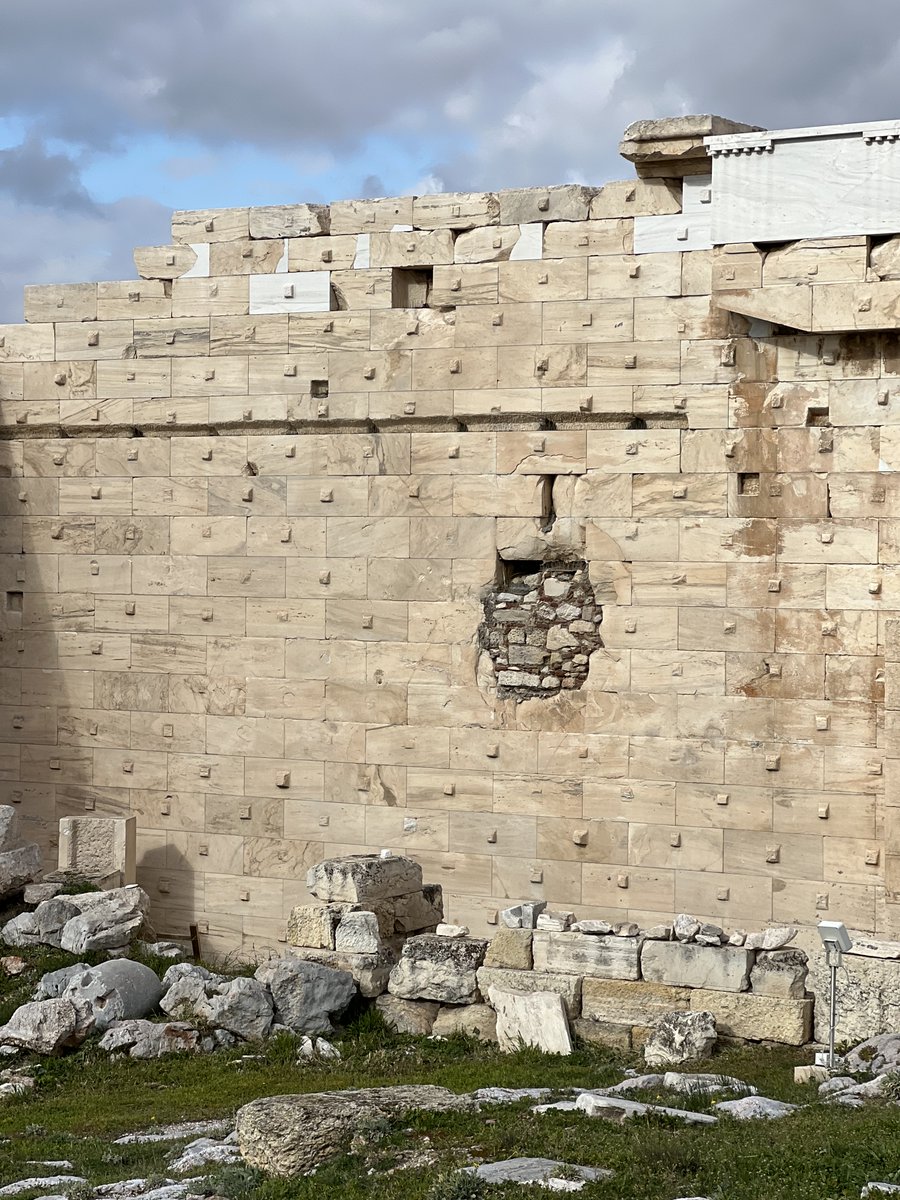
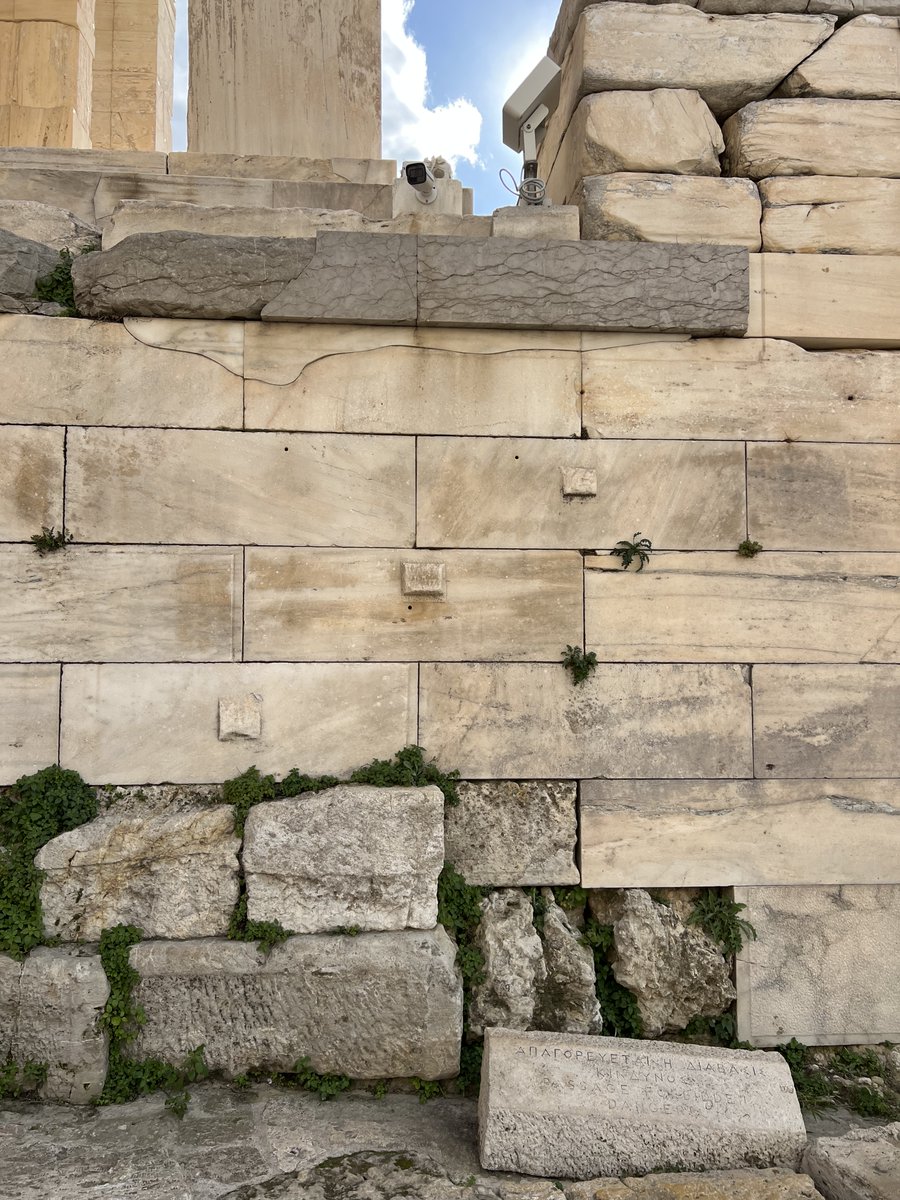
That's cool that you collected your own XRF data! Did you take multiple readings on the stones where you found potassium? It would be interesting to see radial gradients from the nub, or vertical gradients in the direction of gravity during curing. I photographed the Propylaea at the Acropolis recently. Those marble lifting bosses are shaped and placed where a rational builder would put them: centered horizontally, above center of mass, angular so rope grips, one per side, present on every course including bottom. Greek masons dressed bosses on every ashlar because they don't know ahead of time which one ends up in the base course. Yet Andean megalithic walls reportedly lack nubs on bottom-course stones. The conventional explanation is they didn't need lifting. But it's also what you'd expect if water simply drained into the ground. The underside of the bottom-course megaliths should be telling: cast-on-soil would show irregular texture or soil impressions, carved-and-transported would be dressed like the other faces. Has anyone documented this? Compare Hatunrumiyoc. The "lifting bosses" share none of the Greek logic. The V-block has two nubs side by side in the middle of a relatively small stone - makes no sense for lifting or prying. The famous 12-angled stone has one tiny nub at the lowest point, way to the left - for a 6-ton block with 12 precision-fitted angles, you'd expect something bigger and at least one on the right. But both make sense for draining water. On internal structure: if I were casting geopolymer, I'd fill the interior with local rubble and save finer material for the surface. That should be detectable - muon tomography, ultrasonic pulse velocity, GPR could reveal density variations or rubble cores. And if aggregate settled during curing, the center of mass would sit lower than the geometric center. Do you know of anyone who's tested this?
Nico Cserepy tweet mediaNico Cserepy tweet mediaNico Cserepy tweet mediaNico Cserepy tweet media
English
2
0
1
40
Nico Cserepy
Nico Cserepy@nicocserepy·
👀
Marcell Fóti 🪨@FoMaHun

🚨Ancient Secret Revealing Day🚨 This day has finally come. On December 1, 2025 — that is, today, right now — I’m revealing the “secret ingredient” that more than 100 volunteers around the world have already used over the past two months to successfully cast artificial (fake) granite. And since a hundred people do a hundred things a hundred different ways, we’ve made huge leaps forward. When I first announced the “secret material,” I was honestly convinced I knew everything and I was the one handing out wisdom. Yeah, right! No. In these two months I’ve had to introduce versioning, and we’ve jumped two major versions ahead — the recipe is now at v3.0. This team made it possible to invent no-mix casting, which kills two birds with one stone — actually, three: 1. No more hunting for gigantic ancient concrete mixers, because we don’t mix the material anymore (at least not when it’s wet). 2. No more cursed frequencies or ancient vibrators either, because with the v3.0 method we can produce perfectly bubble-free stones. 3. The role of nubs is clear. These positive experiences led me to a decision: let a thousand flowers bloom. I’m not going to bother with patents or any other restrictions — I’m making the “secret ingredient” public. And it is: A pinch of slaked lime 🤣 That's right! I'm not kidding! See the video. Slaked lime borrowed from the leather tanning guy next door. Now, some of you might say that this means I’ve been chasing my own tail for at least two years, because quicklime and slaked lime are also components of wood ash — and we’ve known for two years that wood ash, especially pine ash, creates stone when mixed with waterglass. True. And yet no one before me tried adding even a pinch of slaked lime to waterglass — not 2,000 or 3,000 years ago. Why? Because it is counter intuitive! This day has finally come. On December 1, 2025 — that is, today, right now — I’m revealing the “secret ingredient” that more than 100 volunteers around the world have already used over the past two months to successfully cast artificial granite. And since a hundred people do a hundred things a hundred different ways, we’ve made huge leaps forward. When I first announced the “secret material,” I was honestly convinced I knew everything and I was the one handing out wisdom. Yeah, right! In these two months I’ve had to introduce versioning, and we’ve jumped two major versions ahead — the recipe is now at v3.0. This team made it possible to invent no-mix casting, which kills two birds with one stone — actually, three: No more hunting for gigantic ancient concrete mixers, because we don’t mix the material anymore (at least not when it’s wet). No more cursed frequencies or ancient vibrators either, because with the v3.0 method we can produce perfectly bubble-free stones. These positive experiences led me to a decision: let a thousand flowers bloom. I’m not going to bother with patents or any other restrictions — I’m making the “secret ingredient” public. And it is: A pinch of slaked lime. See the video. Now, the sharp-eared might say that this means I’ve been chasing my own tail for at least two years, because quicklime and slaked lime are also components of wood ash — and we’ve known for two years that wood ash, especially pine ash, creates stone when mixed with water glass. True. And yet no one before me tried adding even a pinch of slaked lime — not 2,000 or 3,000 years ago. So what exactly does it do? The calcium ions in it destabilize the water glass and kick off the formation of silica gel. Our binder is dried silica gel — essentially a type of glass. Meaning: natural granite’s binder is quartz, which is transparent, has a Mohs hardness of 7, and its chemical formula is SiO₂. Our artificial granite’s binder is amorphous silica, also transparent, with a Mohs hardness of 6–6.5, and — no joke — its chemical formula is also SiO₂. If someone looks at these stones without suspicion, it’s insanely difficult to tell the two apart. You need instruments — and an open mind. And why is slaked lime counterintuitive in this recipe? Several reasons. First, it’s alkaline. Any acid — even lemon juice or vinegar — can precipitate silica gel from the solution, but an alkali? No way! Also: lime turns everything white. And at first glance, that seems to be happening here too. But once it stops being lime and becomes just a thorn under the water glass’s fingernail — a catalyst — it turns transparent. And no, this doesn’t turn our material into concrete. The binder is not Calcium Silicate Hydrate — you’d need at least ten times more slaked lime for that. This remains amorphous silica gel, even if calcium ions lurk inside here and there. So what exactly does it do? The calcium ions in it destabilize the waterglass and precipitate silica gel. Our binder is dried silica gel — essentially a type of glass. Compare: Natural granite’s binder is quartz, which is transparent, has a Mohs hardness of 7, and its chemical formula is SiO₂. Our artificial granite’s binder is amorphous silica, also transparent, with a Mohs hardness of 6–6.5, and — no joke — its chemical formula is also SiO₂. If someone looks at these stones without suspicion, it’s insanely difficult to tell the two apart. You need instruments — and an open mind. So the secret of the set is gelation. If you add nothing, water glass simply will not set at this thickness. The mixture can stay liquid for weeks, and you can just pour it back out. But once gelation starts, you’re dealing with a completely different set of physical properties. Gelation gives the entire casting its own internal stability. I’m curious how this behaves at larger scales, but I’m hopeful you can cast multi-ton megaliths without the formwork bursting apart like it would with concrete. This stuff doesn’t flow. Gelation also explains why the surface ends up so smooth it looks polished. As for how the ancient Egyptians polished fist-sized depressions? They didn’t. Silica gel did the work. Water resistance: store-bought waterglass is mainly sodium waterglass, which only produces moderately water-resistant stones. Fine for indoor decorations or desert scenery, but you can’t cast underwater cities — no Osireon — from it. For that you need potassium waterglass — in other words, lye from wood ash. And if any mystery remains, it’s those white veins found in natural stone. “You can’t replicate that artificially!” cry the experts. Ignore them. We can’t replicate veins YET. But since every gear is meshing perfectly so far, the solution to that will come too. Enjoy!

ART
0
0
2
1.1K
Nico Cserepy
Nico Cserepy@nicocserepy·
Hey @YouTube, I know you know which playlist I’m going to save a video to. Please help me out beyond “Most Recently Added” 🙏
English
1
0
5
270
Nico Cserepy retweetledi
Kasra
Kasra@kasrak·
It took me a while to describe what I'm building. It's not quite a chatbot, or a journal, or a normal notes app @hamburger helped me figure it out We asked users what they do with it, and why they do it. The same words kept coming up They brain dump. Partially to get stuff out of their head, yes, but also as a way to get unstuck. To move forward. There's something magical about speaking a few sentences into a notebook, knowing it'll go find you related art, essays, questions while you sleep And when you need a thought partner, it's ready to go with all the context you've created over time So that's what it is A notebook that writes back. Use it to brain dump and move forward.
Kasra tweet media
English
87
45
1.2K
156K
Nico Cserepy
Nico Cserepy@nicocserepy·
Motion to deprecate optional legal middle name, keep given+family, and let individual set optional dynamic preferred name per use case
English
0
0
6
61
Nico Cserepy
Nico Cserepy@nicocserepy·
Every problem in my 30s reduces to sending a good email
English
0
0
5
71
Nico Cserepy
Nico Cserepy@nicocserepy·
There have to be more elegant ways to scale airports than terminals. Something like surface is just for planes in lines grouped by airline and model, FIFO and front plane goes to back if not ready, security shops cars trains underground, drive under your airline’s planes instead Terminals 1-5, escalator from underground to board instead of jet bridge. If really ambitious pool planes, group only by model and assign flights just in time like how gates are assigned today.
English
0
0
2
74