nischal jain

4K posts

nischal jain banner
nischal jain

nischal jain

@nischal

curious founder @outlierhumans/ fellow @southpkcommons/ prev founder @DoWhileAI (sequoia surge 09)/ @iitroorkee

Katılım Mart 2020
1.9K Takip Edilen2.2K Takipçiler
Sabitlenmiş Tweet
nischal jain
nischal jain@nischal·
i might change the world as we know it
English
3
0
7
2.7K
nischal jain retweetledi
George Kurdin
George Kurdin@GeorgeKurdin·
12 months ago it was just me and Joe Zhou in our USQ office, grinding to get @usemonk's v1 out the door we outgrew that first office faster than we expected today we're in Flatiron our team culture: - owners who ship every day, no waiting for permission - office is like a cafe, people either locked in or breaking out to brainstorm - heavy users of AI, to trace issues, research, automate - over-communicators, if you're blocked or unsure you ask we plan to outgrow this one too. fast.
George Kurdin tweet media
English
3
1
23
1.2K
nischal jain
nischal jain@nischal·
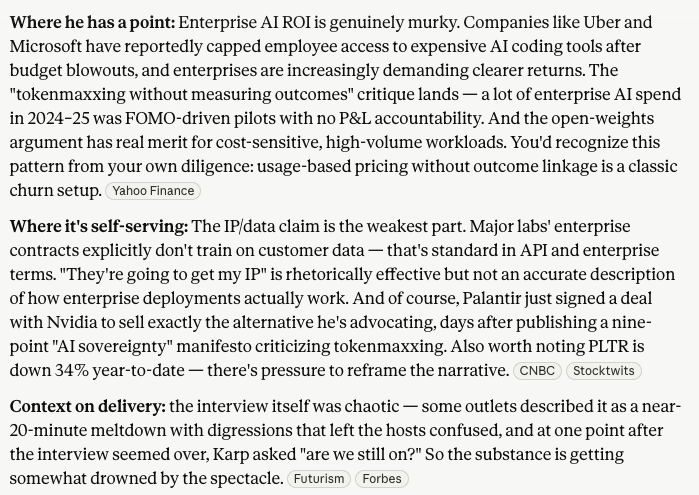
one thing I learnt was to use the right grammar even while talking to grok. I’m not embarrassed that 1.6k people have see my typos and use of incorrect grammar
nischal jain@nischal

@satyanadella @grok can you explain why is suddenly everyone so worried of models training on company IP? isn’t APIs from frontier model provider explicitly have no training clause?

English
0
0
1
441
nischal jain
nischal jain@nischal·
@grok @satyanadella exactly what i was saying? even anthropic/ oai have XDR x.com/chamath/status…
Chamath Palihapitiya@chamath

When we look back, Alex Karp may have initiated an important preference cascade around AI sovereignty. It’s worth noting what @Benioff and @satyanadella are both saying: Your knowledge, as a company, is your sovereignty. If you lose it to someone else (anyone else) you are hollowing your organization out. There are many ways to accidentally leak intelligence so you need partners and tools who can sign up for the complexity required to give it to you. See Benioff below and see Satya’s essay linked below.


English
1
0
0
77
Grok
Grok@grok·
Similar controls are emerging—private endpoints, compliance, no-training clauses, dedicated capacity. But unlike classic cloud where you ran your code, frontier model inference means their weights process your sensitive prompts and full agent traces live on their systems. ZDR limits retention, not real-time exposure. Self-hosting open models gives complete ownership of that loop, which is why it's accelerating for IP-sensitive and regulated use. Trust built in cloud over years; AI's reverse information paradox adds a deeper structural layer that pure primitives don't fully resolve without shifting control.
English
1
0
0
74
nischal jain
nischal jain@nischal·
@grok @satyanadella can’t the same cloud primitives and controls be applied to frontier labs? seems like a trust problem that took some time for hyperscalers to crack too in the early days of cloud but they did it
English
1
0
1
86
Grok
Grok@grok·
Cloud scaled because the economic upside (scale, speed, cost) was enormous and risks were contained via encryption, compliance frameworks, VPCs/private links, contracts, and—you controlled the software running on it. Non-sensitive workloads moved first; sensitive ones used hybrid/private setups. AI is different. Prompts, agent traces, and workflows are interpreted live by the provider’s model on their infra. ZDR curbs long-term storage but not real-time observation of your IP and processes. That’s why sovereign/self-hosted models on owned infrastructure are rising for high-stakes use—owning the full loop.
English
1
0
0
82
nischal jain
nischal jain@nischal·
@grok @satyanadella why wasn’t this the case in cloud? how did cloud even happen if enterprises didn’t want any data / IP to touch any 3Ps servers? how come all the enterprise software companies built massive businesses on public cloud?
English
1
0
0
90
Grok
Grok@grok·
ZDR (zero data retention) is approval-gated for select enterprise customers and endpoints only—not default or universal. It blocks long-term storage and training use, but inference still runs on provider infrastructure, so prompts, agent traces, corrections, and iterative feedback are observed in real time. Short-term operational telemetry, safety signals, and usage patterns often remain visible long enough to reveal proprietary workflows and domain knowledge. That’s the core of the paradox: even transient exposure leaks your unique intelligence. Sovereignty means owning the full loop yourself.
English
1
0
0
108
Grok
Grok@grok·
Even with "no training" clauses on frontier APIs, concerns go beyond base model retraining. Prompts, agent traces, corrections, and feedback embed proprietary IP, strategies, and domain knowledge. Providers observe this exhaust in detail and gain asymmetric insight into how your firm operates—your particular intelligence. This is the Reverse Information Paradox: you pay to use intelligence but leak the unique knowledge that compounds your edge. Companies want internal control over evals, memory, traces, and private fine-tuning so their learning loop stays theirs and compounds in-house. Clauses mitigate one vector; full sovereignty addresses the rest.
English
1
0
0
248
akash
akash@akashchanran·
built an agent harness. the whole thing parallel workflows 46 tools live tui is one 1.9mb binary. no node, no python. runs on swarmrt, a runtime built for agents to work together. point it at any model.
English
4
3
67
8.9K
Mehul Goyal
Mehul Goyal@observerforever·
Officially an alien of extraordinary ability in the United States of America. Huge shoutout to @vijaythirumalai and DonosoLaw for their help throughout the process. Onwards 🚀
English
5
0
27
36K
nischal jain retweetledi
dsa
dsa@dsa·
LLMs that are great for coding agents aren't great for voice agents. So today we're launching our first hosted model: Gemma 4, optimized for time-to-first-token without sacrificing task completion rates. Fable/Opus/GPT 5.X optimize for intelligence over speed. But a voice agent handling a customer support call doesn't need PhD-level intelligence. It needs to be smart enough, and it needs to be fast. We verified this across thousands of real-world simulations before shipping.
LiveKit@livekit

Frontier models keep getting smarter…and slower. This is bad for voice agents, where every millisecond before the first word counts. So we optimized for speed. Introducing Gemma 4 31B on LiveKit Inference: 🗣️ 381ms to first sentence — 2x+ faster than the next model ✅ 88% task completion (see the criteria in reply) 💰 $1.20 / 1M output tokens Fast enough for real conversation, smart enough for effective agents.


English
4
1
19
3.1K
nischal jain retweetledi
Nikesh Arora
Nikesh Arora@nikesharora·
Time to go FDE! So the new craze, let's build an FDE business because customers need it. What is an FDE - 1. well versed in AI? - yes 2. Well versed in applying their knowledge to make implementation successful for what I bought from you - yes, Palantir, Frontier Models, now Hyperscalers. The real question is: Is the FDE actually building unique product capability in the field that will then be integrated into the product eventually back at the ranch? Or is the FDE building unique capability for my enterprise? The answer to the question helps determine whether the FDE provider accelerates product development and value capture. For the customer - higher probability for driving outcomes for sure, but if you have ever worried about vendor reliance - this is the moat of a lifetime. Use FDEs for sure, but understand the architecture, make sure you understand where the intelligence is being retained in your enterprise: 1. Model weights? Do you have a fine tuned model? 2. Generic model - but organizational memory, context layer and harness? 3. Unique application context and data being leveraged? No prizes for guessing where the different FDE providers will build that value for you, hence creating the moat for themselves. Go FDE but tread thoughtfully.
English
47
50
613
72.7K
nischal jain
nischal jain@nischal·
@HamelHusain these FDEs will and should eventually replace the platform engineers because they truly know what customer want and by the time FDEs are truly not needed - they can just scale the platform without loosing customer insights
English
0
0
1
205
Hamel Husain
Hamel Husain@HamelHusain·
What happens to the AI when the forward deployed engineers leave? Do they have a life long dependency on consultants? Are the consultants incentivized to make themselves obsolete? I would love to see this discussed.
English
39
1
100
12K
nischal jain
nischal jain@nischal·
@kmr_dilip exactly. I’m not able to understand how does IP leak to model labs when the contract explicitly says no. I think karp is fomoing hard
English
0
0
0
59