@cherryPayment 谢谢你的免费分享。空头一直在加速出逃,但是股价仍然下跌,所以是空头和多头都在跑路吗?还是说前段时间增发的股票一直在被卖出?
中文
NorthLake
57 posts

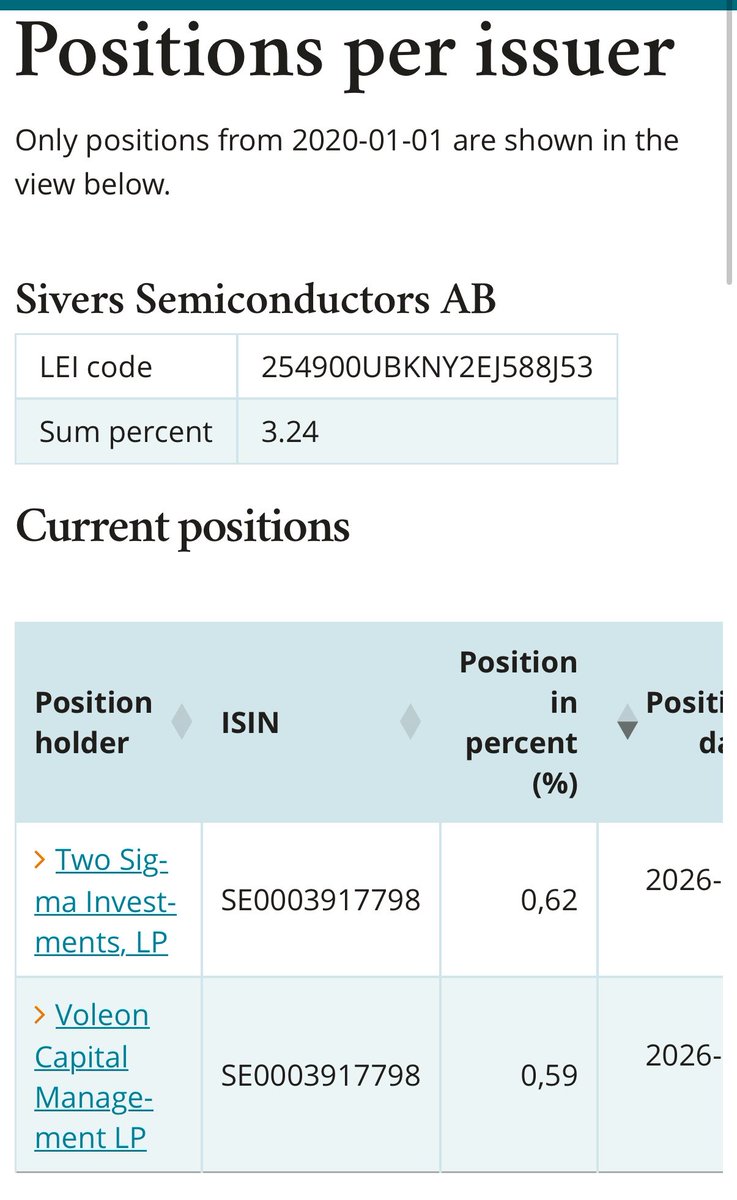
时隔9天,我们来看一下Two sigma和Voleon的最新仓位变化,还记得上次我们说Two Sigma从2.3%砍到1.15%,然后Voleon也同步收缩到0.61%了,看看这一次最新持仓会如何变化…… 1. 根据数据显示 Two Sigma的减仓行为并没有停下来,上次截止到7月9号的1.15%的仓位在一次下降0.17个点,来到了0.98……我相信很多人在上一次数据公布的时候会认为1%附近会是一个”心理持仓位”,机构在这里会停止减仓然后持续持有。 目前看来Two Sigma正式减仓至1 以下,从6月26日的2.3出发,减仓到现在的0.98,仓位上来看已经被削减了57%。 另一方面,这次降幅 0.17相比7号、8号的0.35 和 0.29确实放缓了一些,也很正常毕竟总持仓量减少了。 但有一点需要注意:7/9到7/16之间有将近一周的间隔,不是单日数据。也就是说这一周整体的减仓节奏其实是稳定延续的,只是没有出现上周那种单日脉冲式的加速。 2. Voleon这次还是和上次一样维持在0.61, 没有新的披露变化。如果我们结合上次7月8号已经从0.79%降到0.61%,目前处于”观望”或者”减仓未触发披露阈值”的状态 3. 而这里需要注意的是Sum percent 来到了3.61,而Two Sigma(0.98%) + Voleon(0.61%) = 1.59%,中间有2.02个百分点的缺口比上次的1.89%还大了一点点。 这个缺口要么是Qube等其他机构,要么有新进场的空头,但都没有触发披露。这块”暗仓”值得持续关注。 总的来说,目前机构方面的情况是非常友好的,紧急融资被超额完成,摩根也公开表示 $sive的重要性不亚于 $LITE 等公司,空头方面Two Sigma跌破1的持仓是一个里程碑式的节点,从行为逻辑上看,一家机构把空头仓位从2.3%压缩到0.98%,已经接近”象征性持有”的边界,后续继续大幅加仓做空的动力越来越弱。 再加上etf的出现和瑞典期权市场的开启,我目前是非常肯定机构对于 $sive的喜爱程度远超从前。 同时我们也别忘了 CEO和4位董事在7月9号同步增持,Two Sigma同日减仓到1.15%,现在又进一步退到0.98%——这条时间线还在同向延伸。 一边是空头在撤,一边是内部人在买。 100亿市值指日可待



300关注里程碑纪念!太不容易了! 今天我吐完槽,就扭头去跟蓝V互关的兄弟们互动了一波,去评论互动还是很有帮助的,一天就涨了十几个粉丝,开心! 新关注我的朋友们,我有很多活儿给大家整,保证你的关注值回票价,你们就是我的股东。 没关注的朋友,刷到了这条一定关注我一下,给我一个机会让我打动你。


@cherryPayment 今天到目前为止,LITE涨了12%,GLW涨了9.3%,MRVL涨了7.5%,NOK涨了5.7%,SIVE抛掉鬼故事的缘故,也从底部涨了11.5%
I have large concentration in $SIVE to $AAOI as well. Feels bad to suffer drawdowns from institutional photonics delay bear posts. Just for the same firm to include it in their ETFs at the bottom. NFA, but I’m especially confident about those two going forward despite the drop


$LPKF has been getting a lot of attention in FinX discussions around glass substrates lately, largely because their recent AGM painted a very bullish picture on LIDE technology. I have genuine respect for their technology. But as a Taiwanese who believes in backing and understanding our own local players, I’ve chosen to invest in E&R ($8027.TW) — LPKF’s direct counterpart and competitor here in Taiwan — instead. To be clear, I no longer actively encourage foreign investors to buy individual Taiwanese stocks due to our current regulatory environment. Still, I think the reasoning behind this preference is worth sharing. After reviewing public disclosures, my view is straightforward: On pure technology, $LPKF holds the foundational edge. They originated LIDE and have the most extensive published technical validation around precision glass structuring. While E&R has successfully industrialized similar laser-based TGV processes (widely referred to as LIDE-equivalent in the Taiwan market) and achieved impressive production-scale throughput. However, their real differentiation is not trying to win on lab specs alone. It’s ecosystem integration combined with broader theme coverage within the high-growth advanced packaging space. Through the E-Core alliance, E&R is building a complete local manufacturing chain in Taiwan covering TGV formation, wet etching, metallization/plating, inspection/AOI, and packaging steps. This positions them as a manufacturing integration partner capable of delivering end-to-end solutions. Beyond core TGV, E&R also has meaningful exposure across multiple interconnected sub-themes that are critical for real commercial adoption: • FOPLP (Fan-Out Panel Level Packaging) — already in shipment and expansion phase • CoPoS / panel-level advanced packaging — directly addressing the shift from wafer-level to larger-format solutions for big AI/HPC chips • Laser + Plasma process integration — offering one-stop solutions that improve yield and process control • CPO (Co-Packaged Optics) potential — leveraging glass substrate advantages in optical integration This multi-angle coverage within the glass substrate and advanced packaging ecosystem makes E&R’s theme exposure more diversified and resilient compared to a pure technology play. This is not primarily a technology battle. LPKF excels as a glass processing technology platform. E&R is betting on becoming the partner that can actually turn glass substrates into high-volume, manufacturable products within real supply chains — while also capturing value across the broader stack of panel-level packaging, process integration, and supporting technologies. If glass substrates evolve into a winner-take-all technology game (similar to EUV), LPKF should benefit. But if it develops more like CoWoS — where yield learning, process integration, ecosystem collaboration with foundries/OSATs, and coverage across multiple enabling technologies determine the winners — then E&R’s broader theme positioning and ecosystem approach may ultimately prove justified. In short: LPKF leads on foundational technology. E&R is positioned to win on industrialization, ecosystem execution, and broader coverage of the key sub-themes that will drive actual commercial ramp in advanced packaging. For real commercial adoption in advanced packaging, I believe the latter combination matters more.