

now both
400 posts
now both
@now19068
Random account created to get info on X and now glued to it. MSTR, ASST, ALCPB, SWC, DN3, TSLA, ASTS, https://t.co/64WCip9BHC
England, United Kingdom Katılım Mayıs 2024
326 Takip Edilen101 Takipçiler

Suprised to see Katie Price and her son Harvey opening at the World Cup halftime show.
#WorldCupFinal

English
@EldarMamedov4 3rd place gives more prize money than 4th so there is a reason for it.
English

Abolish the World Cup third-place match. It's cruel, not competitive. Players don't just not want it—they're emotionally hollowed out after a semifinal loss, forced to fake intensity for a medal nobody remembers. Fans know it; the players live it.
English


Got laid off this week after 6 years at FAANG (joined as a grad).
I was a Senior Software Engineer and thought I’d share my compensation breakdown + how I managed my money.
Total Compensation
Base salary: £125k
RSUs: £225k
Bonus: £15k
Gross TC: ~£365k
Normal month (no RSU vest)
Gross salary: £10.4k
Pension contribution: £1k
Take-home after tax: ~£5.8k
RSU vest month (quarterly)
RSU vest: £56.25k gross
After tax/NI: ~£28k net RSUs
Total take-home that month:
~£33.8k
The structure of my RSU vests over four years quarterly. Since then the share price has appreciated quite a bit.
Monthly expenses
Mortgage: £2.5k
Credit card repayment: £1.5k
I do all my spending on my credit card and pay it off monthly, credit cards offer great consumer protection and points scheme.
I generally follow a 90/10 approach:
90% → investing
10% → cash savings
On RSU months:
£25k-£27k invested
Remaining cash kept in a high-yield savings account (~4%)

English

Since when did Sophie Turner from Game of Thrones have such big melons?!

English







@AdamBLiv @Michaeljdobbin Indeed hope prefs come soon while BTC is 60k or less!
English

@Michaeljdobbin Smarter Web has a solid discount right now at 0.93x.
But not too much leverage either! 15.5% leverage ratio or so. I hope they get prefs out and add more before Bitcoin runs :)
English
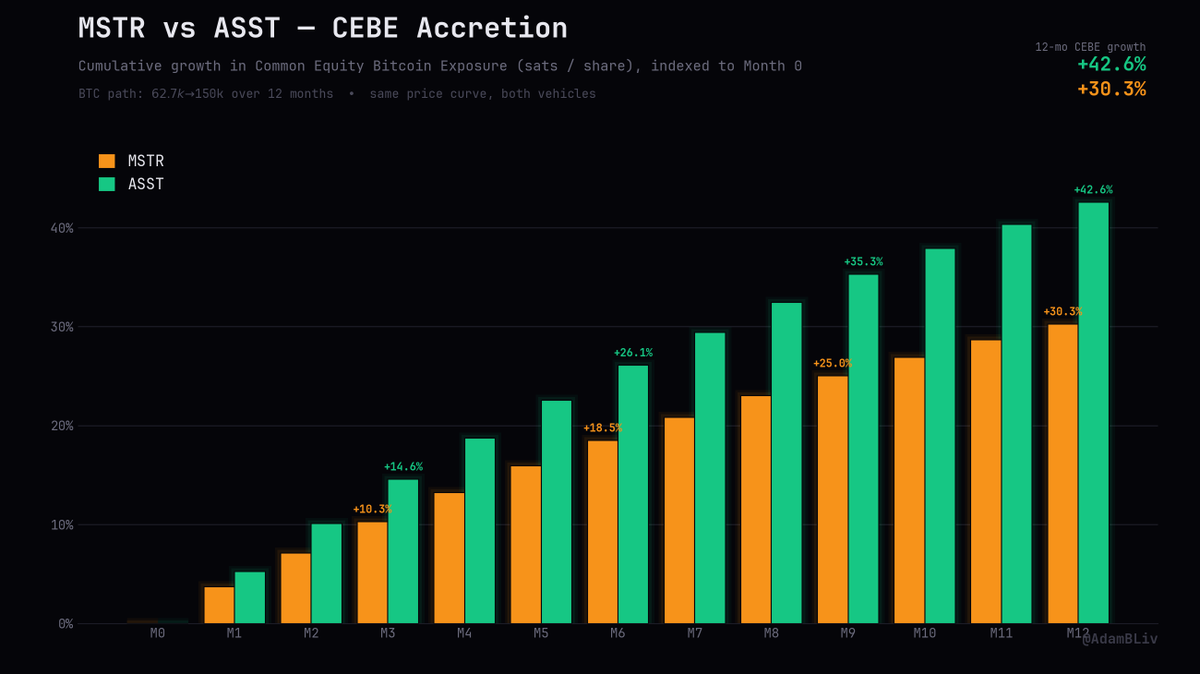
MSTR vs. ASST - Which one outperforms?
If we base the projection solely on a Bitcoin move to $150k...
ASST outperforms MSTR on relative upside.
Let's say BTC goes from roughly $62.7k to $150k.
That’s about a 139% move in Bitcoin.
MSTR’s implied price goes from $98.76 to $307.57... given the market applies the same mNAV it has today.
That’s a 211% gain.
ASST’s implied price goes from $12.54 to $42.80... given the market applies the same mNAV it has today.
That’s a 241% gain.
So the ranking is ASST > MSTR > BTC.
But the important part is WHY.
MSTR’s CEBE goes from 142,844 sats/share to 186,084 sats/share.
That’s +30.3% CEBE growth.
ASST’s CEBE goes from 12,811 sats/share to 18,265 sats/share.
That’s +42.6% CEBE growth.
So ASST generates about 12.3 percentage points more CEBE growth than MSTR in this projection.
That is the torque, the reason ASST wins on upside is because it starts with a higher claim ratio.
When Bitcoin rises, the senior/preferred claims shrink in BTC terms. That means more BTC-equity value spills down to the common.
The higher the claim ratio, the more violent that BTC-denominated claim compression can become.
But this is also why the risk profile is very different.
MSTR starts with a lower claim ratio, and MSTR has more scale and more capital markets depth.
ASST is the spicier vehicle. More upside torque, more amplification to the mechanism.
MSTR implied price return: +211%
ASST implied price return: +241%
MSTR CEBE growth: +30%
ASST CEBE growth: +43%
MSTR market cap growth: +221%
ASST market cap growth: +261%
So ASST wins the upside race in this projection.
MSTR is the institutional Bitcoin refinery.
ASST is the rocket-powered shopping cart with a lit cigarette in the gas tank.
And if Bitcoin rips to $150k while the capital structure behaves, the shopping cart outruns the aircraft carrier.
HOWEVER, you are paying more premium up front to ride the ASST rocket. If the mNAV goes to 1.1x like MSTR's...
ASST with the mNAV compression goes up about 140%.
So ASST basically becomes a slightly levered BTC tracker in this version, while MSTR absolutely smokes it.
Our ASST’s original projection had:
$27.40 CEBE NAV/share × 1.5623 mNAV = $42.80 implied price
But if ASST ends at 1.1x mNAV, then $27.40 × 1.1 = $30.14 implied price
That’s a 29.6% haircut from the original ASST ending price.
So ASST still grows CEBE harder than MSTR, but the valuation compression nukes the outperformance.
For ASST to match MSTR’s return, ASST would need to end around 1.425x mNAV.
So ASST can compress a little from 1.562x and still keep up.
But compressing all the way to 1.1x is too much.
ASST has more CEBE torque, but MSTR’s lower starting valuation means it can obliterate ASST if ASST’s premium burns off.
Do I think this will happen? Nope. But it could and it is a risk whenever you are paying a frothier premium to NAV.
English
@GrainofSaltSF That's what a lot of people on social media don't understand
English

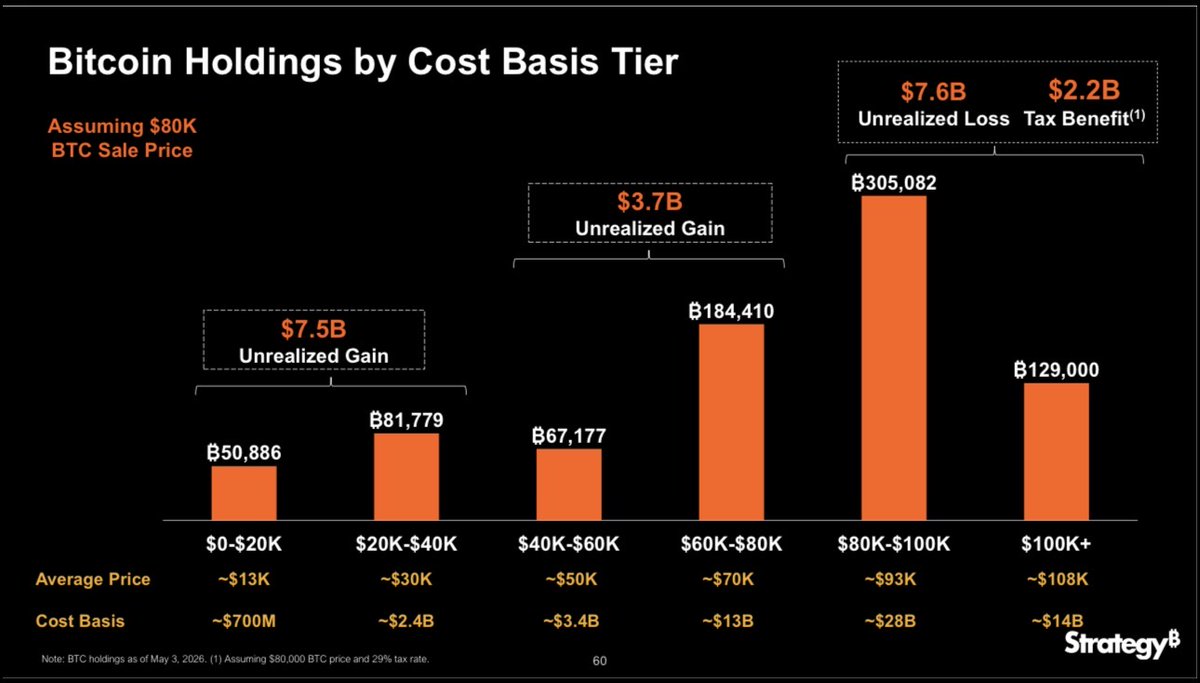
Strategy probably sold much higher cost Bitcoin since
Bitcoin Average cost fell from $75,578 → $75,476
The 8-K did not disclose the purchase price of the Bitcoin sold. I would expect this slide to be updated in the Q2 2026 presentation.
Bitcoin News@BitcoinNewsCom
STRATEGY BITCOIN SALE REALIZES A $55 MILLION LOSS Michael Saylor’s Strategy sold 3,588 BTC between June 29 and July 5 at an average price of $60,197. Based on the company’s average acquisition cost of roughly $75,500 per BTC, the sale locked in an estimated $55 million realized loss. The transactions reduced Strategy’s holdings from 847,363 BTC to 843,775 BTC. Despite selling at a loss, Strategy’s average cost basis fell slightly from about $75,578 to $75,476 per BTC, reflecting the removal of higher-cost coins from its treasury.
English

Turns out there’s no such thing as an infinite money glitch.
Michael Saylor@saylor
Strategy has sold 3,588 $BTC for $216 million to fund dividends on our Digital Credit securities. As of 7/5/2026, we hodl ₿843,775 in our BTC Reserves and $2.55 billion in our USD Reserves. strategy.com/press/strategy…
English

*MICHAEL SAYLOR'S STRATEGY SELLS 3,588 BITCOINS FOR $216 MILLION IN PROCEEDS $MSTR
English

You need to view everything that Strategy are doing under the lens of trying to get into the S&P 500.
Selling 3,588 $BTC is one of those things.
This is solely to satisfy S&P Global and something they said they would do in the earnings call.
The market has been inoculated.
Michael Saylor@saylor
Strategy has sold 3,588 $BTC for $216 million to fund dividends on our Digital Credit securities. As of 7/5/2026, we hodl ₿843,775 in our BTC Reserves and $2.55 billion in our USD Reserves. strategy.com/press/strategy…
English


Strategy has sold 3,588 $BTC for $216 million to fund dividends on our Digital Credit securities. As of 7/5/2026, we hodl ₿843,775 in our BTC Reserves and $2.55 billion in our USD Reserves. strategy.com/press/strategy…
English

'Right now it's touching 500 million people - there's no reason it can't touch 5 billion people.'
His company owns nearly 850,000 Bitcoins worth tens of billions of dollars - with the price of the coins dropping by nearly 50% in just one year we spoke to Michael Saylor at the Las Vegas Bitcoin conference and asked him why people should place a bet on the crypto future.
English
@EneaDenkt Still buying BTCtc? They are mega discount 😂 or waiting 50k?
English

Something I’ve learned from the past 12 in the markets holding big exposure to BTC and BTC Treasuries:
1. There are no experts. Nobody has a clue of what’s happening tomorrow, next month or next year. I kept buying the dips in ‘25 and got destroyed. The market, both BTC and stocks made no sense in the last 12 months. Detached from fundamentals and macro. In the short term you can bin your macro theory and evidence and go bet at the casino.
2. Buying oversold is my new rule. A falling knife can always go lower, but risk is largely limited. If a valuable company or asset is under the 200D or 200W or 200M moving average and historically it has always recovered this is margine of safety.
3. If a stock can raise exponentially, it can also crash 90% before the next bullish trend. It’s simple math. The money that rushed in with low conviction and low patience, won’t stomach a real drawdown and get out.
4. The crowd has terrible judgment. The crowd is lost in an unaware selfreflexivity loop as theorized by Soros and proven on BTC by my favorite Bitcoin Therapist @SullyMichaelvan: Price drops > mood drops > price drops because mood drops. Until price goes up and mood improves. Yet, is not the crowd that leads the first turn in price. The worst piece of this is that the crowd always thinks is right, which eventually is at some point of the cycle, but is always too late to be right at the right time to profit. In nutshell: the crowd gets bearish when the price entered already a bear market and they should be bullish; and it gets bullish at ATH when it should rather question how much higher price can go.
5. Long term bests short term. Every single time. Once you identify value you allocate and wait. Money is in the waiting. The market will offer you a wide range of prices to get your assets off your bag. You don’t take the price the market makes, you stick to your plan and wait until your thesis plays out.
That’s enough learnings for today.
English

My gut feel is we are at the end of the "perpetual preferred" phase.
Investors don't want these things. They don't like the absence of collateral, the dubious ability to return to par, the potential for the coupons to be deferred indefinitely.
Bonds are preferable.
English

Zuck killed the crypto bubble in 2021 with the Metaverse.
Will he put the top in the memory trade for 2026.
If hyperscalers start getting more efficient or have compute supply, it will ease the acute shortage narrative.
Could be at the start of long hyperscalers short memory/semis
zerohedge@zerohedge
*META SHARES JUMP 8.6% ON PLANS TO DEVELOP A CLOUD BUSINESS the pivot to rewarding capex cutters begins
English

Welcome Back to The Hurdle Rate.
Episode 63: The Digital Credit Capital Framework
In this week's Hurdle Rate, the crew opens with the latest on digital credit volatility and the broader market backdrop, before digging into $MSTR capital framework and how management is navigating stress in the system. The conversation turns to institutional behavior, the realities of managing a cash balance sheet, and the dynamics of leverage and short interest within digital credit. We unpack high yield investing perspectives, what resilience and company DNA actually look like in this market, and the specific investor protections built into $SATA. We close with reflections on what it takes to build durable structures in the digital credit era.
Here's the latest with @TimKotzman, @ColeMacro, @PunterJeff, and @Werkman.
English