Tharindu Senapathi

459 posts

Tharindu Senapathi banner
Tharindu Senapathi

Tharindu Senapathi

@ns_tharindu

I do chemistry… in theory.

Colombo, Sri Lanka Katılım Eylül 2018
132 Takip Edilen38 Takipçiler
Tharindu Senapathi retweetledi
Biology+AI Daily
Biology+AI Daily@BiologyAIDaily·
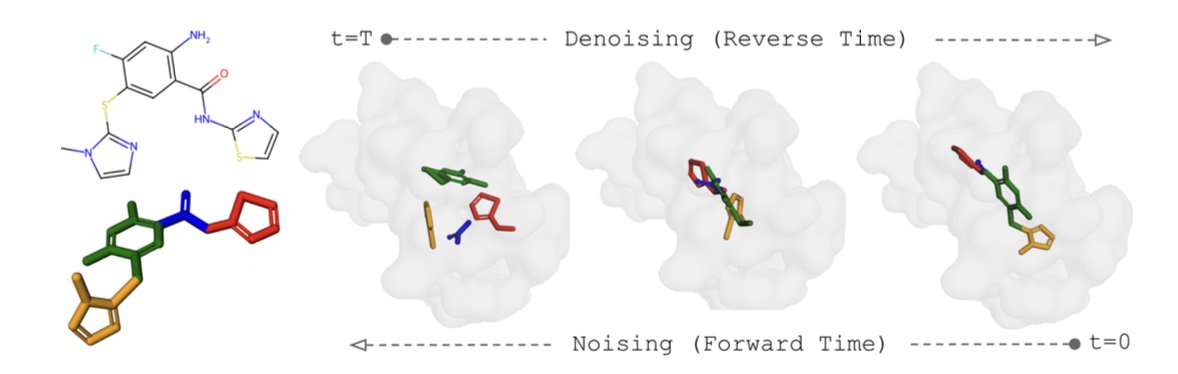
Sigmadock: Untwisting Molecular Docking with Fragment‑Based SE(3) Diffusion 1 This paper presents Sigmadock, the first diffusion‑based docking model that surpasses classical physics‑based tools on the PoseBusters re‑docking benchmark, achieving a Top‑1 success rate over 79 % under the strict PB‑validity metric. 2 The core innovation is a novel fragmentation scheme that breaks a ligand into a small set of rigid‑body fragments by cutting rotatable bonds, allowing the model to learn only SE(3) transformations for each fragment rather than high‑dimensional torsional angles. 3 By operating in the product space SE(3)^m, Sigmadock sidesteps the geometric entanglement that plagues torsional‑space diffusion—where a single dihedral change propagates non‑locally and induces a non‑product measure—leading to more stable training and faster inference. 4 The authors further introduce soft triangulation constraints that enforce bond‑length and angle consistency across fragments, and a SO(3)‑equivariant EquiformerV2 backbone that respects the rotational symmetry of the 3‑D space. 5 Extensive ablation studies show that each component—fragment merging, triangulation, and protein‑ligand interaction encoding—contributes 4–12 % to overall accuracy, and the method generalises to unseen proteins with little data leakage. 6 On the PoseBusters and Astex test sets, Sigmadock reaches near‑perfect Top‑1 accuracy (>90 %) and outperforms both DiffDock and traditional docking programs by large margins, all while using only ~19 k training molecules and 50× faster sampling. 7 The work demonstrates that principled inductive biases and careful geometric modeling can enable deep learning to reliably predict binding poses, opening the door to flexible‑receptor docking and co‑folding extensions. 💻Code: github.com/alvaroprat97/s… 📜Paper: arxiv.org/abs/2511.04854 #DeepLearning #MolecularDocking #DiffusionModels #ComputationalChemistry #SE3 #FragmentBasedApproach
Biology+AI Daily tweet media
English
3
21
88
12.3K
Tharindu Senapathi retweetledi
Jorge Bravo Abad
Jorge Bravo Abad@bravo_abad·
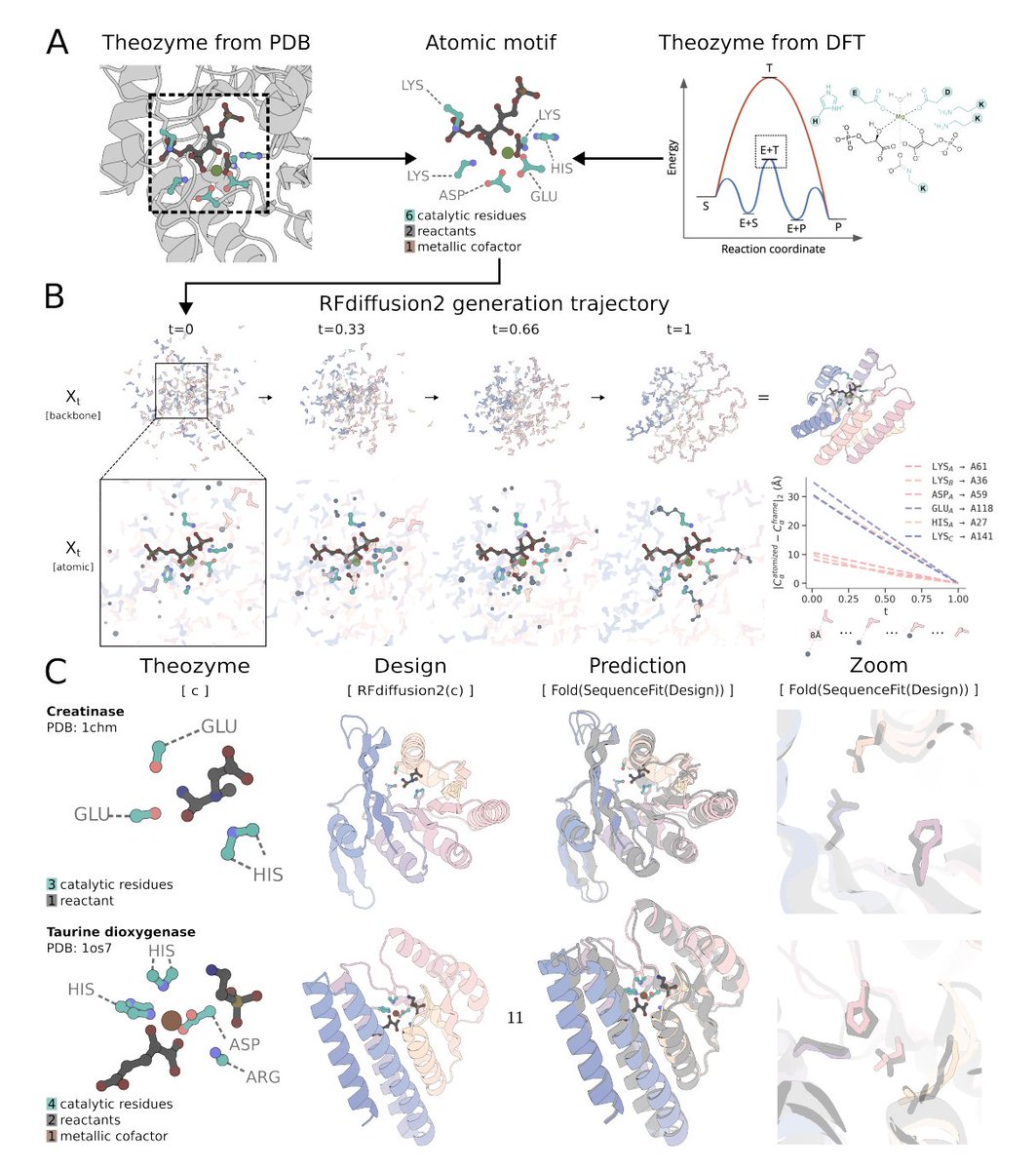
Atom-level enzyme design with RFdiffusion2 Designing new enzymes usually starts from an “ideal” active site—key functional groups arranged around a transition state—and then tries to find or tweak a protein scaffold that can hold that geometry. Existing AI methods can help, but they typically need you to predefine where catalytic residues sit in the sequence and then rebuild the backbone around those side chains. That makes the search rigid and struggles as active sites get more complex. Woody Ahern and coauthors introduce RFdiffusion2, a deep generative model that flips this workflow. Instead of working at the backbone level, it takes atom-level descriptions of the active site (the theozyme: side chains, ligand, metals) and directly generates full protein structures that support it. Crucially, the model itself decides where catalytic residues go in the sequence and which rotamers they adopt, while building a compatible scaffold around them. On a new benchmark of 41 diverse enzyme active sites, RFdiffusion2 successfully scaffolds all 41, versus 16 for previous methods that relied on enumerating residue indices and rotamers. The authors then move beyond benchmarks and into the lab: starting from minimal, atom-level reaction mechanisms, they design retroaldolases, cysteine hydrolases and zinc-based hydrolases, and find active enzymes after testing fewer than 96 sequences per reaction. Some of the zinc hydrolases reach catalytic efficiencies far above earlier de novo designs, with folds that are clearly distinct from any known structure. Taken together, this points toward a new mode of enzyme engineering: specify the chemistry at atomic resolution, and let a generative model propose entirely new proteins to realize it—shrinking the gap between “reaction mechanism on paper” and “working catalyst in the tube.” Paper: nature.com/articles/s4159…
Jorge Bravo Abad tweet media
English
4
22
84
4K
Tharindu Senapathi retweetledi
Biology+AI Daily
Biology+AI Daily@BiologyAIDaily·
Apo2Mol: 3D Molecule Generation via Dynamic Pocket-Aware Diffusion Model 1. A new study titled "Apo2Mol" introduces a groundbreaking approach to structure-based drug design, leveraging a dynamic pocket-aware diffusion model to generate 3D molecules that account for protein flexibility. This innovation addresses a critical limitation in current methods that assume rigid protein binding pockets. 2. The core innovation of Apo2Mol lies in its ability to jointly generate ligands and their corresponding holo pocket conformations from apo states. This is achieved through a full-atom hierarchical graph-based diffusion model, which captures realistic protein-ligand interactions and conformational changes. 3. The researchers curated a high-quality dataset of over 24,000 experimentally resolved apo-holo structure pairs from the Protein Data Bank. This dataset provides a robust foundation for training the model, ensuring that it learns from real-world protein dynamics rather than relying on simulated data. 4. Empirical results demonstrate that Apo2Mol achieves state-of-the-art performance in generating high-affinity ligands. The model not only produces molecules with favorable binding affinities but also generates realistic pocket conformations, advancing the capabilities of dynamic structure-based drug design. 5. The study highlights the potential of Apo2Mol to generate novel ligands for emerging drug targets, even when only apo structures are available. This capability is crucial for practical drug discovery scenarios where holo structures are often unknown. 📜Paper: arxiv.org/abs/2511.14559… #DrugDesign #DiffusionModels #ProteinFlexibility #StructureBasedDesign #AIinBiology
Biology+AI Daily tweet media
English
2
15
53
3.4K
Tharindu Senapathi retweetledi
Physics In History
Physics In History@PhysInHistory·
April 15, 1975: Physicist Paul Dirac lecturing on the history of the positron at the National Academy of Lincei, Rome. Courtesy of INFN.
English
18
140
795
71.6K
Tharindu Senapathi retweetledi
Gabriele Corso
Gabriele Corso@GabriCorso·
Thrilled to finally see BoltzGen, our new state-of-the-art all-atom binder design model, coming out fully open-source after a very extensive experimental validation with many top academic and industry labs! 🧬 The diversity of the experiments is unprecedented, spanning binder modalities from nanobodies to disulfide-bonded peptides and including targets ranging from disordered proteins to small molecules. These experiments demonstrate state-of-the-art performance, for example, a 67% success rate at designing nanomolar nanobody binders against several novel targets with only 15 or fewer designs. 🚀 Incredible work from an amazing team led by @HannesStaerk! 🤗
Gabriele Corso tweet media
English
4
79
356
42K
Tharindu Senapathi retweetledi
Stephane Redon
Stephane Redon@StephaneRedon·
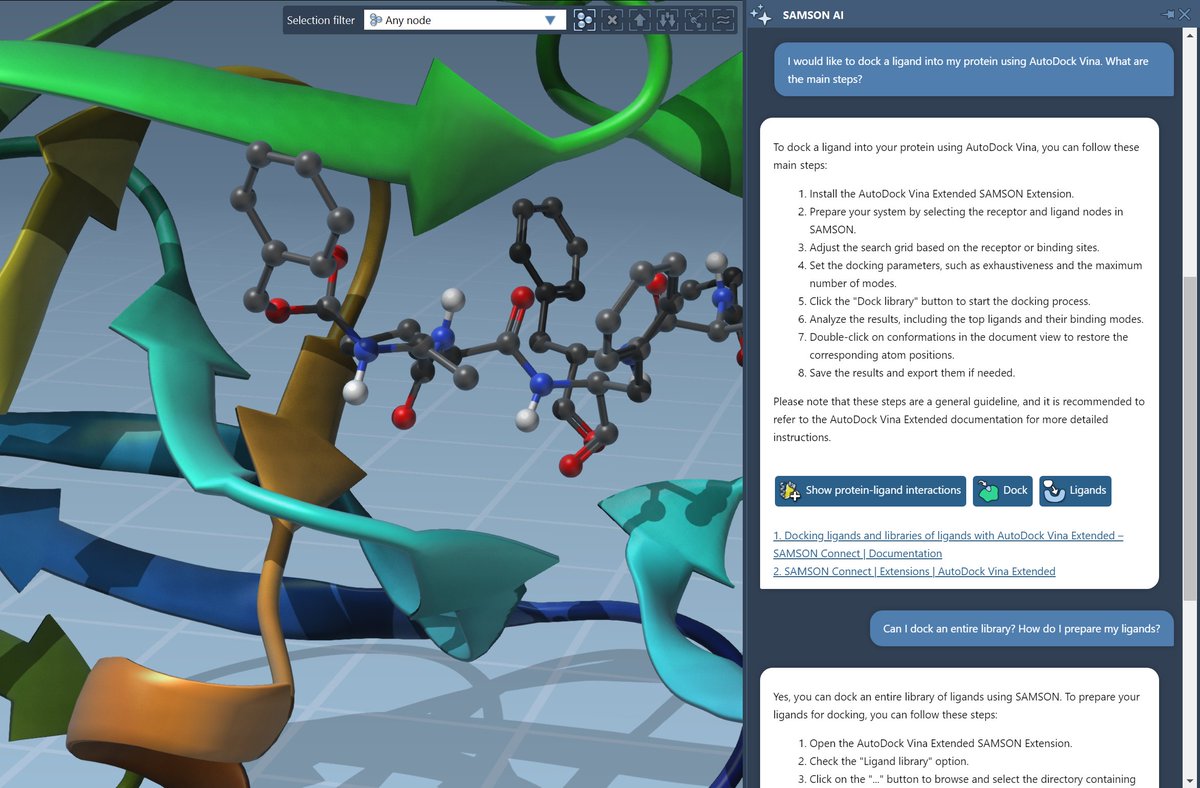
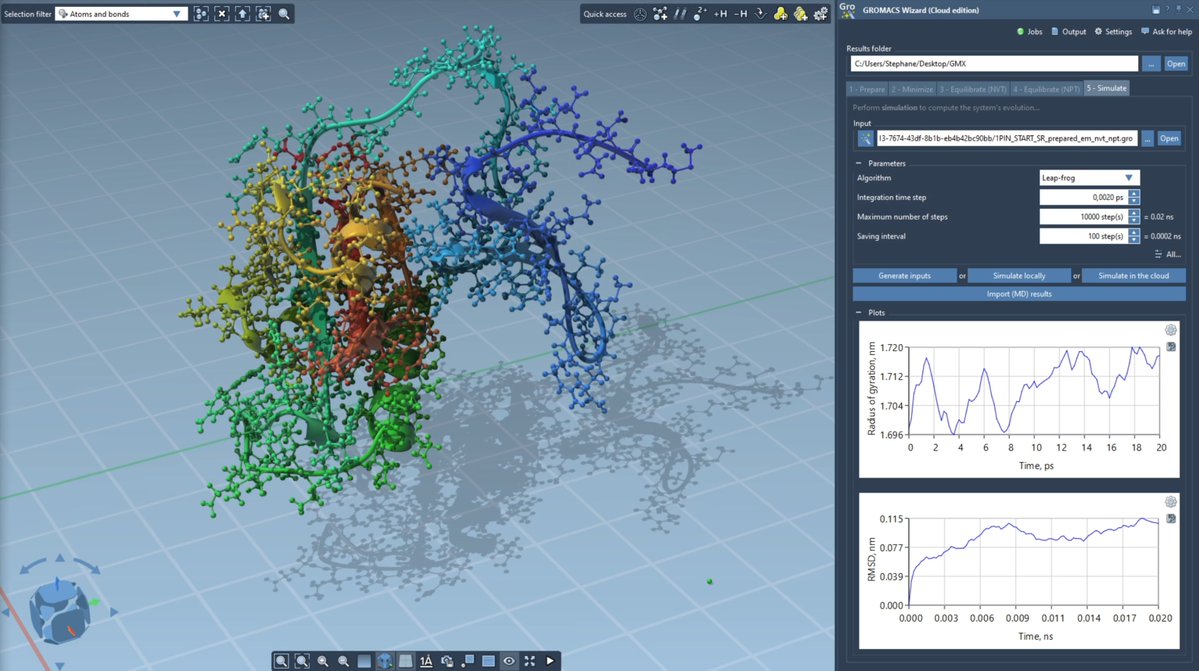
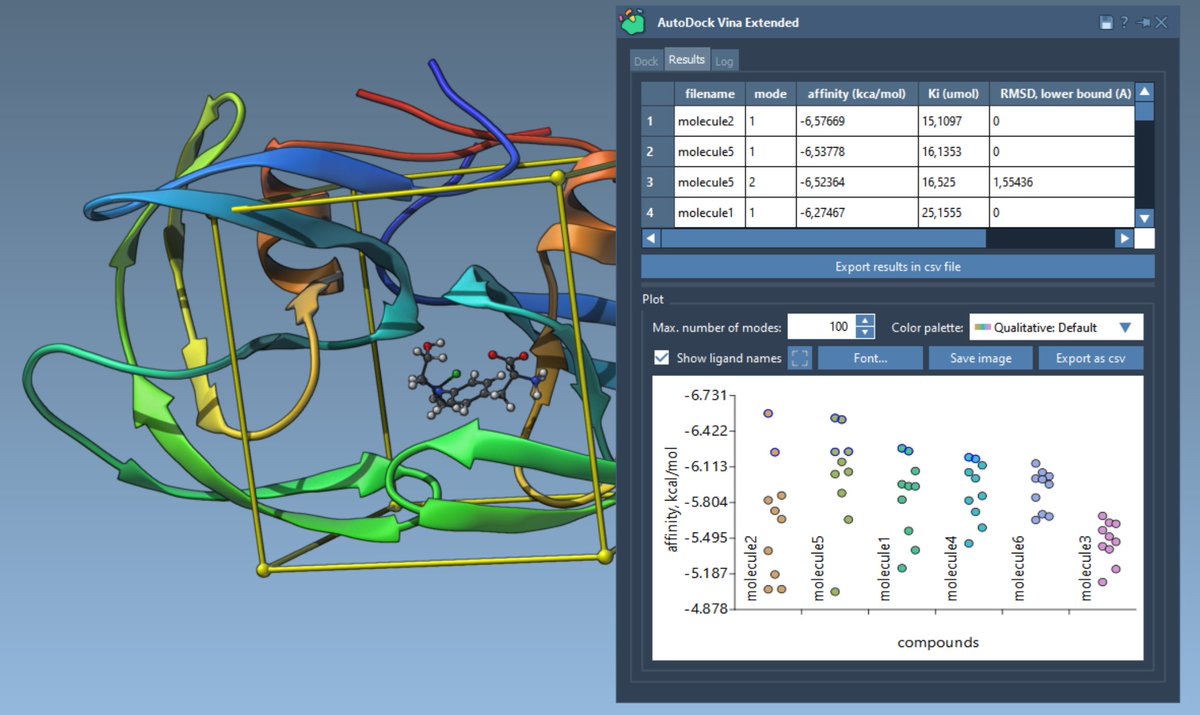
🎉🎉🎉 Today, we have a huge announcement to make: SAMSON is now free for non-commercial use! This includes all extensions for docking, simulating, animating, scripting, and much, much more. Precisely, we are making the entire SAMSON molecular design platform - SAMSON + every SAMSON Extension on SAMSON Connect - free for non-commercial use. This means you can now use SAMSON at no cost in academic and nonprofit settings for: - Education (teachers, students, classrooms) - Academic & publicly funded research - Personal projects (no revenue, no paid consulting) If this is your case, you can activate your free non-commercial license yourself when you sign up at samson-connect.net. This will grant you a free Expert plan and make all SAMSON Extensions free to add on SAMSON Connect. (as you may know, most features run locally, but some optional calculations run in the cloud, such as structure prediction and cloud simulations - these require computing credits). When your work involves paid services, consulting, product development, or commercial R&D, just visit the Pricing page and select one of the commercial plans. You can later revert to non-commercial use. If you are unsure whether you are eligible to a free non-commercial license, please just contact us and we'll work it out with you. Of course, feel free to share the news with your friends, students, and colleagues (and everyone else 😊). #SAMSON #Community
Stephane Redon tweet mediaStephane Redon tweet mediaStephane Redon tweet mediaStephane Redon tweet media
English
16
185
771
46K
Tharindu Senapathi retweetledi
NVIDIA Healthcare
NVIDIA Healthcare@NVIDIAHealth·
🔥nvMolKit landed today🔥 Morgan Fingerprinting, Tanimoto/Cosine similarity and MMFF geometry optimization and conformer generation on GPU, 10-3000x faster. Screen millions of SMILES before coffee & upsize your QSAR pipelines. 🚀 Which dataset operation will you accelerate first? #GPU #cheminformatics #drugdiscovery
NVIDIA Healthcare tweet media
English
6
33
154
73.2K
Tharindu Senapathi retweetledi
Deniz Kavi
Deniz Kavi@kavi_deniz·
RFdiffusion2 now available! Atomic-level scaffolding for complex active sites Available on @tamarindbio now. RFdiffusion2 shows state-of-the-art atomic-level scaffolding that generalizes to complex, multi-island active sites, and it reliably yields active enzymes with modest screening, though activities are still below the best native enzymes and should improve with richer theozymes and sequence/pocket co-design.
English
5
59
301
18.4K
Tharindu Senapathi retweetledi
Ariax Bio
Ariax Bio@AriaxBio·
BindCraft isn't just for miniproteins. A new preprint validates 47-67% success rates for BindCraft-derived peptides with nM affinities. Our tutorial with @MartinPacesa covers this work and walks through our new dedicated peptide interface. Read it here: ariax.bio/resources/bind…
English
3
44
162
15.5K
Tharindu Senapathi retweetledi
NVIDIA Healthcare
NVIDIA Healthcare@NVIDIAHealth·
🚀 The NVIDIA Boltz-2 NIM microservice just got an upgrade: binding‑affinity prediction is now live, at 2-3x speedup over open-source with cuEquivariance and TensorRT! Co‑fold proteins and estimate ligand affinity in one shot. #AIForScience #DrugDiscovery #NVIDIANIM
NVIDIA Healthcare tweet media
English
6
63
307
19.3K