otaviano canuto

14.1K posts

otaviano canuto banner
otaviano canuto

otaviano canuto

@ocanuto

Otaviano Canuto: a sr. fellow at the Policy Center for the New South, a nonresident sr. fellow Brookings Institution, and principal -Center for Macro.&Developm.


Washington DC Katılım Kasım 2010
187 Takip Edilen4.1K Takipçiler
otaviano canuto retweetledi
The Figen
The Figen@TheFigen_·
Unbelievable! 😂 He hasn't even forgotten his goat.
English
642
1.4K
6.7K
197.1K
otaviano canuto retweetledi
Ronaldo Nazário
Ronaldo Nazário@Ronaldo·
As probabilidades podem estar contra a gente… mas nós já vencemos elas cinco vezes e fomos campeões do mundo. Tá liberado acreditar na sexta. 🤞🇧🇷🍻
Português
545
5K
39.4K
3.9M
otaviano canuto retweetledi
Policy Center for the New South
Policy Center for the New South@PolicyCenterNS·
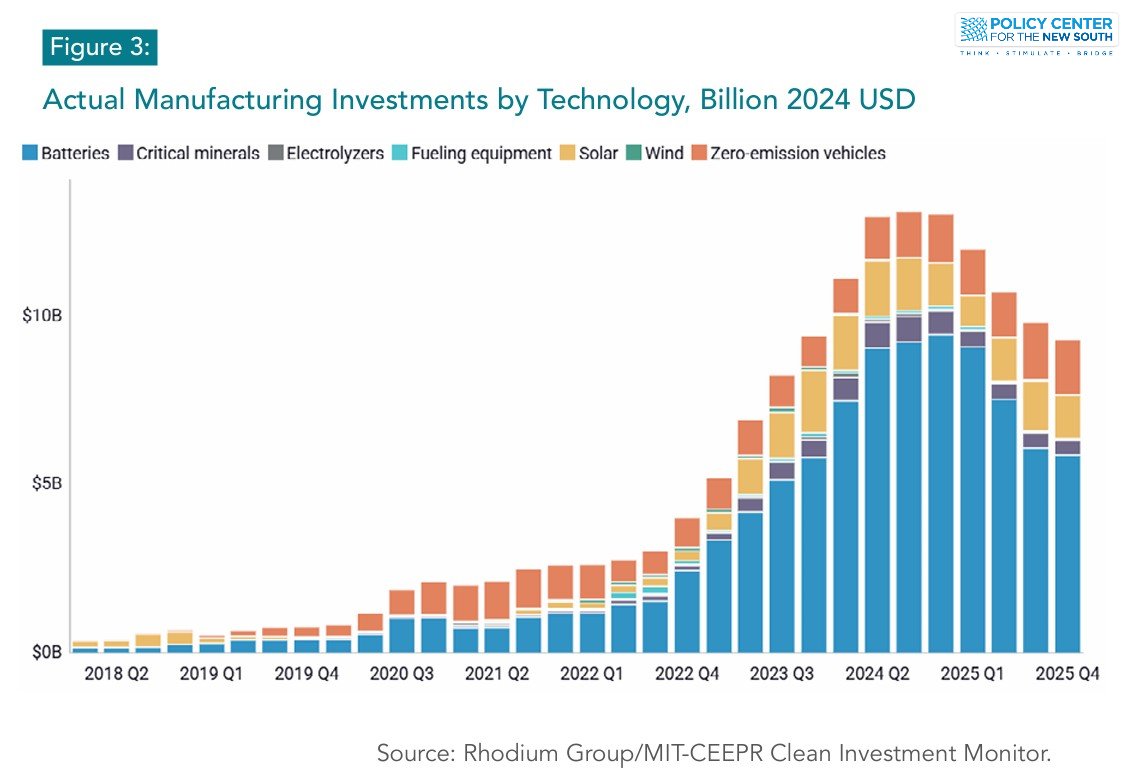
"Estimates indicate that firms announced more than $300 billion in new clean energy & manufacturing investments in the U.S. between 2022 and 2024, w/ battery manufacturing representing one of the largest shares. However, the rapid expansion of production capacity has, in some cases, outpaced short-term growth in electric-vehicle demand". 🔗Read now: policycenter.ma/publications/c…
Policy Center for the New South tweet media
English
0
3
5
190
otaviano canuto retweetledi
Brian Winter
Brian Winter@BrazilBrian·
Latin America is now aging faster than ANY region in the world. Chile has a lower birthrate than even Japan. What is going on?
Brian Winter tweet media
English
2.1K
3K
10.5K
27.5M
otaviano canuto retweetledi
Black-Jesus💧🇿🇦
Black-Jesus💧🇿🇦@KingMntungwa·
Hahaha, it's over! This cow is crazy!
English
1K
1.2K
5.4K
1.1M
otaviano canuto retweetledi
Bank for International Settlements
The BIS Time-series Regression Oracle (BISTRO) works like a ChatGPT for time series: it provides forecasts for key macroeconomic series and enables the exploration of scenarios. Researchers can try it out: bit.ly/4uy0ks9 Learn more: bit.ly/4bM9km6
English
4
44
129
10.7K
otaviano canuto retweetledi
Jon Hartley
Jon Hartley@Jon_Hartley_·
1/Chris Sims is easily one of the most influential macroeconomists (& perhaps most influential empirical macroeconomist) of the last 50 years; he fundamentally changed thinking about monetary policy, metrics,& causality (VARs, time series models). Thread on his greatest hits🧵👇
Jon Hartley tweet mediaJon Hartley tweet media
Jon Hartley@Jon_Hartley_

RIP Chris Sims, a giant in empirical macroeconomics

English
5
164
494
79.1K
otaviano canuto retweetledi
Ricardo Reis
Ricardo Reis@R2Rsquared·
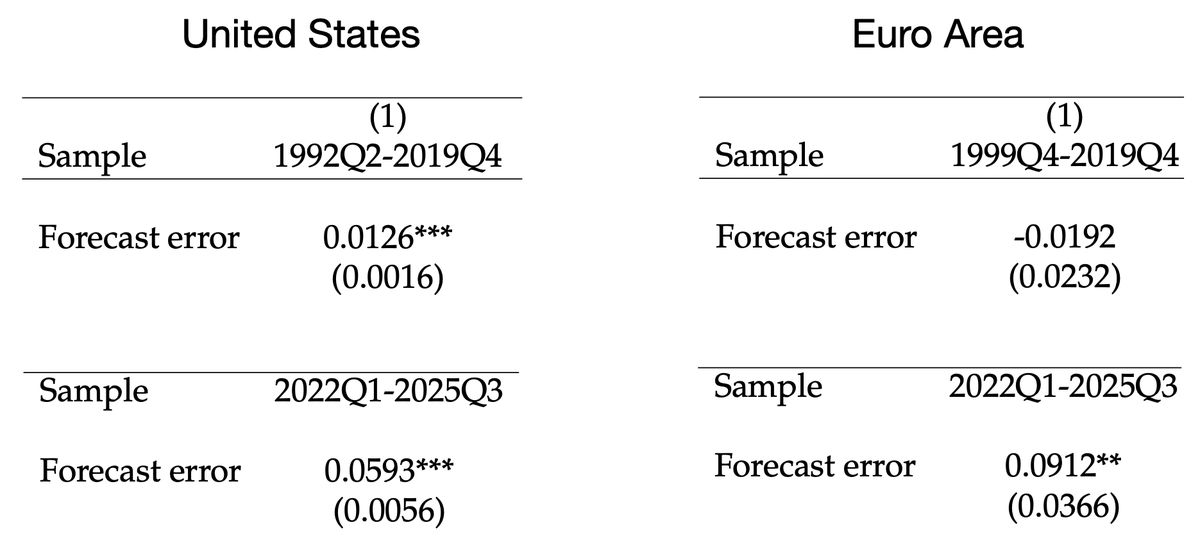
Are inflation expectations well anchored right now? With a new supply shock hitting the global economy, an important question is whether inflation expectations are well anchored. If they are, the shock may have only a quick and temporary impact on inflation. If they are not, there will be “second‑round effects,” as firms expecting higher prices raise their own price, and workers demand higher wages. Just as importantly, if the 2% target loses credibility, consumers and savers may start expecting persistently high inflation, making it far more painful to bring inflation down (think Volcker). Surveys of professional forecasters and market prices of swaps and indexed bonds show that long‑run expected inflation expectations have been roughly on target for several years. The anchor is back in place. But is the anchor as solid into the ground as before the inflation surge? No. Take the answer of a professional forecaster (say the chief economist in a bank) to a survey question: what do you expect average inflation to be over the next 10 years? Compare today’s answer to their answer three months ago in the same survey. If expectations are firmly anchored, this number should not have changed much. The answer should especially not react to whatever happened to inflation during these past three months. It should even more especially not react to how its value differed from what that person expected 3-month inflation would be back then. Long‑run revisions should be uncorrelated with recent inflation surprises for that person. The table below shows the estimates from regressions of long‑run forecast revisions on short‑term surprises (forecast errors) in two periods. The top row uses data from before the 2021 inflation surge; the bottom row uses 2022–25 data. For the US, the link between the two rises by a factor of 4.7. For the EA, it jumps from zero to significantly positive. The long-run inflation anchor is back in place. But it is not as solidly grounded today as it was before the pandemic. Note: a coefficient of 0.09 means that if the inflation in the past three months was 1pp higher, than expected inflation over the next 120 months rises on average by 0.09pp. Using statistical estimates of the persistence of inflation shocks, this is large. Source: Section 2 in Reis "Why Did Inflation Rise and Fall in 2021-24? Channels and Evidence from Expectations" and the references in it.
Ricardo Reis tweet media
English
9
38
206
20.4K
otaviano canuto retweetledi
Policy Center for the New South
Policy Center for the New South@PolicyCenterNS·
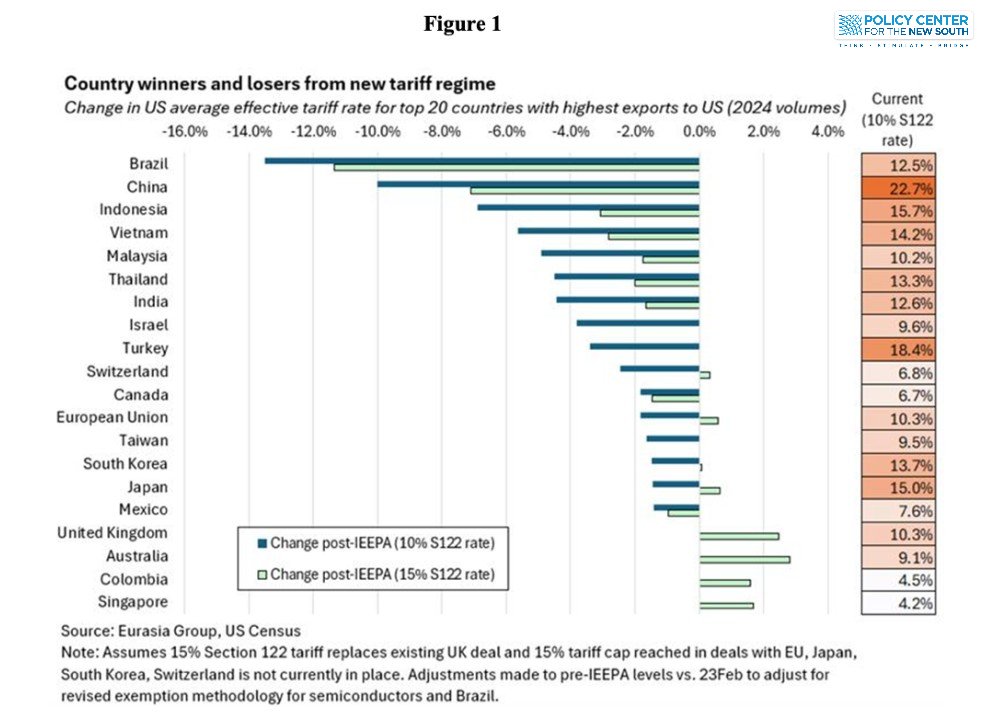
🇺🇸 "Regardless of the new tariff structure, the countries affected most directly by the U.S. International Emergency Economic Powers Act #tariffs have been given some relief, at least in relative terms. This is the case for #Brazil, #India, #China, #Canada, and #Mexico, and for Southeast Asian countries that were previously facing rates of 19%-20%. Recall that extraordinary tariffs on Brazil, with references to former president Jair Bolsonaro’s trial and Brazilian Supreme Federal Court decisions, were applied under IEEPA, as were Trump’s punishments directed at India for buying Russian oil, and China for fentanyl". 📊 This figure illustrates how the unwinding of IEEPA tariffs will impact U.S. #trade partners differently. 🔗Read more: policycenter.ma/publications/p… @ocanuto
Policy Center for the New South tweet media
English
0
2
3
210
otaviano canuto retweetledi
Policy Center for the New South
Policy Center for the New South@PolicyCenterNS·
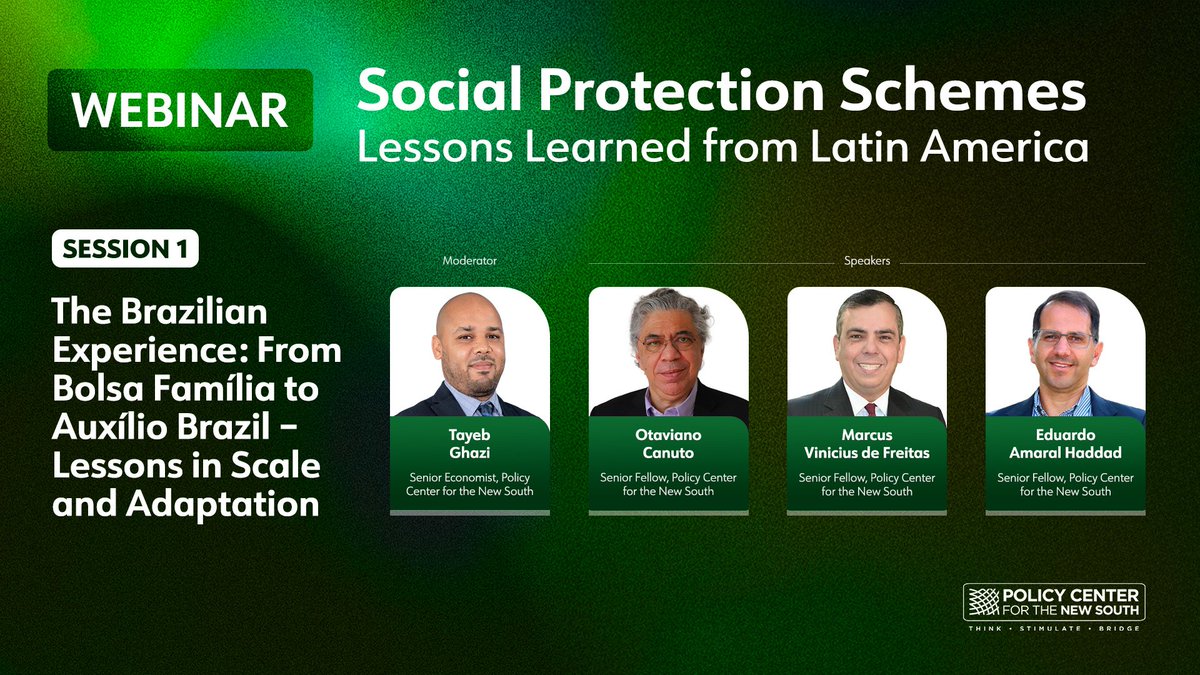
📺 Webinar Series - Social Protection Schemes: Lessons Learned from #LatinAmerica 🔴 Session 1: “The Brazilian Experience 🇧🇷: From Bolsa Família to Auxílio Brasil - Lessons in Scale and Adaptation” 💡 Exploring #Brazil’s social protection journey, our experts show how targeted cash transfers, paired with #health and #education conditionalities, have reduced #poverty, strengthened human capital, and boosted social inclusion, offering practical lessons for designing resilient and adaptive systems elsewhere. 🔗 Watch now: policycenter.ma/events/brazili… @tayeb_ghazi @ocanuto @mvfreitasbr
Policy Center for the New South tweet media
English
0
3
4
190