

老厉害
22 posts

非常值得一读的paper:以尼克松对时任美联储主席伯恩斯施加政治压力要求货币宽松为案例,分析发现美国总统对美联储主席的施压只会导致:1)市场通胀预期抬高导致强力且持久的高物价;2)促成之后十余年的多次通胀;3)未能对实体经济活动产生积极影响。restud.com/political-pres…
中文

老厉害 retweetledi
老厉害 retweetledi

Goldman tries to quantify the net effect of AI both substituting for and augmenting U.S. employment.
Their conclusion: AI substitution in occupations like phone operations and insurance claims administration have reduced monthly payroll gains by around -25K and raised the unemployment rate by 0.16 pp over the past year. AI augmentation in occupations including medicine and education have added +9K to monthly payrolls and lowered the unemployment rate by 0.06 pp. This nets out to a slight -16K drag on payrolls and an increase in the unemployment rate by 0.1 pp.
Caveat: This exercise doesn't account for the possible benefit from either construction hiring due to data-center buildout or AI-driven productivity/income gains.

English
非常值得一读的文章,不同于改开年代的单一目标(GDP),当前地方官员面临不可能三角(三个目标):政治服从、发展科技、金融安全,三者只能取其二。“躺平”因此成了地方官员的最优解。
李其 Lizzi@wstv_lizzi
Sharing a new piece by me and my colleague @shuizaiping2 where we took a deep dive into Xi Jinping’s newly released book on the “correct view of political performance”, a compilation of his speeches spanning more than a decade, many of them previously unpublished! The timing, obviously, is no accident. Ahead of the Two Sessions, Beijing is clearly trying to push a shift beyond GDP worship and redefine what counts as bureaucratic success. In fact Xi has long been frustrated with his bureacrats. He complained about officials who “rack up a mountain of debt, pat their butts, and walk away,” chasing short-term growth at long-term cost. He is equally frustrated with the cadres’ lack of motivation: “some officials won’t lift a finger until the Central Committee issues a written directive… Are you telling me that if I don’t personally issue a directive, the work just grinds to a halt?!” So what’s the new, better KPI, according to Xi? Our takeaway: it’s a trilemma. From Xi’s speeches, good cadres should be expected to deliver 3 things all at once: strict political loyalty / compliance; new + better quality growth through technological upgrading eg “new quality productive forces”; systemic security (avoiding risks + containing those accumulated over the past decade.) The problem? Each of these priorities makes sense on its own. But together, they create a bureaucratic trilemma in which officials can realistically satisfy only two of the three. Is there a way to escape the trilemma? We offer some thoughts...
中文
"This has bedevilled the launch of a property tax, in part because many corrupt officials own several homes. Forcing political elites to come clean would expose pervasive graft—and trigger a pre-emptive wave of home sales when the property market is weak."
The Economist@TheEconomist
Observers fret that Xi Jinping is returning China to Marxism; few notice that, perhaps unwittingly, he has made it a partial tax haven economist.com/leaders/2026/0…
English
“China rolls out incentives to boost Spring Festival spending” = 平均每人1块5
Michael Pettis@michaelxpettis
Xinhua: "Chinese local authorities have allocated 2.05 billion yuan in funds to directly benefit the public through the distribution of consumption vouchers, subsidies, and cash envelopes during the nine-day Spring Festival holiday." For what its worth, that is well under one-tenth of 1% of the country's 9-day GDP. english.news.cn/20260211/1b93e…
English
老厉害 retweetledi
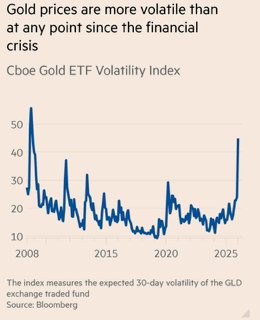
This chart from the Financial Times illustrates the significant ongoing volatility in precious metals, as speculators have effectively sidelined institutional investors for the time being.
Gold is currently trading down 5%, while silver has slumped 10%.
The pressing question is how long this speculative shakeout will last—and just how much damage we should expect.
All we know for sure is that the extraordinary rise in the prices of both, while driven by fundamental factors, attracted lots of speculators.
Meanwhile, oil prices have also fallen, with Brent down 5%, following a slight cooling in the fundamentally tense relations between Iran and the US.
#economy #markets #oil #gold #silver @FT
English
Warsh常年反对QE,看起来反而比Powell更鹰,但他似乎不反对降息并支持“降准”(巴塞尔协议III)。反对QE的原因是认为QE加大贫富差距,这也符合Trump的民粹主义路线,更何况其岳父与Trump的关系,“忠诚不绝对就是绝对不忠诚”😂美联储独立性肯定是不保了
*Walter Bloomberg@DeItaone
TRUMP EYES WARSH FOR FED CHAIR The Trump administration is preparing to nominate Kevin Warsh as the next Federal Reserve chair, according to people familiar with the matter. President Trump said he will announce his pick Friday morning, though the decision is not final. The White House and Warsh have not commented.
中文
很有意思的调研,不过‘Only 39% worried, mostly Republicans’😂
Isaac Stone Fish@isaacstonefish
I wrote a book about Chinese influence in the United States, and found that Chinese propaganda in America has two goals: to convince Americans China's rise will be peaceful, and that China's rise is inevitable. Both are misleading at best. Be very careful making these assumptions.
中文


提升服务消费占比得解决有钱、有闲、有地方消费三个问题,目前看来第一点是最难的,光靠居民部门内部的均贫富、再分配肯定不够,需要政府供给侧思维的彻底转变,五年不够,五年能让中央政府转变思路就不错。先关注央国企利润如何分配给居民部门。反观十五五规划建议,反而是在暗示“加税”
Jing Sima@jingsima_econ
China is prioritizing service consumption this year, with a target to raise its share to 50% by 2030—a 5ppt increase. We believe China can achieve this SHARE increase - like Japan in the 90s, a shift from goods to service consumption is inevitable in a maturing and aging economy.
中文

@oldpowerful 加油,高善文和付鹏退休以后,平时就看你了😂
中文
果然b站给他封了,只剩youtube了😂😂😂
lidang 立党 (劝人卖房/学CS/买SP500/纳100/OpenAI/Anthrop第一人)@lidangzzz
B站是怎么让“老厉害”这种投行研报解读的视频过审的……
日本語