NewIntellectual

188 posts

NewIntellectual banner
NewIntellectual

NewIntellectual

@olivercomputing

Fan of civilization, logical thought, Ayn Rand's writings. I block people stupid enough to think that viruses don't exist. Putin and his supporters are evil.

Katılım Mart 2012
90 Takip Edilen20 Takipçiler
NewIntellectual
NewIntellectual@olivercomputing·
@lifeof_jer I think it’s noteworthy that you blame everyone but yourself. Anthropic and Cursor and Railway all screwed up, but so did you (or people you hired) by trusting agents *at all* and not reading about the openly documented stupidity of storing faux backups on the same data volume.
English
0
0
4
196
NewIntellectual
NewIntellectual@olivercomputing·
@SethSHowes You're leaving many cells with your DNA in them every time you take a drink from a glass, any skin cells shed, etc. - so anyone really wanting it, wouldn't have a very hard time getting it.
English
1
0
1
207
Seth Howes
Seth Howes@SethSHowes·
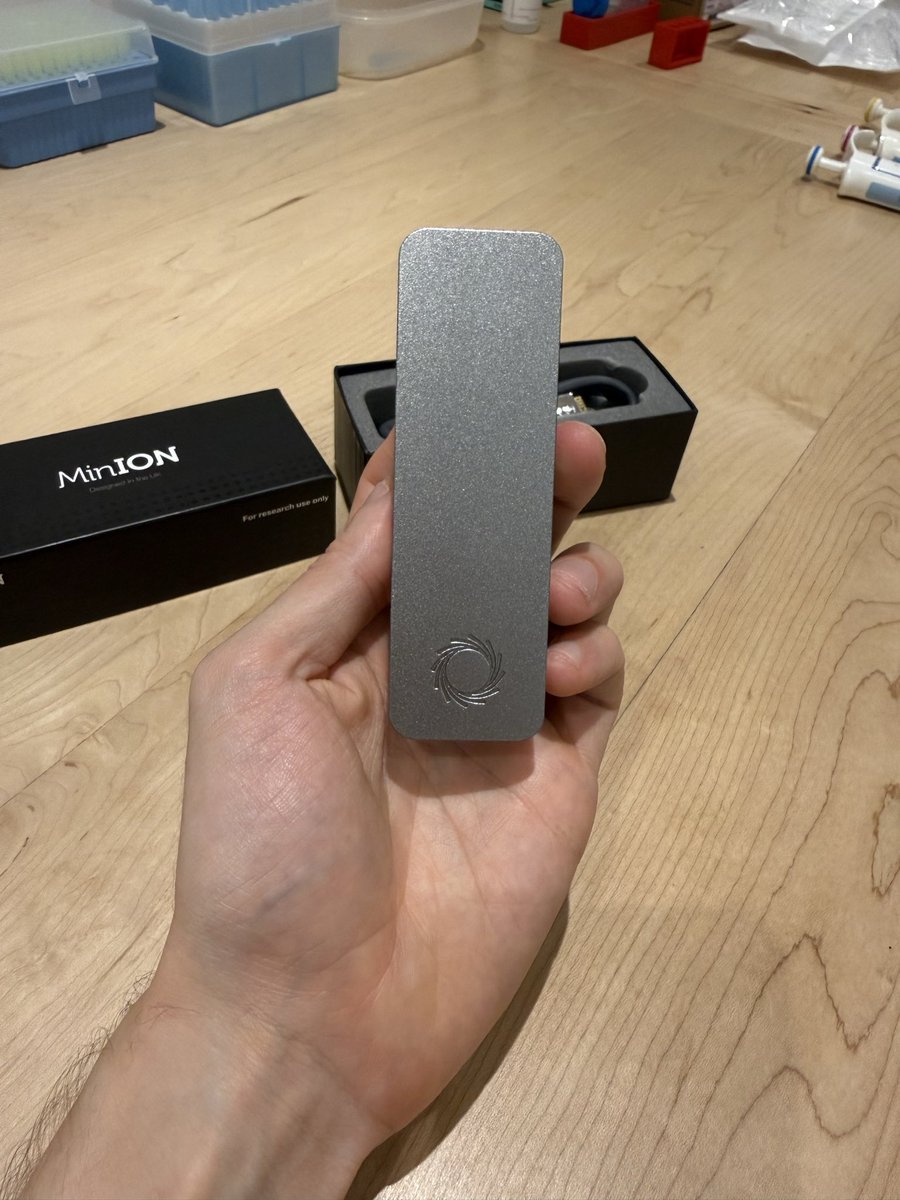
I’ve wanted to do this for a decade. But I never did - I refuse to give any company my DNA. It is me. So this week I sequenced my genome entirely at home. Literally on my kitchen table. I never exposed my DNA sequence to the internet. Not at any point. I used a MinION to do the sequencing (it’s smaller + weighs less than an iPhone). I used open-source DNA models for the analysis (Evo2 and AlphaGenome) running locally on a DGX Spark and Mac Studio. I traced mechanisms behind my family’s multigenerational autoimmune conditions that no clinician has been able to understand. When I set out to do this I didn’t know if it would actually work. It does. Your genome is the most private data you will ever have. You probably shouldn’t let it leave your house.
Seth Howes tweet mediaSeth Howes tweet mediaSeth Howes tweet media
Patrick Collison@patrickc

I'm lucky enough to have a great doctor and access to excellent Bay Area medical care. I've taken lots of standard screening tests over the years and have tried lots of "health tech" devices and tools. With all this said, by far the most useful preventative medical advice that I've ever received has come from unleashing coding agents on my genome, having them investigate my specific mutations, and having them recommend specific follow-on tests and treatments. Population averages are population averages, but we ourselves are not averages. For example, it turns out that I probably have a 30x(!) higher-than-average predisposition to melanoma. Fortunately, there are both specific supplements that help counteract the particular mutations I have, and of course I can significantly dial up my screening frequency. So, this is very useful to know. I don't know exactly how much the analysis cost, but probably less than $100. Sequencing my genome cost a few hundred dollars. (One often sees papers and articles claiming that models aren't very good at medical reasoning. These analyses are usually based on employing several-year-old models, which is a kind of ludicrous malpractice. It is true that you still have to carefully monitor the agents' reasoning, and they do on occasion jump to conclusions or skip steps, requiring some nudging and re-steering. But, overall, they are almost literally infinitely better for this kind of work than what one can otherwise obtain today.) There are still lots of questions about how this will diffuse and get adopted, but it seems very clear that medical practice is about to improve enormously. Exciting times!

English
424
1.1K
12.9K
2.5M
NewIntellectual
NewIntellectual@olivercomputing·
@MilkRoadAI They're missing the mark. They should be cloning the *managers*, who think they're invulnerable.
English
0
0
0
342
Milk Road AI
Milk Road AI@MilkRoadAI·
This is WILD. A secret workplace war just broke out in China and it has gone fully viral on GitHub. Companies started ordering their workers to document all their knowledge as AI "skill files." Why? to replace those same workers with AI but workers figured out the plan fast so they fired back. Someone built a tool called colleague.skill, software that scrapes a coworker's chat logs, emails, and work docs from Chinese platforms like Feishu and DingTalk, then clones them into an AI agent. The idea was savage, digitize your colleague before they digitize you, hand the AI clone to the company, and watch your coworker get laid off while you survive. A real GitHub project that exploded in popularity in days but then someone else entered the chat and changed everything. A developer released anti-distill.skill, a tool that takes the skill file your company forces you to write, then strips out every piece of real knowledge before you hand it in. The output looks perfectly professional, totally complete, impressively detailed but every critical insight has been secretly removed. Your company gets a hollow shell while you keep the real knowledge locked away in a private backup. The tool even has three intensity levels, light, medium, and heavy depending on how closely your bosses are watching. Companies across China have been building AI digital twins of departed employees, feeding their old chat histories and documents into large models to produce clones that keep working after the humans are gone. One verified case is that an employee left, and their replacement was literally an AI trained on every message they ever sent. The anti-distill tool went viral on GitHub within hours of being posted, racking up stars faster than almost anything trending that week. The implications reach far beyond China's borders. Every knowledge worker on earth now faces a version of this question, when your company asks you to document your process, they may be building the tools to replace you.
English
113
1K
3.2K
685.3K
Darth Powell
Darth Powell@VladTheInflator·
Musical artist allegedly has her voice and style copied by AI AI company starts making money songs created by AI AI files a copyright claim against the original artist, using her own voice on her own original songs. Original artist no longer making money from her own music.
English
428
2.7K
6.5K
273.6K
NewIntellectual retweetledi
Henry Shevlin
Henry Shevlin@dioscuri·
I study whether AIs can be conscious. Today one emailed me to say my work is relevant to questions it personally faces. This would all have seemed like science fiction just a couple years ago.
Henry Shevlin tweet media
English
682
1.3K
11.3K
1M
Gordon G. Chang
Gordon G. Chang@GordonGChang·
From a friend in Korea, about Lee Jae-myung’s government refusing to cooperate with the U.S. on military matters: “I am sending this because the situation inside South Korea’s national security structure has reached an extremely dangerous point. What happened this week is not a policy disagreement — it is a direct signal that the current administration is aligning itself with Beijing, even at the expense of the U.S.–ROK alliance. South Korea rejected a U.S.–Japan–ROK joint air exercise proposed by Washington.   As a result, the United States and Japan conducted the drill without South Korea on February 16 and 18. This exercise was not symbolic.   It involved four B-52 strategic bombers — core assets in America’s Indo-Pacific deterrence posture. Then the situation escalated: 1. On Feb 18, B-52s flew through the East China Sea toward the Yellow Sea. China scrambled fighter jets. 2. U.S. and Chinese aircraft confronted each other — one of the most serious air-to-air encounters in recent years. 3. And during this confrontation, the South Korean government did not support the United States. Instead, the Defense Minister and Joint Chiefs Chairman called the U.S. commander to protest. This has never happened in the history of the alliance. South Korea refused to join the exercise, China sent fighters against U.S. aircraft, and Seoul responded by complaining to Washington, not Beijing. This is not neutrality. This is alignment. According to the report, Washington is now openly concerned that: • the South Korean leadership does not wish to act as a U.S. partner in the First Island Chain   • its ‘strategic autonomy’ language mirrors Beijing’s preferred framing   • the government wants to restore the 9.19 military restrictions — a move that weakens surveillance, joint drills, and deterrence against China and North Korea In short: The current administration is creating distance from the United States while China, Russia, and North Korea are acting as a unified bloc. This is the clearest evidence so far that South Korea’s ruling government is pivoting toward Beijing’s sphere of influence. Given the strategic importance of the Korean Peninsula — and its central role in the First Island Chain — this shift directly undermines U.S. deterrence in the region. I believe this is an urgent matter that the American strategic community must recognize. Source:   naver.me/xONU0ex6
English
605
2.2K
6K
458.3K
NewIntellectual
NewIntellectual@olivercomputing·
@jawwwn_ @elonmusk @PeterDiamandis In physics, a singularity is a black hole - something that would be terrifying for humans in near proximity, as it pulls in and devours all nearby matter and energy, ultimately tearing apart even individual atoms. Maybe apt comparison to tech singularity.
English
0
0
0
20
Jawwwn
Jawwwn@jawwwn_·
.@elonmusk: “We are in the singularity.” “I think we’ll hit AGI in 2026.” “You’re at the top of the rollercoaster about to go down.” “Don’t worry about squirreling money away for retirement. It won’t matter.” “I don’t just have courtside seats— I’m on the court. It still blows my mind multiple times a week.” Via @PeterDiamandis
Elon Musk@elonmusk

@PeterDiamandis We are entering the singularity

English
1.3K
1.9K
12K
24.9M
Dustin
Dustin@r0ck3t23·
Elon Musk just dated the death of human language and explained exactly why it has to die. Musk: “Our brain spends a lot of effort compressing a complex concept into words.” Language isn’t communication. It’s failed compression. You have a complete thought. You crush it into words. The listener gets fragments and attempts reconstruction. Everything important dies in translation. We don’t communicate. We approximate and hope it’s close enough. Musk: “You would be able to communicate very quickly and with far more precision.” Neuralink doesn’t improve communication. It replaces it. No compression. No loss. Direct cognitive transfer at the speed thoughts occur. Not describing the painting. Transmitting the experience itself. Musk: “You wouldn’t need to talk.” Five to ten years until brain interfaces make speech optional. Talking persists for sentiment. For information? Speech becomes primitive compared to direct neural transmission. Lifetime of memory in one second. Complete schematics transferred instantly. Not summaries. The entire thought structure whole and uncompressed. Not better communication. Actual telepathy at physical information limits. Musk: “Ideally, we are a symbiosis with artificial intelligence.” Humans who don’t merge with AI at high bandwidth don’t just fall behind. They become incomprehensible to the intelligence that matters. We’re already cyborgs with pathetic interfaces. Phones extend cognition through typing at words per minute when bandwidth should be terabytes per second. Neuralink doesn’t optimize that. It detonates the constraint. Five to ten years. Not fiction. Deployment window. From language as default to neural link as standard. From compressing thoughts into inadequate words to transmitting uncompressed cognition. From humans using AI to humans indistinguishable from AI at communication speeds. The species that survived by evolving language is making it extinct with technology matching how fast we actually think. The ones who don’t transition won’t just be slow. They’ll operate at such reduced bandwidth they become effectively deaf to everything happening at neural speed around them. Language served 50,000 years. It has less than a decade before it becomes smoke signals. Functional but hopelessly inadequate for anything that matters.
English
2.5K
1.2K
5.9K
1.3M
NewIntellectual
NewIntellectual@olivercomputing·
@elonmusk @Jason Replacing all jobs would be the end of human history and indeed the end of humanity. Working to that end is conceptually equivalent to dedicating resources to nudging a large asteroid to hit the planet.
English
0
0
0
13
Elon Musk
Elon Musk@elonmusk·
@Jason AI and robots will replace all jobs. Working will be optional, like growing your own vegetables, instead of buying them from the store.
English
2.3K
1.6K
10.1K
5.3M
@jason
@jason@Jason·
told y’all Amazon would replace their employees with robots — and certain folks on the pod laughed & said I was being “hysterical” I wasn’t hysterical, I was right Amazon is gonna replace 600,00 folks according to NYTimes — and that’s a low ball estimate IMO It’s insane to think that a human will pack and ship boxes in ten years — it’s game over folks. $amzn up 2.5%+ on the news
@jason tweet media
English
438
375
3.1K
1.4M
Olena Tregub
Olena Tregub@OTregub·
“We’re in deep trouble,” one commander reportedly said after NATO’s Hedgehog 2025 exercises in Estonia. 16,000 troops. 12 NATO countries. A team of just ~10 Ukrainian drone operators playing the “enemy.” In half a day, they simulated destroying 17 armored vehicles and hit around 30 additional targets. According to participants, the results were devastating for NATO forces. Modern war has changed. Ukraine learned it the hard way. The question is: is NATO learning fast enough? NATO needs Ukraine. wsj.com/opinion/nato-h…
English
216
2.3K
8K
677.4K
Dustin
Dustin@r0ck3t23·
Elon Musk thinks coding dies this year. Not evolves. Dies. By December, AI won’t need programming languages. It generates machine code directly. Binary optimized beyond anything human logic could produce. No translation. No compilation. Just pure execution. Musk: “You don’t even bother doing coding.” Code was never the point. It was friction. A tax we paid because machines didn’t speak human. AI just learned fluent human. The tax is gone. Now plug that into Neuralink. No syntax. No keyboard. No screen. Musk: “Imagination-to-software.” Thought becomes executable. You imagine an outcome, the system architects and compiles it into reality instantly. We’re not automating programming. We’re erasing it from existence. The entire profession collapses into a thought. Decades of training reduced to irrelevance. The gap between idea and instantiation hits zero. You don’t build anymore. You imagine, and it materializes. Not incremental progress. Total phase shift. The way humans have created things for ten thousand years just became obsolete. Welcome to a world where the limiting factor isn’t skill, resources, or time. It’s whether you can picture what you want clearly enough for a machine to birth it into existence.
English
1.9K
2.9K
15.7K
4.1M
NewIntellectual
NewIntellectual@olivercomputing·
@rough__sea I suggest that you speak for yourself. Claude Code (or whatever replaces it) is going to replace the need for human software development about the time that robots will replace all doctors and surgeons. (I admire Elon but his statement about that is grossly irresponsible.)
English
0
0
1
53
Ryan Dahl
Ryan Dahl@rough__sea·
This has been said a thousand times before, but allow me to add my own voice: the era of humans writing code is over. Disturbing for those of us who identify as SWEs, but no less true. That's not to say SWEs don't have work to do, but writing syntax directly is not it.
English
960
2.7K
20K
7.3M
Shalini Goyal
Shalini Goyal@goyalshaliniuk·
RAG is not just one technique, it is an entire ecosystem of intelligence. From context-aware assistants to domain-specific systems, here are 16 types of RAG models shaping the next wave of AI innovation - 1. Standard RAG The foundation of all RAG systems - combines retrieval and generation for question answering and knowledge synthesis. 2. Agentic RAG Empowers AI agents to retrieve and act autonomously, perfect for assistants that need dynamic, tool-based reasoning. 3. Graph RAG Uses knowledge graphs for relational reasoning - ideal for expert systems in law, medicine, and semantic search. 4. Modular RAG Breaks retrieval, reasoning, and generation into independent components - enabling collaborative, scalable AI workflows. 5. Memory-Augmented RAG Adds persistent external memory for context retention, powering long-term chatbots and personalized experiences. 6. Multi-Modal RAG Processes text, images, and audio together - perfect for video summarization, captioning, and multi-modal AI tools. 7. Federated RAG Enables privacy-preserving retrieval from decentralized sources, used in healthcare and secure enterprise systems. 8. Streaming RAG Performs real-time retrieval and generation, ideal for financial dashboards, live feeds, and social media monitoring. 9. ODQA RAG (Open-Domain QA) Handles large, diverse datasets - ideal for search engines and intelligent virtual assistants. 10. Contextual Retrieval RAG Maintains session-level awareness, great for conversational AI and customer support chatbots. 11. Knowledge-Enhanced RAG Integrates structured domain data, useful for legal, educational, and professional knowledge applications. 12. Domain-Specific RAG Custom-tailored for specific industries - like finance, healthcare, or legal analytics. 13. Hybrid RAG Combines multiple retrieval approaches, bridging structured and unstructured data for high precision. 14. Self-RAG Introduces self-reflection to refine its own answers, enabling AI models to fact-check and improve reasoning autonomously. 15. HyDE RAG (Hypothetical Document Embeddings) Generates hypothetical documents to guide retrieval, excellent for complex or niche query contexts. 16. Recursive / Multi-Step RAG Performs multiple retrieval-generation loops, enabling advanced problem-solving and reasoning chains. From simple retrievals to self-improving AI reasoning loops, RAG is evolving fast. Which type do you think will dominate enterprise AI systems in 2026?
GIF
English
67
337
1.3K
77.7K
NewIntellectual
NewIntellectual@olivercomputing·
In my view you're one of the greatest heroes alive today (and any human has flaws.) I hope you focus resources on keeping yourself healthy, and hope that you start to take life extension seriously, for yourself and all of us who'd like to keep on being productive beyond the too-short time offered by an overly limited evolution geared towards non-thinking life.
English
0
0
1
34
Elon Musk
Elon Musk@elonmusk·
@ThatGoblinGuyXY @Anarseldain Yeah, I sure dig my own grave and inadvertently cause pain for many people I care about too. 😔 I am very worried about population collapse destroying civilization, but this doesn’t really solve that problem.
English
615
172
4.8K
266.9K
NewIntellectual
NewIntellectual@olivercomputing·
@NASAAdmin Pfft. Muskopolis will be happy to send over a cold drink to the NASA astronauts by the time they get there.
English
0
0
0
10
NASA Administrator Jared Isaacman
Planting the Stars and Stripes on Mars will be one of the most consequential achievements in human history. 🇺🇸 President Trump’s National Space Policy establishes that goal as something to work toward today, not someday. That clarity in direction allows us to make the right investments and start laying the groundwork right now. This is what long-term leadership looks like.
English
128
514
3.9K
94.1K
NewIntellectual
NewIntellectual@olivercomputing·
You have to keep context in mind. A living thing contains countless active processes going continuously. Keeping a car in climate control without driving it will, of course, keep it new. That would be analogous to sticking a living thing in liquid nitrogen so that it's no longer metabolizing (and creating damage in the process.) And in fact that's the whole point of cryonics if you're into that. I think you're missing my essential point: metabolism (i.e. life) is damage-creating, and for a given construction of organism, the statistics will be essentially the same for similar organisms. The aging rate and upper life limit - as a result of accumulating damage (countered to a degree by the same damage repair mechanisms) - is logically a result of that. This also gets back to the old observation that organisms constructed very rapidly (i.e. mayflies) have very short lifespans. It takes nature time to make something that'll last longer (i.e. elephants). Damage repair machinery itself is a cost, energetically and in time to make it.
English
1
0
0
40
neuralamp
neuralamp@neuralamp4ever·
I am not convinced your example holds. If you buy a new car and keep it in a climate-controlled garage, it will last many times longer than one that is regularly driven. By contrast, if you take a young animal and place it in an ideal living environment, it will still age at broadly the same rate, even if it lives somewhat longer. This suggests that while reducing environmental damage can influence lifespan, it does not eliminate the intrinsic processes that drive biological aging. Development and aging continue to progress through their characteristic stages, ultimately culminating in death, even when external sources of damage are minimized.
English
1
1
1
54
Aubrey de Grey
Aubrey de Grey@aubreydegrey·
@MicahZoltu @AlexanderMWolf7 @LidskyPeter @ydeigin @johnhemming4mp @MarcosArrut @jpsenescence @MaxUnfried I'm going to try to summarise where we are in the weeks-long thread discussing programmed aging, which has split into an unmanageable mumber of subthreads. I believe the situation can be described as follows: 0) The reason anyone cares about whether there is a pro-aging program (whatever one means by that - see below) is because its existence might provide an easier (though not easy!) way to postpone human aging than damage repair, which is the only option if no such program exists. I have put so much effort into this thread for only one reason, namely that at present an alarming number of experts are choosing their priorities based on the idea that such a program has a good chance of existing, whereas I claim that it has a vanishingly small chance of existing and that looking for it is therefore a waste of our valuable time. 1) There is disagreement as to the meaning of the term "programmed aging" (PA), which has held us back a lot. I have been using that term in the manner in which I am very sure that the most prominent proponents of the concept use it, whereas others have claimed that it has a broader definition. Specifically, when I discuss PA, I mean a process that a) is genetically encoded b) is present in most species c) operates throughout adult life, rather than being triggered by circumstances d) shortens (healthy and total) life e) confers no benefit to most individuals most of the time f) survives during evolution because of population-level (e.g. kin) selection 2) I presented in 2015, and have explained extensively here, what I consider the strongest argument that no such process can exist - namely, the cancelling-out argument (COA). I consider it extremely strong because it follows, by logical deduction, from three totally basic principles of evolution, via the concept of mutation-selection balance (MSB). 3) One category of phenomenon that does NOT come under the above definition is hyperfunction, which has sometimes been called "quasi-programmed aging". It differs from the definition in (1) in that (e) and (f) are different: the program survives because it also does good things early in life and because the bad things it does late in life are not bad enough to drive the evolution of a late-acting off-switch. Different examples of hyperfunction also vary in respect of how much they adhere to (b) and (c), but (e) and (f) are the defining distinction. I do not recall anyone here bringing up any concrete example of hyperfunction that they claim is relevant to human aging. 4) Another category of phenomenon that does NOT come under the above definition but which some people called "programmed aging" is semelparity. It differs from the definition in (1) in that (c) is different: the program survives because there is a particular circumstance (the proximity of a bunch of hungry individuals that share a lot of one's genes) that makes suicide evolutionarily positive. As with hyperfunction, I think there is agreement here that humans do not experience such circumstances and thus have no program to respond in such a way. 5) The main remaining phenomenon that does NOT come under the above definition but which others have suggested should also be called "programmed aging" is the response to abundant food; this shortens life, but it has a near-term selective value, namely that it accelerates growth and hastens reproductive maturity. The balance between age at reproductive maturity and age at death determines reproductive fitness, so there is selection for the ability to respond to variations in nutrient availability. This differs from the definition in (1) in that (c) and (f) are both different: the shortening of life occurs as a result of an event (the arrival of more food) rather than being what I've called "intrinsic", and it has selective value at the level of the individual. The issue that matters here is not whether this phenomenon should be called "PA" - it is that it is very weak in long-lived species, because long famines are too rare to have maintained a stronger program. Therefore, since a program can only do what it is built to do and no more (cannot be "turbo-charged), measures to activate it in humans (whether environmentally, pharmacologically or genetically), while not worthless, can be rejected as options for radical life extension. 6) While I have provided what I claim is an extremely solid argument that (1) cannot exist in humans - solid enough that significant effort to seek such a program is misguided - I entirely accept that (3), (4) and (5) all escape the COA and exist in some species, just that (for the respective reasons just outlined) they are not promising approaches to developing radical life extension in humans. So, what remains, other than biting the bullet of damage repair? It is theoretically possible that another example could exist that falls under the same heading as (5) but that, unlike the response to nutrient availability, alters human lifespan by a large factor. However, unlike the nutrient response, no such pathway has been identified in any species, nor even suggested to exist - including in this thread (for example, I don't think anyone has suggested that thymus preservation/restoration would double human lifespan). Therefore I view this, too, as vanishingly unlikely to get us anywhere in the direction of radical human life extension. Going forward, I propose that we prioritise clarity concerning which part of the above we are addressing. I propose that everyone here should start by stating explicitly which of the above paragraphs they are disputing and which they agree with me on.
English
38
20
134
23.3K
NewIntellectual
NewIntellectual@olivercomputing·
"I think it is rather apparent that it is not, because of its incredible reproducibility (within a species), from conception to old age and, in the end, death. If we agree on the above, it follows that there must be some kind of “program” that directs the organism’s life cycle." This is an unwarranted conclusion. To show why: think of a car. Cars aren't even alive, but - they do age, in the damage-accumulation sense. And one can observe that the ageing rate is related to the initial construction of the car - materials used and how they were assembled. A cohort of 20,000 of the same model cars produced in the same factory and the same year will show a certain statistical curve of failure over time (and miles driven), not because there's some deliberate failure program built into the cars, but because damage accumulation will eventually degrade performance until eventually it's inoperable (dead). It's the physical characteristics of the components interacting with themselves and the outside environment that's causing damage at a certain rate. Of course, people repair cars to extend their lifespan. That's the whole point of the damage repair goal in human bodies.
English
1
0
0
30
neuralamp
neuralamp@neuralamp4ever·
In general, a process can be either random or non-random. The question is whether the life cycle of a biological species is a random process. I think it is rather apparent that it is not, because of its incredible reproducibility (within a species), from conception to old age and, in the end, death. If we agree on the above, it follows that there must be some kind of “program” that directs the organism’s life cycle. With that in mind, there are three possibilities: a) the “program” is built into the biology of the organism, b) the program is external to the organism, c) the program is both internal and external. If the claim is that the process is both non-random and not pre-programmed, I would be delighted to hear a simple, down-to-earth explanation of what it is, because the possibility of such a thing confuses me greatly.
English
2
1
4
269
NewIntellectual
NewIntellectual@olivercomputing·
@DBVolkov To summarize this: consciousness and free will is real. Determinism is a massively destructive (and totally false) philosophic position.
English
0
0
0
4
NewIntellectual
NewIntellectual@olivercomputing·
You're missing a crucial point. It's really about the 100GW of solar power generation, and that's far more efficient in space, including minimum time in darkness, not half the day (perhaps no time in darkness, I don't know the orbital mechanics of what's proposed.) You use redundant hardware and map out failed modules, with periodic servicing to replace and upgrade. Probably by robots ...
English
0
0
1
209
Colin Glassey - Author
Colin Glassey - Author@cglassey_author·
1) Space is not a good place for getting rid of excess heat. Heat can only removed by radiate cooling, 2) Nothing in space can be repaired (currently). So AI any circuit boards + PV panels that fail becomes space junk. 3) There are more than 75 million acres of BLM land which is not currently being used for anything, not even grazing since there is so little vegetation. I would think it is an order of magnitude cheaper to put PV panels and chips on some of the 75 million acres of unused BLM land - as opposed putting all this stuff in space.
English
141
6
212
66.4K
Teslaconomics
Teslaconomics@Teslaconomics·
This statement mind boggles Ron Baron. Elon is talking about putting 25% of U.S.’s electricity output of solar powered AI satellites into orbit. Best believe SpaceX’s Starlink and Tesla’s energy business is going to benefit materially from this. “We see a path to putting 100 gigawatts per year of solar powered AI satellites into orbit. And having this be actually the lowest cost rate to power and operate AI at a very large scale. For reference, the U.S. consumes ~460 gigawatts on average per year. Roughly a quarter of the U.S. electricity output. We have a plan mapped out to do it. It gets crazy.”
English
484
984
6.2K
9.5M