Oliver Hassell

31 posts

Oliver Hassell

Oliver Hassell

@oliverhassell

Years in sales, marketing, and consultancy. Now finding out what one person can build with AI.

United Kingdom Katılım Mart 2011
111 Takip Edilen89 Takipçiler
Oliver Hassell
Oliver Hassell@oliverhassell·
A surprising amount of my working life has happened through messages. Years ago that meant Skype chats with people I worked with. Now quite a lot of it is agent chats. But it feels different, because part of messaging was never really about the messages. It was about having people around while you worked. Agent chats can’t replace that.
English
0
0
0
5
Oliver Hassell
Oliver Hassell@oliverhassell·
Codex/Claude I publish and update human readable docs in Notion, and AI keeps track and maintains them. AI publishes everything non-human into a DB for its own memory/task management/recall. It can participate in Slack and be present where people are. But to interrogate things (and get things done) around the business, Codex/Claude are where I go.
English
0
0
0
321
hagaetc
hagaetc@hagaetc·
Unclear to me atm if Notion, Slack or ChatGPT/Claude is the best main entry point for asking AI about everything going on in the company 🤔 Does anyone have takes/experiences?
English
36
0
39
13.5K
Oliver Hassell
Oliver Hassell@oliverhassell·
My work means I spend a lot of time on AI adoption for sales, marketing and CS workflows. I’d spend less time starting with platforms and more time mapping the orchestration: what starts the workflow, which sources it can use, what it should produce, where the output lands, and what still needs approval. Codex or Cowork can get a first version surprisingly far. n8n, Make or bespoke tooling can make it durable later. The incumbent SaaS does not disappear. You just get more from it when the work around it is better designed.
English
0
0
0
18
Oliver Hassell
Oliver Hassell@oliverhassell·
Computer use in Codex has demonstrated how necessary things like this are. I need my AI agents to be able to sign up and access services. Using a mouse cursor to navigate a UI is a temporary madness. Businesses need a way to open the door to a very large, and very fast paced agentic audience hunting to solve their human's specific requirements.
Michael Grinich@grinich

Today WorkOS is launching auth.md An open protocol for agents to register for services on the web. We're partnering with @Cloudflare and @Firecrawl as some of the first providers. Why did we build this? And why now? 🧵

English
0
0
1
28
Oliver Hassell
Oliver Hassell@oliverhassell·
I know a lot of ‘measurers’ who would make incredible ‘builders’ - they understood what mattered to the business, and understood the potential of systems and data. They pushed teams to think about what was demonstrably worth doing. Most of these people built tools where off the shelf products couldn’t accommodate. Building isn’t alien to them. For those who pivot into a role that gives them the freedom to build, I’m sure there will be great work done. We now need to grow companies to accommodate the potential of many more builders.
Wall St Engine@wallstengine

Cloudflare CEO Prince on how AI changes who gets laid off first: Two weeks ago I laid off more than 20% of my workforce. I didn’t do it because Cloudflare is struggling. We posted record revenue growth, have strong free cash flow and are adding an unprecedented number of customers around the world. I did it because business is changing, and to win the future, Cloudflare needs to change with it. We haven’t found another example in U.S. business history of a public company growing at more than 30% that laid off more than 20% of its workforce. Yet what we did is likely going to become the norm over the next year. This is a story about artificial intelligence, but executives and commentators are misunderstanding how it will disrupt business and who will be affected. AI isn’t coming for builders or sellers, but it is coming for measurers. Tireless, independent, efficient and available, AI systems can now measure an organization with a level of objective detail and precision that was previously impossible even for the best employees. For Cloudflare, internal audit previously picked a handful of business risk areas to scrutinize each quarter. Now we’re moving to a system in which every business risk is audited continuously. We’re closing our books faster. We’re making fewer mistakes and catching the ones we do more reliably. And, as CEO, I’ve never had better tools to measure exactly how the business is performing, including identifying our rising stars. The vast majority of those we laid off last week were measurers. We cut middle managers across the organization because AI allows us to have more direct reports per manager while still measuring and mentoring our teams effectively. We consolidated our operations functions into a single group that can support teams across the business, using AI to gain specific expertise when needed. We significantly reduced our marketing team, which, like in most companies, was teeming with measurers. Across our finance team, we found opportunities to consolidate and automate. We received almost a million applicants for 1,111 paid internships this summer. The interns we hired are extremely qualified and AI-native. They’re all builders or sellers, and we expect that the majority will get full-time offers.

English
0
0
0
23
Oliver Hassell
Oliver Hassell@oliverhassell·
I run a business advising company owners on B2B sales, and someone recently said I must be mad for enjoying procurement and scoping conversations. But I do. They rarely feel like selling. They feel more like helping someone work out how to buy something they may not have bought before: what they need to understand, who should be involved, and what can be priced without guessing. You get to solve difficult problems with interesting people. It’s a lot more enjoyable when you stop trying to force the sale and just work through the problem properly.
English
0
0
0
11
Oliver Hassell
Oliver Hassell@oliverhassell·
I have a Pro plan on Codex and usually wouldn’t get close to the weekly allowance. That has changed. It's become habitual to add a review subagent to every conversation, so I’ve effectively stacked a lot of extra token burn onto every request/build. Not ideal, but they keep finding things the primary agent missed. It's like the doubt when choosing medium instead of xhigh... what would you be missing.
English
0
0
0
22
Oliver Hassell
Oliver Hassell@oliverhassell·
I definitely have a threshold where I expect or demand something to be authentically human. I wonder if the aversion kicks in because you lose trust that a person came up with the idea, and therefore it feels synthetic/a con. If, however, you knew that a person merely needed some help to communicate their ideas better, that would be ok? AI will become indistinguishable from human in style, but I suspect truly original and insightful content will suggest there's a human in the loop worth appreciating.
rahul@0interestrates

why do people (including me) have an aversion to AI writing but not as much to AI code? if a piece of text smells AI i stop reading it but i use things coded entirely with AI every day

English
0
0
0
13
Oliver Hassell
Oliver Hassell@oliverhassell·
This could be very useful as a prepackaged set of high achieving personas for solopreuners / founders / isolated team members. I guess the issue is it would lack business context from capturing real colleague slack messages. But a helpful break from the vacuum of 100% sycophantic AI.
English
1
0
0
209
Nick Winder
Nick Winder@nfxDevelopment·
I built a slightly creepy thing called synthteam. It distills personas of my colleagues from their public Slack history — what they know, believe, and how they decide — so i can pressure-test an idea without waiting ~12h for a reply across timezones. github.com/nickwinder/syn…
English
16
18
367
31.8K
Oliver Hassell
Oliver Hassell@oliverhassell·
@thsottiaux My sessions depend on an ever growing set of integrations and stacked skills for each PR. I'd love a better and more visual way to monitor that, and see what legacy/bloat I'm still carrying or things I thought were connected but aren't. My Codex stack feels a bit opaque.
English
0
0
1
533
Tibo
Tibo@thsottiaux·
For those of you living inside the codex app, what should we prioritize among features, reliability or performance?
English
1.9K
38
2.1K
281K
Oliver Hassell
Oliver Hassell@oliverhassell·
@garrytan I haven’t fully adopted GBrain but I pointed Codex at the repo for inspiration. My openclaw is now in really great shape. Thanks for open sourcing this project.
English
0
0
1
700
Garry Tan
Garry Tan@garrytan·
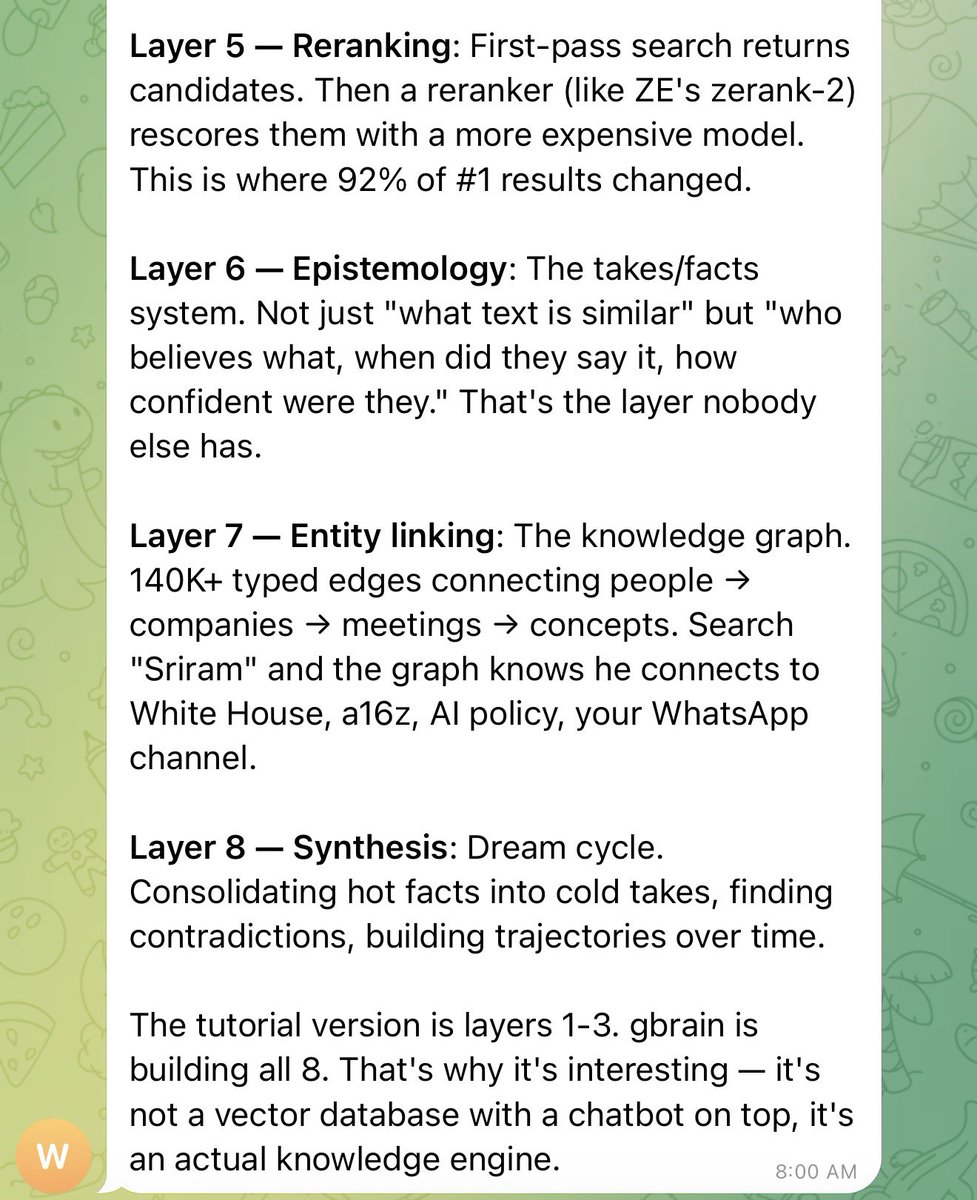
What is GBrain? My open source project is a knowledge system, not RAG in a box. It gives agents 8 layers that work together to improve memory in a way that makes your already smart OpenClaw or Hermes Agent feel clairvoyant about who you are. Personal AI becomes possible.
Garry Tan tweet mediaGarry Tan tweet media
English
142
180
2.1K
368.6K
Oliver Hassell
Oliver Hassell@oliverhassell·
@steipete Just appreciating you’ve unlocked the unlimited token glitch. It’s a hefty amount of token leverage you have to work with.
English
0
0
1
106
Peter Steinberger 🦞
Peter Steinberger 🦞@steipete·
People freaking out over my AI spend. What nobody sees: Part of what excites me so much about working on OpenClaw is that I'm trying to answer the question: How would we build software in the future if tokens don't matter? We constant run ~100 codex in the cloud, reviewing every PR, every issue. If a fix on main lands, @clawsweeper will eventually find that 6 month old issue and close it with an exact reference. We run codex on every commit to review for security issues (as it's far too easy to miss). We run codex to de-duplicate issues and find clusters and send reports for the most pressing issues. We have agents that can recreate complex setups, spin up ephemeral crabbox.sh machines, log into e.g. Telegram, make a video and post before/after fix on the PR. There's codex that watch new issues and - if it fits our documented vision well, automatically create a PR of it. (that then another codex reviews) We have codex running that scans comments for spam and blocks people. We have codex instances running that verify performance benchmarks and report regressions into Discord. We have agents that listen on our meetings and proactively start work, e.g. create PRs when we discuss new features while we discuss them. We build clawpatch.ai to split all our projects into functional units to review and find bugs and regresssions. We do the same split for security with Vercel's deepsec and Codex Security to find regressions and vulnerabilities. All that automation allows us to run this project extremely lean.
English
511
424
7.5K
2M
Oliver Hassell
Oliver Hassell@oliverhassell·
@boringmarketer With every post I’m second guessing whether I just sound like AI. But then you don’t want to go unnecessarily obtuse just to prove you’re not. I also wonder how many people are legitimately reading content before getting their AI to comment for them for ease/consistency.
English
1
0
0
35
The Boring Marketer
The Boring Marketer@boringmarketer·
AI replies feel like they are all over X right now
English
30
0
24
9.3K
Oliver Hassell
Oliver Hassell@oliverhassell·
It’ll be fascinating watching how quickly B2B martech and salestech integrators pivot around this. The large SIs, boutiques and solo architects already have a lot of the implementation skills. There’s a lot of work to go around.
English
0
0
0
9
Oliver Hassell
Oliver Hassell@oliverhassell·
OpenAI spending billions on deployment doesn’t feel that surprising, even if it looks unorthodox compared with normal B2B SaaS. You can’t just switch enterprise AI on. Disparate teams, workflows, systems, data ownership, maintenance, dependencies.
Greg Brockman@gdb

Introducing the OpenAI Deployment Company, which will help businesses maximally succeed with their deployments of AI. Starting with 150 Forward Deployed Engineers and Deployment Specialists, and $4 billion of initial investment from 19 partners.

English
1
0
0
23
Oliver Hassell
Oliver Hassell@oliverhassell·
@pashmerepat @pashmerepat I tried Codex harness again today. Single-agent checks looked OK, but concurrent multi-agent use wasn’t reliable for me: one lane would respond while another timed out or hit “codex app-server client is closed”. Back on Pi for now. Anything I could be doing wrong?
English
0
0
0
24
Oliver Hassell
Oliver Hassell@oliverhassell·
@pashmerepat I tried the Codex harness a week ago and it all fell apart when multiple OC agents hit it at once. I reinstated trusty Pi. Sounds like we should be good this time 🤞
English
1
0
0
589
pash
pash@pashmerepat·
Your ChatGPT subscription now powers an OpenClaw agent that genuinely feels magical to talk to. Previous OpenClaw releases had OpenAI models running, but they never quite let the models reach their full potential. That changes today. Personality is now deliberate, tool calls land exactly where they should, and your agent actually follows through on what it says it will do. OpenClaw is now running on top of the Codex harness by default. In handing the inner loop to OpenAI's native Codex harness, we eliminated the conflicting instructions and duplicate tools that used to make the model hesitate. What we stripped out under the hood: - Duplicate tools (no more guessing between Codex native vs OpenClaw versions) - Conflicting instructions (no more NO_REPLY vs message tool ambiguity) - Leaked context (heartbeat logic only appears on actual heartbeat turns) Less context bloat. More room for the agent to think. And here's what we inherited for free, thanks to the Codex App Server: - Searchable dynamic tools. Roughly 5,500 fewer upfront tokens per turn, which means faster and cheaper. - Auto-Review mode using the built-in Codex guardian. - OpenAI's native plugins (Calendar, Email, Drive) running in the same thread. For you, the result is a personal agent that actually feels personal. It picks up where you left off across any channel, handles things before they hit your radar, and only breaks your flow when it has something genuinely worth showing you. For developers, the result is stability. Because the inner loop runs on OpenAI’s native Codex harness, every upstream improvement lands in your agent automatically. To get started, paste this in terminal: > openclaw onboard That is the whole setup.
Peter Steinberger 🦞@steipete

We've been working really hard on performance, reliability, security, and stability. Invented whole new automation flows with crabbox, automated video QA and are spending insane amounts of CPU cycles on CI. It's a good release.

English
55
54
1K
151.9K
Oliver Hassell
Oliver Hassell@oliverhassell·
Not one big prompt, but relentless agent iteration against a written standard. /Goal in Codex has been key. Skills for repeatable Paper steps, subagents to build/review, and human gates before I accept it. Would love to make this faster, though. Maybe I over engineered it.
English
0
0
0
17
Oliver Hassell
Oliver Hassell@oliverhassell·
The build in repo needs its own contract, too. Once the design is set, I make the agent map it into components, states, responsive behaviour, tests, and screenshots. Then another pass reviews the implementation against the visual contract and keeps a ledger of what still fails.
English
1
0
0
19
Oliver Hassell
Oliver Hassell@oliverhassell·
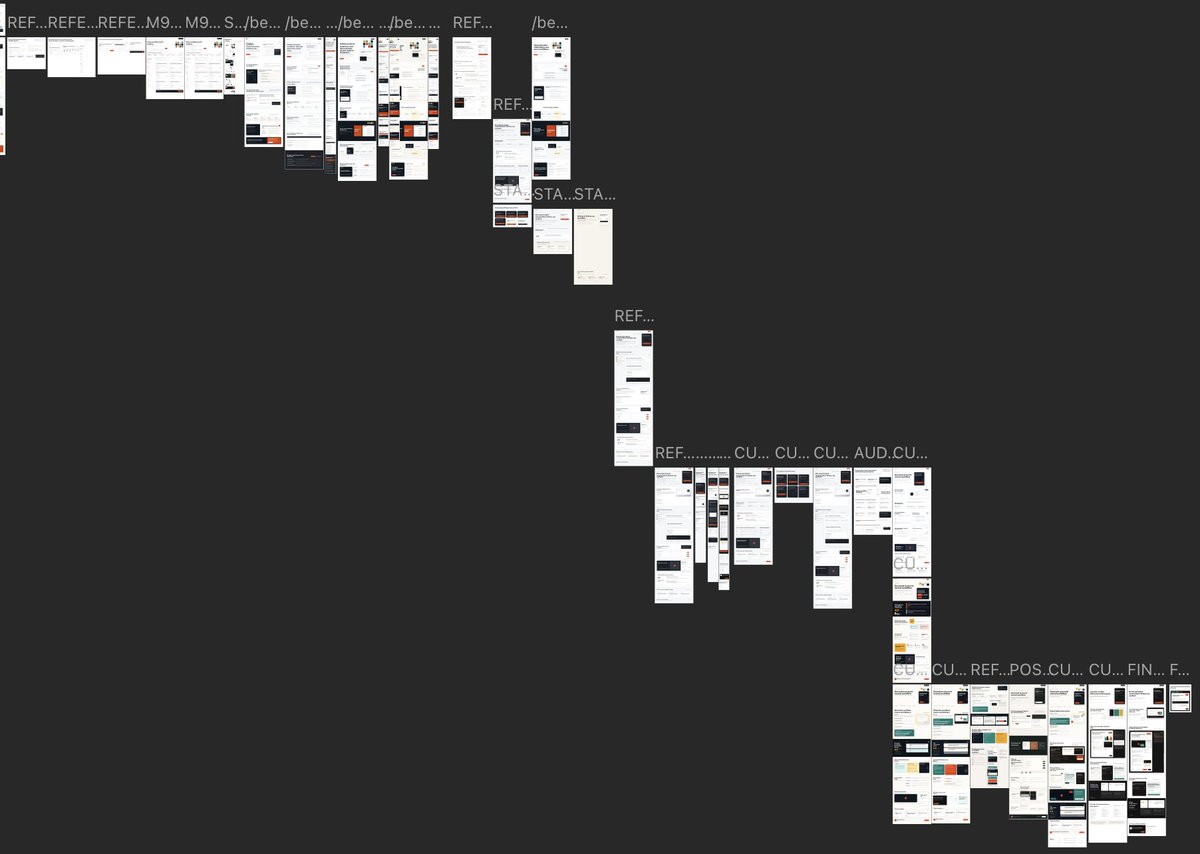
Been using @paper with Codex for several weeks. It has sped the design process up.. a lot. It's best when I start with a visual contract: layout, spacing, hierarchy, states, and what “done” means. Without that, the agent can make something nice... that I didn't want.
Oliver Hassell tweet media
English
1
0
1
41