Adebakin Olamilekan Olujimi retweetledi
Adebakin Olamilekan Olujimi
3.8K posts

Adebakin Olamilekan Olujimi
@olujimi_the_dev
Building onchain systems with intent. ex @pasarHq | ex @noughtaegis | ex @spectroniq | alumni @AtriumAcademy | alumni @CyfrinUpdraft
Lagos, Nigeria Katılım Temmuz 2023
4.8K Takip Edilen643 Takipçiler

@echo_vick BAOBAB Protocol is the first decentralized exchange where orders become tradeable assets. Unlike traditional DEXs where your order is just a database entry, BAOBAB mints every limit order as an NFT you can stake, collateralize, trade.
github.com/olujimiAdebaki…
English
Adebakin Olamilekan Olujimi retweetledi

Over the weekend... I built an open-source Palantir! 🚀
It visualizes these:
- Country conflict intelligence
- Military bases locations
- Near real-time threat mapping
- Deep research/Intel on entities like Hezbollah or any groups
Learn wars, conflicts, military bases and history of nations with the Global threat map. 🧙
🔗 globalthreatmap.up.railway.app
English
Adebakin Olamilekan Olujimi retweetledi

"The Math of Why You Can't Focus at Work".
by Can Duruk
justoffbyone.com/posts/math-of-…
English
Adebakin Olamilekan Olujimi retweetledi

90% of candidates don’t get shortlisted.
Because they don’t use numbers.
You’re reading this because “90%” caught your attention.
That’s exactly how recruiters think too.
Resumes without metrics are invisible.
---
The real truth about resumes (as someone who looks at a lot of them)
Most resumes sound like this:
> “Worked on backend services”
> “Handled APIs”
> “Responsible for performance improvements”
This tells me nothing.
No scope.
No impact.
No ownership.
---
What recruiters actually look for
They scan for signals of impact:
Scale
Ownership
Results
Decision-making
Numbers create those signals instantly.
---
The language shift that changes everything
❌ Common language (gets ignored)
> Worked on microservices
> Improved performance
> Handled database queries
> Fixed production issues
> Led a team
✅ Impact language (gets shortlisted)
> Spearheaded migration of 6 services from monolith to microservices, reducing deploy time by 42%
> Optimized critical APIs, cutting P95 latency from 820ms → 310ms
> Reduced database load by 35% through indexing and query rewrites
> Resolved recurring production incidents, lowering on-call alerts by 60%
> Led a team of 5 engineers, delivering features used by 1M+ users
Same work.
Very different perception.
---
Why verbs like spearheaded matter
Words like:
Spearheaded
Drove
Owned
Designed
Architected
Led
Signal agency.
They tell the reader:
“This person didn’t just attend meetings.
They moved things forward.”
---
A simple resume formula that works
Use this structure for every bullet:
Action verb + What you did + How + Measurable outcome
Example:
Spearheaded redesign of caching strategy using Redis, reducing API error rates by 47% during peak traffic
If you can’t attach a number:
+ Add scale (users, services, regions)
+ Add frequency (daily, weekly, per second)
+ Add before/after comparison
---
Think about it!
Recruiters spend 6–10 seconds per resume.
They don’t read. They scan.
Numbers force their eyes to stop.
If your resume has no metrics, you’re asking them to imagine your impact.
They won’t.
Make it obvious.
Make it measurable.
Make it impossible to ignore.
That’s how you get more interviews.
English
Adebakin Olamilekan Olujimi retweetledi

Check out this Book "Distributed Services with Go" by Travis Jeffery
Link: pragprog.com/titles/tjgo/di…
After reading this book you'll be able to build a complete event-streaming service from scratch
you'll master:
> gRPC for networked services
> Service discovery with Serf
> Consensus algorithms (Raft)
> TLS & mutual authentication
> Observability (metrics, logs, traces)
> Kubernetes deployment
> Load balancing strategies
This book is for Gophers who know the basics and want to apply Go to real-world distributed systems.
This book walks through building a complete distributed system.

English
Adebakin Olamilekan Olujimi retweetledi

Modern System Design 2026 Roadmap
├── /00_Foundations
│ ├── system_design_overview
│ │ ├── goals_and_tradeoffs
│ │ ├── scalability_latency_throughput
│ │ └── reliability_availability
│ ├── networking_basics
│ │ ├── tcp_ip_http
│ │ └── dns_and_load_balancing
│ └── data_structures_algorithms_for_systems
│
├── /01_requirements_and_constraints
│ ├── functional_vs_nonfunctional
│ ├── capacity_planning
│ ├── latency_budgeting
│ └── apis_and_contracts_specification
│
├── /02_core_architectural_patterns
│ ├── monoliths_vs_microservices
│ ├── event_driven_architecture
│ ├── service_oriented_architecture
│ └── serverless_patterns
│
├── /03_scalability_design
│ ├── horizontal_vs_vertical_scaling
│ ├── partitioning_and_sharding
│ ├── caching_strategies
│ │ ├── cdn_cache
│ │ ├── redis_memcached
│ │ └── cache_invalidation
│ └── queuing_and_buffering
│ ├── message_queues
│ └── kafka_pubsub_patterns
│
├── /04_data_management
│ ├── database_selection
│ │ ├── relational_db_design
│ │ ├── nosql_design_patterns
│ │ └── multi_model_databases
│ ├── consistency_models
│ │ ├── strong_vs_eventual
│ │ └── transactional_guarantees
│ ├── distributed_databases
│ └── backup_and_disaster_recovery
│
├── /05_api_and_microservices
│ ├── rest_api_design_principles
│ ├── graphql_and_hybrid_apis
│ ├── api_gateway_patterns
│ ├── versioning_and_deprecation_strategies/
│ └── rate_limiting_and_throttling
│
├── /06_observability_and_monitoring
│ ├── logging_and_tracing
│ │ ├── structured_logs
│ │ └── distributed_tracing
│ ├── metrics_and_alerting
│ │ ├── prometheus
│ │ └── grafana
│ └── chaos_engineering
│
├── /07_fault_tolerance_and_reliability
│ ├── redundancy_patterns
│ ├── circuit_breakers
│ ├── fallback_strategies
│ ├── rate_limiters
│ └── graceful_degradation
│
├── /08_edge_and_content_delivery
│ ├── cdn_architectures
│ ├── edge_computing_patterns
│ ├── regional_replication
│ └── geo_routing
│
├── /09_security_at_scale
│ ├── authentication_authorization
│ │ ├── oauth2_jwt
│ │ └── zero_trust_models
│ ├── encryption_in_transit_at_rest
│ ├── secret_management
│ └── api_security_patterns
│
├── /10_cloud_native_design
│ ├── containers_and_orchestration
│ │ ├── docker
│ │ └── kubernetes
│ ├── infrastructure_as_code
│ │ ├── terraform
│ │ └── cloudformation
│ ├── autoscaling_and_self_healing
│ └── multi_cloud_and_hybrid_architectures/
│
├── /11_real_time_and_stream_processing
│ ├── websocket_design_patterns
│ ├── streaming_with_kafka
│ ├── complex_event_processing
│ └── realtime_analytics
│
├── /12_large_scale_search_and_ai_workloads
│ ├── vector_search_infrastructure
│ ├── embedding_pipelines
│ ├── retrieval_augmented_generation
│ └── model_serving_at_scale
│
├── /13_cost_and_performance_optimization
│ ├── performance_tuning
│ ├── cost_effective_architectures
│ ├── autoscaling_cost_savers
│ └── reserve_capacity_strategies
│
├── /14_case_studies_modern_systems
│ ├── design_amazon_like_ecommerce
│ ├── scale_netflix_like_streaming
│ ├── build_tiktok_like_feed
│ ├── social_network_architecture
│ └── large_scale_collaboration_platform
│
└── /15_capstone_design_exercises
├── exercise1_global_chat_service
├── exercise2_high_throughput_payment_system
├── exercise3_real_time_gaming_service
├── exercise4_distributed_search_platform
Grab the System Design eBook:
codewithdhanian.gumroad.com/l/ntmcf

English
Adebakin Olamilekan Olujimi retweetledi

Some common questions I see in most Golang interview reports 👇
Goroutines vs Threads
How goroutines are scheduled, M:N model, when they block, and why they’re cheap.
Channels (buffered vs unbuffered)
How synchronization works, blocking behavior, and when to use each.
Concurrency vs Parallelism
What Go gives you by default, and how GOMAXPROCS affects execution.
Interfaces in Go
Implicit implementation, zero-value interfaces, and why they enable clean design.
defer keyword
Execution order, stack behavior, and common pitfalls (especially in loops).
Pointers vs Values
When to pass by value vs pointer, performance and mutability trade-offs.
Error handling in Go
Why Go avoids exceptions, idiomatic error wrapping, and errors.Is/As.
Slices vs Arrays
Backing array, capacity growth, and why slice bugs happen.
Maps internals
Reference semantics, concurrency issues, and why maps aren’t thread-safe.
Garbage Collection basics
How Go’s GC works at a high level and how it affects latency.
If you’re solid on these, most Go interviews should be easy.
SumitM@SumitM_X
Some common questions that you I see in most Java Interview reports : - Optional in Java - Why String is immutable - Spring profiles - terminal and intermediate operations in streams

English
Adebakin Olamilekan Olujimi retweetledi

If you’re auditing an AMM protocol, these papers and articles are essential reading 🫡
🚩 Decentralized Finance & Automated Market Making
🔗 arxiv.org/pdf/2307.03499…
🚩 AMM Integration Tips
🔗 blog.pessimistic.io/amm-automatic-…
🚩 Understanding AMM Vulnerabilities
🔗 medium.com/oxorio/cracks-…
🚩 Typical Vulnerabilities in AMM Protocols
🔗 blog.decurity.io/typical-vulner…
🚩 DeFi Slippage Attacks
🔗 dacian.me/defi-slippage-…
🚩 Generalizing Knowledge on DEXs with AMMs — Part I
🔗 medium.com/uclcbt/general…
🚩 Generalizing Knowledge on DEXs with AMMs — Part II
🔗 medium.com/uclcbt/general…
English
Adebakin Olamilekan Olujimi retweetledi

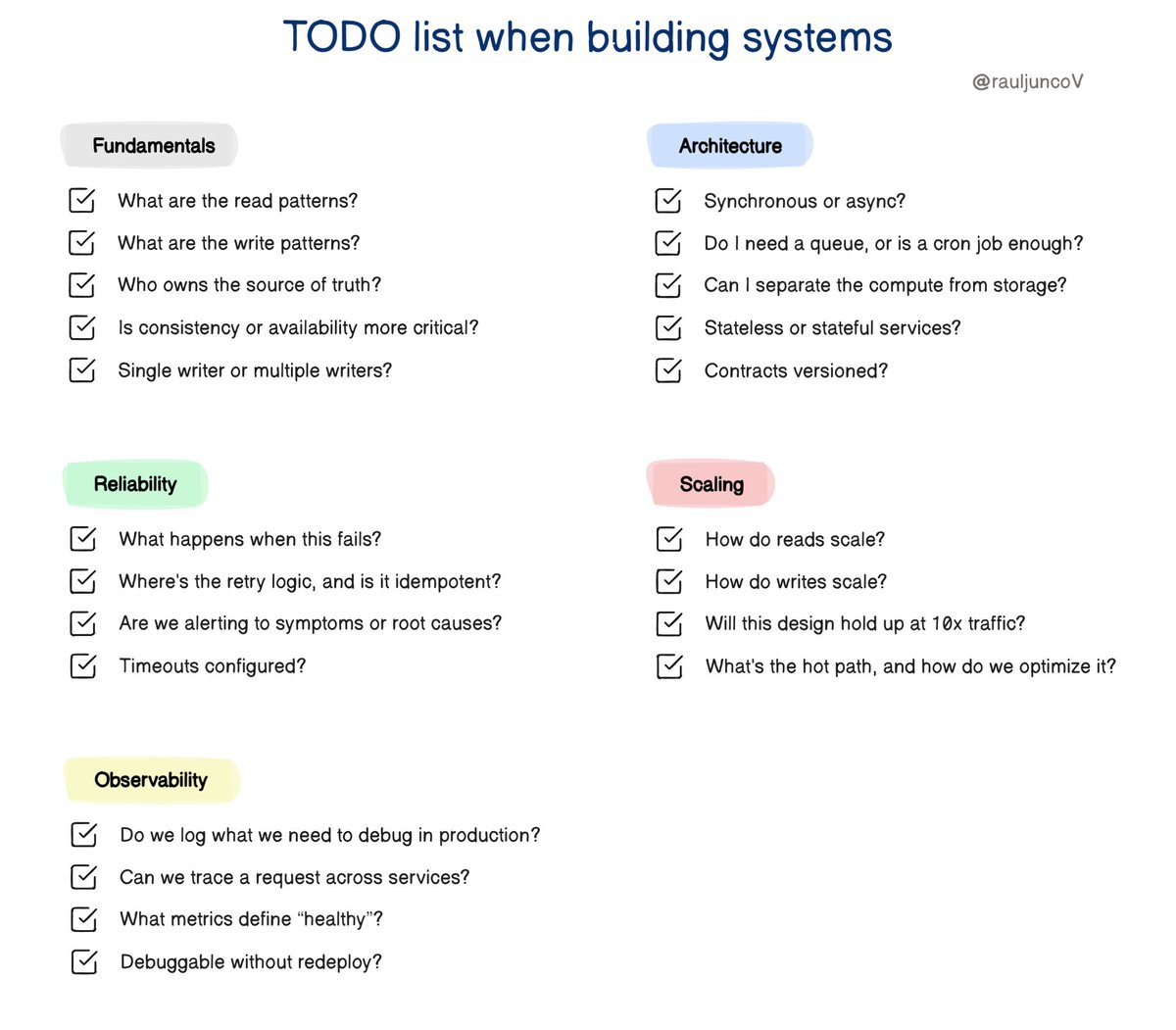
I treat system design like a checklist.
Here’s my go-to mental TODO list when building systems:
Fundamentals
- What are the read patterns?
- What are the write patterns?
- Who owns the source of truth?
- Is consistency or availability more critical?
- Single writer or multiple writers?
Architecture
- Synchronous or async?
- Do I need a queue, or is a cron job enough?
- Can I separate the compute from storage?
- Stateless or stateful services?
- Contracts versioned?
Reliability
- What happens when this fails?
- Where’s the retry logic, and is it idempotent?
- Are we alerting to symptoms or root causes?
- Timeouts configured?
Scaling
- How do reads scale?
- How do writes scale?
- Will this design hold up at 10x traffic?
- What’s the hot path, and how do we optimize it?
Observability
- Do we log what we need to debug in production?
- Can we trace a request across services?
- What metrics define “healthy”?
- Debuggable without redeploy?
I don’t always follow it linearly, but if something breaks or feels off, this list helps me pinpoint what I may have overlooked.
Add something for the next engineer 👇

English

@Vickish11 @grok Pls where are you sailing to..
Pls stay put Nigeria needs ur vote 2027 is not far lol
English

@developer_dao I would complete this end to end
github.com/olujimiAdebaki…
English
Adebakin Olamilekan Olujimi retweetledi

In Haskell, this is known as The Handle Pattern
jaspervdj.be/posts/2018-03-…
English
Adebakin Olamilekan Olujimi retweetledi