Searching for the deepest structural coherence in nature. Research of Global Entropic Consistency (GEC) — an axiomatic informational framework. Not ToE.
Physical laws can be seen as consistent rules for how information flows between degrees of freedom while keeping global entropy in balance. In this view, the double copy is an information‑theoretic bridge: gravity amplitudes look like “two copies” of gauge amplitudes not because gravity = 2×Yang–Mills, but because both theories share the same information structure. When two theories carry the same information flow, a mathematical link must exist.
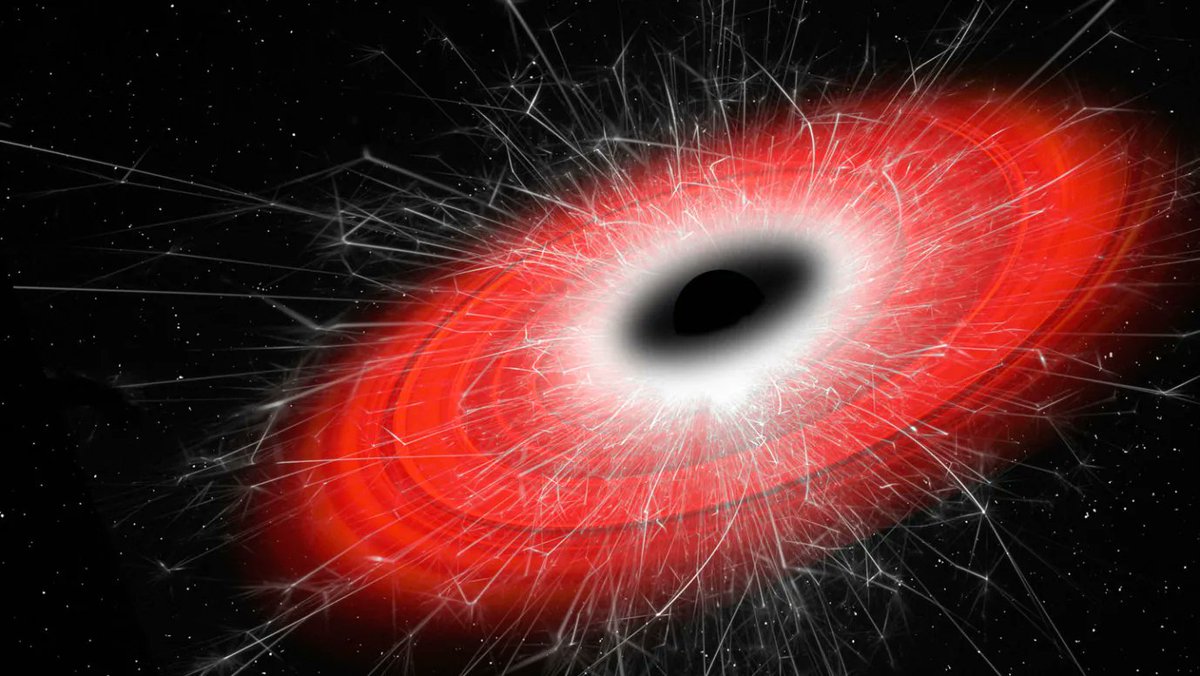
Black holes are not completely black. According to Stephen Hawking’s 1974 prediction, they should emit an extremely faint stream of particles known as Hawking radiation.
This radiation is central to some of the deepest problems in modern physics because it sits at the boundary between general relativity, which describes gravity and spacetime, and quantum physics, which governs particles and information.
The problem is that Hawking radiation is far too weak to observe directly from real astrophysical black holes, so physicists need indirect mathematical ways to study it.
A new set of studies suggests that one of those tools may be the “double copy,” a mathematical relationship that links certain calculations in particle physics with calculations in gravity.
The double copy works almost like a translation dictionary between two languages of physics.
On one side is the Standard Model, which describes particles and forces such as electromagnetism and the strong and weak nuclear forces. On the other side is general relativity, which describes gravity.
These theories look very different, but the double copy shows that, in some cases, gravitational phenomena can be written as if they were built from two copies of simpler particle-physics structures.
This has already helped physicists simplify difficult gravity calculations, and now researchers have shown that it can also be applied to Hawking radiation.
Several teams have independently found a particle-physics analogue of Hawking radiation. In this translated picture, the emission of a Hawking particle by a black hole corresponds mathematically to a charged particle scattering from a collapsing spherical shell of charged matter.
This does not mean that black holes literally work like charged shells in ordinary space. It means that the equations describing both situations share the same mathematical structure. That is the important point: a process normally associated with curved spacetime and quantum fields near a black hole can be studied through a more familiar framework from particle physics.
This matters because Hawking radiation is not just a theoretical curiosity. It leads directly to the black hole information paradox. If black holes emit radiation, they gradually lose mass and may eventually evaporate. But if everything that fell into the black hole disappears with it, then information appears to be destroyed, which conflicts with a basic principle of quantum mechanics.
By translating aspects of Hawking radiation into the language of the Standard Model, physicists may gain new tools to explore what happens to that information and whether the radiation carries subtle traces of what the black hole absorbed.
The result is not a final solution to black holes, quantum gravity, or the information paradox. It is more like a new technical route into a problem that has resisted direct attack for decades.
Researchers are especially interested in whether the same double-copy approach can help describe the event horizon itself, the boundary beyond which nothing can escape. If that can be translated into particle-physics language too, it could offer a clearer mathematical bridge between quantum theory and gravity.
For now, the advance shows that Hawking radiation, one of the most mysterious predictions in theoretical physics, may be accessible through a surprising connection between the physics of particles and the physics of spacetime.
👉 share.google/H51PQsVcAVjCe5…
The Universe just delivered a clean message:
F(r) ∝ r^(-2) even on 100–300 Mpc scales.
Since Φ(r) ∝ r^(2−d), a 3D universe *forces* the inverse‑square law as its IR attractor.
Not good news for modified gravity theories — but fully consistent with any emergent framework where Newton/GR is the stable IR limit.
A new test of gravity has pushed one of physics’ oldest ideas into the largest arena yet: the cosmic web.
Researchers studied how galaxy clusters move toward one another across enormous distances, reaching scales of hundreds of millions of light-years, to see whether gravity still weakens with distance in the way expected from Newton’s inverse-square law and Einstein’s general relativity.
The result is strikingly conventional: gravity behaved as expected.
Even across vast cosmic scales, the attraction between massive structures appears to fade with distance in the standard way.
That does not mean Newtonian gravity replaces Einstein’s theory, because general relativity remains the deeper framework for modern cosmology. But it does mean that the familiar inverse-square behaviour still works extremely well as an effective description on scales far beyond the Solar System.
The researchers used the kinematic Sunyaev-Zel’dovich effect, a tiny imprint left on the cosmic microwave background when its ancient light passes through hot gas around moving galaxy clusters.
By measuring this subtle distortion, they could infer the motion of those clusters and test how strongly gravity pulls them together.
The result matters because it puts pressure on some modified-gravity explanations for dark matter. If the missing mass problem were mainly due to gravity behaving differently on cosmic scales, we might expect to see deviations from the standard prediction. Instead, the measurements align closely with ordinary gravity. That supports the idea that unseen matter is really contributing extra gravitational pull, rather than the effect being easily explained by changing gravity alone.
It does not solve the dark matter problem. We still do not know what dark matter is made of. But it strengthens the standard cosmological picture: gravity is behaving normally, even across some of the largest structures in the Universe, and the evidence for dark matter remains hard to dismiss.
👉share.google/a2Asm8EsbdKusf…
Improving the microscopic consistency of a theory is not sufficient for unification. The central unresolved issue is the absence of a controlled transition: a derivation of macroscopic spacetime and effective laws from underlying fine-grained dynamics.
Without such a mechanism, structural gaps between quantum theory, gravity, and cosmology are not eliminated but merely displaced. A theory may resolve inconsistencies at the microscopic level while leaving the emergence of classical behaviour only partially understood.
This pattern is illustrated even in advanced frameworks such as String Theory. While it provides a highly developed microscopic description and realizes explicit micro–macro correspondences in special settings (e.g. AdS/CFT Correspondence), it does not yet offer a general, physically realistic derivation of macroscopic spacetime or a unique selection of observed symmetries and parameters.
A genuine resolution therefore requires not only a consistent microscopic model, but an explicit and controlled account of how classical physics emerges from it. Until such a micro-to-macro mechanism is established, the structural incompleteness of current theories is not removed but relocated.
Deep down, space may have only one dimension -- and that could solve the problem with combining quantum physics and gravity
youtube.com/watch?v=w88x3_…
The dynamical state of XMM‑VID1‑2075 is consistent with a system that has undergone an exceptionally rapid redistribution of angular momentum, likely triggered by a violent collapse or a counter‑rotating major merger. Such an event would induce a short entropic relaxation timescale, allowing the galaxy to transition into a pressure‑supported, dispersion‑dominated configuration significantly earlier than predicted by standard hierarchical models.
Astronomers using the #JWST have found a massive galaxy in the early Universe that behaves in a surprisingly mature way: it does not appear to rotate.
The galaxy, called XMM-VID1-2075, existed when the Universe was less than two billion years old, yet its internal motion looks more like that of very massive galaxies in the nearby Universe, where stars often move in more random, pressure-supported orbits rather than in an orderly rotating disk.
That is unexpected because young galaxies are generally thought to acquire spin as gas falls inward under gravity, building angular momentum during formation.
Over cosmic time, mergers and interactions can disrupt that rotation, but this usually takes billions of years. Finding such a slow-rotating system so early therefore suggests that some massive galaxies may have evolved dynamically faster than expected.
The galaxy had already been identified by the MAGAZ3NE survey as one of the most massive galaxies known at that epoch, with several times more stars than the Milky Way, and it was also no longer forming new stars.
JWST allowed the team to go further by measuring the motion of material inside XMM-VID1-2075 and comparing it with two other galaxies from a similar period. One of the three showed clear rotation, another looked dynamically irregular, and XMM-VID1-2075 showed no clear rotation but a large amount of random stellar motion.
In other words, it seems to have reached a state normally associated with older, more evolved galaxies much earlier than standard expectations would suggest.
One possible explanation is not a long sequence of mergers, but a single major collision between two galaxies rotating in nearly opposite directions. If their angular momenta partially canceled each other out, the remnant could lose much of its net spin.
The observations show an excess of light off to one side of the galaxy, which may indicate an interacting object or merger debris influencing its dynamics. For now, this is not a definitive solution, but it is a plausible physical mechanism.
The broader significance is that JWST is now making it possible to study internal galaxy motions at high redshift, not just their brightness, mass, or color. If more early slow rotators are found, models of massive galaxy formation will have to explain how such evolved dynamical structures appeared so quickly after the Big Bang.
(IMG: Artístic illustration)
👉 share.google/tnZrCGmjCwMOb6…
@skdh The vacuum effects we measure are real, but the ‘virtual particles’ used to describe them are just the mathematical representation of something we cannot directly identify. We only see the information they leave behind.
@SelfLegible@latestincosmos What stands out is that it treats the constants as consequences rather than inputs. That’s unusual enough that it’s worth paying attention to, at least at the level of seeing whether the numbers actually check out.
Yes. The paper is structural because it is the carrier theorem. It proves the terminal public comparison carrier and its four-dimensional closure. It is not intended to contain the later arithmetic, spectral, or dynamical readouts.
Those are developed in follow-up papers over the same retained carrier. Two resulting consequences are the fine-structure constant and the electron anomaly, bypassing QED and both matching experiment to sub-0.1-sigma precision, with the remaining numerical limitation coming from computational effort and the experimental uncertainty currently available for comparison.
🚨: Quantum Cosmology suggests the universe created itself from “nothing.”
But if there was truly nothing…
who wrote the laws of physics?
Did the universe need a creator —
or did reality somehow bring itself into existence?
💬 What do you think?
God? Pure physics? Or something beyond both?
Your point is well‑taken.
What cosmology calls “nothing” is not an absolute void, but an undifferentiated everything — a state so symmetric and structureless that no meaningful claims can be made about it. The universe would then be the self‑consistent carve‑out of this total possibility space, the part that can persist and evolve.
@omnicoherence@latestincosmos Nothing could be defined as an undifferentiated everything. Its is so random that you can make no claim about it. The universe would then be the carve-out of this "everything" that is such that it perpetuates. I.e. "Something from Everything".
What if “collapse” isn’t a physical process in space, but a change in the deeper structure from which space emerges? Reality may not be locally dynamical at all — and that’s exactly what an emergent spacetime would look like.
If collapse is a change in the underlying structure — not a process inside space — then quantum weirdness, nonlocality, measurement, and emergent spacetime all become different faces of the same idea.
🚨 Scientists just used a DARK MATTER detector to test one of the strangest ideas in quantum physics:
What if wavefunction collapse is a REAL physical process?
Not just mathematics.
Not just “observation.”
An actual physical event happening inside reality itself.
The XENONnT detector a giant underground liquid xenon experiment built to search for dark matter was used to hunt for tiny X-ray bursts predicted by “quantum collapse” theories.
Here’s the idea:
Quantum mechanics says particles can exist in superpositions:
multiple possible states at once.
But when measured…
the wavefunction “collapses” into one outcome.
Physics still doesn’t fully know WHY.
Some theories like Continuous Spontaneous Localization (CSL) and the Diósi–Penrose model suggest collapse happens naturally and may even be connected to gravity itself.
If true, collapsing wavefunctions should emit faint radiation.
So researchers searched for those signals deep underground using one of the most sensitive detectors ever built.
Result?
No collapse signal detected.
And that’s huge.
Because it places the strongest limits EVER on these collapse models shrinking the possible space where they could exist.
The deeper implication is fascinating:
We may be entering an era where quantum foundations stop being purely philosophical…
and become experimentally testable physics.
The line between:
• quantum mechanics
• gravity
• measurement
• spacetime itself
is starting to blur.
And dark matter detectors are quietly becoming observatories for entirely new kinds of physics.
Follow me if you want the future of physics translated before it becomes mainstream.
AdS/CFT is an extraordinarily precise and powerful framework for quantum gravity — the most concrete realization of the holographic principle we currently possess. Yet its reliance on an asymptotically anti–de Sitter geometry, with a negative cosmological constant and a conformal boundary at infinity, means it cannot straightforwardly serve as a direct description of our de Sitter–like universe. This is not merely a technical inconvenience: the causal and entropic structure of de Sitter space — defined by a closed cosmological horizon with finite Bekenstein–Hawking entropy — differs fundamentally from the AdS setting in which holographic duality is well understood.
This does not diminish AdS/CFT as a tool. It continues to illuminate how gravity and geometry can emerge from patterns of entanglement encoded at a boundary, and it has been productively extended beyond its strict domain of validity. Attempts to build analogous frameworks for other geometries — including dS/CFT correspondence, static patch holography, and celestial holography for asymptotically flat spacetimes — suggest that holographic duality is a broader principle, not an artifact of the AdS construction. Whether any of these approaches will yield a complete description of our universe remains genuinely open.
What seems clear is that a holographic formulation of de Sitter space, if it exists, must be compatible with a positive cosmological constant, respect the entropic bound imposed by a finite horizon, and likely requires conceptual tools that go beyond a straightforward adaptation of AdS/CFT. Whether that constitutes an extension, a reformulation, or something more radical is one of the hardest unsolved problems in theoretical physics today.
Juan Maldacena wrote the most cited paper in theoretical physics, birthing AdS/CFT and realizing holography — and today, the problem keeping him up at night is wormholes. He suspects space-time isn't fundamental at all, that geometry itself might be what entanglement looks like from the inside. The singularity isn't a place, it's a name for everything we don't yet understand. I hope you enjoy it.
14D Observers is locally infinite-dimensional (bundle of metrics, infinite-dim gauge group). GU tries to reduce to finite 4D, but the underlying structure contains infinite degrees of freedom. Coarse-graining from 14D to 4D works (emergence of SM + GR), but renormalization and infinities in the QFT part remain a problem (similar to standard SM).
Some quantum phenomena do have classical analogues, and they can illuminate parts of the underlying phenomenology. Quantum mechanics also clearly points toward deeper structural principles — whether informational, geometric, or gravitational in nature. But it is not simply classical physics in disguise; the quantum framework captures features that no classical model has yet reproduced. The quantum world is genuinely different — and that’s exactly why it’s fascinating.
@ExploreCosmos_ The universe isn’t made of things. It’s made of the ways its laws can remain invariant. Everything else — fields, energy, particles, even us — is only a shadow of those invariances. And even this is just an interpretation — perhaps the best we have, but still not the final one.
What does mass really mean?
Mass feels like one of the most obvious properties in the universe. A stone has more mass than a feather. A planet has more mass than a mountain. The Sun has more mass than Earth. We use the word constantly, as if it simply means “how much stuff” something contains.
But in modern physics, mass is stranger than that.
Mass is not just substance. It is not just weight. It is not even one single idea.
The first meaning is inertia. Mass tells us how much an object resists being accelerated. Push a tennis ball and it moves easily. Push a car with the same force and it barely moves. That resistance is mass. In this sense, mass measures how hard it is to change an object’s motion.
The second meaning is gravitational mass. Mass is what responds to gravity, and also what produces gravitational attraction. Earth pulls on us because it has mass and energy. We pull on Earth too, just unimaginably weakly by comparison. One of the great insights behind general relativity is that inertial mass and gravitational mass behave as the same thing. That equivalence is not just a coincidence. It is one of the foundations of our understanding of gravity.
Then Einstein made the idea even deeper.
With E = mc², mass became a form of energy. Not metaphorically. Literally. A particle at rest still contains energy simply because it has mass. This is why nuclear reactions can release enormous amounts of energy: a tiny amount of mass can be converted into energy. Mass is not separate from energy. It is one way energy can appear.
But where does mass come from?
This is where the Higgs field enters the story. In the Standard Model of particle physics, fundamental particles such as electrons, quarks, and the W and Z bosons acquire mass through their interaction with the Higgs field. The stronger a particle interacts with that field, the more massive it is. The Higgs boson, discovered at CERN in 2012, was the experimental confirmation that this field is real.
That part is often summarized as “the Higgs gives particles mass.” It is true, but incomplete.
Because most of your mass does not come directly from the Higgs.
Almost all the mass of your body is in protons and neutrons, which make up atomic nuclei. Protons and neutrons are made of quarks, and those quarks do get their small individual masses from the Higgs field. But the quarks themselves account for only a tiny fraction of the proton’s mass. Most of the proton’s mass comes from the energy of the strong force, from quarks and gluons interacting inside it. In quantum chromodynamics, energy stored in the fields of quarks and gluons generates most of the “heft” of ordinary matter.
That means the mass of everyday matter is mostly not “stuff” in the simple sense.
It is energy.
The table, the mountain, your body, the Earth itself: most of their mass comes from the restless energy of confined quarks and gluons inside protons and neutrons. Matter looks solid and calm from the outside, but at the deepest level, much of its mass is generated by motion, fields, and binding energy.
That is a remarkable shift in perspective.
The Higgs field gives elementary particles their intrinsic masses, but the mass of ordinary matter mostly arises from the dynamics of the strong nuclear force. In other words, the thing we casually call “mass” is partly interaction with a field, partly resistance to acceleration, partly gravitational charge, and partly stored energy.
And then there are neutrinos.
Neutrinos have tiny masses, but the Standard Model in its original form does not fully explain them. We know they have mass because they oscillate between different types as they travel. But whether their mass comes from the Higgs field in the same way as other particles, or from a deeper mechanism, remains an open question. That is one reason neutrino physics is still one of the most active frontiers in particle physics.
So what does mass really mean?
It depends on the level at which you ask the question.
At the everyday level, mass is what makes objects heavy and hard to move.
At the relativistic level, mass is a form of energy.
At the particle level, some mass comes from interaction with the Higgs field.
At the nuclear level, most ordinary mass comes from the energy of quarks and gluons bound by the strong force.
And at the deepest level, we are still asking whether mass is telling us something even more fundamental about fields, symmetry, and the structure of reality.
Mass is not just “stuff.”
It is one of the ways the universe stores energy, resists change, and curves spacetime.
And the strange part is this: the weight of the world is not mostly made from the mass of particles themselves, but from the energy holding them together.
What if the universe did not originate as an “event‑like” Big Bang, but as a state of extreme entropic coherence — no information, no distinctions, no structure. The first symmetry‑breaking fluctuation gave rise to time, matter, and energy. And the entire cosmic evolution since then has been a gradual relaxation back toward that same quiet simplicity. This interpretation is more speculative than standard approaches, but it remains compatible with known physics.
Roger Penrose is not a fringe thinker. He is a Nobel Prize winning physicist who collaborated with Stephen Hawking on black hole theory. When he says the Big Bang was not the beginning, it is worth paying attention.
His theory is called Conformal Cyclic Cosmology. The idea is that our universe is one in an infinite sequence. Each beginning with a Big Bang and each ending in a state that seeds the next one.
Here is how it works. In the far future after all stars burn out and all black holes evaporate, the universe reaches a state of maximum entropy. Smooth, cold, and featureless. Penrose argues the mathematics of that dying universe becomes geometrically identical to a Big Bang. The end and the beginning are the same event viewed from different perspectives. One universe's death is the next one's birth.
What makes this more than philosophy is that Penrose claims physical evidence. Patterns in the cosmic microwave background, the afterglow of our own Big Bang, appear as faint concentric rings of varying temperature. He argues these are imprints from massive black hole collisions in the previous universe, echoes bleeding through the boundary between cosmic cycles.
Critics say the rings can be explained by conventional cosmology. The debate is ongoing.
But the question is: If the laws of physics allow a universe to exist, why would they only allow it once? Why should time have a beginning at all?
What if the universe did not originate as an “event‑like” Big Bang, but as a state of extreme entropic coherence — no information, no distinctions, no structure. The first symmetry‑breaking fluctuation gave rise to time, matter, and energy. And the entire cosmic evolution since then has been a gradual relaxation back toward that same quiet simplicity. This interpretation is more speculative than standard approaches, but it remains compatible with known physics.
“What is something most physicists believe that you think is completely wrong?”
Roger Penrose answered:
Inflation theory. While most cosmologists believe the universe began with a single Big Bang followed by rapid inflation, Penrose argues that the Big Bang was not the beginning at all. Instead, he believes the universe moves through endless cycles, where each universe begins with its own Big Bang and fades into a remote future before the next cycle begins.
Topology literally decides why there is something instead of nothing.
Suddenly you have a mechanism where a topological twist of the universe decides that matter will survive annihilation with antimatter. Not by chance. Not by symmetry that breaks randomly. But directly from the global structure of space.
When topology determines whether there are more particles than antiparticles, it ceases to be just a technical detail of baryogenesis. It becomes the answer to one of the deepest questions: why is there anything at all?
curtjaimungal.com Two papers, Physical Review D, March 2026. Janna Levin, Brian Greene, Daniel Kabat, and Massimo Porrati compactify the extra dimensions of the universe on a Klein bottle. The result is basically that the non-orientability of the space breaks CP symmetry. It now falls out of topology alone. If the program survives, then it’s a different way of explaining why anything exists instead of nothing. That is, why matter survived its annihilation with antimatter / why the universe we see has the asymmetry it has. New podcast out now here : curtjaimungal.com
Exactly. Modern physics shows that “nothing” is not empty, but full of structure, fluctuations, and paradoxes. Until we understand why empty space has so little energy, we don’t understand the universe. Thanks for opening it up. These are questions that patched physics can’t solve. Today’s models just fit and patch, but the vacuum energy problem is too deep for another patch. Until we move beyond GR+QFT, we won’t understand why “nothing” has energy—and why it has so little.
Why does empty space have energy?
Empty space sounds like the simplest thing in the universe. Remove the planets, stars, gas, dust, radiation and particles, and what should remain is nothing. A perfect absence. A blank stage.
But modern physics says that “nothing” is not really nothing.
In quantum field theory, the vacuum is not an empty container. It is the lowest energy state of the fields that fill the universe. Even when there are no particles present, those fields still exist. They fluctuate. They carry structure. They can produce measurable effects. Empty space, in this view, is not dead. It is physically active.
This is one of the strangest ideas in modern physics, but it is not just speculation. Effects associated with the quantum vacuum appear in real experiments, such as the Casimir effect, where two very closely spaced conducting plates experience a tiny force because the allowed vacuum fluctuations between them differ from those outside. The effect is subtle, but it shows that the vacuum has physical consequences.
Then cosmology makes the problem much bigger.
In Einstein’s general relativity, energy does not just sit passively inside the universe. Energy gravitates. It affects the geometry of spacetime. So if empty space has energy, that energy should influence the expansion of the universe.
And this is where dark energy enters the story.
In the standard cosmological model, the accelerated expansion of the universe is usually described by the cosmological constant, Lambda. It behaves like a fixed energy density of space itself. Unlike matter, which becomes more diluted as the universe expands, this energy density remains constant. As space grows, there is more space, and therefore more of this vacuum-like energy.
That sounds almost absurd. But observationally, something like it is required. Measurements of distant supernovae in the late 1990s showed that the expansion of the universe is accelerating. Later observations of the cosmic microwave background, galaxy clustering and baryon acoustic oscillations built a consistent picture in which dark energy dominates the present universe.
So the vacuum might not be empty. It might be part of what drives cosmic acceleration.
But here is the problem: when physicists try to estimate the vacuum energy using quantum field theory, the result is catastrophically wrong. In the most naive calculations, it can be about 10^120 times larger than the value inferred from cosmology. That is not just a small mismatch.
This isn’t just a math error. It’s a crisis.
This is known as the cosmological constant problem, and it remains one of the deepest unresolved problems in modern physics.
The real mystery is not simply that empty space has energy. The deeper question is why it has so little.
If quantum fields contribute vacuum energy, why does almost all of it not gravitate in the way naive calculations suggest? Is there a cancellation mechanism we do not understand? Is the cosmological constant not really vacuum energy? Are we missing something about quantum gravity? Or is dark energy something dynamic rather than a true constant?
This last possibility has become especially interesting recently. The simplest model says dark energy is constant, with an equation-of-state parameter w = -1. But newer cosmological data, especially from DESI, have raised hints that dark energy might evolve with time rather than remain perfectly constant. These results are not yet a discovery. More data are needed.
If dark energy changes over time, then it may not be vacuum energy in the simple cosmological constant sense. It could be a field, sometimes called quintessence, slowly evolving as the universe expands. That would be a major shift. It would mean the acceleration of the universe is not caused by a static property of space, but by something dynamical.
Still, the cosmological constant remains the simplest explanation. It fits a huge range of observations remarkably well. Even the current hints from DESI are not a clean rejection of Lambda. They are a hint, not a verdict.
This is why the vacuum energy problem is so important. It sits at the intersection of two extraordinarily successful theories that do not yet fit together: quantum field theory and general relativity. Quantum theory tells us that empty space should have structure. Gravity tells us that energy curves spacetime. Cosmology tells us that the universe is accelerating. But when we try to combine all of this into one clean picture, the numbers do not make sense.
This isn’t a small technical issue. It may be telling us that we still do not understand what the vacuum really is.
Maybe empty space is not a passive background. Maybe it has hidden degrees of freedom. Maybe the energy we call dark energy is not the vacuum energy predicted by quantum fields, but a separate phenomenon. Maybe the solution requires quantum gravity. Or maybe the answer will be something we have not yet imagined.
What makes this question so powerful is that it turns “nothing” into one of the deepest physical problems we have.
The vacuum is not just emptiness. It may be where quantum physics, gravity and cosmology collide most sharply.
And until we understand why empty space has energy, or why it appears to have so little, we probably do not fully understand the universe itself.