@ProfKibwana He mentioned that while still the president, remember as head of state he used to get the best of what the intelligence arm could provide.
Why is Frm President Kenyatta frequently raising the youth issue? Does he know something other politicos don’t know? Recently, he advised his daughter Ngina to find out what Kenyan youth are doing. Again he was in a Makerere youth palaver. What’s up,Prezo? opr.news/364fe48250424e…
Victory for the People!
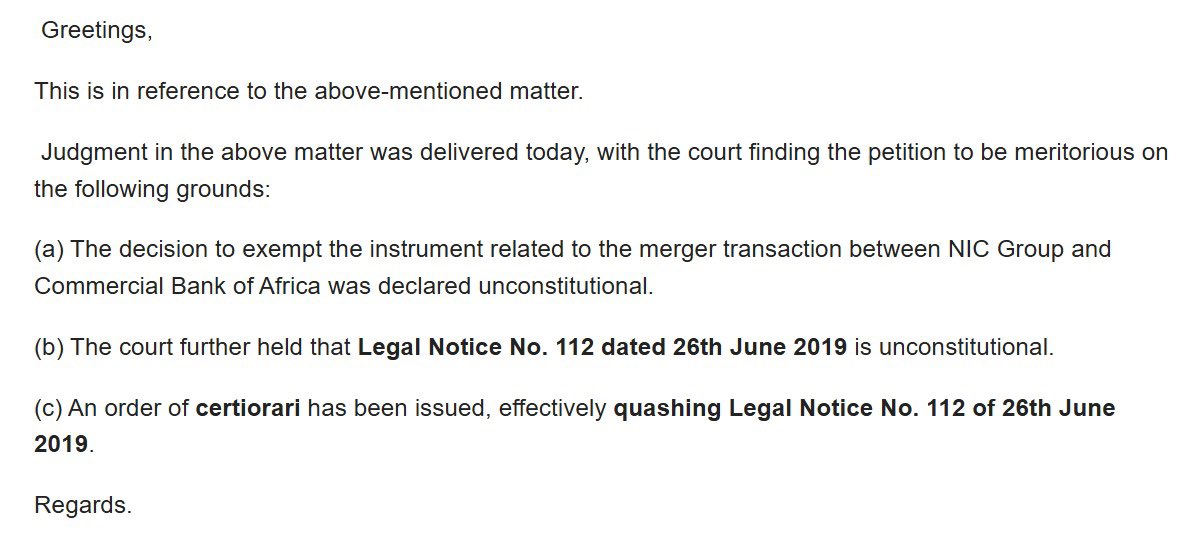
Today, the courts have delivered a monumental judgement in the case involving NIC group and Commercial Bank of Africa (CBA), declaring the tax exemption under Legal Notice No. 112 of June 2019 unconstitutional!
In the legal battle, I exposed an attempt by these banks to evade over 7 billion KES in taxes through a merger that would have let them escape their rightful tax obligations with NCBA Bank and Standard Chartered being central to the transaction.
The Executive, through the National Treasury, had granted this exemption which bypassed the legal processes for tax matters making it unconstitutional.
Thanks to the court’s decision, Legal Notice No. 112 is officially quashed, protecting the public purse from this unlawful tax evasion.
This is a huge win for Kenya. We must stay vigilant and demand transparency!
@KinyashCfc@blockxs@citizentvkenya Ngombe za Baba na Baba tulisema wakati huo na Uhuru tuka fungia mtu kwenda Uganda, mukapigia jamaa Debe mukasema na Muturi freedom is coming! Chichanganye na upizi wenu. Ooh signing doc. Ooh 10 billion
Muturi: I landed in Dubai and received a phone call from Ruto, who told me that Russian oligarchs were waiting at the airport and I needed to sign documents (on a Ksh.129B deal). I declined, saying I needed to review the documents in the office citizen.digital/news/irredeema…
I haven't been to the State House for a while, but I wonder why Kenya 1 takes his tea while on the move. Is the kitchen far from his office, or does he love his tea while taking a walk? 😎
My fellow Kenyans,
Earlier this week, I promised that my next review of our governments’ spending, and specifically the extent of the cancer of corruption in our country, will be focused on the National Government.
In continuing with my contribution to civic education, I am here with that analysis.
Before I get started, I want to take this opportunity to introduce some economic concepts that will set the stage and make it easier to digest what we are going to be talking about.
When am not researching our governments’ spending and corruption, I work as an economist. More specifically, as a Transfer Pricing Economist, advising multinational corporations (“MNCs”) from across the world. For anyone unfamiliar with this field of work, the field deals with helping MNCs manage their relationships with related entities across the globe from an economic standpoint to make sure that each entity earns a profit that is commensurate with functions it undertakes, assets it employs in conducting its business, and risks that it bears in the normal conduct of business.
Without trying to get too much into the weeds, the underlying concept in this field of economics is something known as the “arm’s length principle”.
And this is what it means.
Let’s say you intend to build a house. And you have received three quotes. One from your brother (so you are related to each other), and then two from two other people that are total strangers to you. Assume that the quality of work, the time estimate, the cost, and all other important considerations are the same across the three quotes. In this case, the arm’s length principle would tell you that, unless you have ulterior motives, you should be indifferent as to who does the job. You are just looking to get the job done, and so, you being a reasonable person, will NOT PAY more for something you can get someone else to do, equally as good, and for the same price.
While the above might appear like it’s too much to grasp, when you step back and try to understand the fundamental idea behind it, it is actually very easy to comprehend. It just means that nobody would be ok with paying more for services or product than they can get out there in the market. And this applies to all of us. When you are thinking about where to shop for groceries, pricing, is a very important consideration, is it not?
So now, you have hopefully learnt a little bit of economics. At least enough for our topic today. That is my gift to you this Friday. This concept will allow us to review how people involved in contracts awarded by our government conduct themselves, and determine whether normal people who are not driven by ulterior motives such as corruption would behave them same.
The key objective today is to review how our government at the National Level is conducting its affairs, and then connect that behavior with our fiscal situation as described here in this commentary.
As usual, let’s start with a few pictures for context.
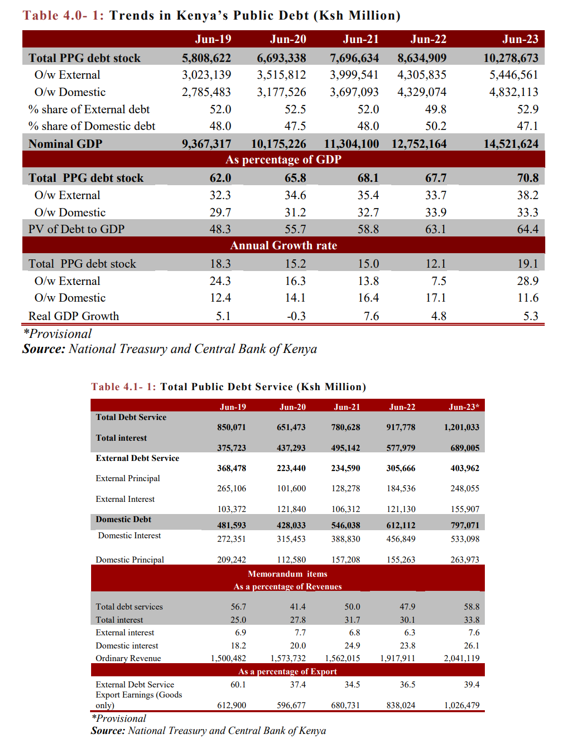
Please refer to the first picture. This picture shows a summary of our fiscal (or financial) situation. It has a bunch of numbers, but me highlight what you need to understand for our discussion from that picture.
70.8%. This number represents the ratio of our debt to our gross domestic product (“GDP”) as of June 2023. It is basically telling you how much debt we have as a country, relative to our income. It is kind of similar to you having an income of KSH 1 million per year, but you owe KSH 700,000 in debt. Thinking about that number that way easily drives home the point that the higher the percent, the worse your situation gets, right? And clearly, our situation is not good.
15.9%. The second thing I want to you to understand is that our debt over the last 5 years (2019-2023) has been growing at a rate of 15.9% annually. For example, if you look at 2019, in Table 4.0 of Picture number 1, you will see that our debt for that period increased by 18.3%. If you take the 5 years and compute the average, you get 15.9%.
4.5%. In those 5 years, our GDP growth as a country has been 4.5% annually. Same approach as above in terms of how we compute that number.
So, our debt is growing by close to 16% annually, but the economy grows by a fraction of that, 4.5%. You don’t need to be a genius to see this disconnect, do you?
Think about it this way. If your debt is growing faster than your ability to service that debt, you have a problem on your hands, right? In the last 10 years or so, our national debt has risen from KSH 2 trillionin 2013 to about just under KSH 11 trillion today. That is approximately 450% growth in debt. During the same time, our GDP has grown by around a third of that. The reason this is important for our discussion is that we need to ask whether taking loans like these to spend the way we spend is prudent, or not.
58.8%. Because of this insane and totally unsustainable level of borrowing, today, our country is spending 58.8% of every shilling collected as tax to pay only interest on the debt. To understand how crazy this is, imagine you make KSH 100,000 per month, but you need to spend KSH 60,000 per month on interest you owe. That is before you eat, before paying your mortgage or rent, before paying for your children’s education, healthcare, etc. Crazy, right?
Now, please take a look at the second picture, which contains some pictures of public facilities in Texas. Specifically, sports stadiums. I show you these pictures to show you what normal people do with taxpayer’s money, if they need to spend it on infrastructure. This is important because much of what we are going to be focusing on today is how our National Government is spending our money on things like stadiums.
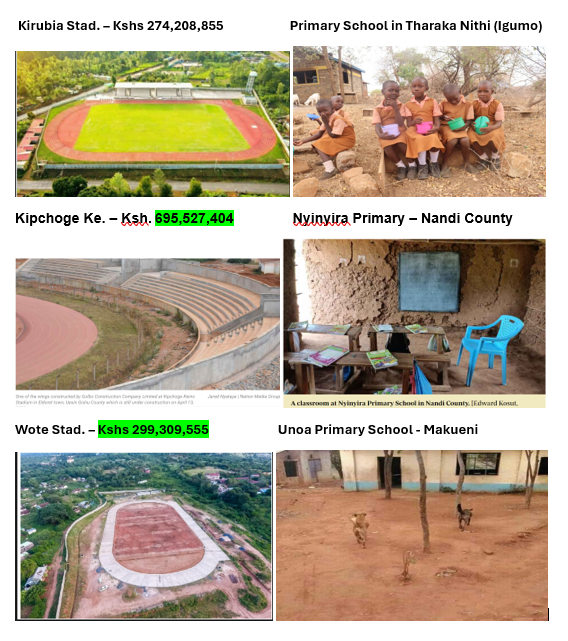
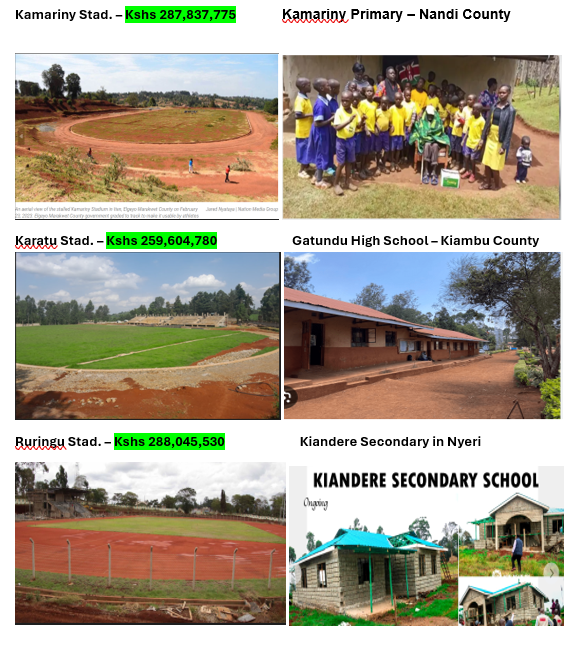
Now, I invite you to take a look at the third and fourth pictures. These pictures contain a small fraction of the projects that our National Government has undertaken, in the 2022-2023 fiscal year, through the Sports Docket of the National Government. I will provide some details below, but the point is for you to keep the following in mind. On the same pictures (3 and 4), I highlight a project that our National Government has done (attempted to do is more appropriate here), the amount of money spent, and then show you other things in those same locations that 99% of Kenyans would agree is the better place to spend scarce funds on.
So, as I detail the examples of my findings below, use the lesson above about the arm’s length principle to help you determine whether the transaction/contract makes sense, or whether it is more likely that corruption (the ulterior motive) is the real reason for the transaction/contract/project, because there are no other discernible benefits to Kenyans.
As I delve into the details below, a few things to keep in mind.
One. As I have always said, none of the information I present here is new, or should be new, to the government, including parliament. This information is 100% available to them. If they have not asked about it, which they have not, it is because they are not interested. Period, end of story.
Two. By this time, we have established that there is a lot of corruption taking place at the counties. We have covered Turkana County, Mandera County, Migori County, and Nairobi. In all these cases, most people were shocked at the scope and extent of looting. What I want you to remember is the following. Only 15% of our revenue as a country is sent to the Counties. Much of it get’s stolen, or paid as salaries and ridiculous sounding allowances such as “risk allowance”, “responsibility” allowance and other fake-sounding garbage.
85% of the revenue is spent by the National Government. So when I describe my findings here, which focus only one year (2022-2023 fiscal year), and only a very small fraction of the departments, you just need to try and extrapolate what I discuss below throughout the National Government foot print to really appreciate the enormity of our problems.
Third. A few days ago, one person told me that they fear that the government will not use my findings to correct the situation in our country. As I told that person, my primary audience is not the government, which, for the avoidance of any doubt, I believe is composed by and large of thieves and clowns. Using American parlance, I would say that our government is “tore up from the floor up”.
And so, my primary audience is you, and every other Kenyan who is interested in finding solutions to our problems. People who know that our country can do better. People who believe in a just and fairer society, a society that is governed by the rule of law, and not criminals. People who believe that it is not sustainable nor just to have only 1% of 2% of the population eat up the vast majority of the Kenyan pie, illegally or otherwise, while everyone else tries to eek a living.
Now, let’s go over some findings.
Listen to this. The Energy and Petroleum Regulatory Authority (“EPRA”) sent out a request for proposals (“RFPs”) for petroleum fuel marking, testing and monitoring services. 4 companies responded. Two of these companies were determined by EPRA to have met the set criteria and were recommended for award being the lowest bidders in both technical and financial aspects, at a total price of Kshs.546,354,432 (USD 4,944,384). Keep that number in mind.
Further, a professional opinion issued by the Head of Procurement recommended award of the tender to the two firms, which was approved by the Director General three days later. In a surprising turn of events, EPRA’s management decided to issue this tender to a firm that was not one of the two shortlisted companies, or even one of the bidders. The contract was signed two (2) days after the acceptance letter and before the lapse of fourteen (14) days provided for in Section 135 (3) of the Public Procurement and Asset Disposal Act, 2015.
In other words, this whole tender process was a charade designed to give the impression that the tender process was legitimate and lawful. This new company was awarded the contract, and was paid Kshs.2,356,105,351 (USD16,773,403). The amount was higher than that quoted in the cancelled tender of Kshs.694,438,732 (USD 4,944,384) by Kshs.1,661,385,718 (USD11,829,019).
Are you following what is happening here? The government cancels the winning bid, and two days later issues the contract to a company that did not even bid, and then pays 4 times the amount agreed to by an “arm’s length entity”.
Now, do you remember the lessons from our starting discussion of the arm’s length principle? Let’s apply that here. Why would anyone agree to pay 4 times the amount that someone else is willing to do the job for? Why? Would you do this with your own money? Is this normal? Why would anyone do this?
When EPRA management was asked by auditors to explain this discombobulating set of events, they said that the new service provider was the only one with the ability to install and implement a new IT system. Get ready to be surprised. There was no requirement like this in the tender, and infact none of the bidders covered this in their responses, because it was a newly made-up requirement designed to achieve a certain desired result.
Even after this new contract was awarded to this new company illegally and at a price that was 4 times what anyone should be willing to pay, the IT system was never installed or implemented. But you and I lost Kshs.1,661,385,718 (USD11,829,019) to corruption. In just one transaction among thousands.
So, please use the above example to get a feel of the lay of the land when it comes the tendering process through the government. As I detail more examples below, many events won’t make sense until you remember that normal people won’t behave that way. Only criminals would behave that way.
I brought up the issue of stadiums that the National Government has been “building” because they are an easy way to illustrate the absolute rot that is our government.
Take a look at the examples below:
Kamariny Stadium, Elgeyo Marakwet County. In 2016 (see picture number 4), the National Government awarded a contract to a contractor to build a stadium in Kamariny, Elgeyo Marakwet. The contract price was KSH 287,837,775. The first question is, why? Why do we need to spend almost 300 million in the middle of nowhere while we have schools that are so dilapidated in the same place? Why?
Anyway, during the most recent physical inspection done in March 2024, it was discovered that the project was only 30% complete, and the contractor has never been seen since 2017. Let that sink in. Has not been seen or heard from since 2017. Took the money, and disappeared.
I want you go back to that picture and ask yourself whether ANYONE with a brain would decide to spend almost KSH 300 million in a place like Kamariny where that money could be better spent building better classrooms, or paying teachers a living wage. Look at the classroom to the right of that “stadium” and ask yourself whether a human being not totally consumed by corruption would make that decision. The answer is NO. An emphatic NO.
Thes CS for Sports Mr. Ababu Namwamba, now says that this project will be abandoned because it was not “well planned”. They did not think about why there were doing it in the first place. But the money is gone.
Kipchoge Keino Stadium, Nandi County. Contract signed on 16 August, 2016 with expected completion date of 30 January, 2023, for KSH 369,697,973. Physical inspection of the project on 5 March, 2024 revealed that the project had not been completed, the works had stopped and the contract termination process was underway. KSH 369 million stolen. No explanation. That was Phase 1.
There was a Phase 2. Contract signed on 18 August, 2017, for KSH 325,829,431. Expected project completion date was 30 January, 2023. Physical inspection carried out on 5 March, 2024 revealed that the contractor had abandoned the site. Nothing has been done. Another KSH 325 million stolen.
Karatu Stadium, Kiambu County. Contract price: KSH 259,604,780. The contract period was eight (8) months, from 16 September, 2016. Physical inspection (by auditors) revealed poor workmanship. The main bars and columns had honeycombs, and it appeared the ratios in the mixing of motor and gravel was not correct since while compacting, the gravel separated with the motor, thus exposing the metal and weakening the strength of the beams.
The perimeter wall had caved in and had not been repaired, the car park had not been done and the borehole had also not yet been drilled as at the time of the audit. It was also noted that the Public Works officers had not visited the site since the year 2020. In other words, KSH 259 million stolen. The contractor either walks away after getting paid, or delivers almost nothing and walks away free and clear.
Wote Stadium, Makueni County. Contract price: KSH 299,309,555. Contract was for a period of five (5) months from 5 January, 2017 to 31 May, 2017. Inspection done in March 2024, shows the project was incomplete, many changes were done without approval. In addition, it was established that incidences of theft of materials on site were witnessed. KSH 299 million down the drain.
Ruringu Stadium, Nyeri County. Contract price: KSH 288,045,530. Expected completion date of 5 August, 2017. However, physical verification carried out in March, 2024 revealed that the project was not complete, more than six (6) years since the expected completion date. Drainage was poorly done, resulting in flooding into neighbouring homesteads whenever it rained. No power. No VIP lifts were installed despite being included in the Bill of Quantities. Electrical works were not done. Defective athletic track/peeling of tartan. In other words, KSH 288 million down the drain.
Kirubia Stadium, Tharaka Nithi County. Contract price: KSH 274,208,855. Contract signed on 5 January, 2017, with expected completion date of 5 August, 2017. Reported as complete but NOT commissioned. Inspection reveals: The running track had been constructed and tartan laid. However, the tartan had developed numerous gapping cracks and potholes that made it impossible to be put to the intended use.
Further, the racing track could only accommodate six (6) lanes, instead of the eight (8) lanes as recommended by the International Association of Athletics Federations (IAAF) and the Bill of Quantities (BQ). The grass on the football pitch was removed because it was discovered to be of low quality and wrong variety. Sprinkler does not work. Other systems leaked. The public toilets, both ladies and gents, had poor elevation as there were signs of rain water flooding and collecting on the tiled floor. It was also noted that out of the thirty-four (34) toilets for both men and ladies, only four (4) had floor traps that could drain splashed water down to the water way drainage system. No explanation was provided for non-adherence to the BQ.
Seating terraces had started peeling off, an indication of poor concrete mix and non-railing on the part of masonry works.
That is just a small sample of the shenanigans at the Sports Docket alone, in just one year.
Let’s take a look at the “Tourism Fund”.
Proposed Ronald Ngala Utalii College. The construction works for the proposed Ronald Ngala Utalii College was awarded to a local contractor on 14 May, 2013 at a contract sum of Kshs.8,961,370,998. The contract commencement date was on 20 June, 2013 and date of practical completion on 19 June, 2018.
Today, the government says this development will end up costing KSH 11 billion.
Do yourself a favor and google this proposed development, and ask yourself if you would pay even half of that amount for this.
Here is a surprise for you. Mysteriously, the government has “approved” several requests for an extension from this contractor, because the contractor is unable to complete the work as contracted. Here is the surprise. Because of these “extensions” you and I have paid KSH 2,763,441,016 in penalty/interest. Let that sink in. The government awards a contract to someone who is struggling to deliver on the contract pursuant to the contract. They request extensions for years, and the government approves the extensions. And then, we are billed KSH 2.7 billion in interest/penalty.
Lake Basin Development Authority. Another government agency.
This agency awarded a contract for Kshs.481,532,181 to a certain company relating digging boreholes. Upon inspection years later, it is discovered that almost nothing has been done. When management is asked for an explanation, they say that they are unable to get it done because of “apparent hostility” from locals who say that they were not given an opportunity to participate in deciding whether this project is important, as well as the fact that they have not been told how the project will benefit them. In other words, nobody asked whether it is prudent to spend this amount of money there in the first p;ace, and no opportunity whatsoever was given to locals to get their thoughts on this project. KSH Kshs.481,532,181 down the drain.
Look, we do not have enough time to deal with just 5 of the National Government dockets. Just trust me when I tell you, what I just described is a microcosm of what is happening in the entire government.
I introduced you to the concept of the arm’s length principle so that you can use it to review these events and be in a better position to assess with reasonable accuracy whether the people involved in these events, the government and the contractors, are behaving normally.
When you read through these shenanigans, no other conclusion is reasonable under these circumstances, other than, these decisions are driven by corrupt motives. Nobody in their right mind will invest KSH 300 million to build a crappy looking “stadium” in Elgeyo Marakwet when there is a dilapidated school nearby than needs those funds. Nobody in their right minds awards a contract to a party that did not bid on a project, and then pays 4 times the amount the market price. Normal people don’t do that.
So, the objective today was to try and paint a picture of how our government operates, and how corruption has led us to our sorry fiscal situation.
So, today, you and I owe almost KSH 11 trillion in debt. When you look around and ask, “what did we get for that”? The answer is almost nothing. In the Keynesian school of economics, government spending is designed to spur economic growth. The idea is that, if we spend KSH 300 million to build something that is necessary and valuable, that money will bring economic growth to that area. The workers that now have a job can send their children to school, paying fees. The teacher that get’s paid can pay rent. The landlord can take his family out on the weekend and spend money. And this is what is supposed to generate growth.
What we see in our country is a perversion of that model. What we see is that firstly, the government awards contracts to thieves. Secondly the contract is often for projects that add no real value, such as stadiums in the middle of nowhere. Thirdly, the contracts are often inflated several times over. Fourth, often, as we have seen, these contractors that are usually criminal partners of government officials, either take the money and run, or, deliver the worst quality of product and services.
What results from that is, KSH 11 trillion in debt, and absolutely nothing to show for it. That is how you can spend KSH 11 trillion and up worse than before.
Those are the facts, and they are not in dispute.
I have said before that when the average person cannot tell any difference between the thug on the street and the government, all bets are off. That society is on its way to becoming a failed society. That is where we are today.
You will notice that I copy the president, his deputy, and the EACC on every one of these posts. I do it because in our country, law and order, and justice mean absolutely nothing today. The small measure of justice than citizens can hope to get today, is shaming our thieves. But I have to tell you, these thieves, seemingly, are impossible to shame. They are absolutely diabolical.
But we must not give up. We must demand full accountability. Do not let anyone entice you with the gospel of forgiveness. These thieves can ask their God to forgive them, not us.
We will show them no mercy when we send them home and then to prison in due course. There cannot be talk about forgiveness when a few people have abused their positions of trust to devastate entire generations of innocent people.
As a final thought today, I want to speak to the smart people of Kenya. Our country is in deep trouble, courtesy of the thieves in office today. As I see it, nobody is coming to save us. We are the ones that we have been waiting for. We should all ask ourselves how we can help device solutions to these problems. It is not enough to just articulate the problems. It is enough to complain. We need to get in the business of solving problems. For a long time, smart people in our country have shied away from politics and left it to thieves and clowns. The unfortunate result of that is what we are facing today. A total collapse of our society, and deep apathy and mistrust in our country’s ability to function.
This must end. If you are capable of running for office to show voters the contrast between a thief or a clown and a genuine, smart public servant, please consider doing so. This will serve Kenya well.
@WilliamsRuto@rigathi@EACCKenya@EAukot@MigunaMiguna@NAssemblyKE@Senate_KE@EricLatiff@OkiyaOmtatah@citizentvkenya@NationBreaking@TIKenya@AbabuNamwamba
@TelkomCare_Ke I reiterate again, chasing you to activate and reactivate my number ain't an income activity for me. You can count one more customer who has held up since 2005 LOST!
@OneAcreFund Hii in taarifa ya kuwa julisha huduma zenu ni duni na huenda ikanisababishia hasara. Mbolea nilioagiza tarehe 28Nov, hadi was Leo sijaiona. Wahudumu wenu hawatoi habari wala tukio hilo si kero kwao.
When I told you that Jubilee’s debt binge was going to end in premium tears, who did you think was going to shed the tears? When you were posting Prados here calling it a tenderpreneur starter kit how did you think that was going to end? Sit down.
Effective nutrient management is crucial for optimizing crop growth & achieving high yields. It involves understanding the nutrient requirements of crops, maintaining soil nutrient balance & employing sustainable practices to enhance nutrient availability bit.ly/3SNkNZS