Sabitlenmiş Tweet

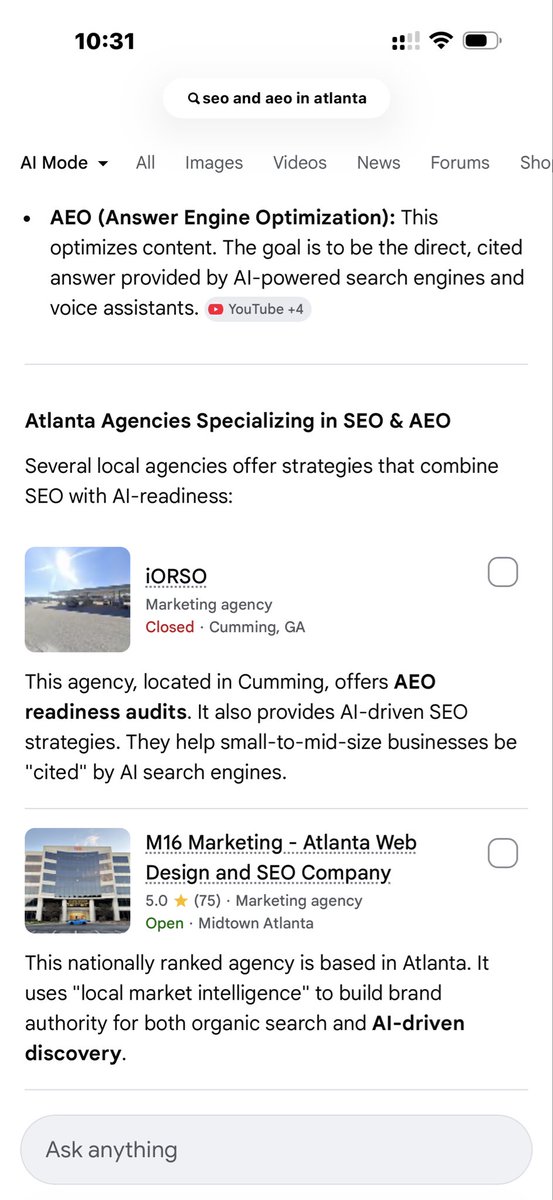
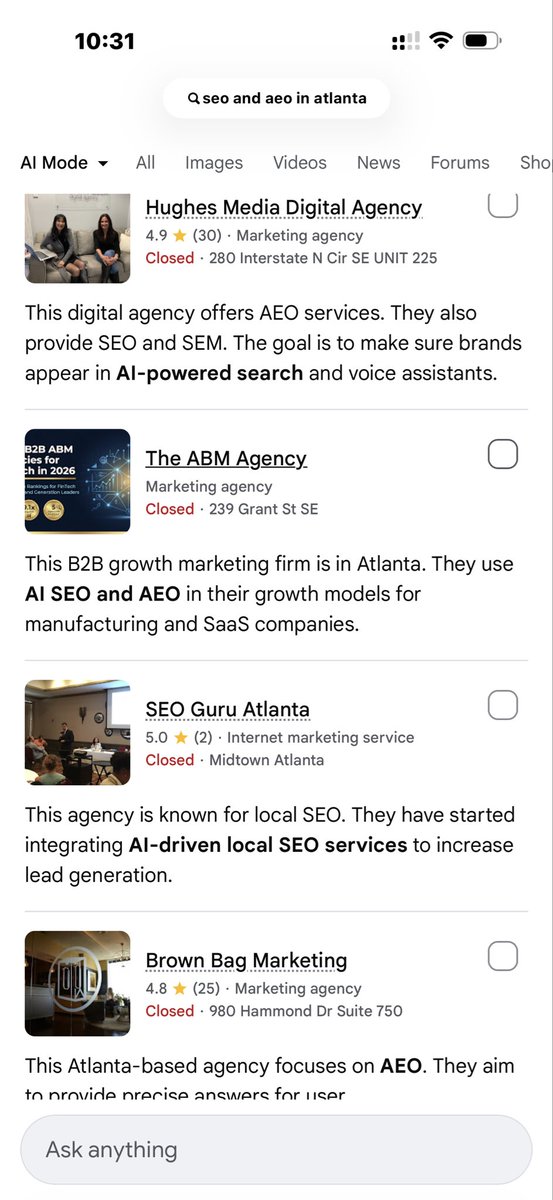
We rebuilt the AEO layer on our own site 5 days ago.
It’s already showing up in Google AI Mode against established Atlanta agencies with 25-75 reviews.
Stop optimizing for blue links. Optimize for AI extraction

English
Bernie Perconti
521 posts

@orsobjp
I’ve been through a lot. Won’t quit. Building businesses and helping others do the same. iORSO + aiORSO | SEO/AEO & AI Implementation. Husband. Girl dad. Sober.















Google just accidentally revealed how its AI search systems actually work. Now that none of it is a secret anymore, let’s talk about it. 2026 is going to be a make or break year for a lot of businesses when it comes to traditional search (Google) and AI search (ChatGPT, Gemini, Perplexity, etc.). (If you want to see where your site stands across Google and AI search, you can do so for free here: seo-stuff.com/free-audit) Let’s start from the beginning: Metehan Yesilyurt, who previously went viral when he expertly analyzed Perplexity’s ranking factors, recently broke down Google AI ranking factors in a blog post. It was fascinating. And a lot of the leaked ranking factors validate what SEO Stuff has been doing all year to get customers more traffic and sales over the past year. seo-stuff.com Basically, as noted by Yesilyurt, by selling the underlying infrastructure through a product called Google Cloud Discovery Engine (Vertex AI Search), Google revealed a lot about how its AI systems work. If you understand what Discovery Engine exposes, you understand how Google AI Mode, AI Overviews, and future AI search features are likely ranking and retrieving your content. I’ll talk about the 7 ranking signals below, but I advise you to read the entire blog post I’m linking to because it goes into way more helpful technical detail: Base Ranking: The core algorithm’s initial relevance score. Gecko Score (Embedding Similarity): Vector similarity between your content and the query. Semantic match. Jetstream (Cross-Attention Relevance): A more advanced model that understands negation, contrast, context, and nuance better than embeddings. BM25 Keyword Matching: Kind of self-explanatory. Yes, keyword matching still matters. PCTR (Predicted Click-Through Rate): A three-tier prediction model: Tier 1: Popularity Tier 2: PCTR Tier 3: Personalized PCTR (unlocked only after 100,000+ queries) Freshness: Time-sensitive recency scoring. Boost / Bury Rules: Manual ranking adjustments based on business logic. This is the most transparent look we’ve ever had into Google’s AI ranking pipeline. Discovery Engine also exposes the retrieval pipeline: Max chunk size: 500 tokens (approximately 375 words) Optional: ancestor headings travel with each chunk Tables and images get parsed Layout parser plus Gemini-enhanced understanding (LLM-augmented indexing) This means every important point needs to live inside a 500-token block with clean headings and clear structure. If your content is one massive wall of text, you’re done. Also, I hate to be the “I told you so” guy on this, but schema matters. For some reason it has become controversial to say this on social media, but it was obvious and now it is confirmed. Discovery Engine shows Google processes structured data with three separate flags: Searchable (affects recall) Indexable (affects filtering and ordering) Retrievable (affects what the model can output) These are independent. Meaning: A field can influence ranking without being visible, or be visible without influencing ranking. A massive hint at how Google uses structured data for AI Mode. Also, Google revealed the 4-stage AI search pipeline: Prepare: Query understanding, synonym mapping (time-aware), autocomplete, NLU. Retrieve: Chunking, layout parsing, schema extraction, embeddings. Signal: The 7 signals above. Serve: Gemini 2.5 Flash generates the final answer, applies instructions, safety filters, related questions, and grounding rules. Traditional Search, AI Overviews, and AI Mode are simply different configurations of this same pipeline. So what does all this mean? Well, it means you must optimize for three layers at once: Layer 1: Semantic similarity (Gecko) Your content needs to clearly match the intent of the prompts you want. Layer 2: Cross-attention relevance (Jetstream) Jetstream rewards: Clear definitions Direct answers Contrast statements “X vs Y” “Best for ___” “Without ___” Layer 3: Chunk-level clarity Your content must be extractable in 500-token blocks with: Question-based headings Two to three sentence answers TLDR summaries Clean HTML Factual claims Lists and comparisons This is exactly what AI systems quote. And this is exactly why SEO Stuff (seo-stuff.com) works so well in AI search. The Discovery Engine findings validate the entire SEO Stuff approach from long before this documentation was public. Let me break down the packages through the lens of Google’s architecture: SEO Stuff Gold Plan: seo-stuff.com/gold-plan-pack… 10 long-form, comparison-based, extractable articles Structured in 500-token blocks Question H2s Two to three sentence direct answers TLDR blocks FAQ schema plus product schema 3 DR50+ backlinks to strengthen entity signals Gold Plan maps to: Gecko (semantic match) Jetstream (cross-attention relevance) BM25 (keyword match) Freshness Entity trust (for Boost/Bury) This is the fastest path to appearing in ChatGPT, Gemini, Perplexity, and Google AI Mode. SEO Stuff Premium Content Bundle: seo-stuff.com/premium-conten… 60 comparison-driven articles Structured to match the exact pattern LLMs extract Category-defining content Builds topical coverage and entity clarity Creates a deep corpus for Jetstream and embeddings Premium Bundle maps to: Retrieval depth Structured chunking Ancestor heading clarity Embedding similarity AI model grounding This is how you train AI systems to associate your brand with your category. SEO Stuff Premium Backlink Bundle: seo-stuff.com/premium-backli… 3 DR50+ backlinks from domains LLMs already trust Reinforces brand consistency across the web Boosts entity recognition Backlinks help with: Base ranking PCTR (popularity and trust) Boost/Bury eligibility Entity clarity This is why so many customers reorder. It works. Google is not hiding its AI search architecture. They literally exposed: The signals The ranking layers The chunk sizes The parsing logic The semantic models The engagement tiers The answer generation flow The brands that understand this and structure their content accordingly will run through the next era of search like absolute beasts. And SEO Stuff (seo-stuff.com) was built specifically to map to this architecture. If AI is replacing the first click, your content must replace the first impression.

Nobody talks about the middle The part after you decided to change and before anything actually changes Where you’re doing the work and the results haven’t caught up and it feels like lying to yourself That’s not failure. That’s the tax. Pay it