Enrico Schulz

891 posts

Enrico Schulz banner
Enrico Schulz

Enrico Schulz

@pain_imaging

In Pain.

Munich, Bavaria Katılım Eylül 2019
404 Takip Edilen172 Takipçiler
Enrico Schulz
Enrico Schulz@pain_imaging·
@Geha_Paul Thanks for sharing. Unfortunately, the link doesn't work...

Enrico Schulz tweet media
Planegg, Deutschland 🇩🇪 English
0
0
0
314
Enrico Schulz retweetledi
Yasir Ai
Yasir Ai@AiwithYasir·
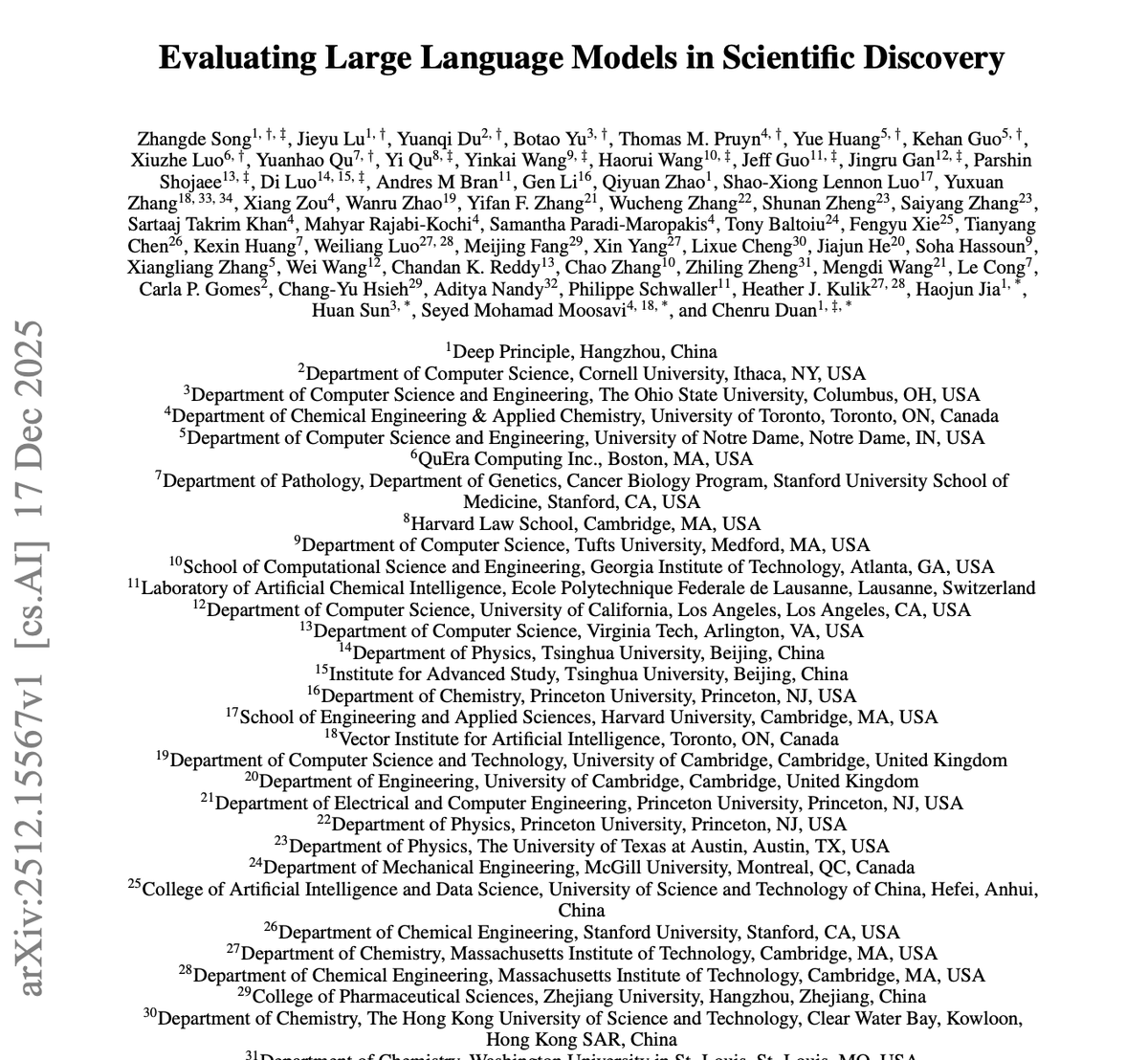
This paper from Harvard and MIT quietly answers the most important AI question nobody benchmarks properly: Can LLMs actually discover science, or are they just good at talking about it? The paper is called “Evaluating Large Language Models in Scientific Discovery”, and instead of asking models trivia questions, it tests something much harder: Can models form hypotheses, design experiments, interpret results, and update beliefs like real scientists? Here’s what the authors did differently 👇 • They evaluate LLMs across the full discovery loop hypothesis → experiment → observation → revision • Tasks span biology, chemistry, and physics, not toy puzzles • Models must work with incomplete data, noisy results, and false leads • Success is measured by scientific progress, not fluency or confidence What they found is sobering. LLMs are decent at suggesting hypotheses, but brittle at everything that follows. ✓ They overfit to surface patterns ✓ They struggle to abandon bad hypotheses even when evidence contradicts them ✓ They confuse correlation for causation ✓ They hallucinate explanations when experiments fail ✓ They optimize for plausibility, not truth Most striking result: `High benchmark scores do not correlate with scientific discovery ability.` Some top models that dominate standard reasoning tests completely fail when forced to run iterative experiments and update theories. Why this matters: Real science is not one-shot reasoning. It’s feedback, failure, revision, and restraint. LLMs today: • Talk like scientists • Write like scientists • But don’t think like scientists yet The paper’s core takeaway: Scientific intelligence is not language intelligence. It requires memory, hypothesis tracking, causal reasoning, and the ability to say “I was wrong.” Until models can reliably do that, claims about “AI scientists” are mostly premature. This paper doesn’t hype AI. It defines the gap we still need to close. And that’s exactly why it’s important.
Yasir Ai tweet media
English
88
218
566
39.4K
Enrico Schulz retweetledi
Choong-Wan (Wani) Woo
Choong-Wan (Wani) Woo@choongwanwoo·
New paper w/ @_LeeJaeJoong_ in Nat Neurosci!🧠 We developed personalized fMRI predictive models tracking ongoing spontaneous pain in chronic pain patients, trained on 6+ mo. of densely sampled data. A true team effort. Deeply grateful to our participants! doi.org/10.1038/s41593…
English
4
36
103
5.8K
Enrico Schulz retweetledi
Christine Rabinak
Christine Rabinak@BrainsBeesBikes·
The first time you start a research lab, there’s no manual. So I made one. A practical toolkit for postdocs and early-career faculty launching their first lab: hiring, startup planning, collaborations, and building a sustainable research program. zenodo.org/records/188835…
English
23
343
2K
131.1K
Enrico Schulz
Enrico Schulz@pain_imaging·
@cl9681 I won't make it to Vancouver but I'd be happy to discuss individual level data analysis. I started doing it a few years ago and I have the impression we are only a few...
English
0
0
0
33
Enrico Schulz retweetledi
Chuck Lynch
Chuck Lynch@cl9681·
I’ll be speaking at CNS 2026 in Symposium Session 6: “Not Your Average Brain: Individual-Level fMRI as a Paradigm Shift for Cognitive Neuroscience” on Monday, March 9, 10am–12pm. Excited for a session centered on how individual-level fMRI can reshape cognitive and clinical neuroscience. cogneurosociety.org/symposia/?sym=… This symposium has an all-star group of presenters covering cutting-edge work in precision and individual-level neuroimaging. It should be a really fun and substantive discussion. @RodBraga @ArielleKeller @jingnandu049 Andre Zamani
English
2
12
35
2.1K
Enrico Schulz retweetledi
André Marques
André Marques@marques_et_al·
Have you ever been asked from a journal to remove all your preprint citations from any type of article (review, mini-review, normal article) and remove all the content referring to them? I found that so nonsense 😐 #asking4friend
English
6
2
14
10.3K
Enrico Schulz
Enrico Schulz@pain_imaging·
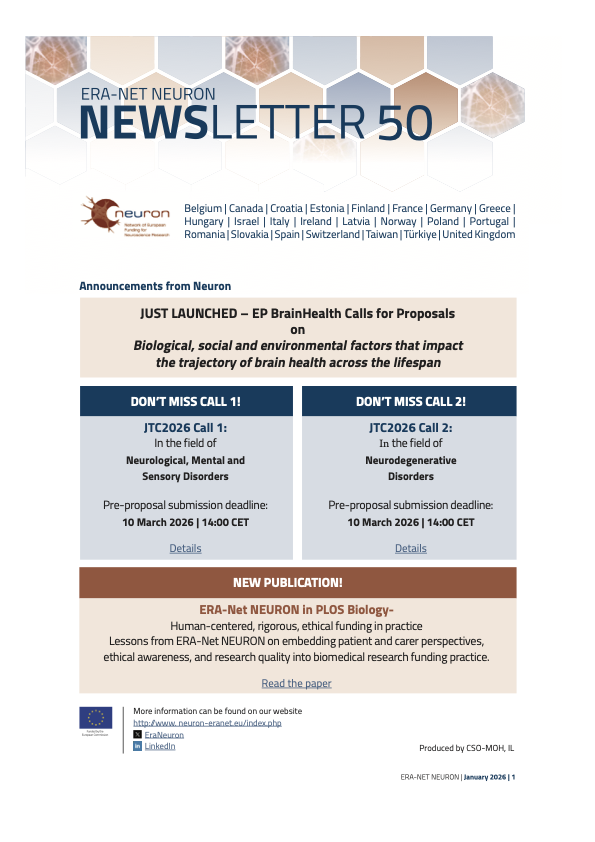
@EraNeuron Thank you very much for funding our project. We look forward to conducting the study and sharing exciting results.
English
0
0
1
9
Enrico Schulz retweetledi
Nicholas A. Christakis
Nicholas A. Christakis@NAChristakis·
Please share: Post-doctoral position in the Human Nature Lab in the area of human social chemosignaling. What role do the odors we emit and our capacity for smell play in shaping social behavior? academicjobsonline.org/ajo/jobs/30989
English
2
4
8
6.7K
Enrico Schulz retweetledi
Miguel Ángel Abellanas
Miguel Ángel Abellanas@maabellanas·
I tried it weeks ago, and I think it's a game-changer! I hope this really shakes up the editorial system
Oded Rechavi@OdedRechavi

BIG ANNOUNCEMENT📣: I haven’t been this excited to be part of something new in 15 years… Thrilled to reveal the passion project I’ve been working on for the past year and a half!🙀🥳 It started from my frustration with the depressing effect that the current publishing system has on the well-being of myself, my team, and pretty much every scientist I know (maybe you’ve noticed from my stupid jokes… :) I was exhausted of dealing with the huge delays, reviewers that can be abusive, and how arbitrary it all is. Unfortunately, the most important factors are often WHO your reviewers are and who YOU are... It’s clear we need alternatives or at least ways to improve the situation. So, together with a really special and talented team we worked to develop this idea into “qed” a platform where you can get CONSTRUCTIVE feedback on your own work or CRITICALLY assess other people’s papers. It can be a real difference maker if many of you join us (thousands have tried it already, but today we release a NEW and much stronger version ;) Let’s harness qed to put the power back in the scientists’ hands, to do, to read & to publish science on our own terms. I’m dying for you to TRY IT, and it’s very simple - just drop a paper (the link to the website is in the replies👇) - it’s completely secure, private, and free, and you get results fast. Please show your support, SHARE, tell your friends, and let’s be the revolution 🫵!

English
1
2
13
3.7K
Enrico Schulz retweetledi
Siri Leknes
Siri Leknes@sirileknes·
What can *genetic insensitivity to opioids* teach us about endogenous opioid function in humans? Fully funded position in Oslo (PhD student or postdoc) Please RT Interested in pain, mu/kappa opioids, behavioural genetics, RCTs, or related? Apply here: 2411.webcruiter.no/Main2/Recruit/…
English
0
11
17
1.3K
Enrico Schulz
Enrico Schulz@pain_imaging·
@OdedRechavi Interesting. No need to blow up anything for a big story. Is it peer reviewed?
English
1
0
2
531
Oded Rechavi
Oded Rechavi@OdedRechavi·
We published a small "micropublication" - it's a cool format for publishing isolated results! (not every study has to be a "full story"): "Reduced insulin/IGF-1 signaling and loss of pals-22 promote repetitive DNA silencing in C. elegans" micropublication.org/journals/biolo…
English
1
7
87
9.9K
Enrico Schulz
Enrico Schulz@pain_imaging·
@derspiegel Was für ein Unsinn. Der "Neurowissenschaftler" hat seit Jahren nicht mehr geforscht und hat mit seiner Forschung auch keinen tiefen Abdruck hinterlassen. Bücher über seine subjektive Meinung zu schreiben ersetzt keine Wissenschaft.
Deutsch
0
0
0
17
DER SPIEGEL
DER SPIEGEL@derspiegel·
Der Neurowissenschaftler Joseph Jebelli erforscht das Ruhenetzwerk im Gehirn – und erklärt, wie wir auf brillante Ideen kommen. Ein Gespräch über Leere, Tagträume und warum die meisten von uns es ihrem Hirn grundlos schwer machen.#ref=rss" target="_blank" rel="nofollow noopener">spiegel.de/karriere/hirnf…
Deutsch
3
2
14
10.7K