Alex Desjardins@PrimeTrading_
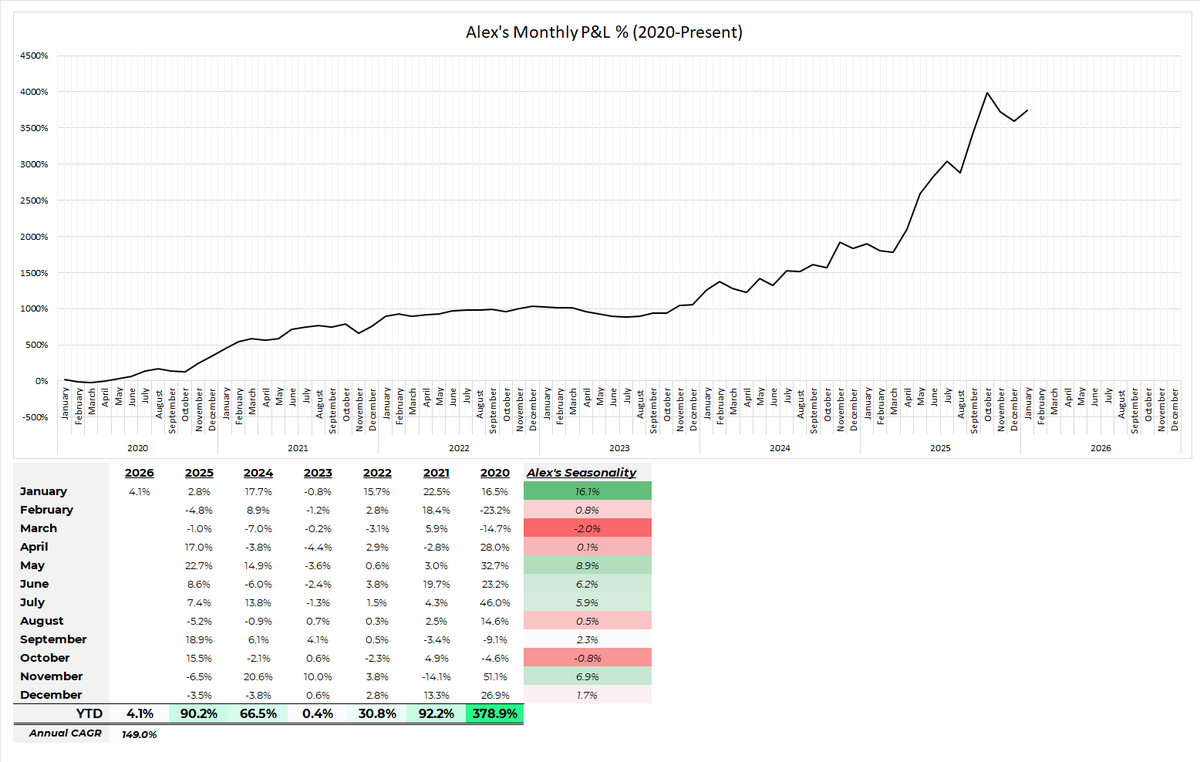
Alex’s PF performance. - Dec. & full 2025 📑🛡️
MTD ( -3.5% )
YTD ( +90.2% )
YTD benchmark QQQ (+20.16%)
Hey guys!
2025 is in the books — and it was a defining year.
This wasn’t just a good P&L year. It was the year where everything finally clicked structurally.
After years of refining, cutting, and stress-testing my process through different cycles, 2025 was about stripping the system down to what truly matters — and then executing it with patience and intent. No more noise. No more forcing. Just trading the right names, in the right environment, at the right time.
I fully embraced my core edge this year: pullbacks, buying weakness into structure, and letting trades work. The goal wasn’t to trade more — it was to trade better. Improve patience. Reduce cognitive load. Lower stress. And let probability do the heavy lifting.
The result speaks for itself: +90% on the year, while maintaining control, consistency, and sanity.
One of the biggest shifts for me in 2025 was doing less:
• Fewer trades
• Fewer tickers
• Less screen time
• Less emotional bandwidth spent reacting
That alone was a massive performance unlock.
Integrating TradersLab into my daily routine was also a game-changer. It didn’t change my edge — it removed friction. Cleaner preparation, faster filtering, better focus on what actually matters. My routine became lighter, more repeatable, and far more sustainable.
And finally, the Patient Panda concept wasn’t just a fun analogy this year — it became a real execution tool. Waiting for structure. Waiting for confirmation. Sitting through normal noise without flinching. That patience showed up directly in both performance and quality of life.
Heading into 2026, I genuinely like where I’m at. I’m not looking to reinvent anything. The core system stays the same. From here, it’s about small refinements, better execution, and continuing to share those improvements transparently in the PTA section.
Big thanks to everyone following along, learning, questioning, and staying disciplined.
This is how long-term edges are built.
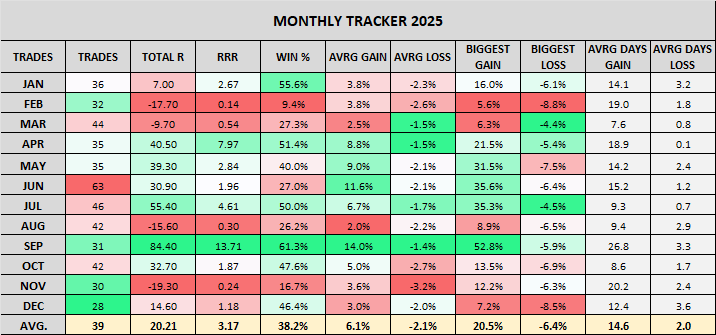
MTD / 2025 Performance Summary
• YTD Performance: +90%
• Win Rate: ~40%
• Average trades per month: ~39
Activity stayed controlled. Even in strong months, I didn’t scale trade count aggressively — most gains came from better timing, not more trades.
Win rate: ~38% (by design)
A sub-50% win rate is not a weakness in this system — it’s a feature. The edge comes from asymmetric payoff, not prediction accuracy.
Large R months drive the year:
APR: +40.5R
JUL: +55.4R
SEP: +84.4R
These months didn’t come from higher accuracy — they came from letting winners expand, holding structure, and not capping upside too early.
Negative R months stayed contained:
Losing months were limited in magnitude and quickly recovered. This is a direct result of:
• Cutting losers fast
• Respecting structure breaks
• Reducing exposure when the market environment wasn’t aligned
Average RRR: 3.17
This is the core driver of performance. Losses stayed small while winners were allowed to expand, validating the pullback + structure framework.
Average gain vs average loss:
• Avg gain: +6.1%
• Avg loss: -2.1%
Winners were nearly 3x larger than losers, which allowed the equity curve to compound despite modest win rates.
Biggest gain vs biggest loss:
• Biggest gain: +52.8%
• Biggest loss: -8.8%
This spread highlights disciplined downside control while still allowing room for multi-week runners to work.
Holding time asymmetry:
• Avg days gain: 14.6
• Avg days loss: 2.0
This is one of the most important stats of the year. Losers were cut quickly, while winners were given time and space to develop. Patience showed up directly in the numbers.
Monthly distribution:
Performance was not linear. A handful of strong months (APR, JUL, SEP) accounted for a large portion of the yearly gains, while losing months remained contained. This reinforces the importance of market timing and knowing when not to press.
Overall, the stats confirm that 2025 was not about trading more, predicting better, or chasing returns. It was about letting structure, R-multiples, and patience do the work, while keeping risk tightly controlled during unfavorable environments.
This is exactly the type of statistical profile I want to carry forward into 2026.
Best performance came from a limited number of high-quality market windows
This year reinforced something I’ve learned repeatedly over time: performance doesn’t come from constant activity. Most of the gains came from a handful of well-timed periods where market structure, breadth, and leadership aligned. The job was simply to be ready, patient, and appropriately sized when those windows opened — and to protect capital when they didn’t.
Consistency, risk control, and process adherence mattered far more than any single trade or month.
PTA — 2026 Focus & Refinements
Going into 2026, the goal isn’t to trade more or take more risk. It’s to extract more from the same edge, with the same discipline, while continuing to reduce stress and decision fatigue.
Carrying More Size Through Winners
One of my main refinements for 2026 is how I handle winners after they prove themselves.
Instead of trimming multiple times into strength (e.g. at 2R and 5R), I want to simplify the process:
• Take one trim at 2R (⅓ of the position)
• Carry the remaining ⅔ as a true runner core
• Manage that core strictly off structure, not targets
The intent here is clear: maximize participation in the few trades that actually drive yearly performance. The stats already show that large R winners do the heavy lifting. This adjustment is about giving those trades more room to work, without increasing initial risk.
Nothing changes on entry, risk, or sizing — only on how long I stay involved once the trade has earned it.
Size & Risk Per Trade — Staying Exactly Where I Am
I’m in a very good place with position sizing and risk per trade, and I have no intention of increasing it in 2026.
No single trade can materially damage my equity
Drawdowns remain manageable
Portfolio construction removes emotional pressure
Decision-making stays clean under stress
This balance is a feature, not a limitation. It allows me to:
• Sit through normal volatility
• Hold winners longer
• Avoid reactionary decisions
The focus in 2026 is better utilization of size, not more size.
Gap-Down Days — Mental Framework
These all-day gap-down sessions are designed to feel worse than they are. Pressure all day, weak close… then everything gaps up the next morning.
My focus in 2026 is mental framing, not reaction.
Discomfort ≠ information
Red P&L is not a signal. Structure is.
Goal = avoid irreversible decisions
I’m not optimizing. I’m surviving.
Zoom out
If daily structure and leadership haven’t changed, neither has the trade.
Resolution often comes after the close
Forcing clarity intraday is how good positions get dumped.
Bottom line:
Less reaction. More observation. Trust structure.
Wishing everyone a great 2026 — both in the markets and outside of them.
Stay healthy, stay patient, and don’t lose sight of why you’re doing this in the first place.
Plenty of opportunities ahead. Let’s approach them calmly and with intent.
Cheers,
Alex ✌️
• Every entry, exit, and trims are taken in real time in the PrimeTrading Discord community, with educational explanations for all trades.
• I share all my trades and monthly trading performance results since January 2020 for transparency.