Paztek Scan
515 posts

Paztek Scan
@paztek_
Exploring the Casino Industry in Web3

Is $GEOD worth buying in 2026? Let’s start with this… Mind you, @GEODNET is not your typical crypto project. They are building a global, decentralised GPS correction network that gives drones, robots, and autonomous systems centimetre-level accuracy. Because in the real world, precision is a requirement. Right now, most GPS systems can be off by several meters. That might not sound like much until you realise what that actually means A drone missing its landing point, a construction layout being slightly off, or an autonomous system making the wrong decision. GEODNET fixes that, bringing positioning accuracy down to just a few centimetres. That alone puts it in a completely different category from most tokens in the market. But what makes this even more interesting is that the demand for this kind of precision already exists in Web2. Companies like @DJIGlobal , @TrimbleCorpNews , and John Deere rely heavily on high-precision GPS systems to power their operations. These are billion-dollar industries where accuracy directly affects efficiency, cost, and performance. What GEODNET is doing is quietly stepping into that space, offering a decentralised alternative to the expensive, centralised infrastructure these industries depend on. And this isn’t just a future idea. The network is already being used by real people, surveyors, drone operators, and enterprises, who are paying for access. That means this is one of the few projects in crypto that isn’t just running on speculation, but on actual revenue. Now here’s where it gets even more interesting. A significant portion of that revenue is used to buy back and burn the token. So as more people use the network, the supply reduces while demand increases. It’s a simple dynamic, but a powerful one, and it’s the kind of structure long-term investors pay attention to. Zooming out, the bigger picture becomes even clearer. We’re moving into a world of autonomous systems. Companies like Amazon are already experimenting with drone delivery, while Tesla continues pushing toward self-driving and robotics. None of these systems can function properly without extremely accurate positioning. Without precision, automation breaks. That’s where GEODNET quietly fits in, not as the flashy front-end product, but as the invisible layer that makes everything work. It may not have the loudest marketing or the most hyped headlines, but the signals are there. The network is growing, adoption is happening, and the use case is undeniable. So no, this isn’t a meme coin, it’s an infrastructure. And infrastructure plays are usually slow to start… but when they scale, they become very hard to ignore. If you’re chasing quick flips, $GEOD might not be your play. But if you’re thinking long term, GEODNET is one of those projects that could quietly build while everyone else is distracted.

Is $GEOD worth buying in 2026? Let’s start with this… Mind you, @GEODNET is not your typical crypto project. They are building a global, decentralised GPS correction network that gives drones, robots, and autonomous systems centimetre-level accuracy. Because in the real world, precision is a requirement. Right now, most GPS systems can be off by several meters. That might not sound like much until you realise what that actually means A drone missing its landing point, a construction layout being slightly off, or an autonomous system making the wrong decision. GEODNET fixes that, bringing positioning accuracy down to just a few centimetres. That alone puts it in a completely different category from most tokens in the market. But what makes this even more interesting is that the demand for this kind of precision already exists in Web2. Companies like @DJIGlobal , @TrimbleCorpNews , and John Deere rely heavily on high-precision GPS systems to power their operations. These are billion-dollar industries where accuracy directly affects efficiency, cost, and performance. What GEODNET is doing is quietly stepping into that space, offering a decentralised alternative to the expensive, centralised infrastructure these industries depend on. And this isn’t just a future idea. The network is already being used by real people, surveyors, drone operators, and enterprises, who are paying for access. That means this is one of the few projects in crypto that isn’t just running on speculation, but on actual revenue. Now here’s where it gets even more interesting. A significant portion of that revenue is used to buy back and burn the token. So as more people use the network, the supply reduces while demand increases. It’s a simple dynamic, but a powerful one, and it’s the kind of structure long-term investors pay attention to. Zooming out, the bigger picture becomes even clearer. We’re moving into a world of autonomous systems. Companies like Amazon are already experimenting with drone delivery, while Tesla continues pushing toward self-driving and robotics. None of these systems can function properly without extremely accurate positioning. Without precision, automation breaks. That’s where GEODNET quietly fits in, not as the flashy front-end product, but as the invisible layer that makes everything work. It may not have the loudest marketing or the most hyped headlines, but the signals are there. The network is growing, adoption is happening, and the use case is undeniable. So no, this isn’t a meme coin, it’s an infrastructure. And infrastructure plays are usually slow to start… but when they scale, they become very hard to ignore. If you’re chasing quick flips, $GEOD might not be your play. But if you’re thinking long term, GEODNET is one of those projects that could quietly build while everyone else is distracted.


\スターレイル3周年まであと1日/ 声優お祝いメッセージ~灰色シェイク組~公開✨ 一緒にスターレイル遊ぼう! フォロー& ハッシュタグ「スターレイル3rdアニバ」を付けて引用リポストすると、抽選で出演声優の記念サイン色紙が当たる! 〆4/26 23:59

Is $GEOD worth buying in 2026? Let’s start with this… Mind you, @GEODNET is not your typical crypto project. They are building a global, decentralised GPS correction network that gives drones, robots, and autonomous systems centimetre-level accuracy. Because in the real world, precision is a requirement. Right now, most GPS systems can be off by several meters. That might not sound like much until you realise what that actually means A drone missing its landing point, a construction layout being slightly off, or an autonomous system making the wrong decision. GEODNET fixes that, bringing positioning accuracy down to just a few centimetres. That alone puts it in a completely different category from most tokens in the market. But what makes this even more interesting is that the demand for this kind of precision already exists in Web2. Companies like @DJIGlobal , @TrimbleCorpNews , and John Deere rely heavily on high-precision GPS systems to power their operations. These are billion-dollar industries where accuracy directly affects efficiency, cost, and performance. What GEODNET is doing is quietly stepping into that space, offering a decentralised alternative to the expensive, centralised infrastructure these industries depend on. And this isn’t just a future idea. The network is already being used by real people, surveyors, drone operators, and enterprises, who are paying for access. That means this is one of the few projects in crypto that isn’t just running on speculation, but on actual revenue. Now here’s where it gets even more interesting. A significant portion of that revenue is used to buy back and burn the token. So as more people use the network, the supply reduces while demand increases. It’s a simple dynamic, but a powerful one, and it’s the kind of structure long-term investors pay attention to. Zooming out, the bigger picture becomes even clearer. We’re moving into a world of autonomous systems. Companies like Amazon are already experimenting with drone delivery, while Tesla continues pushing toward self-driving and robotics. None of these systems can function properly without extremely accurate positioning. Without precision, automation breaks. That’s where GEODNET quietly fits in, not as the flashy front-end product, but as the invisible layer that makes everything work. It may not have the loudest marketing or the most hyped headlines, but the signals are there. The network is growing, adoption is happening, and the use case is undeniable. So no, this isn’t a meme coin, it’s an infrastructure. And infrastructure plays are usually slow to start… but when they scale, they become very hard to ignore. If you’re chasing quick flips, $GEOD might not be your play. But if you’re thinking long term, GEODNET is one of those projects that could quietly build while everyone else is distracted.

The on-chain burn of $GT for Q1 2026 has been completed. 🔥 We just saw another $20M+ torched this quarter alone. That brings the total burned value to over $1.3B since the start. $GT is officially 62% down from the original 300M supply. But here’s the real takeaway: GT is no longer just a "burn narrative." It’s evolved into the literal heartbeat of the ecosystem. We’re seeing AI, Memes, DEX volume, and TradFi all feeding into one place. It’s tied directly to gas for the @Gate Layer, trading, and governance. When you pair a shrinking supply with that kind of multi-sector utility... Usage starts to scale much faster than most people expect. The foundation is set and the on-chain activity is finally catching up. Feels like something major is building here.


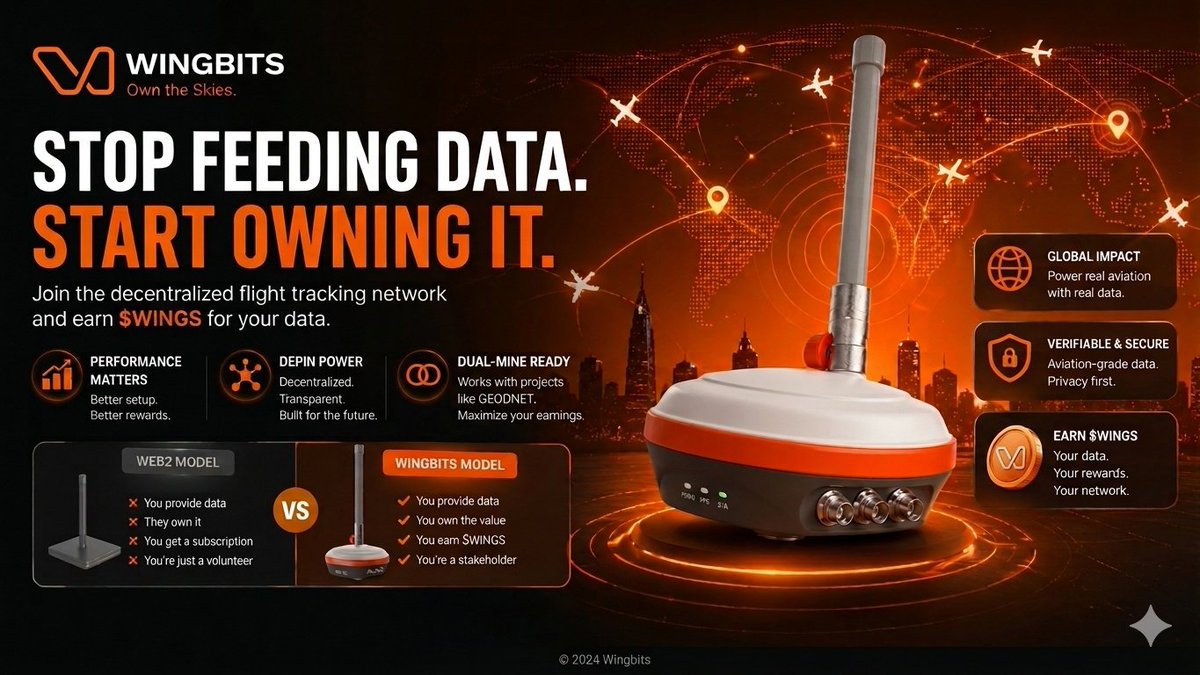
I have been thinking about the real difference between @wingbits and traditional Web2 flight tracking Here is what I figured out, the difference is clear. For years, platforms like Flightradar24 and FlightAware have used the same model You run a receiver (often your own SDR setup), feed them data, and they reward you with a premium subscription. It’s a decent perk, but in reality, you’re contributing valuable flight data to a system they fully own and monetize. For Wingbits they completely flipped the script. Yes, the upfront cost is higher, typically $400–$600 for the hardware But you’re not just buying equipment. You’re buying into a DePIN network on Solana where your data contribution has direct economic value. Instead of a subscription, you earn $WINGS tokens based on the quality, quantity, and location of the data you provide. You move from a passive feeder to an actual stakeholder with ownership in the network. That shift is what makes Wingbits stand out. It rewards performance, better antenna placement, clearer line-of-sight, and optimized setups that genuinely pay off Turning a hobby into something you can actively improve and scale. And because it lives in the DePIN space, compatible hardware can even dual-mine with projects like @GEODNET, letting you extract more value from the same location and equipment. It might sound expensive but probably, your earnings can cover the cost later on. Wingbits offers something Web2 never did Real ownership, upside potential, and a seat at the table in a decentralized aviation data network. Hence, don't compare... The gap is wide


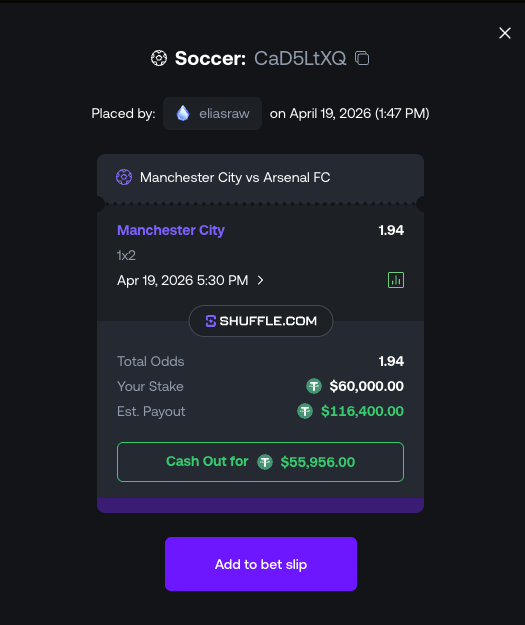
The whole team is impressive, and something massive is coming. Guys, it feels like a mindshare, but this time, it’s where you get to know which casinos you can win big on and withdraw from without stress. A whole lots of tools🔥 Brought to you by @fairgambling and @eliasraw7.

The whole team is impressive, and something massive is coming. Guys, it feels like a mindshare, but this time, it’s where you get to know which casinos you can win big on and withdraw from without stress. A whole lots of tools🔥 Brought to you by @fairgambling and @eliasraw7.

"Will the Fed cut rates in June?" or "Who will win the championship?" You can now trade these outcomes directly on @Gate. Through its integration with @Polymarket, Gate brings real-world prediction markets into the exchange experience, allowing you to take positions on global events just like any other trade. Polymarket has seen explosive growth, with weekly trading volume surpassing $1B, valuation approaching $15B, and major markets attracting over $1M in liquidity. This means you’re not trading in isolation; you’re trading against real global consensus. Getting started is simple. Here’s how it works: 👉 Create or log in to your Gate account: gate.com/share/VGQSVW8L… 👉 Go to: gate.com/prediction/for… 👉 Select any prediction market 👉 Trade instantly using USDT or USDC On the Gate App: 👉 Update to the latest version (8.12.5 or newer) 👉 Open the app and log in 👉 Navigate to the Alpha section 👉 Open Polymarket from your profile under Trade 👉 Start trading Yes/No markets using your spot balance No bridges, no gas fee and no complex setup. At its core, prediction markets are simple; prices reflect probability. A market priced at $0.70 implies a 70% chance of that outcome happening. You’re choosing between “Yes” or “No,” and if you’re correct, the contract settles at $1. The lower the price you enter, the higher your potential upside. You can enter and exit positions anytime, reacting instantly as new information changes market sentiment. Right now, some of the most popular markets include the 2026 FIFA World Cup winner, the 2026 NBA champion, Bitcoin price targets for April, the next F1 Drivers’ Champion, and where WTI crude oil will trade by April 2026. Gate removes the friction and brings prediction markets into a seamless, professional trading environment, giving you the tools to act on what you know.


【生放送投稿キャンペーン】 3.5周年記念生放送「希望の星が再び輝く刻」の配信を記念して、プレゼントキャンペーンを開催します🥳 #輝けNIKKE3周年半 を付けて感想を投稿すると、豪華賞品が獲得できるチャンス🍑 ◆配信場所 YouTube:youtube.com/live/Pz8Jbk2Zt… X:x.com/i/broadcasts/1… TikTok:@nikke_japan/live" target="_blank" rel="nofollow noopener">tiktok.com/@nikke_japan/l…
Mirrativ:mirrativ.com/live/sGYO4D7cZ… さらに! トレンド1位達成で【指揮官への特別なサプライズ】のプレゼントも決定💕 気になるその中身は…?🤔 ぜひ予想してみてくださいね✍️ もちろん@NIKKE_japan のフォローもお忘れなく☝️ それでは、皆さまのご参加をお待ちしております! #NIKKE #NIKKEAnniversary
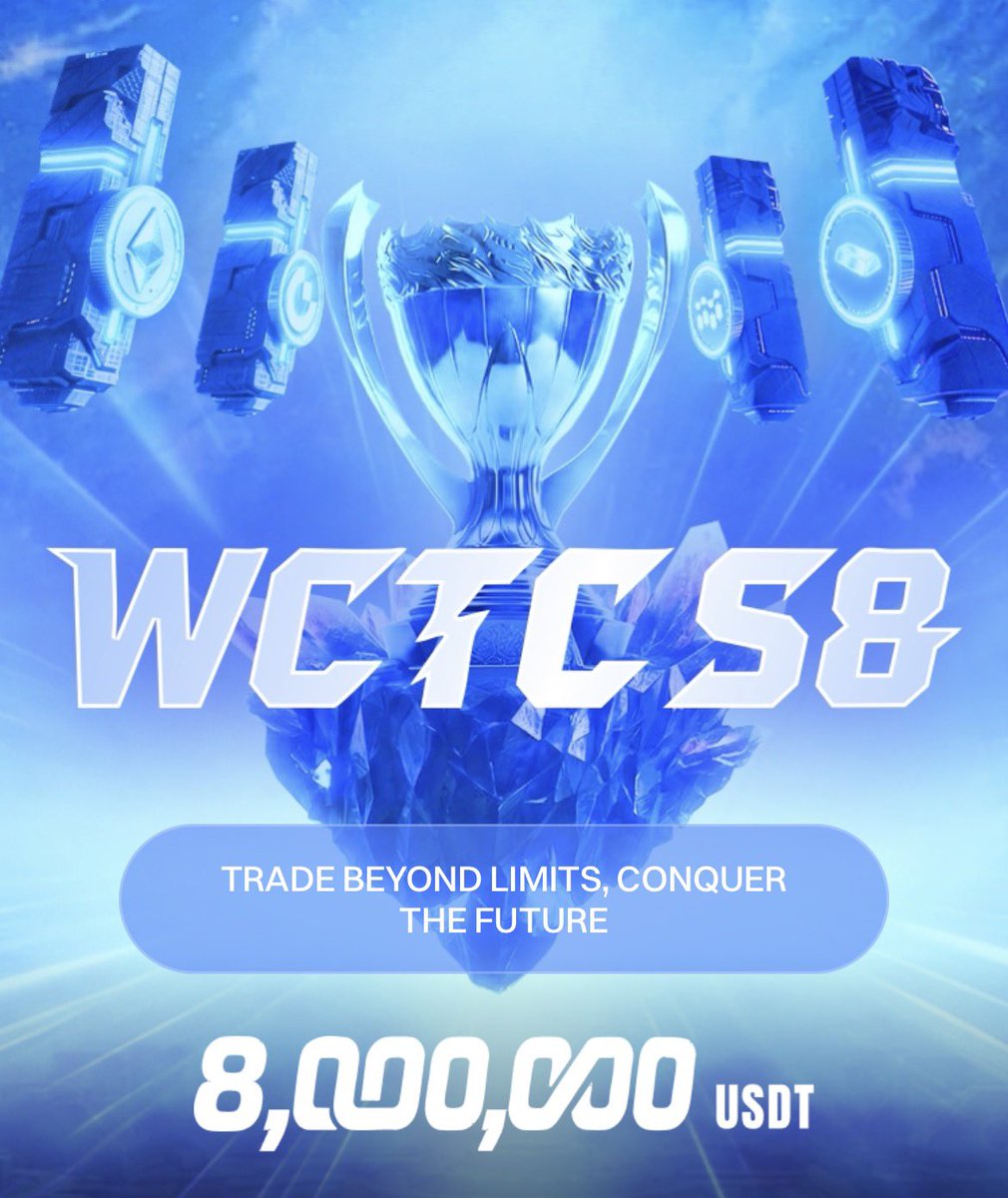
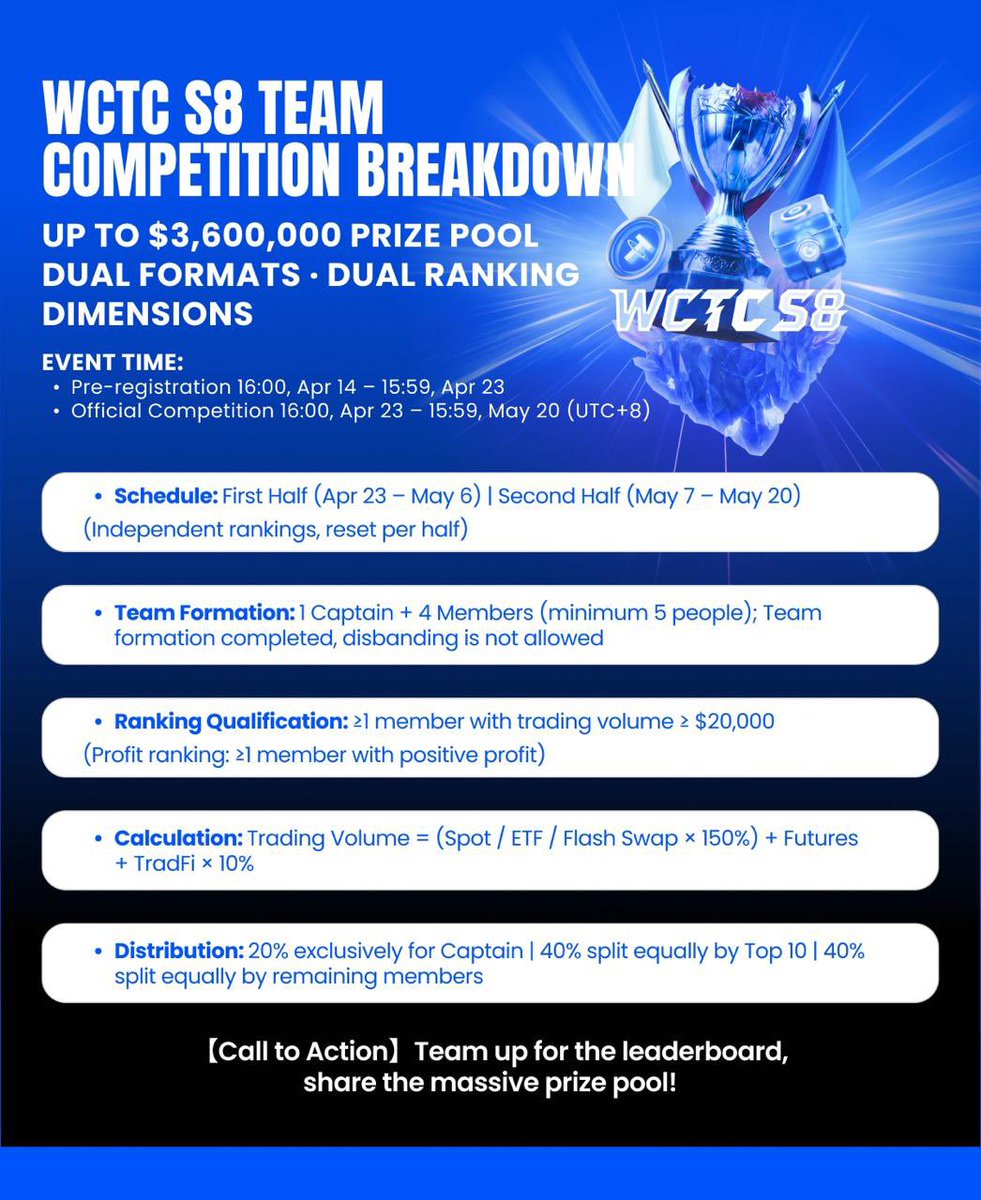
Here comes another massive opportunity presented by @Gate Gate is celebrating its 13th anniversary, and they’ve turned it into something huge They have launched a WCTC 2026 Season 8, a global trading competition with a staggering 8,000,000 USDT prize pool 📅 Timeline to keep in mind: ➤ Registration: April 14 – April 23, 2026 ➤ Competition period: April 23 – May 20, 2026 ⚙️ How it works: This is multiple battle formats in one arena: ➤ 👥 Team trading competitions ➤ 🧑💻 Individual trading rankings ➤ ⚔️ 1v1 “PK” trading battles Participants are ranked based on trading volume and profit performance, meaning the more strategic and consistent you are, the higher you climb. 📈 Dynamic rewards system: ➤ The prize pool isn’t fixed, it expands as more traders join ➤ More participation = bigger rewards for everyone involved 🎁 Mystery perks & bonuses: Beyond the main prize pool, there are: ➤ Mystery boxes ➤ Trading vouchers ➤ Bonus rewards for completing event tasks ➤ Surprise incentives along the way This is more than just a celebration… it’s a high-stakes opportunity to test your skills, compete globally, and earn big. The question is, are you stepping into the arena or watching from the sidelines? 👀 Join us now 👇👇


There’s one important concept about DePIN that we all love: cost reduction. Imagine the cost of installing cameras, radars or an inbuilt AI system that can detect drones; most times it can miss or even misinterpret (AI). But there’s a solution DePIN has brought to us by @FliteGrid... they built a system that uses the in-built Remote ID already inside modern drones. Remote ID means every drone is already broadcasting its identity, location and speed in real-time. So instead of building expensive systems to “search” for drones, you simply deploy sensors that listen to what is already being broadcast in the air. This changes everything because now detection is no longer about heavy infrastructure; it becomes about coverage. Each sensor is low-cost and only covers a small area, but when you connect thousands of them, you get wide-scale visibility across entire cities and critical regions. And because multiple sensors can pick up the same drone signal, the system can cross-check and verify the data, which improves accuracy and reduces false readings. So what FliteGrid is really doing is removing the need for expensive detection systems and replacing it with a distributed network of simple listening devices. And when you zoom out, this is not just drone detection anymore; it becomes a real-time intelligence layer for the entire sky. And the data generated from this is extremely valuable for airports, governments and security systems that need constant airspace awareness. That is the real power of FliteGrid in the DePIN ecosystem.


As we draw closer to the final episode of "Mastering the Investor’s Mindset in DePIN!" We should understand by now that DePIN networks take time to mature. The truth is, signals are often subtle, and not every project that starts strong will finish strong. This is where portfolio thinking becomes essential. Because even with the right mindset, understanding tokenomics, recognising real demand, evaluating viability, and observing behaviour through downturns, uncertainty still exists. Infrastructure is complex. Execution varies. Outcomes diverge over time. A disciplined investor does not try to eliminate that uncertainty; they manage it. In DePIN, this begins with accepting that different networks are at different stages of development. Some are still bootstrapping supply. Others are transitioning toward demand. A few are beginning to demonstrate real economic viability; treating all of them the same leads to poor decisions. Early-stage networks carry more uncertainty. Their tokenomics may still be evolving. Demand may not yet be proven, and incentives may heavily influence participation. These networks offer potential, but they require more caution. More mature networks, on the other hand, may show clearer signs of demand, stronger alignment, and improved value capture. They may not feel as “early,” but they offer greater visibility into durability. A disciplined portfolio reflects this difference. It does not concentrate entirely on unproven systems, nor does it ignore emerging opportunities. Instead, it balances exposure across varying levels of maturity, aligning risk with conviction. This is not about diversification for its own sake. It is about positioning. Positioning based on what you understand about each network’s structure, progress, and viability. Over time, portfolio thinking also requires adjustment. As networks evolve, their role within a portfolio should evolve as well. Projects that begin to demonstrate real demand and sustainability may deserve increased conviction. Those that fail to show structural improvement may need to be reduced or removed. This is where many investors struggle. They become attached to narratives. They hold positions based on past expectations rather than present reality. But DePIN, like all infrastructure, reveals its strength gradually. And when the signals change, disciplined investors respond. Portfolio thinking also reinforces patience. Instead of relying on a single outcome, the investor allows multiple positions to develop over time. Some will take longer, some may fail, but the overall structure is designed to capture value where it genuinely compounds. This reduces the pressure to react emotionally to short-term movements. It replaces urgency with process. Mastering the investor’s mindset in DePIN means understanding that conviction is not static. It is built, tested, and refined as networks reveal their true characteristics. And a disciplined portfolio is simply the expression of that understanding. Not every network will succeed. But the ones that do will justify the patience, the analysis, and the structure behind the decisions. And that is how long-term value is captured in a space where progress is real, but never guaranteed.