
Physics of Complex Systems Lab

34 posts

Physics of Complex Systems Lab banner
Physics of Complex Systems Lab

Physics of Complex Systems Lab

@pcsl_epfl

Physics of Complex Systems Laboratory @EPFL. Statistical mechanics and theory of machine learning. Led by Prof. Matthieu Wyart. Profile run by students.

Lausanne - Switzerland Katılım Kasım 2021
18 Takip Edilen144 Takipçiler
Physics of Complex Systems Lab retweetledi
Matthieu wyart
Matthieu wyart@MatthieuWyart·
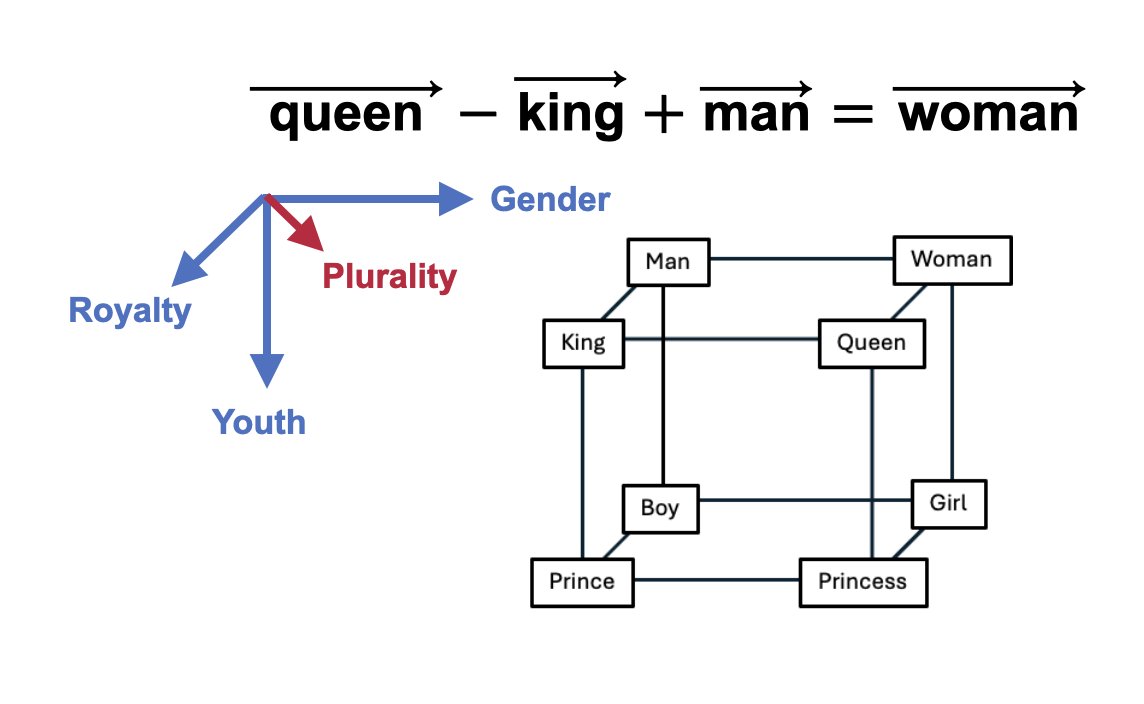
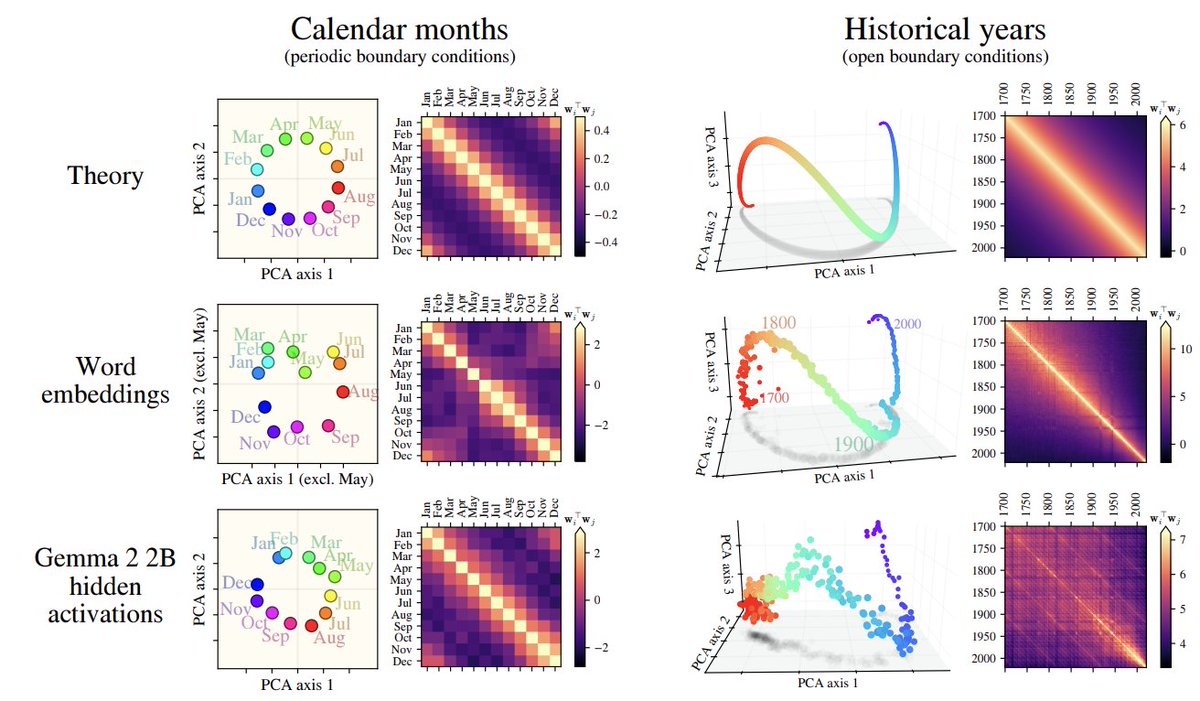
What governs the geometry of time and space embeddings in LLMs? We show it follows from translation symmetry in language statistics. With Dhruva Karkada, @DanKorchinski, Andres Nava, @yasamanbb arxiv.org/abs/2602.15029
Matthieu wyart tweet media
English
7
60
352
25.8K
Physics of Complex Systems Lab retweetledi
Matthieu wyart
Matthieu wyart@MatthieuWyart·
"Physics" approach to LLMs studied how synthetic languages are parsed after training, but the mechanism of learning how to parse was not known. Which correlations in data are used, and how many data are needed for that? This is answered here for a class of context-free languages.
Francesco Cagnetta@Fraccagnetta

❓ How do LLMs learn hierarchical structure from sentences alone? 🚨 We build PCFG-like synthetic datasets with two knobs---hierarchy + ambiguity---and derive a correlation-based learning mechanism that predicts the sample complexity of deep nets. Results 👇

English
1
10
55
5.6K
Physics of Complex Systems Lab retweetledi
Matthieu wyart
Matthieu wyart@MatthieuWyart·
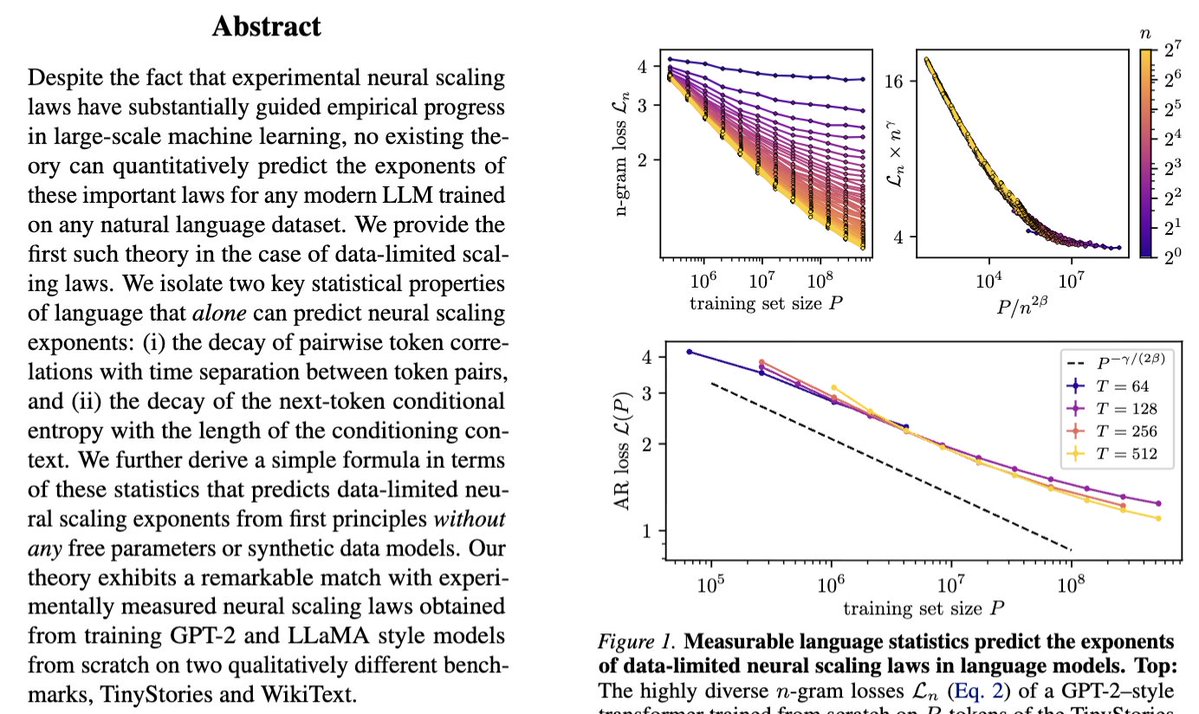
This paper asks: What controls the scaling laws of LLMs? Two key ideas: (i) as the training set size increases, correlations are detected on a longer context scale and (ii) on this scale, LLMs function optimally: the loss is ~ the next-token conditional entropy.
Surya Ganguli@SuryaGanguli

Our new paper "Deriving neural scaling laws from the statistics of natural language" arxiv.org/abs/2602.07488 lead by @Fraccagnetta & @AllanRaventos w/ Matthieu Wyart makes a breakthrough! We can predict data-limited neural scaling law exponents from first principles using the structure of natural language itself for the very first time! If you give us two properties of your natural language dataset: 1) How conditional entropy of the next token decays with conditioning length. 2) How pairwise token correlations decay with time separation. Then we can give you the exponent of the neural scaling law (loss versus data amount) through a simple formula! The key idea is that as you increase the amount of training data, models can look further back in the past to predict, and as long as they do this well, the conditional entropy of the next token, conditioned on all tokens up to this data-dependent prediction time horizon, completely governs the loss! This gets us our simple formula for the neural scaling law!

English
1
7
39
7.7K
Physics of Complex Systems Lab retweetledi
Surya Ganguli
Surya Ganguli@SuryaGanguli·
Our new paper "Deriving neural scaling laws from the statistics of natural language" arxiv.org/abs/2602.07488 lead by @Fraccagnetta & @AllanRaventos w/ Matthieu Wyart makes a breakthrough! We can predict data-limited neural scaling law exponents from first principles using the structure of natural language itself for the very first time! If you give us two properties of your natural language dataset: 1) How conditional entropy of the next token decays with conditioning length. 2) How pairwise token correlations decay with time separation. Then we can give you the exponent of the neural scaling law (loss versus data amount) through a simple formula! The key idea is that as you increase the amount of training data, models can look further back in the past to predict, and as long as they do this well, the conditional entropy of the next token, conditioned on all tokens up to this data-dependent prediction time horizon, completely governs the loss! This gets us our simple formula for the neural scaling law!
Surya Ganguli tweet media
English
20
117
576
60.2K
Physics of Complex Systems Lab retweetledi
Daniel Korchinski
Daniel Korchinski@DanKorchinski·
I’m excited to present my work at #NeurIPS with Dhruva Karkada, @yasamanbb and Matthieu Wyart tomorrow. If you want to understand why analogical reasoning emerges geometrically in simple language models, come check out our poster (# 3209) Friday afternoon at 16:30!
Daniel Korchinski tweet media
English
2
3
26
3.7K
Physics of Complex Systems Lab retweetledi
Surya Ganguli
Surya Ganguli@SuryaGanguli·
We have 14 survey lectures for our @SimonsFdn Collaboration on the Physics of Learning and Neural Computation! All videos available at: physicsoflearning.org/webinar-series Here is the list: @zdeborova: Attention-based models and how to solve them using tools from quadratic networks and matrix denoising @KempeLab: Recent lessons from LLM reasoning @MBarkeshli: Sharpness dynamics in neural network training @KrzakalaF: How Do Neural Networks Learn Simple Functions with Gradient Descent? Michael Douglas: Mathematics, Economics and AI Yuhai Tu: Towards a Physics-based Theoretical Foundation for Deep Learning: Stochastic Learning Dynamics and Generalization @SuryaGanguli: An analytic theory of creativity for convolutional diffusion models Eva Silverstein: Hamiltonian dynamics for stabilizing neural simulation-based inference @adnarim066: Generation with Unified Diffusion Bernd Rosenow: Random matrix analysis of neural networks: distinguishing noise from learned information @jhhalverson Nerual networks and conformal field theory @KempeLab Synthetic data: friend or foe in the age of scaling @WyartMatthieu Learning hierarchical representations with deep architectures @CPehlevan Mean-field theory of deep network learning dynamics and applications to neural scaling laws
English
2
57
250
22.1K
Physics of Complex Systems Lab retweetledi
Alessandro Favero
Alessandro Favero@alesfav·
🎓My PhD thesis is now on arXiv! It follows a thread of compositionality in AI: from locality in CNNs, to the 'grammar' diffusion models learn to be creative, to task composition in foundation models. Officially a Dr 🎉 and starting as a Physics-AI Fellow at DAMTP @Cambridge_Uni
Stat.ML Papers@StatMLPapers

The Physics of Data and Tasks: Theories of Locality and Compositionality in Deep Learning ift.tt/9B0HFnC

English
3
1
22
1.2K
Physics of Complex Systems Lab
Excited to be part of the new @SimonFdn Collaboration on the Physics of Learning and Neural Computation!
Simons Foundation@SimonsFdn

Our new Simons Collaboration on the Physics of Learning and Neural Computation will employ and develop powerful tools from #physics, #math, computer science and theoretical #neuroscience to understand how large neural networks learn, compute, scale, reason and imagine: simonsfoundation.org/2025/08/18/sim…

English
0
0
8
451
Physics of Complex Systems Lab retweetledi
Francesco Cagnetta
Francesco Cagnetta@Fraccagnetta·
And so it begins @icmlconf ... Tuesday 11 am (east hall) -> We dive into the training process of diffusion models to understand how generalization and combinatorial creativity emerge, with @alesfav. Wednesday 11 am (east hall) -> What Really Drives Neural Scaling Laws? Hierarchical Structure vs. Power-Law Distributions. If you’re interested in hierarchical structure in data, physics of DL, or just want to chat, come say hi!
English
0
3
19
1.2K
Physics of Complex Systems Lab retweetledi
Francesco Cagnetta
Francesco Cagnetta@Fraccagnetta·
Neural scaling laws are powerful and predictive, but what sets the exponent? Previous work links it to power-law data statistics, echoing classical results of kernel theory. arxiv.org/abs/2505.07067 shows that hierarchical structure matters more. Accepted @icmlconf 2025 🎉
Katie Everett@_katieeverett

There were so many great replies to this thread, let's do a Part 2! For scaling laws between loss and compute, where loss = a * flops ^ b + c, which factors change primarily the constant (a) and which factors can actually change the exponent (b)? x.com/_katieeverett/…

English
1
4
22
1.7K
Physics of Complex Systems Lab retweetledi
Francesco Cagnetta
Francesco Cagnetta@Fraccagnetta·
@jxmnop What about this arxiv.org/abs/2406.00048? We use a model of hierarchical data to make analytical predictions about the sample size required to reach the n-gram performance as a function of n, then test the predictions of the theory in experiments with standard DL architectures
English
0
3
12
561
Physics of Complex Systems Lab retweetledi
Alessandro Favero
Alessandro Favero@alesfav·
Amazed by language diffusion models like Mercury? So are we 🤯 But how do they actually learn to generate coherent (and creative!) text from scratch? We dig into it using simple formal grammars and statistical physics. Just accepted @icmlconf 2025 🎉
Alessandro Favero tweet media
English
1
4
31
2.3K
Physics of Complex Systems Lab retweetledi
Alessandro Favero
Alessandro Favero@alesfav·
I’ll be @NeurIPSConf Tuesday-Sunday! Happy to chat about the physics/science of DL, hierarchies and compositionality in images and language, diffusion models, task arithmetic, and model merging. Feel free to reach out! Also, I’m looking for job opportunities starting next fall!
English
0
1
10
405
Physics of Complex Systems Lab retweetledi
Francesco Cagnetta
Francesco Cagnetta@Fraccagnetta·
At @NeurIPSConf until Sunday. Come to my poster Wed, 4:30 PM (neurips.cc/virtual/2024/p…). Also reach out if you want to chat about hierarchical data structures and theory of deep learning!
Francesco Cagnetta tweet media
English
1
6
43
3K
Physics of Complex Systems Lab retweetledi
Stat.ML Papers
Stat.ML Papers@StatMLPapers·
Probing the Latent Hierarchical Structure of Data via Diffusion Models ift.tt/e5I0Kr7
English
0
8
91
6.4K
Physics of Complex Systems Lab retweetledi
Francesco Cagnetta
Francesco Cagnetta@Fraccagnetta·
Couldn't agree more, and neither could the reviewers---I am glad to announce that my latest work on modeling the hierarchical and compositional structure of text data has been accepted at #NeurIPS2024! Check it at arxiv.org/pdf/2406.00048.
Simons Institute for the Theory of Computing@SimonsInstitute

"The structure of data is the dark matter of theory in deep learning" — @SuryaGanguli during his talk on "Perspectives from Physics, Neuroscience, and Theory" at the Simons Institute's Special Year on Large Language Models and Transformers, Part 1 Boot Camp.

English
2
2
25
2.2K
Physics of Complex Systems Lab retweetledi
Francesco Cagnetta
Francesco Cagnetta@Fraccagnetta·
Just published in @PhysRevX! Enjoy open access at journals.aps.org/prx/abstract/1… and stay tuned for the follow-up on language modelling!⏲️
Francesco Cagnetta@Fraccagnetta

1/3 Check this ---> arxiv.org/abs/2307.02129. After years of dabbling in machine learning theory, we (finally) go back to our physics roots and introduce an idealised model of data that sheds light on a pressing question of the field: how do deep neural networks work?

English
0
3
28
2.6K