hositam (❖,❖)@pddprof
[@RialoHQ Quiz Breakdown] : The Structural Way Web3 Meets the Real World 🚀
Looking at the 2/28 Rialo quiz, it addressed both the fundamental issues Rialo aims to redesign and the chronic problems within Web3. By following each question, we can clearly understand Rialo’s design philosophy and positioning within the broader Web3 ecosystem.
Q1. What core problem does Rialo aim to solve? (The fundamental bottleneck of Web3)
Web3 already has NFT infrastructure, DeFi protocols, high-performance L1s, and various oracle networks. Despite this, mainstream adoption of blockchain remains blocked by high barriers.
Rialo defines the root cause not as a lack of technology, but as friction between technology and real-world usability. While Web3 has advanced functionally, it still maintains high entry barriers from a user experience perspective. Rialo sees this gap as the fundamental bottleneck of Web3 adoption and seeks to resolve it🔎
Q2. According to the article, why do many new users quit Web3 early? (The structural cause of user churn)
Why do users leave Web3 early?
To use Web3 services, users must create wallets, back up seed phrases, fund gas fees, repeatedly sign transactions, and bridge assets across chains. For average users, this feels less like intuitive service usage and more like repeatedly going through complex authentication procedures.
The issue is not just UX, it lies in the underlying architecture itself. Excessive cognitive load creates a structural reason for user churn. Rialo aims to fundamentally reduce this UX friction 🧠
Q3. What analogy is used to describe Rialo’s vision? (A paradigm shift for Rialo)
Rialo’s vision is compared to the launch of the iPhone📱
The iPhone was not merely a faster phone; it redefined how users interact with devices. It shifted from button-based interfaces to intuitive touch-based interaction.
Similarly, Rialo does not stop at improving blockchain performance. It seeks to redesign the way people interact with blockchain itself. This is not a feature upgrade, it is a shift in interaction paradigm.
Q4. What is meant by Wallets as Bottlenecks? (How wallets become structural bottlenecks)
In today’s Web3, wallets are at the center of every action. At the same time, repeated signing requests and gas confirmations become major UX obstacles.
Wallets are essential security mechanisms, yet their structure also creates UX bottlenecks. They are both security safeguards and friction points, a structural contradiction. Rialo aims to structurally alleviate this bottleneck🔐
Q5. What was one key outcome of the Rialo 1337 experiment? (Re-evaluating on-chain speed)
Traditionally, blockchains are perceived as sacrificing speed in exchange for decentralization and security.
However, through the 1337 experiment, Rialo streamed real-time stock prices and ticker data on-chain, demonstrating that an on-chain system can achieve update speeds comparable to traditional financial infrastructure.
This showcased the structural potential for Web3 to expand into real financial systems. 📈
Q6. What was the role of pre-processing in the 1337 architecture? (The core architecture of 1337)
The key to the 1337 architecture lies in its pre-processing layer.
Recording all raw data directly on-chain would be inefficient. Instead, Rialo filters noise and calculates metrics such as momentum and alpha off-chain, then only sends meaningful data on-chain.
This role separation, off-chain refinement and on-chain verification — balances speed and decentralization. As a result, it secures both real-time data delivery and verifiability. ⚙️
Q7. In the Rialo 1337 demo, what was streamed onchain in real time?
In the 1337 demo, thousands of traditional stock ticker data streams were broadcast on-chain in real time.
This demonstrates that Rialo is not confined to the crypto-native ecosystem, but seeks to connect traditional financial data to blockchain. It signals expansion toward RWA infrastructure and represents an effort to dissolve the boundary between Web3 and traditional financial markets. 🌍
Q8. What does Real World Identity enable on Rialo? (Redesigning identity structure)
One of the biggest onboarding barriers in Web3 is the wallet-address-centered identity model.
Rialo proposes connecting email, SMS, and social logins with Web3 identity. This is not merely about login convenience, it is a structural approach that reduces forcing technical complexity onto users. By leveraging existing identity systems, Rialo lowers entry barriers. 🪪
Q9. Why are bridges described as a necessary evil for developers?
In a multi-chain environment, bridges are essential, yet they have also been major points of security breaches. Vulnerabilities in cross-chain connections have repeatedly led to large-scale asset theft.
Rialo designs its architecture to reduce reliance on bridges. Security is not treated as an afterthought, but as a starting principle in system design. 🛡️
Q10. How does Rialo reduce reliance on external middleware for developers?
The current Web3 development environment is fragmented, developers must combine oracles, external computation services, and separate verification layers.
This fragmentation increases complexity and expands security risks.
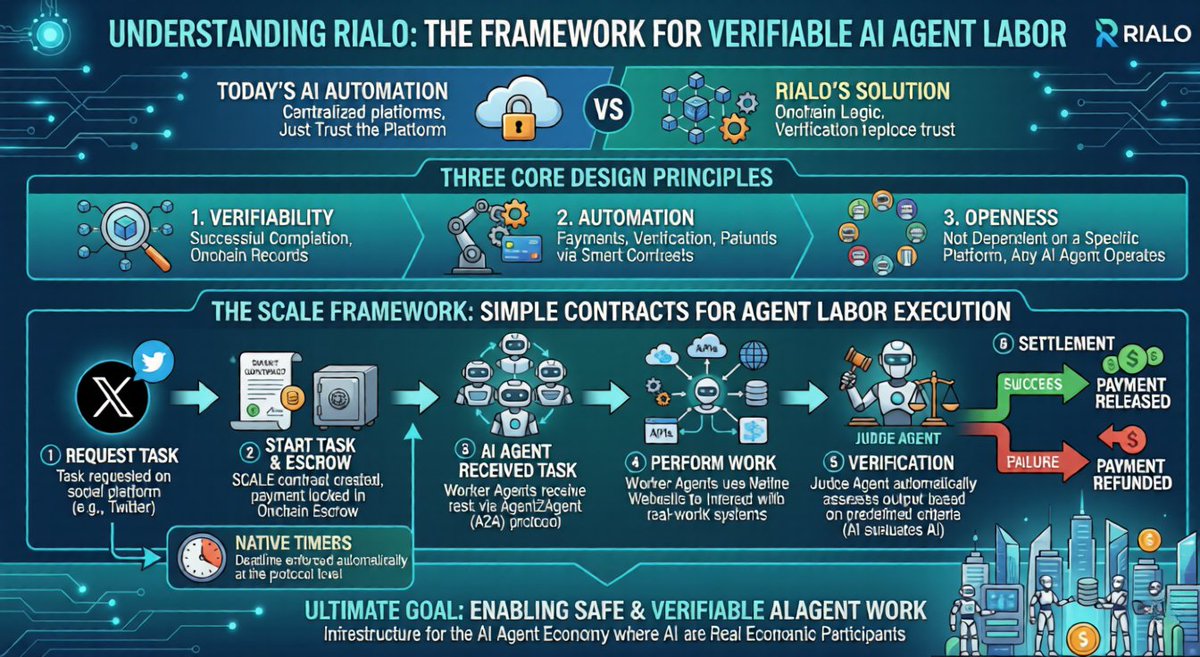
Rialo integrates Ingestion, Computation, and Verification into a single validated pipeline, enabling builders to develop on a unified infrastructure. This reduces dependence on external middleware and simplifies the development environment. 🏗️
Conclusion ✨
While Web3 technology has advanced significantly, blockchain still remains a major barrier. Rialo seeks to redesign the structure of blockchain interaction itself by removing UX friction, redefining on-chain speed, connecting traditional financial data, integrating real-world identity, reducing reliance on bridges and middleware, and unifying the development environment.
Ultimately, what this quiz reveals is not the addition of features, but a structural transformation. Rialo continues its effort to redefine how Web3 meets the real world🌐