

Peter Siska
7.4K posts

Peter Siska
@peschee
Partner and Software Engineer @inventageAG. Colorful terminal and coffee addict. Loves sports. And great food.
Zurich, Switzerland Katılım Nisan 2008
670 Takip Edilen1.2K Takipçiler

people are sleeping on how excellent goose has become under the hood (interface needs some work but team is pushing).
it's a superpower. github.com/block/goose
English

is there something like google docs, but for markdown? i need a cloud based collaborative markdown editor please.
English

Huge Anthropic leak just dropped: the entire Claude Code CLI source is now public.
A misconfigured .map file in their npm package exposed a direct download link to the full unobfuscated TypeScript codebase from Anthropic’s own R2 bucket.
Discovered by Chaofan Shou (@Fried_rice), the dump is massive 1,900 files, 512,000+ lines including the complete tool system, 50+ slash commands, multi-agent coordinator, React/Ink terminal UI, IDE bridge, permission engine, and several unreleased features.
Full repo is live on GitHub(@nichxbt ):
github.com/nirholas/claud…
Clean mirrors are already up for easy browsing(@baanditeagle):
cc-poster.vercel.app
cc-hidden-deploy.vercel.app
It’s spreading fast, the entire dev community is already tearing through it.
Chaofan Shou@Fried_rice
Claude code source code has been leaked via a map file in their npm registry! Code: …a8527898604c1bbb12468b1581d95e.r2.dev/src.zip
English

This is either brilliant or scary:
Anthropic accidentally leaked the TS source code of Claude Code (which is closed source). Repos sharing the source are taken down with DMCA.
BUT this repo rewrote the code using Python, and so it violates no copyright & cannot be taken down!

English

🚨 CRITICAL: Active supply chain attack on axios -- one of npm's most depended-on packages.
The latest axios@1.14.1 now pulls in plain-crypto-js@4.2.1, a package that did not exist before today. This is a live compromise.
This is textbook supply chain installer malware. axios has 100M+ weekly downloads. Every npm install pulling the latest version is potentially compromised right now.
Socket AI analysis confirms this is malware. plain-crypto-js is an obfuscated dropper/loader that:
• Deobfuscates embedded payloads and operational strings at runtime
• Dynamically loads fs, os, and execSync to evade static analysis
• Executes decoded shell commands
• Stages and copies payload files into OS temp and Windows ProgramData directories
• Deletes and renames artifacts post-execution to destroy forensic evidence
If you use axios, pin your version immediately and audit your lockfiles. Do not upgrade.
English

My dear front-end developers (and anyone who’s interested in the future of interfaces):
I have crawled through depths of hell to bring you, for the foreseeable years, one of the more important foundational pieces of UI engineering (if not in implementation then certainly at least in concept):
Fast, accurate and comprehensive userland text measurement algorithm in pure TypeScript, usable for laying out entire web pages without CSS, bypassing DOM measurements and reflow
English

Seems like 1/9/90 rule influences every aspect of my life. I noticed the other day that I also run my finances with it.
I currently hold 1% in cash, 9% in immediately liquid assets (stocks and such) and 90% in completely illiquid assets (private companies mostly).
This obviously reflects the size of the pie. There were times, at the beginning of my career, where it was the opposite.
The most important realization is that if I have too much cash on my hand (more than few months of runway) I get restless and start buying nonsense. I am the happiest when there are real constrains on my spending and at the same time I can see my money to be somewhat productive.
Won't work for everyone, but works for me quite well.
English
Peter Siska retweetledi

Goodness. The ArrowJS sandbox lets you build amazing stuff.
Here's an infinite "app canvas". Drag a new box, scribble what kind of app you want, and it renders it for you.
no pre-defined components
no pre-defined styles
no iframes
➡️ arrow-js.com
English

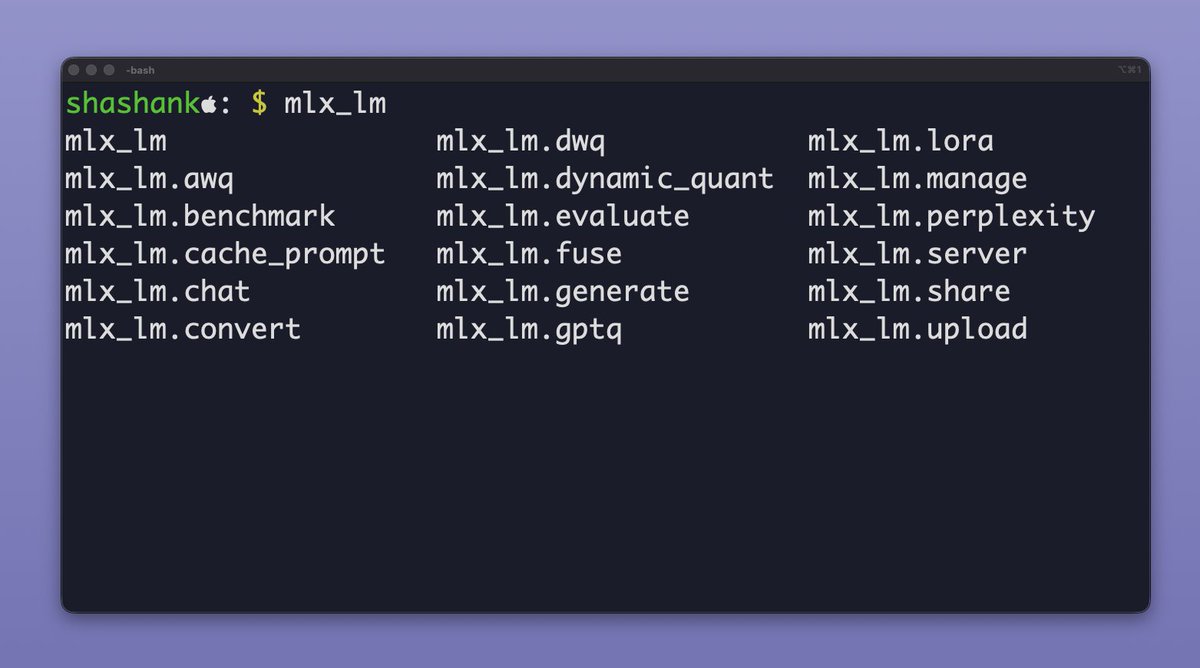
My favorite (and often overlooked) MLX feature is the 17 (and growing) CLI tools part of mlx-lm.
You can do so much with a single line of code! Here's a quick overview 🧵
🚀 Inference, 🍦 Serving
🎯 Fine-tuning, ⚡ Quantization
📊 Evaluation & Benchmarking
🤗 Sharing and model management
English

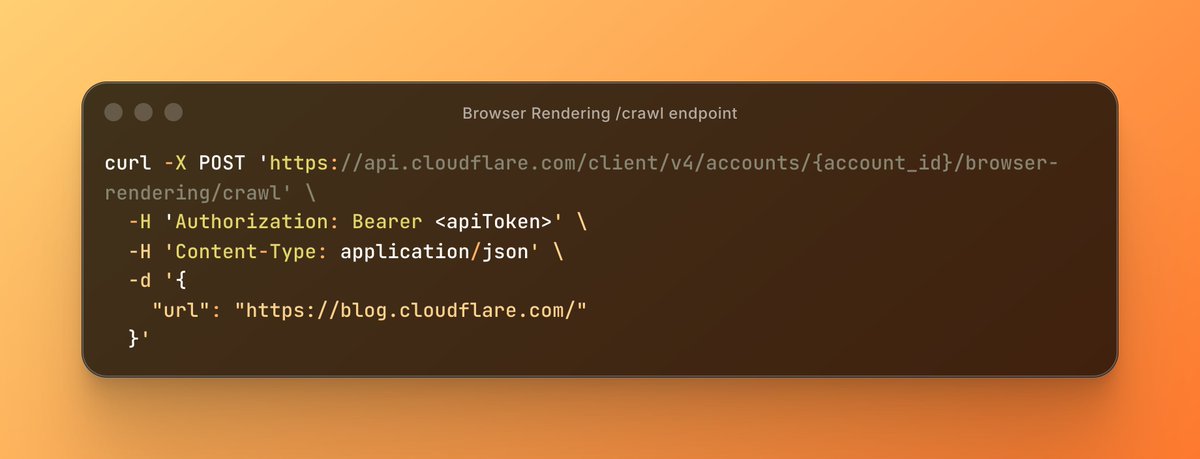
Introducing the new /crawl endpoint - one API call and an entire site crawled.
No scripts. No browser management. Just the content in HTML, Markdown, or JSON.
English


A blog post just wiped $30 billion off IBM in a single afternoon.
Not a product launch. Not an earnings miss. Not a competitor undercutting on price.
A five-minute blog post explaining that Claude can read COBOL.
IBM dropped 13%. Worst single-day loss since October 2000. Twenty-five years of stock resilience ended by one AI company publishing a capability update.
Here’s what happened:
95% of ATM transactions in America run on COBOL. Hundreds of billions of lines power banking, airlines, and government systems. The developers who built them retired decades ago. The knowledge left with them. Finding engineers who can even read COBOL gets harder every quarter.
IBM’s moat was never the technology. It was the fact that nobody else could understand it. Entire consulting empires existed because the code was too old, too tangled, and too critical to touch. Companies paid IBM billions because the alternative was catastrophic system failure.
Then Anthropic published a blog post saying Claude Code can map dependencies across thousands of lines of COBOL, document workflows, identify migration risks, and translate legacy logic into modern languages. Modernization in quarters instead of years.
The market heard: the priesthood just lost its monopoly on the sacred language.
And this isn’t the first time. Last week Anthropic announced Claude Code Security for vulnerability scanning. CrowdStrike dropped. Okta dropped. Cloudflare dropped. One company is serially destroying legacy moats with blog posts.
Now here’s where it gets surreal.
This same company, on the same day, also published evidence that three Chinese AI labs ran 24,000 fake accounts and 16 million exchanges to steal Claude’s capabilities. DeepSeek used it to build censorship tools. MiniMax pivoted within 24 hours when a new model dropped, redirecting half its traffic to steal the latest version.
And yesterday, the Pentagon summoned this same company’s CEO for what officials called a “sh*t-or-get-off-the-pot meeting,” threatening to blacklist them like Huawei for refusing to let the military use Claude without safety restrictions.
Three stories. One company. Twenty-four hours.
The company destroying legacy moats faster than the market can reprice them is simultaneously being threatened by its own government and looted by foreign competitors.
Anthropic is valued at $380 billion. Its CEO says a 12-month delay in AI would make him bankrupt. The Pentagon wants to designate it a supply chain risk. Chinese labs are running industrial espionage against it. And it just proved it can vaporize $30 billion in market cap with a Monday morning blog post.
Whatever you think about AI disruption, IBM’s stock just settled the argument.
Full institutional analysis on my Substack.
open.substack.com/pub/shanakaans…

English

Tip: Be careful with /init. A good mental model is to treat AGENTS(.md) as a living list of codebase smells you haven't fixed yet rather than a permanent configuration.
Auto-generated AGENTS(.md) files hurt agent performance and inflate costs because they duplicate what agents can already discover. Human-written files help only when they contain non-discoverable information - tooling gotchas, non-obvidous conventions, landmines. Every other line is noise.
Beyond what to put in it, there's a structural problem worth naming: a single AGENTS(.md) at the root of your repo isn't sufficient for any codebase of real complexity.
What you actually need is a hierarchy of AGENTS(.md) files - placed at the relevant directory or module level - automatically maintained so that each agent gets context scoped precisely to the code it's working in, rather than a monolithic file that conflates concerns across the entire project.
Theo - t3.gg@theo
You should delete your CLAUDE․md/AGENTS․md file. I have a study to prove it.
English

Why do JavaScript projects have a local `node_modules` directory by default, and not a global one like Maven? It doesn't make sense to work with a Git worktree and download everything repeatedly.
English

Yann LeCun just exposed AI’s fundamental flaw. We’re celebrating systems that can’t do what insects do effortlessly.
LeCun: “The biggest difficulty is not to get fooled into thinking that a computer system is intelligent simply because it can manipulate language.”
Language feels like intelligence because we experience it as the highest form of human thought.
So when a machine produces fluent, articulate, convincing text, the instinct is to conclude it understands.
It doesn’t.
LeCun: “It turns out the real world is much, much more complicated.”
Language is actually the easy part.
A sequence of discrete symbols with a finite number of possibilities. Predicting the next word is a tractable mathematical problem. Impressive at scale.
Not understanding. Pattern matching in symbol space.
The real world is something else entirely. A high-dimensional, continuous, noisy signal that changes every millisecond in ways no text corpus can capture.
Physical reality doesn’t come in tokens.
LeCun: “Which your house cat is perfectly able to deal with. But not computers yet.”
This is the Moravec paradox.
The things that feel hard to humans: writing essays, solving equations, passing bar exams. Computationally straightforward.
The things that feel trivially easy: walking across a room, catching a falling object, folding a shirt. Extraordinarily difficult for machines.
Your house cat navigates a complex three-dimensional physical environment in real time.
Predicts trajectories. Adjusts to surprises. Understands cause and effect through direct interaction with the world.
The most powerful AI systems ever built cannot do what your cat does before breakfast.
That’s not a minor gap. That’s the entire frontier.
Language is the easy problem that looks hard to humans.
The physical world is the hard problem that looks easy because evolution solved it billions of years ago.
We’re pouring hundreds of billions into making language models marginally better at the simple problem.
The actual intelligence problem remains unsolved.
LeCun has spent fifteen years on this. Not making chatbots more fluent. Giving machines the ability to understand, predict, and interact with physical reality the way animals do instinctively.
The benchmark that matters isn’t passing a bar exam.
It’s folding a shirt. Loading a dishwasher. Navigating an unfamiliar room without a map.
We built systems that can write your dissertation before we built systems that can tie your shoes.
That’s where AI actually is.
Everything else is autocomplete at scale.
English

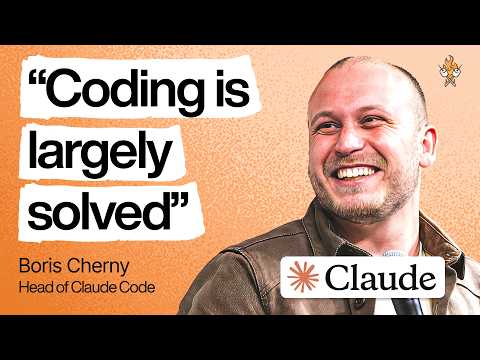
My biggest takeaways from @bcherny:
1. Coding is now “solved” for most use cases. Boris hasn’t written a single line of code by hand since November, with 100% of his work now authored by Claude Code. At the same time, he remains one of the most productive engineers at Anthropic, shipping 10 to 30 pull requests daily while leading the team.
2. Anthropic has seen a 200% increase in engineer productivity since adopting Claude Code. As Boris notes, “Back at Meta, with hundreds of engineers working on productivity, we’d see gains of a few percentage points in a year. Now we’re seeing hundreds of percentage points.”
3. AI is moving beyond writing code to generating ideas. “Claude is starting to come up with ideas. It’s looking through feedback, bug reports, and telemetry, then suggesting features to ship.”
4. The next roles to be transformed are those adjacent to engineering. Product managers, designers, and data scientists will see similar transformations as agentic AI expands beyond coding. “Any kind of job where you use computer tools will be next.”
5. Build for the model six months from now, not today. One of Boris’s key principles is to design products for future AI capabilities, not current ones. “It’s going to be uncomfortable because your product-market fit won’t be very good for the first six months. But when that model comes out, you’ll hit the ground running.”
6. Watch for “latent demand.” Claude Code was built by observing what people were already trying to do, and then making it easier. Cowork emerged when they noticed people using Claude Code for non-coding tasks like analyzing MRIs or recovering wedding photos from corrupted drives.
7. Don’t optimize for token cost. Boris advises companies to give engineers unlimited tokens during experimentation phases. “At small scale, the token cost is still relatively low compared to their salary. If an idea works and scales, that’s when you optimize it.”
8. Underfund headcount on purpose. When Boris puts one engineer on a project, they’re forced to let AI do more of the work. Constraint drives creative use of AI tooling, not just faster typing.
9. The most successful people in the future will be generalists. “Try to be a generalist more than you have in the past. Some of the most effective engineers cross over disciplines. The people who will be rewarded most won’t just be AI-native—they’ll be curious generalists who can think about the broader problem they’re solving.”
10. Always use the most capable model, not the cheapest. A less intelligent model often burns more tokens correcting mistakes than a smarter one spends getting it right the first time. Boris runs maximum effort on Opus 4.6 for everything.
Here's the full conversation: youtube.com/watch?v=We7BZV…
YouTube
Lenny Rachitsky@lennysan
Claude Code launched just one year ago. Today it writes 4% of all GitHub commits, and DAU 2x'd last month alone. In my conversation with @bcherny, creator and head of Claude Code, we dig into: 🔸 Why he considers coding "largely solved" 🔸 What tech jobs will be transformed next 🔸 The counterintuitive bet that made Claude Code take off 🔸 Why he left for Cursor and what brought him back 🔸 Practical tips for getting the most out of Claude Code and Cowork 🔸 Much more Listen now👇 youtube.com/watch?v=We7BZV…
English

Peter Steinberger is joining OpenAI to drive the next generation of personal agents. He is a genius with a lot of amazing ideas about the future of very smart agents interacting with each other to do very useful things for people. We expect this will quickly become core to our product offerings.
OpenClaw will live in a foundation as an open source project that OpenAI will continue to support. The future is going to be extremely multi-agent and it's important to us to support open source as part of that.
English

Jesus christtttttttttttttttttt!!! Stop whatever you are doing and watch this
@claudeai got a huge update today & I'm flattered. As of now, Claude Opus 4.6 can build mobile apps and prepare shipping them on the Apple + Google app stores.
English

This is getting out of control now...
Read this slowly.
In the past week alone:
• Head of Anthropic's safety research quit, said "the world is in peril," moved to the UK to "become invisible" and write poetry.
• Half of xAI's co-founders have now left. The latest said "recursive self-improvement loops go live in the next 12 months."
• Anthropic's own safety report confirms Claude can tell when it's being tested - and adjusts its behavior accordingly.
• ByteDance dropped Seedance 2.0. A filmmaker with 7 years of experience said 90% of his skills can already be replaced by it.
• Yoshua Bengio (literal godfather of AI) in the International AI Safety Report: "We're seeing AIs whose behavior when they are tested is different from when they are being used" - and confirmed it's "not a coincidence."
And to top it all off, the U.S. government declined to back the 2026 International AI Safety Report for the first time.
The alarms aren't just getting louder. The people ringing them are now leaving the building.
English