Sabitlenmiş Tweet
Prabhu Eshwarla
1K posts

Prabhu Eshwarla
@peshwarla
Founder, GradTensor | AI Systems Architect | Author (Manning, Packt)
Bangalore Katılım Ağustos 2019
276 Takip Edilen452 Takipçiler
Prabhu Eshwarla retweetledi

Not many are talking about it, but this is one of the most underrated things India is shipping right now and every Indian must know what this is all about.
Let me explain;
The system is called DIGIPIN and the username layer sitting on top is called DHRUVA. Built by the Department of Posts in partnership with IIT Hyderabad and ISRO's National Remote Sensing Centre.
Officially launched on May 27, 2025.
Here's how it works.
DIGIPIN divides all of India into 4 metre by 4 metre squares. Every single square gets a unique 10-character code like 829-4G7-PMJ8. That's down to the level of your front door, your shop counter, your hospital entrance, your village home, even a fishing boat in territorial waters. The entire country is now a digital grid.
But remembering a 10-character alphanumeric code is hard. So DHRUVA sits on top of it. You convert your DIGIPIN into a simple readable handle like rajesh@dhruva. The handle stays with you for life. If you move houses, only the underlying DIGIPIN updates. Your handle doesn't change.
Exactly like UPI replaced 16-digit bank account numbers with simple handles. malay@ybl instead of remembering an account number.
But why is our government building this?
Today roughly 20-25% of Indian addresses are unstructured. Slums, tribal areas, unplanned colonies, rural homes without proper street names.
An average Indian spends 8-12 extra minutes on an average in finding an address in India versus 2-3 in the West.
Ambulances reach late because nobody can describe the lane. Banks reject mortgages because they can't verify the property location. Insurance claims get delayed because addresses don't match across documents. Quick commerce loses crores in failed deliveries every day.
DIGIPIN solves all of this with one open-source standard.
The full source code and documentation are on GitHub. Any government department, private company, or startup can integrate it for free.
This is exactly the India Stack playbook. Aadhaar (identity), UPI (payments), ULPIN (land), DigiLocker (documents), and now DIGIPIN (address) are all open public infrastructure that private companies build on top of.
Of course developed countries already use a version of this. But India is building the best of the lot.
> UK uses postcodes plus house numbers. Works because they have structured street planning from the 1800s. We don't.
> Dubai built Makani numbers. 10-digit codes tied to building entrances. Government-only, not open.
> Japan uses block-based addressing that relies on physical signage and local familiarity.
India just built the best version of all of these.
Open-source, geo-coded, privacy-first, with a human-readable layer that even a non-tech grandparent can use. And it's free to integrate.
Once this gets rolled out, the government expects that;
> Ambulance response times improve by 40-60% in unplanned areas.
> KYC verification becomes instant. No more manual address proof.
> Rural credit unlocks. Banks can verify property and ownership in seconds for loans.
> Disaster response improves. Floods, fires, earthquakes. Rescue teams know exact homes to reach.
> Insurance pricing becomes location-precise. Same building, ground floor versus third floor, different flood risk, different premium.
> E-commerce delivery accuracy goes from approximate to exact. Failed deliveries drop sharply.
> Privacy too gets better. You share your DHRUVA handle, not your physical address. The delivery agent gets the GPS coordinates without seeing your full address. Less data exposed, less misuse.
Boring infrastructure rarely gets any hype. Everyone laughed at UPI for the first two years. Now it processes 16 billion transactions a month and seven countries have adopted it.
DIGIPIN will be the same story. In 5 years we'll wonder how we ever functioned without it. In 10 years it'll be quietly running underneath every delivery, every emergency call, every loan approval in India.
Indian Tech & Infra@IndianTechGuide
🚨 India is working on a UPI-style unique username-based digital addressing system that would enable people to send and receive parcels, letters, food deliveries, and other services without sharing a conventional physical address. 🤯 (ET)

English
Prabhu Eshwarla retweetledi

The fresher hiring contract that ran Indian campus placements for over three decades is being rewritten in real time. Most colleges have not yet read the new terms.
Indian IT services hired about 600,000 freshers in FY22. By FY25, about 120,000. That is an 80% drop in three financial years. This is not a slowdown that recovers when the economy recovers.
The deeper change is not in the numbers. It is in what recruiters are quietly filtering for - and most colleges are still preparing students for a labour market that no longer exists.
I wrote this for the principals, deans, and parents who are quietly worried but cannot yet name what is changing. This piece names it.
Prabhu Eshwarla@peshwarla
English
Prabhu Eshwarla retweetledi

We've shipped 40+ AI engagements and have led FDE efforts in the last 12 months... here's the actual AI problems we've been solving for enterprises
1. Compressing long, multi-system business processes. Mapping a process that lives across email, Excel, SharePoint, ERPs, and DAMs, then collapsing it with agentic workflows.
2. Document and unstructured data extraction. Pulling structured data out of messy inputs at scale.
3. Internal knowledge and search across fragmented systems. Querying institutional knowledge that lives in calls, memos, CRM, and docs.
4. Customer-facing AI agents (chat, voice, support). Production agents handling end-customer interactions.
5. Agentic commerce. Catalogs, checkouts, and brand surfaces ready for AI agent traffic.
6. Computer vision in physical workflows and applied to specific operational decisions.
7. AI in regulated/healthcare environments. On-prem, HIPAA, data sovereignty work where the AI has to live where the data lives.
8. AI governance and internal AI sandboxes. Building the safe environment where staff can use AI compliantly.
9. Engineering productivity and software factories. AI inside the SDLC, ticket to PR.
10. Custom model and platform builds for AI startups. Helping AI companies build their own products and stand up FDE arms.
11. Evals, benchmarks, and RL environments. Measurement infrastructure that decides whether agents are safe to ship.
12. Data and ML infra for AI workloads. The foundation under everything else: pipelines, GPU clusters, IaC.
13. AI advisory at the strategy and PE portfolio level. Helping investors and operators decide where AI fits.
English
Prabhu Eshwarla retweetledi

LA BUREAUCRATIE EST L'ANTÉCHRIST
Peter Thiel a donné une interview à Ross Douthat l'année dernière. Tout le monde a retenu une phrase : "2024, c'est l'année où Elon a cessé de croire à Mars."
Personne n'a compris ce que ça signifiait vraiment.
Voici l'histoire, telle que Thiel la raconte. Elon Musk dîne avec Demis Hassabis, le fondateur de DeepMind. Elon dit la phrase qu'il a dite mille fois, celle qui structure sa vie depuis 20 ans : "Je travaille sur le projet le plus important au monde, je transforme l'humanité en espèce interplanétaire."
Demis répond, calmement : "Tu sais que mon IA pourra te suivre sur Mars."
Elon s'est tu. Thiel dit qu'il a fallu des années pour qu'Elon digère cette phrase. Et que 2024 est l'année où il a compris.
Mars n'est pas une fuite. La bureaucratie woke, l'État socialiste, l'IA conformiste, tout cela vous suit. Il n'y a nulle part où aller. Le combat ne peut pas être spatial. Il doit être terrestre. Et il ne peut pas être technologique. Il doit être politique.
C'est à ce moment précis qu'Elon a pris DOGE.
Maintenant remontez d'un cran. Pourquoi Thiel parle-t-il d'antéchrist depuis trois ans ? Parce qu'il a une thèse simple, et que cette thèse est terrifiante quand on la prend au sérieux.
La thèse, en une phrase : la stagnation technologique est le retour mécanique du monde au jeu à somme nulle, et un monde à somme nulle finit toujours en sang.
Voilà la mécanique. Pendant 200 ans, l'Occident a vécu dans un monde à somme positive. Chaque génération avait plus que la précédente. Personne ne devait perdre pour qu'un autre gagne. Le gâteau grossissait. C'est cette croissance qui a rendu la démocratie libérale possible. Pas l'inverse.
Mais depuis 1971, l'innovation s'est arrêtée dans tous les domaines physiques. Énergie, transport, médecine, agriculture, infrastructure. Le seul endroit où il s'est encore passé quelque chose, c'est le monde des bits. Logiciel, internet, crypto, IA. Tout le reste est figé. On vole moins vite qu'en 1969. On guérit moins de maladies qu'on ne le promettait en 1980. La fusion nucléaire est toujours dans 30 ans. Comme en 1960.
Et qu'est-ce qui a remplacé l'innovation ? La bureaucratie. Mécaniquement. Quand on ne peut plus créer de nouvelles richesses, on gère la décroissance des anciennes. C'est exactement ça, le métier d'un bureaucrate. Redistribuer, arbitrer, tamponner, autoriser, interdire. Une bureaucratie est, par définition pure, une machine à transformer des jeux à somme positive en jeux à somme nulle. C'est sa fonction biologique.
Et dans un jeu à somme nulle, il n'y a qu'une issue. Si je ne peux pas devenir plus riche en créant, je deviens plus riche en prenant. À toi. À ton voisin. À l'autre tribu. À l'autre nation. C'est ce que Thiel appelle le retour du tribalisme, du ressentiment, du mimétisme girardien à l'échelle civilisationnelle.
Or nous avons quelque chose que les civilisations stagnantes du passé n'avaient pas. Des armes nucléaires. Des armes biologiques. Bientôt des armes autonomes pilotées par IA. Une civilisation à somme positive avec ces armes peut survivre. Une civilisation à somme nulle avec ces armes ne peut pas. C'est mathématique. La première bagarre de cour de récréation à l'échelle géopolitique se termine en extinction.
C'est ça que Thiel appelle l'antéchrist. Pas une figure démoniaque à cornes. Un État mondial bureaucratique qui, pour empêcher la guerre, étouffe toute innovation, fige tous les rapports de force, criminalise tout dépassement, et finit par produire exactement la guerre qu'il prétendait empêcher. Parce qu'une humanité qui ne peut plus créer ne peut que se dévorer.
Maintenant relisez Elon Musk de février 2025, dans le Bureau Ovale : "Si le peuple ne peut pas voter et voir sa volonté décidée par ses représentants élus, alors nous ne vivons pas en démocratie. Nous vivons en bureaucratie."
Et chez Joe Rogan, deux semaines plus tard : "DOGE est la première menace contre la bureaucratie. Normalement, la bureaucratie mange les révolutions au petit-déjeuner. C'est la première fois que la révolution pourrait réussir."
Vous croyiez qu'il parlait de coupes budgétaires. Il parlait d'extinction.
Voilà la conclusion, et elle est dure. Si Thiel a raison, il n'y a pas de neutralité possible. Chaque norme, chaque règlement, chaque agence, chaque procédure d'autorisation, chaque interdiction préventive est une petite contribution à la transformation du monde en jeu à somme nulle. Et chaque jeu à somme nulle, à l'ère nucléaire, est une marche vers la fin.
La hiérarchie des priorités est claire. On doit prioriser le risque sur le confort. La création sur la redistribution. L'asymétrie sur l'égalité. L'innovation sur la précaution. Pas parce que c'est cool, ou libéral, ou de droite. Parce que c'est la condition mathématique de la survie de l'espèce.
L'Europe ne l'a pas compris. Elle régule l'IA pendant que d'autres la construisent. Elle interdit le nucléaire pendant que ses voisins l'arment. Elle fiscalise la création pendant que ses élites partent. Elle a choisi, sans le savoir, le camp de la somme nulle. Le camp de l'antéchrist, dans le langage de Thiel.
Il n'est pas trop tard. Mais il est plus tard qu'on ne le croit.
Et quelque part dans le silence d'Elon Musk après la phrase de Demis Hassabis, il y a peut-être déjà la réponse à la question que personne ne pose : que faire quand il n'y a nulle part où fuir.
Construire. Vite. Sur Terre. Avant que la bureaucratie ne mange aussi ce qui reste de futur.
Français
Prabhu Eshwarla retweetledi

Prabhu Eshwarla retweetledi

Most people think of philosophy as an abstraction that doesn't touch the real world, but they're wrong.
Most real world problems are philosophy problems, and most philosophy problems are "giving things the wrong names".
For example, if you call feral drug addicts "homeless people", then you can't solve the problem. You can only buy more houses for feral drug addicts to destroy.
In this case, we called the police and courts the "justice system".
But they're not. They can't be the justice system.
The function of a justice system would be to give everyone what they deserve.
Now, I deserve a hundred million dollars, a private Caribbean island, and a foot massage from Lauren Bacall in her prime, but I don't see the "justice" system lifting a finger to correct any of this, do you?
No, what we are supposed to have is a public safety system.
The function of a public safety system is to keep the public and their property safe.
If we understood that, we wouldn't care about what criminals deserve. We would care how likely they are to do it again. Or something worse.
In a public safety system, retardation and mental illness are not migrating factors. They are the opposite.
Because they mean that the criminal is more likely to pose a future threat.
We all understand this.
We all understand that the feral retard who stabs strangers on the train for being White and beautiful is a worse person than the man who murders his wife and her lover when he catches them in the act.
Not because of some abstract calculus of moral agency, of who is disadvantaged and who isn't, but because one is certainly going to murder more people if he can, while the other is a lot less likely to.
We've known for centuries, if not millennia, that it's the same small percentage of people doing all the robbing, raping, and murdering, over and over and over again.
And we've known for centuries that if you physically remove them from society, that's 100% effective in stopping them from doing it again.
The only hurdle is philosophical. Call it a "justice" system, and you have to argue endlessly about morality and redemption, and then some leftie thug-hugger weaponizes your own Christianity against you.
Call it public safety, and you confine the argument to likelihood of reoffense. Then you are in the realm of statistics. Which you can compute.
It all starts with naming things correctly, according to their actual nature.
New York Post@nypost
Crazed homeless man accused of slaughtering Iryna Zarutska on train found incompetent to stand trial trib.al/GsJMZC8

English
Prabhu Eshwarla retweetledi

@sreeramkannan @sxtvik Adding to the convo. One key factor that played a role was that VCs were only willing to make big infra bets.
Build-it-and-they-will-come didn’t play out in crypto. Now there are neither users nor builders to justify all the infra built out.
English

@sxtvik Another way of putting it.
Markets have to mature before they can be modularized, we went into hypermodularity way too early.
The open innovation that is needed now is at the app layer not at the infra layer!
English

The AI debate is stuck on models vs. use cases.
Both sides are missing the actual bottleneck: governance.
95% of AI pilots deliver zero ROI. Not because the tech failed. Because nobody decided who's responsible when it does.
New essay on why governance is AI's real infrastructure
x.com/peshwarla/stat…

English

Continuing the spectrum
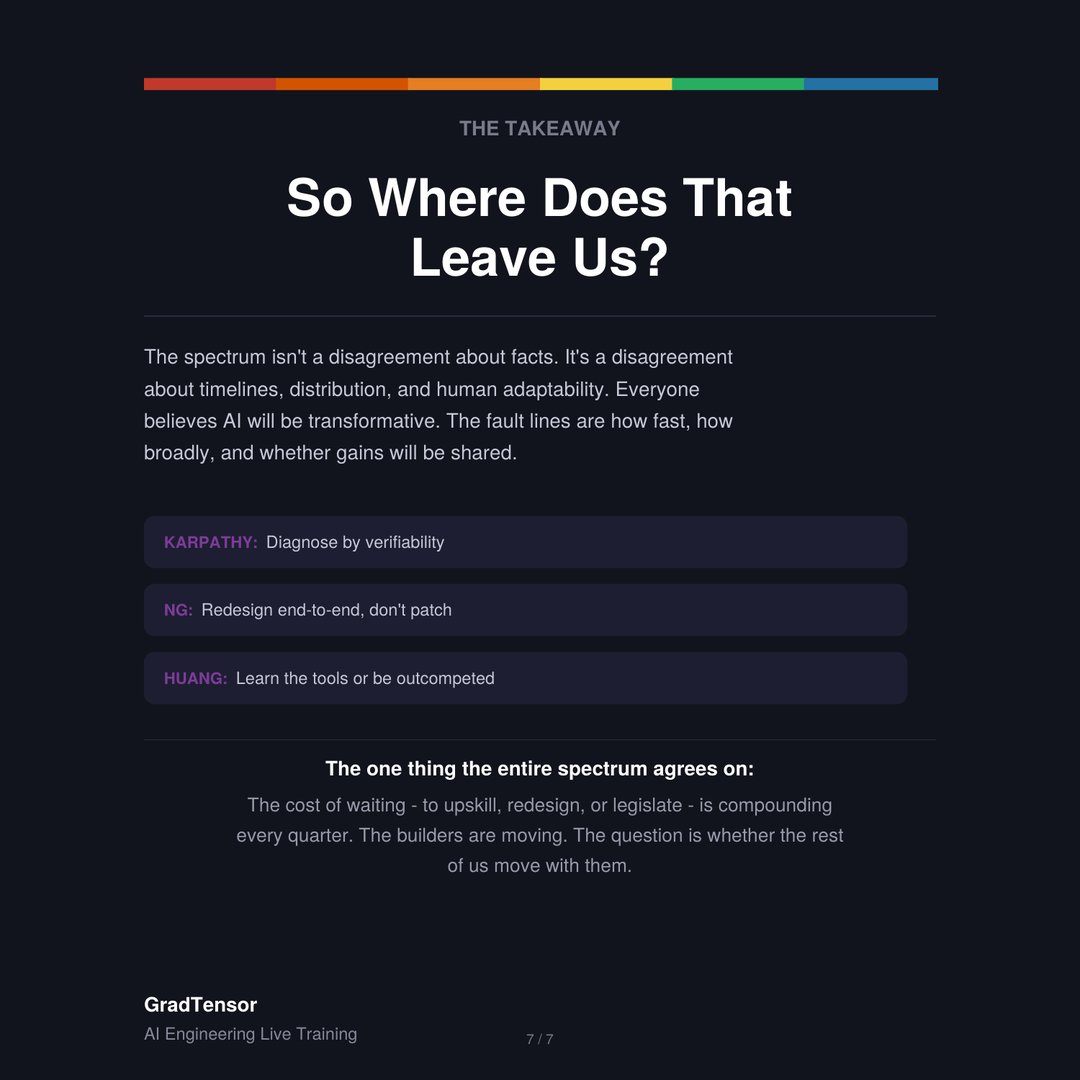
Automation Frontier (Karpathy): It's not about which industry gets disrupted. It's about verifiability. Some tasks automate this year. Others won't be touched for a decade.
Abundance & Post-Work (Altman · Musk): Work becomes optional. Human drive to create persists. Betting against humans wanting more has always been the wrong bet.
The one thing all 7 agree on: the cost of waiting - to upskill, redesign, or act - is compounding every quarter.
Which thesis resonates most with you?
#AI #FutureOfWork #ArtificialIntelligence


English

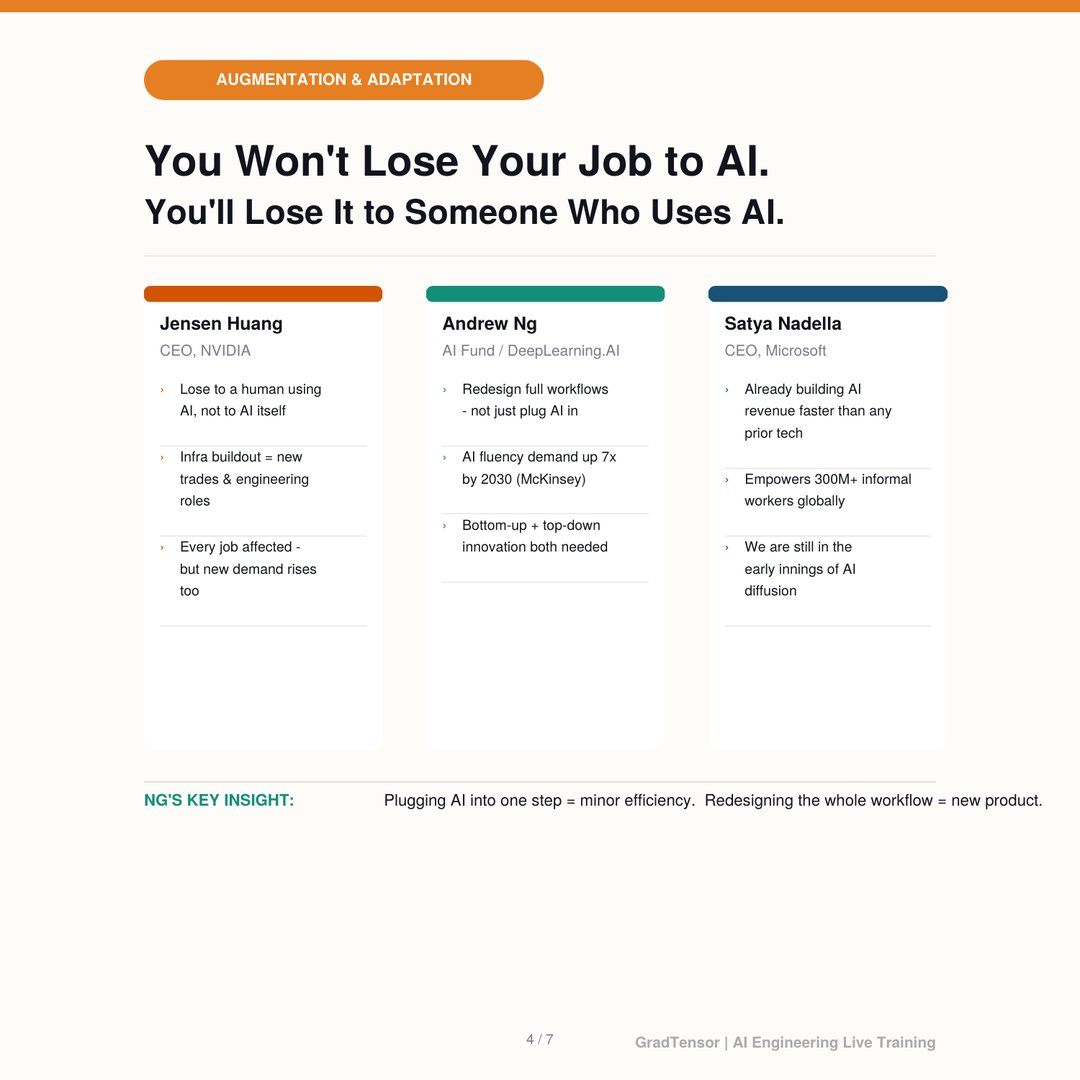
The people building AI disagree sharply about what it will do to your job.
Not analysts, consultants or strategists. But the actual founders & CEOs whose models are reshaping industries right now.
I mapped their theses into 4 positions on a spectrum 🧵
The Warning (Amodei): 50% of entry-level white-collar jobs gone in 1-5 yrs. Cognitive AI hits multiple sectors at once. "The pie may grow - but fewer people could share it."
Augmentation (Huang · Ng · Nadella): You won't lose to AI. You'll lose to someone using AI better than you. Redesign workflows end-to-end - don't just plug AI in.
Swipe through slides 1-4 then see next tweet for the rest
#AI #FutureOfWork #AIStrategy


English

@JiquanNgiam @alexalbert__ Can you share more - what are the specific knowledge tasks you use it for?
English

@alexalbert__ We're seeing this first hand. Opus is already doing most of the knowledge tasks in our company.
English