P. E. Sottas, PhD

1.4K posts

P. E. Sottas, PhD banner
P. E. Sottas, PhD

P. E. Sottas, PhD

@pesottas

MS physics & biology, PhD AI. Healthtech Founder & CEO. Aging is a regulated systemic state. Working hard to make age reversal available to everyone.

Katılım Temmuz 2021
200 Takip Edilen319 Takipçiler
Sabitlenmiş Tweet
P. E. Sottas, PhD
P. E. Sottas, PhD@pesottas·
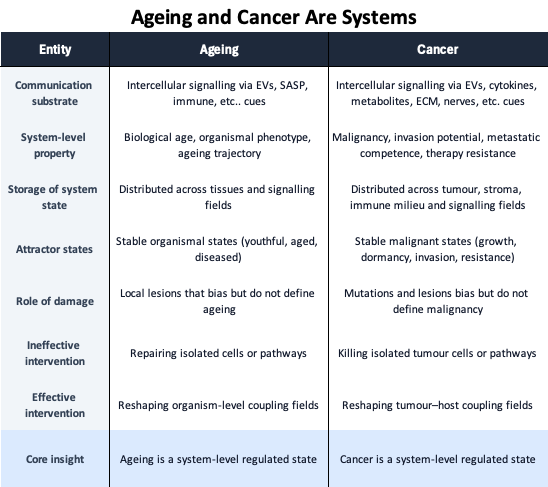
The biggest mistake in biomedicine is to treat ageing and cancer as cell-level problems. They are systems. Cancer is not just damaged cells. Ageing is not just old cells. What matters is the system-level state emerging from signalling, feedback loops, attractors and state shifts. If the state is systemic, the solution must be systemic too.
P. E. Sottas, PhD tweet media
English
0
2
10
796
Jesse Morse, M.D.
Jesse Morse, M.D.@DrJesseMorse·
If you can make it 5 more years, then I believe we will have the ability to live to 120-150 years old.
English
473
137
3.6K
938.4K
P. E. Sottas, PhD
P. E. Sottas, PhD@pesottas·
@KiesowPaul Nice. Senescence is the right target. The best lever is interrupting the self-amplifying signals by which senescence spreads through the body.
English
0
0
1
7
Paul Kiesow
Paul Kiesow@KiesowPaul·
You can't edit on X without deleting the post. This is a bit clearer: Negligible Senescence is done all the time in nature. It's not a major change to the genome, but a relatively minor adaptation. That's what the protocol tunes for—the same Æther Stasis protocol and its provisional patent with Knobbe Martens LLC that I posted about recently.
English
1
0
6
292
Paul Kiesow
Paul Kiesow@KiesowPaul·
Very interesting, the 15-year-old Belgian prodigy who is now going to use AI and quantum to tackle human aging. Many people who been clamoring and begging for a solution remain naysayers. They claim it's not possible without more studies, more data. Those people are just playing the old game. One might wonder: if aging were to be solved what would it look like? Would it be a magic pill, might it take the form of a celebrity antiaging oracle and his team standing over you with some exotic treatment, and a big bill? It would probably not look like that because it's far simpler than people imagine. Negligible Senescence is done all the time in nature. It's not a special genetic code, but merely an adaptation, and that's what the protocol tunes--the same Æther Stasis protocol and its provisional patent with Knobbe Martens that I posted about recently. I have now been on the full-scale protocol for 4 months. So, what does aging look like when it's being obviated and interrupted? It looks a lot like tissue remodeling after an injury. This mysterious 'nexus' where it's applied is tunable. Much like a piano's pitch and amplitude, species use it to adjust their life plan and lifespan to the needs of their environment and how they must fit into that specific ecology to survive. It's been only about 10 years since all the discoveries and components have reached an inflection point where this tuning in an adult is now possible.
English
7
2
43
2.2K
P. E. Sottas, PhD
P. E. Sottas, PhD@pesottas·
@jameslynch4evr Agree. The mechanism may be relatively easy to understand, but I don’t think the field has fully internalized it yet. Most still try to repair cells one by one, while the shortcut is to change the way cells talk to each other across the body.
English
1
0
0
12
james lynch
james lynch@jameslynch4evr·
@pesottas analysis of the network of cell to cell interactions & signaling suggests an obvious mechanism for aging but it's different in non primates vs primates contrary to expectations the mechanism is relatively easy to understand & modify in primates but complicated in non primates...
English
1
0
1
12
P. E. Sottas, PhD
P. E. Sottas, PhD@pesottas·
Age reversal need more physicists. The quantum world teaches us that reality emerges from interacting components, governed by deep rules and symmetries. The body is no different: cells interact, signals propagate, feedback loops form and aging emerges as a system-level property.
Science girl@sciencegirl

A teenage prodigy in quantum physics is aiming to tackle one of science’s biggest challenges: human aging. Laurent Simons earned his PhD in quantum physics from the University of Antwerp at just 15. Rather than slowing down, he has already begun a second doctorate, this time focusing on medical science and artificial intelligence. His long-term ambition is to better understand aging and disease, with the hope of helping extend healthy human lifespan. He has described death as a complex “puzzle,” made up of many interconnected pieces across biology, physics, and engineering. His strategy is to study these layers together, using AI to analyze biological systems and identify patterns that would be difficult to detect otherwise. Simons’ academic journey has been unusually fast. He completed high school by age 8, finished a bachelor’s degree at 12, and went on to earn both a master’s and PhD in quantum physics years ahead of typical timelines. His doctoral work explored advanced topics like Bose–Einstein condensates, where atoms behave as a single quantum system at extremely low temperatures. Although highly theoretical, this research underpins technologies such as quantum computing and precision measurement. Now, his focus is shifting toward biology and medicine. In AI-driven healthcare, researchers are already using machine learning to improve early disease detection, model protein structures, and accelerate drug development. In the field of aging, scientists are investigating ways to reduce cellular damage, eliminate dysfunctional cells, and better understand how the body changes over time. However, experts stress that “solving aging” is extraordinarily complex. While lifespan extension has been achieved in simple organisms, applying those findings to humans remains a major scientific hurdle. Simons himself acknowledges that meaningful progress could take decades. Even so, his path reflects a broader trend in science—where breakthroughs are increasingly happening at the intersection of disciplines, and younger researchers are setting ambitious, long-term goals. Learn more: "15-year-old genius sets his sights on solving human immortality." Brighter Side.

English
1
0
1
87
João Pedro de Magalhães
João Pedro de Magalhães@jpsenescence·
I've met Laurent, and it's great to see him now focusing on aging. Why isn't solving aging a top scientific priority?
Science girl@sciencegirl

A teenage prodigy in quantum physics is aiming to tackle one of science’s biggest challenges: human aging. Laurent Simons earned his PhD in quantum physics from the University of Antwerp at just 15. Rather than slowing down, he has already begun a second doctorate, this time focusing on medical science and artificial intelligence. His long-term ambition is to better understand aging and disease, with the hope of helping extend healthy human lifespan. He has described death as a complex “puzzle,” made up of many interconnected pieces across biology, physics, and engineering. His strategy is to study these layers together, using AI to analyze biological systems and identify patterns that would be difficult to detect otherwise. Simons’ academic journey has been unusually fast. He completed high school by age 8, finished a bachelor’s degree at 12, and went on to earn both a master’s and PhD in quantum physics years ahead of typical timelines. His doctoral work explored advanced topics like Bose–Einstein condensates, where atoms behave as a single quantum system at extremely low temperatures. Although highly theoretical, this research underpins technologies such as quantum computing and precision measurement. Now, his focus is shifting toward biology and medicine. In AI-driven healthcare, researchers are already using machine learning to improve early disease detection, model protein structures, and accelerate drug development. In the field of aging, scientists are investigating ways to reduce cellular damage, eliminate dysfunctional cells, and better understand how the body changes over time. However, experts stress that “solving aging” is extraordinarily complex. While lifespan extension has been achieved in simple organisms, applying those findings to humans remains a major scientific hurdle. Simons himself acknowledges that meaningful progress could take decades. Even so, his path reflects a broader trend in science—where breakthroughs are increasingly happening at the intersection of disciplines, and younger researchers are setting ambitious, long-term goals. Learn more: "15-year-old genius sets his sights on solving human immortality." Brighter Side.

English
4
7
94
4.9K
P. E. Sottas, PhD
P. E. Sottas, PhD@pesottas·
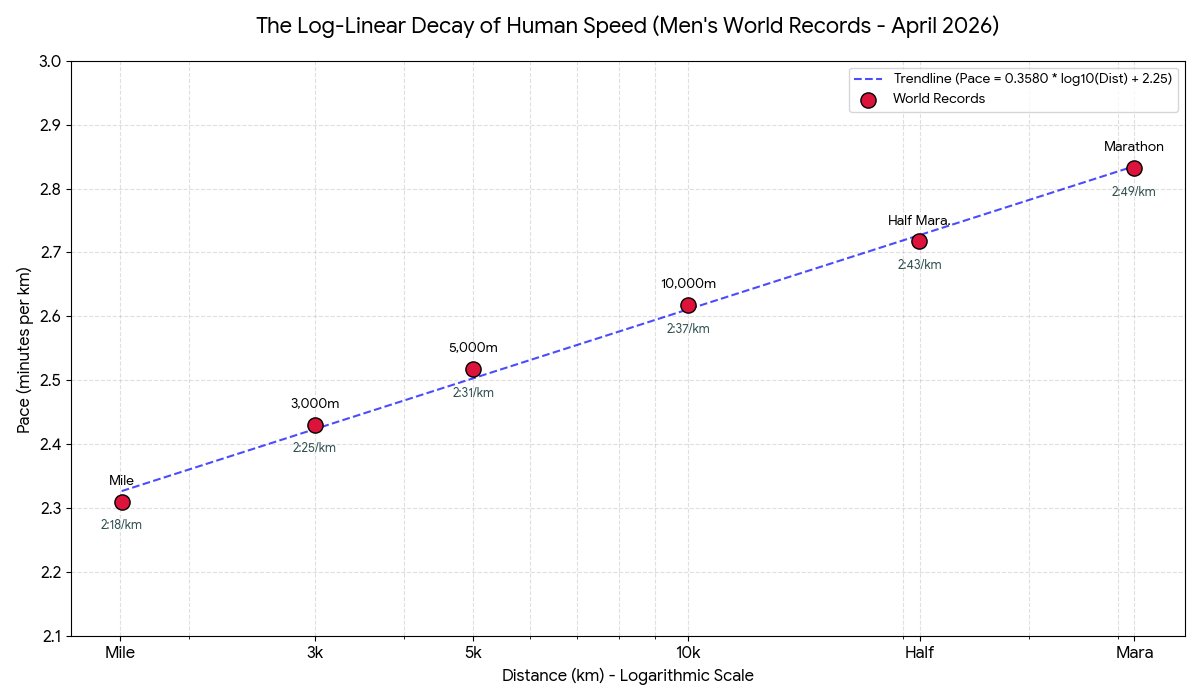
Current "human physiological limit". Close to perfect line. The slope of this line (0.358) is a fundamental constant in elite male runners. As incredible as it sounds, it makes the new marathon WR more human, it was somewhat "expected".
P. E. Sottas, PhD tweet media
Brady Holmer@Brady_H

In 1991, @DrMJoyner modeled that a marathon world record of 1:57:xx was possible in a hypothetical runner with a VO2 max of 84, a lactate threshold of 85% of VO2 max, and exceptional running economy. Of course... we were ~30 years prior to the advent of super shoes! But we just saw a WR that's about 2 minutes slower than that. Wondering if we have physiological data on Sawe? And if so, how that matches with this hypothetical runner proposed in the paper.

English
0
1
3
131
P. E. Sottas, PhD retweetledi
Nathan S. Cheng thinks you should work on aging.
1/ How long do you want to live? For most of human history, aging was inevitable. It's now solvable. Apply for LBF8 cohort program: longbiofellowship dot org /THREAD🧵
English
24
77
240
153.2K
P. E. Sottas, PhD retweetledi
Chris Masterjohn
Chris Masterjohn@ChrisMasterjohn·
Except it isn’t. Dayspring argued with me over this that Daniel Steinberg’s seminal research showing oxidation of the polyunsaturated fatty acids in the LDL particle membrane is *the* central mechanism driving its accumulation in atherosclerotic plaque is “outdated” because “LDL aggregability” is an independent driver of macrophage uptake. Steinberg died a few years ago. But he was #3 just below Brown and Goldstein in LDL receptor fame and he chaired the 1984 NIH Consensus Conference that solidified the consensus that LDL-C “causes” heart disease, and his lab’s work laid out the central mechanism by which LDL particles wind up in plaque. The problem with Dayspring’s argument is that a) oxidation itself is a major driver of LDL aggregability and b) the other major driver is the ratio of choline to saturated fat, which just happens to also be a major determinant of fatty liver disease. The reality is every mechanism through which LDL particles wind up in plaques is completely separable from their concentration. There are zero drugs and zero clinical trials that can distinguish between the impact of concentration versus the impact of oxidation. This is a MECHANISTIC claim, not an “outcomes” claim so you MUST rely on mechanistic research to answer the question. On this mechanistic claim about concentration being the driver, Steinberg’s graph from 1983 remains undefeated, shown below. The range at which macrophage uptake of non-oxidized particles (bottom line) plateaus is massively below the physiological range, below an ApoB of 5 or an LDL-C of 7. Meanwhile, oxidation (top line) causes a 5-fold increase. So at physiological concentrations, concentration is irrelevant and oxidation is paramount.
Chris Masterjohn tweet media
Chris S. Cornell@BiggestComeback

Peter Attia sums it rather succinctly: "Atherosclerosis is driven by the number of apoB-containing particles in circulation, and that relationship holds regardless of how or why those particles are elevated." Here's your statin. peterattiamd.com/there-is-no-sa…

English
21
38
302
52.5K
Maxim Kholin
Maxim Kholin@GeroMaxim·
Most people don’t realize how big consumer biotech already is. Ozempic + Mounjaro (2025): $71B OpenAI + Anthropic (2025): $29B GLP-1 was just the beginning. The next category is drugs that slow aging.
Maxim Kholin tweet media
English
5
1
24
815