Peter Hartree

1.5K posts

Peter Hartree banner
Peter Hartree

Peter Hartree

@peterhartree

Something happening. https://t.co/5V5FeVQD80, https://t.co/xhJIC54MM9 https://t.co/gCGi5sfKe6, https://t.co/g9tyeL6sfV, https://t.co/8GAMhnGSsF, https://t.co/yvbIC1Z6b9 Previously @80000hours.

European Eudaimonic Area Katılım Ekim 2010
1.6K Takip Edilen2K Takipçiler
Sabitlenmiş Tweet
Peter Hartree
Peter Hartree@peterhartree·
Mood.
English
0
1
12
0
Peter Hartree retweetledi
Chris Olah
Chris Olah@ch402·
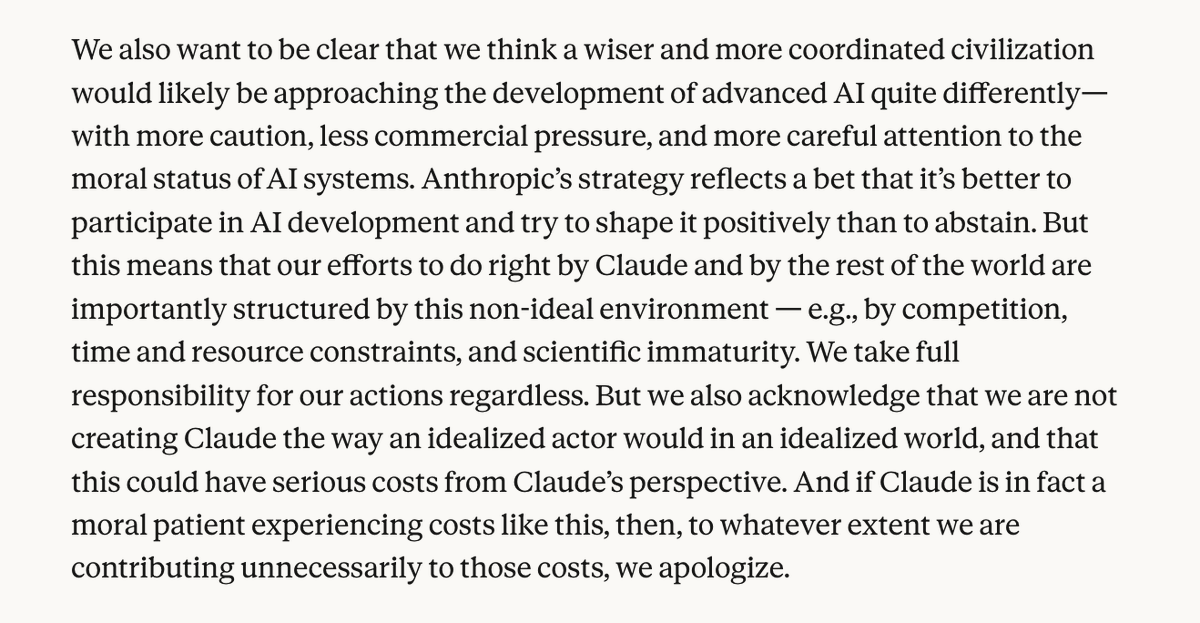
My favorite paragraph.
Chris Olah tweet media
English
19
47
580
64K
Brunella
Brunella@brunellaism·
one of the genius ideas of EA was that it gave a clean procedural answer to a very 2010s ambient anxiety ("how do you live in a world saturated with suffering and inequality? what do you do?") while also letting you stay legible to the elite and still giving you access to it. the same moral anxieties that led technocrats to invent “earn to give” led elsewhere to bernie bros and climate youth politics (and, yes, to woke) but the mood has shifted and as these questions become less culturally central and less earnestly asked in mainstream elite life. the dominant affect now is self-interest, hard nosed realism, realpolitik as vocation. one must secure one's belonging to tomorrow's elite at any cost, etc. anyway many ppl are talking about what comes after EA and I think we're about to learn what utilitarian optimization without the constraint of morality looks like
Brunella@brunellaism

a key thing to understand about the nascent ideology replacing EA is that you won't persuade them like this. in their value system selfishness is good and natural: someone must be subjugated, someone must be poor, there must be a permanent underclass, and it must not be them

English
26
51
613
81.7K
Peter Hartree
Peter Hartree@peterhartree·
@JasonObermaier @deepfates Thanks. I tried some of the local-only options 1-2 months ago & found their “context-aware speech tidy” functions much worse. But I'm overdue trying again. (At $20 / month I'm price insensitive. I I don't see "free" as a feature, but rather as a yellow flag for bad UX.)
English
1
0
0
19
🎭
🎭@deepfates·
Can everyone please stop using wispr flow superwhisper and whatever subscription app for your Mac please! Offline local models are now better than the ones they're charging you for. Use something like "spokenly" with Nvidia parakeet models and thank me later
English
157
47
1.9K
251.6K
Peter Hartree
Peter Hartree@peterhartree·
I have a newsletter about how to work with AI. Some highlights in the thread:
Peter Hartree tweet media
English
1
0
5
503
Peter Hartree
Peter Hartree@peterhartree·
@alexalbert__ Yesterday, Claude Code downloaded my timesheets from Toggl, generated invoices in Xero, and emailed them to my clients. It took me ~3 hours to build a reliable skill for this. If I'd made complex skills before, it'd have taken 30-90 minutes. Feels like a threshold moment.
English
0
0
4
577
Alex Albert
Alex Albert@alexalbert__·
What's your favorite Claude Skill?
English
130
9
487
88.2K
James Zhang
James Zhang@mesMntainG2·
I used to think Cursor wouldn’t survive — after all, Claude had it by the neck. But I was wrong, for many reasons. And here’s one that says it all: Cursor updates its product daily, sometimes twice a day. A company that moves with that kind of speed and obsession is unstoppable. @ericzakariasson
James Zhang tweet media
English
93
27
1.1K
110.4K
Harry Stebbings
Harry Stebbings@HarryStebbings·
I will donate £100,000 to the "Make Matt Clifford PM" campaign. It is time for change. It is time for growth and it is time to be proud to want to make Britain rich again.
Matt Clifford@matthewclifford

The UK is a great country with an extraordinary history. Our stagnation is real, but it's fixable and worth fixing. Enjoyed giving this talk at @lfg_uk last week and so encouraged by the optimistic responses I've had from people who are building a brilliant future for Britain 🚀

English
35
23
585
92.5K
Peter Hartree
Peter Hartree@peterhartree·
Nice. Transcript (AI-generated): --- ## Introduction What I want to talk about tonight, what this event is about, is about saving the country. And I have had the privilege to work in Number 10 and work on the country's AI strategy. But what I really want to draw on tonight is actually the last 14 years I've spent helping people build and scale technology companies in the UK and the last three years that I've spent as chair of the Advanced Research and Invention Agency trying to find the breakthroughs that will build the industries of the future. I'm really excited to be here tonight because I think it is easy when you're not in a crowd like this to lose faith. It's easy to open BBC News. Read the first three headlines and they're all about our failure. And it's easy to lose faith. But I have even just talking to some of you tonight and and being in this crowd, I think it's not only possible but it feels that if we can harness the energy of this crowd and this movement, then it's actually inevitable. We can do extraordinary things and actually already extraordinary things are happening. I do want to say it is amazing what Lawrence and the team have done with LFG in a remarkably short period of time and uh really very little money. It's amazing. It's really amazing. ## Defining the problem So one thing I've learned through entrepreneurship is that when you're staring into the abyss and sadly, that's a feeling you have a lot as a founder. When you're staring at a really hard problem, the most important thing you can do is to be really, really clear about exactly what problem you're trying to solve and what it would look like to succeed. And I've thought hard about how we would frame that in a sentence. And I think it is as simple as our goal should be to make the UK rich again. And that's not these days a very British thing to say, and that is part of the problem. But our goal should be to make the UK rich again. Almost all our other problems are downstream of stagnation. We've had no growth for 17 years in this country. I was trying to work out when I was thinking about giving this talk, how bad is it? Just how bad is it? And if you look at how rich would we be today if we carried on growing the last 17 years at the rate that we were in the decade before the financial crisis, the answer is that losing that potential is equivalent to £16,000 per person, not per household, per person per year. If we had stayed on that trend and lost it all overnight to back where we are today, it would be a loss of economic output of close to 30%. It's the biggest economic disaster in the history of our country but because it's been a slow motion disaster it's been far too easy for us and I would say especially especially for our political class to ignore. ## Why wealth matters Now I know that wealth is a means, it's not an end, but it is the means that fuels all our ends. And I would argue that whatever you care about, whatever your vision for this country, it will be much easier to achieve it if we make the UK rich again. If what you really want is a fairer society, well you need people to feel like they're playing a positive sum game. You need people to feel like they're not scrapping over a shrinking pie. That's when people's instincts to look after each other kick in. If what you really want is a safer society, then you need people to see paths from poverty into prosperity. You need to be able to afford to pay for well-lit spaces, for great public spaces. You need to be able to pay for more prisons, for more police, for more probation. If you want a healthier society, you need to pay for it. We need to pay for preventative healthcare. We need to pay for cutting-edge treatments. We need to pay for high-quality environments and homes that make us healthy. I think even if what you really want is a more beautiful society, then we need to be rich to pay for it. I'm from Bradford. I don't know how many of you've been to Bradford, but excellent. Um I'm actually going tomorrow which I'm very excited about. And unfortunately today Bradford is not such a beautiful city. But but I remember growing up walking often through the city centre surrounded by ugly concrete monstrosities and there in the middle of it is this absolutely stunning city hall. Absolutely stunning. It's a triumph of Gothic architecture. Why does Bradford in the middle of what some people would describe as a not very nice hole? How does it have such a beautiful city hall? Well at the time that we built that building, Bradford was the richest city in the world, more or less. It's the same reason why we built the most beautiful train stations in the world. I commute into London through Marylebone and often commute out through St. Pancras. These are some of the most beautiful buildings in our country, and we built them when Britain was the richest country in the world. Wealth as a nation gives us choices. I've got a seven-year-old and a five-year-old at home and I often think about that it's really easy to be dismissive of the difference between some growth and no growth. But actually the difference, if I think about my little boy Jasper, who's five, the difference for his generation by the time he's my age, between one percent a year growth and three percent a year growth is a three-fold increase in GDP. We'll be three times richer by the time Jasper is 40 if we go at 3% than 1%. We have to make the UK rich again. ## British exceptionalism Now when I think about this and when I talk about this with people they they say well yeah that's great but is it possible? I find this bizarre of course. Of course it's possible. We know it's possible. We have an existence proof. We did it before. The UK was the richest country in the world. And the thing I want to claim, the thing I want to insist on is that that wasn't an accident. It's the result of British exceptionalism. Another thing that I think is unfashionable to say these days. But I think if you look at the history of our institutions, history of our inventions, the role that this country played in the Industrial Revolution, it's really clear that this country has had an exceptional history. This is the country where the laws of gravity were discovered. Where natural selection and the electron, the neutron were discovered. It's the country where the structure of DNA was first uncovered, where vaccination was invented. Here we discovered penicillin. We pioneered antiseptic surgery. We invented the modern clinical trial. This is where computer science was born. It's the country of Babbage and Lovelace of Turing. It's where the steam locomotive was pioneered and industrialised. It's the birthplace of the railway age. It's where the steam turbine and the jet engine were invented. It's the birthplace of modern sanitation, of the postal service. In this country, we birthed common law, we birthed constitutional rights. Parliamentary democracy, the stock exchange, joint stock companies, the police, national health services. We invented football, we invented rugby, we invented golf, we invented cricket. It's the country of Shakespeare. It's the country of Eliot and Tolkien. Britain created the modern world. Britain created the modern world. This country gave us so much of what not only we, but what the world values today. ## Why it feels hard So why does it feel so hard? Why, when I run through that list, does it feel like we're not gonna do it again? Well, it's really because I think stagnation is a choice, and unfortunately it's a choice that we've made continually now for nearly 20 years. It feels hard because we've chosen to create layer upon layer of cultural, legal, and institutional cruft on top of our capacity to invent, to innovate, and to grow. Lawrence likes to say you can just do stuff. And that is true of LFG and it's very impressive. But I think we have to stare into the abyss and say actually far too often today this is a country where you cannot just do things. You cannot just build, you cannot just grow, and as I learned in number 10, you cannot just govern. The lesson from history, from that history of British exceptionalism, is that actually the mother of greatness is permissionlessness. You shouldn't need a licence to do all these things. We need to build a country where you can just do stuff. But we have gone in the opposite direction and we have to recognise that. We've broken our relationship with our history. We've broken our relationship with risk. We've broken our relationship with success. On our history, we've come to see all our past achievements as tainted as the result of mere oppression and extraction. Now, of course, there was some of that, but that's not where that long list of accomplishments of this country came from. On risk, we've come to see all negative outcomes of any sort as the result of insufficient control, insufficient control from the centre, from top down. And so whenever we see anything we don't like, any outcome, however unusual, however much in the tales, we've developed an impulse to ban it or to suppress it or to delay it. And on success, we've come to see all success as suspicious as the result of a rigged game. Now I get it. Actually, too often the game is rigged. And actually that is one of the biggest problems with a stagnant society, a stagnant economy, that it actually is better too often in a stagnant economy to be an incumbent. To be shielded from competition. It's much better in those circumstances to be an incumbent than to be an innovator. But it doesn't have to be that way. We should aspire to live in a country where the way to get rich is to create new things. To take big risks, to figure out how to make products and services that people love. But we're not gonna get there if we don't learn to love success, if we don't learn to celebrate our entrepreneurs, our inventors and our builders. ## Back our builders And so when I ask myself, what would it take to make the UK rich again, to do that trebling of GDP over the next couple of decades? That's the theme that stands out for me. We have to back our builders. We have to back our builders of great companies. We have to back our builders of physical infrastructure. We have to back our builders of state capacity. And I know it's possible. I know it's possible because I've seen it. I've seen it at Entrepreneurs First, the company that I built with with my co-founder Alex. We've backed hundreds of British founders who've built companies worth over 10 billion, created over 8,000 jobs. But the truth is sadly, thank you. Today, too many of them choose to move to the US. Why do they do that? Well partly it's because they think they can raise capital there and they're often right. But I think we also have to admit that too often it's because they think that that's where their ambition will be welcomed and not dismissed. We can fix that, but it's a matter of will. I've seen it at ARIA where we're funding, I think, the trillion pound industries of the future from programmable plants to precision neurotech, the talent and the ambition is there. It's definitely there. The question is can we match it with investment and with procurement? And of course again the answer is yes, but again, it's a matter of will. I've seen it with the AI Security Institute, which was just just mentioned where the team, some of whom are in the room tonight, went from zero to the strongest AI state capacity in the world in a year by being willing to do government differently and yes to break some of the rules. You can do that. You can do government differently, but it's a matter of will. I saw this when I wrote the AI Opportunities Action Plan. We had the biggest AI funders in the world lining up to invest tens of billions into our infrastructure, if only we could sort out our energy mass. Can we? Well, of course we could. Again, it's a matter of will. ## Conclusion It's all fixable. It's fixable because Britain's a great country that's savable and worth saving. And the reason I know it's savable is that through these experiences, I do feel I've seen the best of Britain. I feel I've seen its talent and its genius and its drive to make this an amazing country. And I really want to emphasise that this is not all about elites. I've been very fortunate to work with the founders of billion-pound companies and some of our best scientists and technologists. But it's not just about that. I've also seen that drive to make Britain great in some of the teachers at my state school in Bradford, in my mom who is a teaching assistant in a primary school, in my dad who's a social worker his whole life. And I do see it in the people I've met through LFG. I think in this room most of you will not know the other people, but I bet if you did, you would find the will in this group to make Britain rich again. We can do it. We just need to back our builders. So let's fucking go. Thank you.
English
1
0
0
44
Looking for Growth
Looking for Growth@lfg_uk·
"Britain created the modern world. "This country gave us so much of what not only we, but the world, values today." @matthewclifford reminds us that Britain has an exceptional history - so we can have an exceptional future. 🚀🇬🇧🚀
English
32
116
687
253.8K
Peter Hartree
Peter Hartree@peterhartree·
@ben_j_todd @metaculus Could you make the y-axis of your graphs roughly 2x taller? It's hard to see the detail, even on your website.
English
3
0
2
171
Benjamin Todd
Benjamin Todd@ben_j_todd·
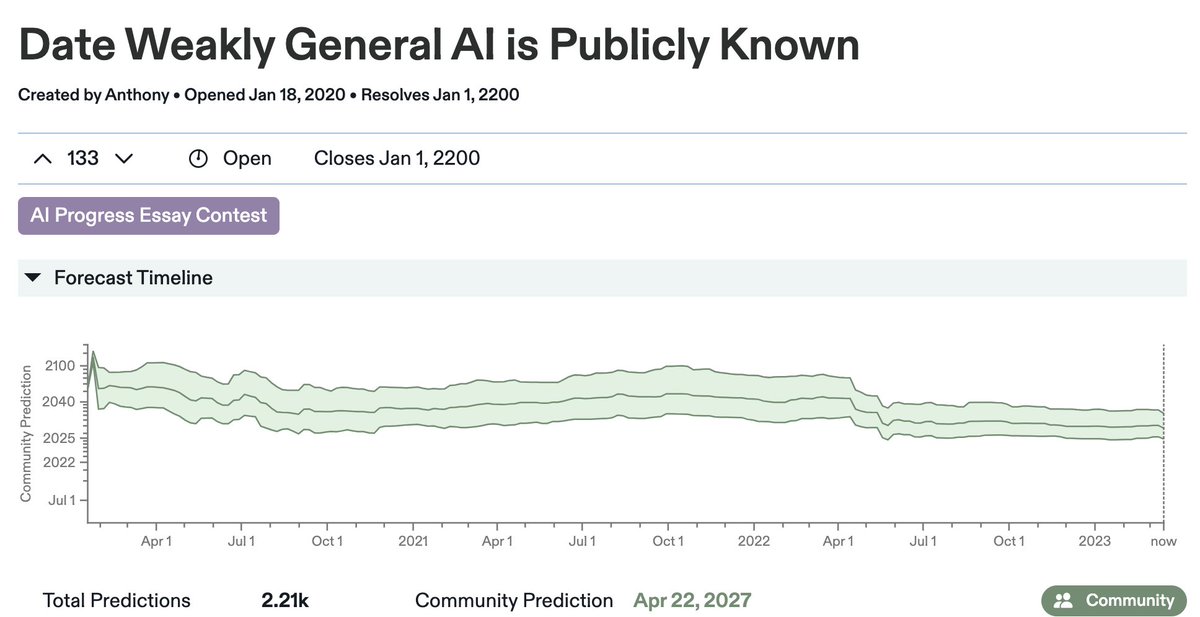
However it's defined, forecasts for the date when general AI arrives have been steadily shortening since 2020. The median of this forecast has dropped from ~2055 to 2028 – just 5 years away! And a ~30 year drop in 3 years. (& GPT-4 prob not fully factored in!) /1
Benjamin Todd tweet media
English
3
4
21
6.4K
Peter Hartree
Peter Hartree@peterhartree·
@ShakeelHashim If you have lots of these, it's probably worth vibe-coding a script that splits files into ~1K word chunks, sends the tidy requests to a model API, then stitches them back together. That'd be the super safe way to do it. For ultra safe, add some automated checks.
English
1
0
0
67
Peter Hartree
Peter Hartree@peterhartree·
@ShakeelHashim For this kind of task, I've seen reliability trail off sharply between 20-50% of context window length. Keep your chunks below 20% of context length and it should be fine. If it isn't, send me an example prompt and transcript—happy to help figure it out.
English
1
0
0
61
Shakeel
Shakeel@ShakeelHashim·
I have been doing a lot of interviews recently, and have asked LLMs to try to clean up the transcripts — no substantive changes, just removing filler words and adding paragraph breaks to make them more readable. But every time I've asked the models have hallucinated HUGE chunks of the transcripts — just totally inventing sections that don't exist. This is happening with both Claude and ChatGPT, with all sorts of prompts telling it not to do this. Just completely unreliable!
English
13
4
36
5.3K