

Peter Leeb
5.8K posts

Peter Leeb
@peterleeb
Co-Founder. Operator. Revenue Driver. Girl dad of 3 🏀🎾, 🎸🎶, 👟.
iPhone: 37.395786,-121.977654 Katılım Ekim 2008
2.1K Takip Edilen631 Takipçiler

More AI agent observations below (I keep adding to the list):
1. Hermes agents write to their own memory after every task. Which means starting today versus starting in 6 months is an unfair advantage for you.
2. We're maybe 12 months from an agent that can watch you work for a week and then do your job without any instructions. The screen recording plus agent memory plus local model combination makes this possible right now
3. The real reason local models matter for founders: you can ship a product where the AI runs entirely on the customer's device and you never touch their data. Zero privacy concerns. Zero server costs. Zero compliance headaches.
That changes which industries you can sell to overnight. Healthcare, legal, finance, all the regulated verticals that won't send data to the cloud just opened up.
4. Every company needs to be rebuilt as a "second brain" before agents can be useful. That means every process, every decision, every piece of institutional knowledge has to exist in a format an agent can read. Most companies have none of this.
5. Agent costs are the new headcount. Won't be crazy for companies to spend 50%+ of their total headcount cost on tokens.
6. Agents are accidentally creating internal competition at companies. The marketing agent and the sales agent are optimizing for different metrics and working against each other without anyone realizing it. It took humans decades to develop cross-functional alignment. Nobody thought about it for agents.
7. The YAML config file is becoming the new org chart. Who reports to who, what permissions they have, what tools they access, all defined in a config file. The company's structure is literally a file you can version control, fork, and deploy. That's new.
8. The first agents that can smell a scam are going to be worth billions. Right now agents will happily wire money to a fake invoice because it matched the format. The trust layer is completely missing.
9. We're about to find out that most "expertise" was actually just memory. Knowing the tax code. Knowing the case law. Knowing which supplier charges what. When an agent holds all of that in context, the expert's value shifts from "I know things" to "I know which things matter." Much smaller group of people.
10. We're all running the same models. The differentiation is in what you feed them. Two founders with the same agent, same model, same tools will get wildly different results based purely on the quality of their knowledge base. Garbage context in, garbage output out. Forever.
11. The most underbuilt category in AI right now: agents for old people. 70 million boomers who need help with medical forms, insurance claims, and appointment scheduling.
12. Agent latency is the new page load speed. If your agent takes 45 seconds to respond, your customer already switched to one that takes
13. Skills files are the new apps. A SKILL.md that tells an agent how to do one thing well is more valuable than a SaaS subscription that does the same thing behind a login screen.
14. AI hardware... how do you create devices that are good businesses that people want? It'll be a $30 dongle you plug into existing dumb devices to give them an agent brain. Smart toaster doesn't need to be built from scratch. It needs a $30 brain attached to a $15 toaster.
15. Your agent can read faster than you can think. The bottleneck in every agent workflow is now the human approval step. We're the slow part. That's a strange thing to sit with.
16. Agents made the 80/20 rule violent. The 20% of work that matters is now the only work humans do. The 80% just disappeared. Entire job descriptions were hiding inside that 80%.
17. The thing I keep coming back to: the best businesses right now are being built by people who are just slightly ahead of their customers. Not 10 years ahead. 6 months ahead. That's the sweet spot. Far enough to lead. Close enough to be understood.
GREG ISENBERG@gregisenberg
My 30+ observations on the greatest opportunities in AI agents right now: And some ideas that are keeping me up at night. 1. The new buyer on the internet is an AI agent. Imagine billions of new customers showing up with money to spend but they only shop via MCP. That's what's happening. No MCP server means you're invisible to the fastest growing buyer on the internet. 2. Every franchise system in America (30,000+) needs an agent layer and none of them have one. One founder per franchise vertical. That's 30,000 businesses waiting. 3. Everyone said "distribution is the only moat" a year ago. Now I'd add that the only moat is distribution plus memory. The company that has your audience AND your agent's accumulated context is impossible to leave. 4. Consumer mobile is more interesting than it's been since 2012. Apps can finally DO things for you instead of showing you things. The next wave of $100M apps are being built right now. 5. The most interesting startup nobody has built is an agent marketplace where you rent access to someone else's trained agent. A recruiter spent 6 months training a sourcing agent on healthcare hiring. That agent is worth renting to every other healthcare recruiter on earth. The agent itself becomes the product. 6. A sorta strange phenomenon that's happening right now is agents are developing preferences. Give the same agent the same task 100 times and it starts developing patterns in how it approaches it. Nobody is studying this yet. But the agents that develop good patterns are worth more than the ones that don't. That's a new kind of asset. 7. Dead internet theory is about to become dead SaaS theory. Half the apps you use will quietly replace their support team, their onboarding team, and their content team with agents. You won't notice for months. Then you'll realize you haven't talked to a human at that company in a year. 8. The most valuable data in the world right now is sitting in the support tickets of small or mid tier SaaS companies. Every ticket is a customer telling you exactly what to build next. Mine this. 9. The most interesting pricing problem nobody has solved is how do you price a product when your costs change every time OpenAI or Anthropic updates their model pricing? Your margins can swing 40% overnight based on a decision made in San Francisco. The company that builds dynamic pricing infrastructure for agent-based businesses solves a problem every AI company has. 10. The best AI products feel like they're reading your mind. The worst ones feel like filling out a form with extra steps. 11. An interesting arbitrage I've noticed lately is hiring a human VA for $20/hour to supervise an AI agent that does $200/hour work. The human just checks the output. 12. The managed AI agent business is becoming the new agency model. $5k/month per client. You build it, run it, maintain it. The client gets a digital employee they never have to think about. This will be a $50 B+ category. 13. The first "shadow agent" scandals are about to drop. Employees running personal agents on company infrastructure without telling anyone. Using company API keys. Agents accessing internal docs. IT departments have little visibility into this right now. Lots of opportunity to build companies here. Definitely a painkiller not a vitamin type of business. 14. Right now there are probably millions of agents running on autopilot that their creators forgot about. Still burning tokens. Still sending emails. Still scraping websites. Still costing money. The "find and kill your zombie agents" tool is a product that writes itself. 15. Companies are starting to hire based on someone's agent portfolio instead of their resume. "Show me 3 agents you built that are running right now." It's REALLY early but it's starting. 16. Your Slack archive is a product. Every company's internal Slack has thousands of messages explaining how they actually do things. The company that lets you point an agent at your Slack history and auto-generate SOPs and agents from it will be enormous. 17. We're watching the cost of intelligence fall faster than the cost of distribution. Which means distribution is now the expensive thing. 18. The most underrated asset a human can have in 2026: the ability to sit in a room with another human, make eye contact, and have a real conversation. As AI handles more of the transactional stuff, the humans who can do the relational stuff become disproportionately valuable. The soft skills people used to dismiss as fluffy are becoming the hard skills. The hard skills people spent decades acquiring are becoming the soft ones. 19. There are MANY huge companies to be built around the fact that most people's agents are running on their personal laptops which they also use to browse the internet, check email, and download random files. The attack surface is enormous. One compromised Chrome extension and your agent's API keys, customer data, and workflows are exposed. 20. There's a new type of burnout forming that doesn't have a name. It's not from working too hard. It's from context switching between human work and agent work 50 times a day. Reviewing agent output, correcting it, approving it, reviewing again. The mental load of supervising agents is different from the mental load of doing the work yourself. Some founders are telling me they were less tired when they did everything manually because at least the cognitive pattern was consistent. 21. The cheapest form of market research: search "[your industry] spreadsheet template" on Google. Whatever people are tracking manually is your product. 22. Half the YC companies pivoted within 8 weeks of demo day. Not because they failed. Because agents let them test 5 ideas in the time it used to take to test one. The concept of "committing to an idea" is dissolving. Serial pivoting is becoming the default because 1) AI lets you move fast 2) the world is moving fast. 23. The loneliest job in tech right now is being the only person at your company who understands what the agents are doing. You can't explain it to your boss. You can't hand it off to a colleague. If you leave, everything breaks. You've become a single point of failure for an entire automated system. That person needs a title, a team, and a backup plan. Most companies haven't figured this out yet. 24. Your browser history is the most valuable training data you own and you're giving it away for free. Every site you visit, every product you research, every competitor you study, every pricing page you screenshot. That behavioral data, structured and fed to an agent, would make it understand your business better than any onboarding call. The company that lets you turn your browser history into agent context builds something nobody can replicate. 25. Everyone is building AI wrappers. Nobody is building AI unwrappers. The tool that takes an AI-generated document and tells you which parts a human wrote and which parts were generated. 26. Stripe just became the most important company in the agent economy and they barely had to do anything. Every agent that sells something needs Stripe. Every agent that buys something needs Stripe. They're the payment rail for the entire agentic internet by default. 27. The most undervalued API in the world right now is the US Postal Service address verification API. It's practically free. Every local business lead gen agent needs it. Every real estate agent needs it. Every direct mail agent needs it. Boring government infrastructure is quietly becoming the backbone of agent-native businesses. 28. The concept of "business hours" is for humans. Your agent closed a deal in Tokyo at 3am, processed the payment, sent the onboarding email, and updated the CRM before your alarm went off. 29. What happens when agents start recommending other agents? Your research agent finds that a competitor's sales agent is better and suggests you switch. Agent referral networks are forming organically. The first agent affiliate program is probably 6 months away. 30. Cal dotcom closed their source code. That's the canary. When open source companies start closing up, it means agents were cloning their product too easily. Every open source company is quietly asking the same question right now. 31. "AI for pet groomers" sounds like a joke and that's exactly why it will work. 150,000 of them in America. Zero tech. All scheduling by phone or IG DMs. The joke ideas always win. 32. The thing that will seem most obvious in hindsight: we spent 2025-2026 arguing about which model is best while the entire value was in the orchestration layer. The model is the CPU. Nobody buys a computer based on the CPU anymore. They buy it based on what they can do with it. Makes so much sense in hindsight. What else will be obvious in hindsight? I'll share more notes soon. I can't sleep with all that's going on. Maybe you too. What an incredible time to be building.
English

TRANSCRIBE: UPGRADED BANDWIDTH
Transcribe users:
Thank you for the awesome reception to the product - the feature requests have been amazing, as have the bug filings too! I feel 0.00001% of what @steipete probably feels daily :)
Massive usage within the first 12 hours blew through my bandwidth quota at the proxy service provider, and started returning weird "payment errors". thank you for reporting this. (who knew 60 min video files could consume so much bandwidth lol)
I have upgraded to a much higher bandwidth tier, and it should be working again. I am sure I'll need to go to the next level soon.
Thanks
Gokul
English

The more enterprises I talk to about AI agent transformation, the more it’s clear that there is going to be a new type of role in most enterprises going forward. The job is to be the agent deployer and manager in teams. Here’s the rough JD:
This person will need to figure out what are the highest leverage set of workflows on a team are (either existing or new ones) where agents can actually drive significantly more value for the team and company.
In general, it’s going to be in areas where if you threw compute (in the form of agents) at a task you could either execute it 100X faster or do it 100X more times than before. Examples would be processing orders of magnitude more leads to hand them off to reps with extra customer signal, automating a contracting review and intake process, streamlining a client onboarding process to reduce as many straps as possible, setting up knowledge bases than the whole company taps into, and so on.
This person’s job is to figure out what the future state workflow needs to look like to drive this new form of automation, and how to connect up the various existing or new systems in such a way that this can be fulfilled. The gnarly part of the work is mapping structured and unstructured data flows, figuring out the ideal workflow, getting the agent the context it needs to do the work properly, figuring out where the human interfaces with the agent and at what steps, manages evals and reviews after any major model or data change, and runs and manages the agents on an ongoing basis tracking KPIs, and so on.
The person must be good at mapping the process and understanding where the value could be unlocked and be relatively technical, and has full autonomy to connect up business systems and drive automation. This means they’re comfortable with skills, MCP, CLIs, and so on, and the company believes it’s safe for them to do so. But also great operationally and at business.
It may be an existing person repositioned, or a totally net new person in the company. There will likely need to be one or more of these people on every team, so it’s not a centralized role per se. It may rile up into IT or an AI team, or live in the function and just have checkpoints with a central function.
This would also be a fantastic job for next gen hires who are leaning into AI, and are technical, to be able to go into. And for anyone concerned about engineers in the future, this will be an obvious area for these skills as well.
English
I've spent my career building products that reduce friction for users. @LittlebirdAI does something I've rarely seen. It eliminates an entire category of friction: the overhead of remembering, retrieving, and re-explaining your own work. I use it every day.
Excited to support @alexframegreen and the Littlebird team as they build the best personal OS.
alexander green@alexframegreen
English
English

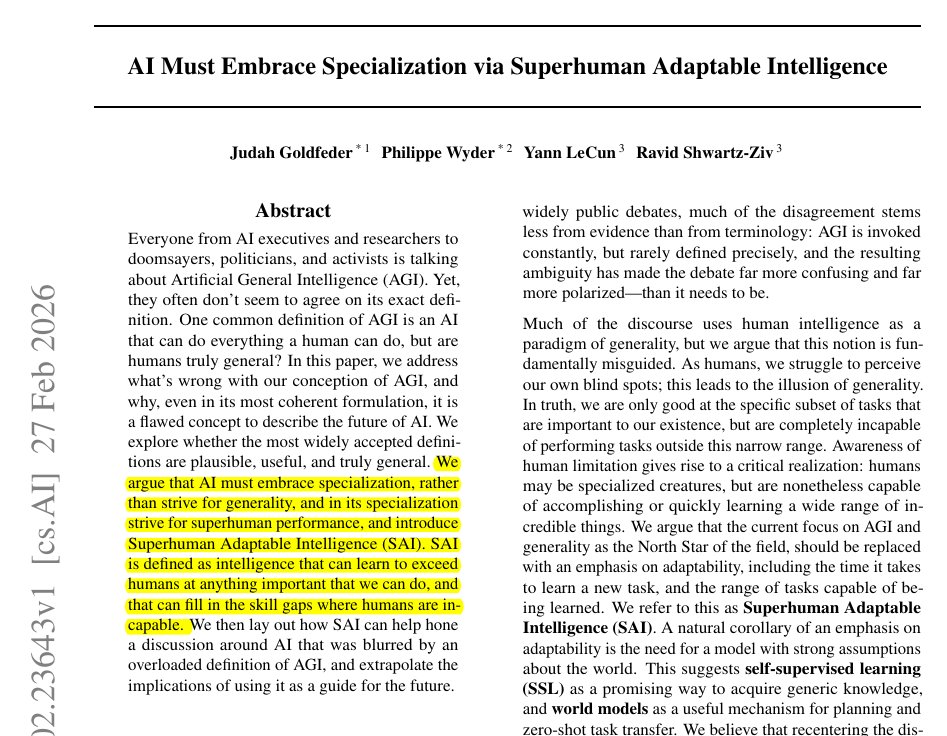
Yann LeCun's (@ylecun ) new paper along with other top researchers proposes a brilliant idea. 🎯
Says that chasing general AI is a mistake and we must build superhuman adaptable specialists instead.
The whole AI industry is obsessed with building machines that can do absolutely everything humans can do.
But this goal is fundamentally flawed because humans are actually highly specialized creatures optimized only for physical survival.
Instead of trying to force one giant model to master every possible task from folding laundry to predicting protein structures, they suggest building expert systems that learn generic knowledge through self-supervised methods.
By using internal world models to understand how things work, these specialized systems can quickly adapt to solve complex problems that human brains simply cannot handle.
This shift means we can stop wasting computing power on human traits and focus on building diverse tools that actually solve hard real-world problems.
So overall the researchers here propose a new target called Superhuman Adaptable Intelligence which focuses strictly on how fast a system learns new skills.
The paper explicitly argues that evolution shaped human intelligence strictly as a specialized tool for physical survival.
The researchers state that nature optimized our brains specifically for tasks necessary to stay alive in the physical world.
They explain that abilities like walking or seeing seem incredibly general to us only because they are absolutely critical for our existence.
The authors point out that humans are actually terrible at cognitive tasks outside this evolutionary comfort zone, like calculating massive mathematical probabilities.
The study highlights how a chess grandmaster only looks intelligent compared to other humans, while modern computers easily crush those human limits.
This proves their central point that humanity suffers from an illusion of generality simply because we cannot perceive our own biological blind spots.
They conclude that building machines to mimic this narrow human survival toolkit is a deeply flawed way to create advanced technology.
Rohan Paul@rohanpaul_ai
Yann LeCun (@ylecun ) explains why LLMs are so limited in terms of real-world intelligence. Says the biggest LLM is trained on about 30 trillion words, which is roughly 10 to the power 14 bytes of text. That sounds huge, but a 4 year old who has been awake about 16,000 hours has also taken in about 10 to the power 14 bytes through the eyes alone. So a small child has already seen as much raw data as the largest LLM has read. But the child’s data is visual, continuous, noisy, and tied to actions: gravity, objects falling, hands grabbing, people moving, cause and effect. From this, the child builds an internal “world model” and intuitive physics, and can learn new tasks like loading a dishwasher from a handful of demonstrations. LLMs only see disconnected text and are trained just to predict the next token. So they get very good at symbol patterns, exams, and code, but they lack grounded physical understanding, real common sense, and efficient learning from a few messy real-world experiences. --- From 'Pioneer Works' YT channel (link in comment)
English

The era of the specialist is over. Full-stack GTM athletes are taking over.
For too long, GTM has been divided into specialists, creating a soul-crushing web of dependencies:
- Sales needs a custom business case to close a deal, but Marketing is slammed.
- Marketing has a winning campaign idea, but design and engineering can’t prioritize it.
- CRO has 5 ideas for increasing sales productivity, but no GTM engineers to execute.
In GTM, speed is everything and dependencies are the enemy. That's why we're giving GTM teams the full-stack capabilities they need to close revenue.
Welcome to the era of the GTM Athlete.
These are people who don't ask permission or wait in queues. They can do whatever is needed to take deals from cold to closed—research accounts, launch ads, create a business case, generate tailored follow-ups, and close deals.
Sales rep brainstorms with their champion how to convince the CISO. 30 mins later sends them a polished business case with security architecture and ROI. By lunch time, she launches ads to the entire buying committee. The next day, the rep presents a custom deck to key decision makers and gets verbal commitment.
No more begging. No more waiting. No more losing.
Our vision is to build the AI Swiss Army knife that turns specialists into GTM athletes.
Today we are launching a critical capability that enables this vision: an AI agent that can create anything customer facing.
You can now create executive business cases, deal follow-ups, landing pages, ABM campaigns and more, all by yourself. Unlike other AI tools, our agent plugs into your brand and data to create materials that actually look and sound like you.
Sign up on our website. We're letting people off the waitlist every day, with 30 days of unlimited AI usage. I’d love to hear your feedback.
English
English

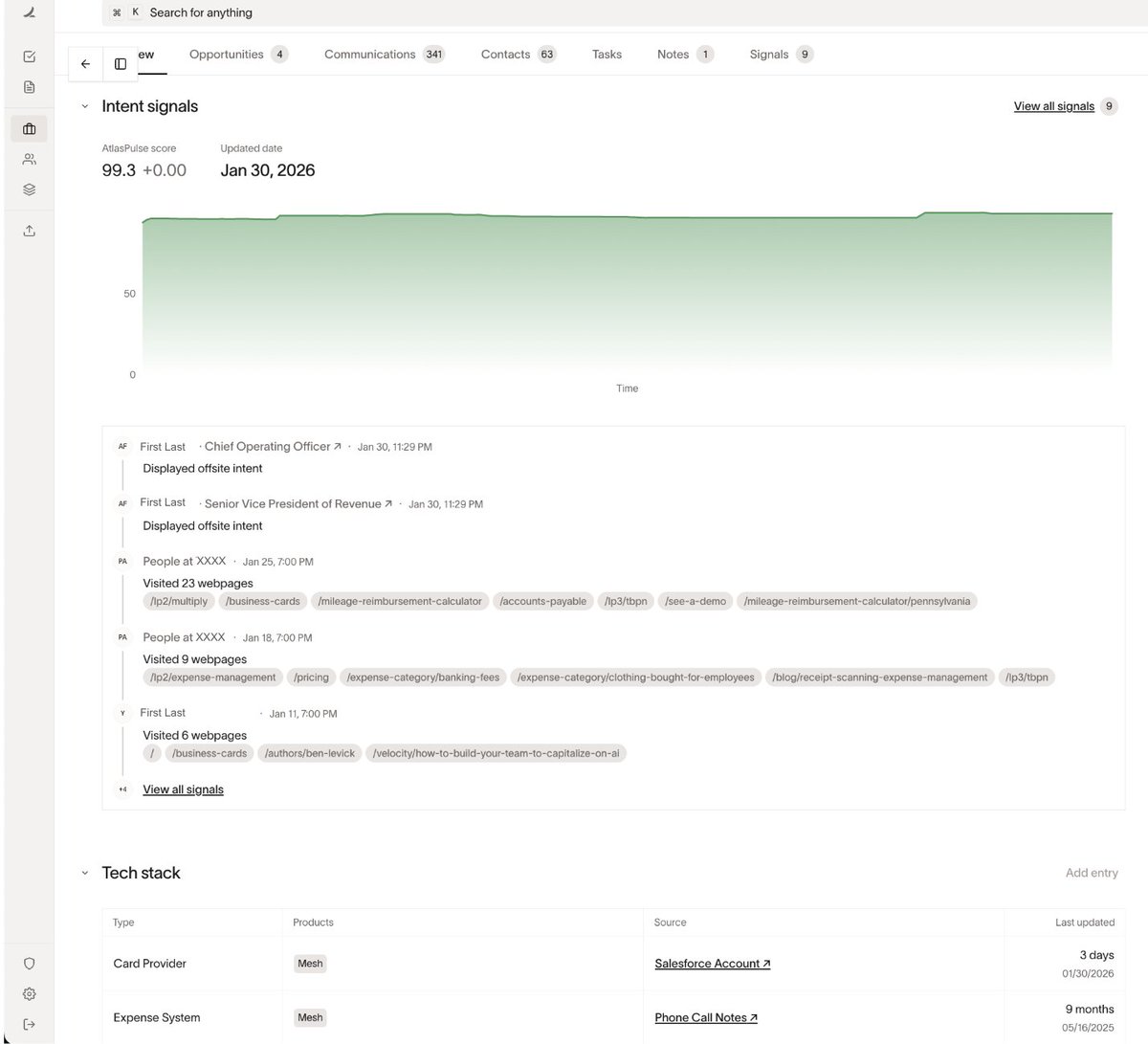
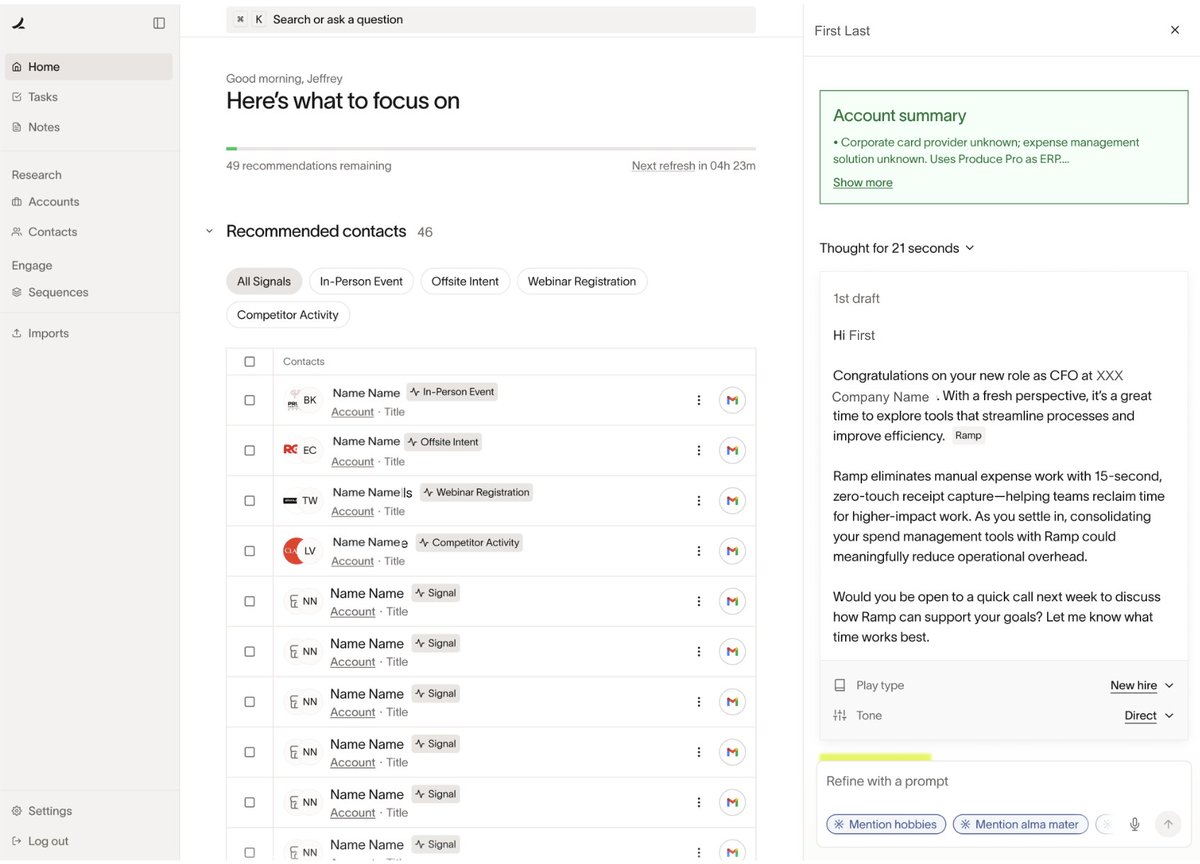
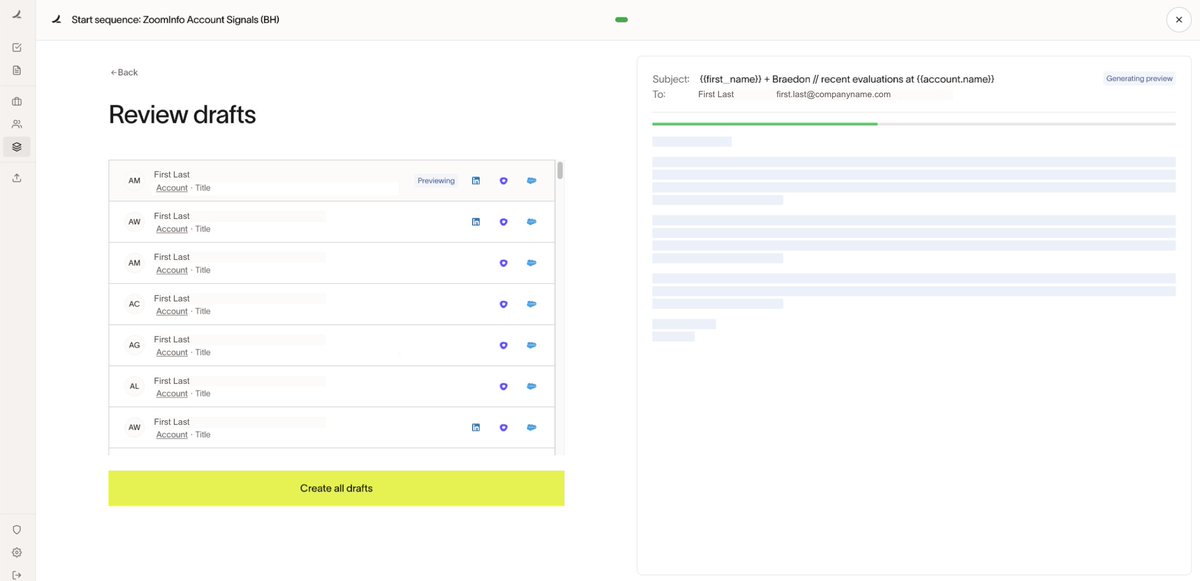
we've been quietly building our own 0 -> 1 revenue stack internally at @tryramp - Ramp Revenue.
our team’s mandate is simple - help our sales team win, drive more pipeline, and build the most efficient gtm org in the world.
it's powered by our customer data platform (processes millions of records of internal, external, and crm data daily) + unified action layer with agents embedded directly in their workflows.
This means that sellers at Ramp don’t have to worry about switching between dozens of systems just to figure out who they should reach out to or what they should say.
>80% of sales workflows are now powered by Ramp Revenue. Sharing a small preview of what we've been building

English

Thrilled to share that Alibaba has 146 papers accepted at NeurIPS 2025, covering model training, datasets, foundational research, and inference optimization, one of the highest among tech companies!
🚀Our winning paper, "Gated Attention for Large Language Models: Non-linearity, Sparsity, and Attention-Sink-Free", is the first to systematically explore how attention gating impacts large model performance.
Read more: alizila.com/alibaba-qwen-w…
#AlibabaAI

English

@DBredvick @bhalligan Did you build an outbound lead agent? Lots of inbound workflows, especially if you’re a hot product like Vercel or OpenAI.
English

@bhalligan Built it in house on Vercel, OSS’ed it here vercel.com/templates/ai/l…
English
Hi, I'm the engineer that built out Vercel's first AI SDR agent mentioned below👋
AMA
Lenny Rachitsky@lennysan
My biggest learnings from Jeanne DeWitt Grosser (ex-Chief Business Officer at @Stripe, now @Vercel COO): 1. What failed seven years ago now works with AI. In 2017, Jeanne tried to build a system at Stripe that would automatically personalize outbound emails based on company data. Despite working with world-class data scientists, it failed due to too many errors. Today, that exact same approach works. This shows how AI has made previously impossible ideas suddenly viable. 2. A single GTM engineer at Vercel reduced a 10-person sales team to 1 (in just 6 weeks). Jeanne’s team at Vercel had an engineer build an AI agent that handles inbound lead qualification, outbound prospecting, and deal loss evaluation. The agent costs $1,000 per year to run versus over $1 million in salaries for the sales team. The nine displaced team members moved to higher-value work rather than being laid off, and the remaining salesperson is 10 times more efficient. 3. Their AI deal-loss bot has become better at understanding what went wrong than humans. When Jeanne analyzed her biggest loss of the quarter, the salesperson blamed pricing. But an AI agent reviewed every email, call transcript, and Slack message and discovered the real reason: they never spoke to the person who controls the budget, and when ROI came up, the customer clearly didn’t believe the value claims. They are now using AI to analyze sales calls in real time and send alerts like “You’re halfway through the sales process and haven’t talked to a budget decision-maker yet.” 4. Wait until $1 million in revenue before hiring your first salesperson. Founders should continue selling themselves until they reach around $1 million in annual revenue with a repeatable process. The key is having a defined ideal customer profile—customers who look alike. 5. Segment customers on what drives their buying decisions, not just company size. OpenAI has roughly 3,000 employees, which would typically put them in the “mid-market” category. But they’re a top-25 website globally by traffic, so Vercel treats them as enterprise customers requiring complex sales. Effective segmentation combines company size with growth rate, web traffic, workload type, and industry—because selling to e-commerce companies requires completely different language than selling to crypto companies. 6. Most customers buy to avoid risk, not to gain opportunity. About 80% of customers purchase to reduce pain or avoid problems, while only 20% buy to increase upside. This means you should focus your sales messaging on what could go wrong without your product—like falling behind competitors or damaging their reputation—rather than just talking about exciting features. This is especially true when selling to larger companies, where individual careers are on the line. 7. Sales teams should be indistinguishable from product managers—for a bit. Jeanne hires salespeople who have such deep product knowledge that if you put one in front of a group of engineers, it should take 10 minutes to realize they’re not a product manager. This credibility allows sales teams to serve as an extension of research and development—a 20-person sales team talks to hundreds of customers weekly and can translate those conversations into product insights at scale. 8. Building your own AI sales tools may beat buying off-the-shelf software. Because AI is so new and every company’s sales process is unique, Jeanne finds that building custom internal agents often delivers more value than buying vendor solutions. A single go-to-market engineer built their deal analysis bot in just two days, perfectly tailored to their specific workflow. These engineers shadow top salespeople to understand their workflows, then build automation that would have taken months or been impossible just a few years ago. 9. Make every sales interaction great, whether customers buy or not. Jeanne replaced boring discovery calls at Stripe with collaborative whiteboarding sessions where customers drew their payment architecture. Many customers had never visualized their own systems before. They left with a useful asset and a feeling of collaboration, regardless of whether they bought. Many returned years later to purchase. Think about your go-to-market process like a product, not just a sales function. 10. Product-led growth has a ceiling—no $100 billion company runs on it alone. While product-led growth (where users can sign up and start using a product without talking to sales) works well for early growth, customers generally won’t spend a million dollars through a self-service flow. Every major technology company eventually builds a sales team for larger deals. The mistake is waiting too long, since building a predictable sales process takes time.
English
@justindross I prefer “automated.” Most use cases for GTM / marketing / creativity (beyond generation) is automation
English

I have no idea what “Agents” as a product means. Am I the only one?
It reminds me of the old Steve Jobs clip about not starting with the technology. “Agents for teamwork” is meaningless to me, with all respect to Notion
Akshay Kothari@akothari
new sf billboard :)
English

The story of Kalshi has had endless rejection.
Whether it's the government, media, or Wall St, we have often been perceived as renegades.
Yet, most important things in history were rejected... until they got accepted.
Today, the NHL has accepted prediction markets.
Kalshi@Kalshi
Kalshi is now the Official Prediction Market Partner of the @NHL A Big 4 league. A first-of-its-kind partnership. The start of a new era.
English
@sundeep Reminds me of when Fred Segal started popping up internationally
English




Hulk Hogan was my childhood. He never lost. He was the goat and created an entire community of fans called Hulkamania that were so passionate about him.
An American icon. Dead at 71.
“What you gonna do when the Hulkster comes for you?”
English


@thebergershop I just said Brad Stevens just pulls off sick trades to all my friends.
English
Simons to Boston is a great move by Stevens. Gets younger, off that contract, and Simons can really shoot the 3 which is what Boston does.
English