Philipp von dem Knesebeck

1.2K posts

Philipp von dem Knesebeck banner
Philipp von dem Knesebeck

Philipp von dem Knesebeck

@philippvdk

General Partner at Vinthera, LP & Direct Investor in Venture Capital

Munich, Germany Katılım Kasım 2011
536 Takip Edilen638 Takipçiler
Philipp von dem Knesebeck retweetledi
samir kaji
samir kaji@Samirkaji·
I talk to thousands of LPs every year. Here's what I'm seeing right now when it comes to how they're approaching VC. 1) Late-stage co-investments have never been hotter. The top 5-7 names have effectively *unlimited* demand. And that supply/demand imbalance has created three real issues: First, the question of *true* access. Many of the SPVs floating around for these companies are not sanctioned by these companies. Buyer beware. These companies are tight on their cap tables, and access can be gated beyond just capacity. The fee creep is getting egregious. Someone shared with me recently that for a top AI lab, a group was charging 15% upfront, 20% carry, and 30% over a 2X. At those economics, you can take what would be a generational company but a bad investment. Fees are the silent killer of returns in late-stage co-invest, and this risk is now being focused on the logo, but ignoring the fee effects. Additionally, for those who aren't getting access to the top companies must go a tier (or two) below. Very dangerous in a high-intensity / valuation market for AI. As I've mentioned, there will be a lot of expensive mistakes made as we figure out what winners will look like in the future. 2) Capital is flowing to large, established brands. This is the clearest trend right now. LPs are concentrating on the top multi-stage and Series A firms. The logic is straightforward: these are easier to underwrite, and given how extreme the power law has become, investors want exposure to the trophy assets soon after investing. If you're a top 10-20 brand, you're oversubscribed, sometimes in multiples. If you're not, the fundraising environment is a different world. 3) Emerging and emerged managers are in the toughest spot, with a notable exception. Spinouts from top firms and operators with strong brands are moving fast and generally very oversubscribed. For everyone else, the bar has never been higher. I think this is actually where the opportunity is for LPs If they have the time/expertise to do so. The issue isn't that LPs don't know this. Most do. The problem is twofold: the time and difficulty of sourcing and diligencing emerging managers is real, and the hangover from 2019-2021 is still very present. A lot of people tried VC during that era who probably shouldn't have, and the failure rate on those Fund 1s has made the entire segment harder to navigate. Matching supply and demand here has become nearly impossible. Supply (Managers) far exceeds demand due to the issues noted.
English
14
23
190
36.5K
Philipp von dem Knesebeck
IF IRR is calculated as an actual cash flow-based metric it may be a useful addition to DPI containing a time based variable. The reality is that given the 12-15 year cycle to return meaningful cash in early stage venture, the present value of cash flows over this time span is mostly discounted to close to zero. Otherwise, a non cash flow-based IRR metric that is so often presented, might just show that the GP is investing in hot and probably overpriced rounds in sectors that attract quick marks up due to high cash intensity (or spend happy founders). The latter type of IRR is a poor predictor of future cash flows in my experience...
English
0
0
0
18
Pavel Prata
Pavel Prata@pavelprata·
DPI is the multiple (how much you returned). IRR is the speed (how fast you got there). Different nature entirely. You can have high IRR with low DPI (small, quick wins), or high DPI with low IRR (large but slow outcomes). Funds that have both are rare, which is why LPs always look at them together, not as a single number.
English
1
0
1
99
Peter Walker
Peter Walker@PeterJ_Walker·
MOIC is BS, IRR matters more. @gokulr on Harry's pod is obviously right in the long-term. Short-term...IRR tends to look too good in early years after a couple big markups. Is there truly one venture metric to rule them all? No. Well, maybe DPI. But no.
Peter Walker tweet media
English
5
4
15
2K
Philipp von dem Knesebeck retweetledi
Auren Hoffman
Auren Hoffman@auren·
VC funds can be way more LP friendly most funds are NOT optimized for LP friendliness. there are massive amounts of decision points where GPs can favor themselves over LPs. the obvious one is fees. the less obvious one: when a fund does an SPV, that deal was sourced because the fund was already an investor. should some of the SPV economics flow back to the fund's LPs? very few funds do this. it gets talked about but almost never implemented… funds should also clearly decide which expenses it should charge to the fund and which expenses it should charge to the management company. The fewer expenses charged to the fund, the better it is for LPs. LP-friendly funds should recognize this and telegraph how they charge expenses to LPs. there’s also the community side. many LPs in seed funds are incredible individuals -- founders, executives, family offices -- who'd benefit enormously from knowing each other. funds see emerging categories early, spot trends before they're obvious, identify other funds worth backing. most funds share none of this with their LPs. the bar for being LP-friendly in venture is genuinely on the floor. quarterly letters and a capital call notice -- that's the industry standard. it shouldn't be hard to clear that bar but most funds don't even try. the best fund-LP relationships aren't transactional. they compound the same way the best founder relationships do.
English
6
6
58
9.6K
Philipp von dem Knesebeck retweetledi
Paul Lee
Paul Lee@iPaulLee·
A lot of emerging managers ask: “How small is too small for a first venture fund?” The answer depends less on the number and more on whether the strategy actually works. From an LP perspective, the answer is usually simpler than people think. 🧵
English
1
1
9
2.1K
Philipp von dem Knesebeck retweetledi
Pavel Prata
Pavel Prata@pavelprata·
Ok, let’s do a quick exercise. If we take a realistic $50M fund (pretty average for emerging managers in 2025–2026 vintages from both coasts), here's how it can actually work: 1/ 2/20 which is ~$10M management fees over 10 years with ~$40M deployable capital 2/ Reserve ~25% from the fund size for follow-ons which is $12.5M (you can recycle aggressively or bump to 40% if conviction is high) 3/ Leaves ~$27.5M for initial checks 4/ Pure Seed focus (no pre-seed mix to keep it clean): "hot Seed" rounds today: often $4–6M on $20–30M post, but let’s take $5M on $25M post If the fund tries to lead with 50% of the round ($2.5M checks), you’re suddenly looking at maybe 11 companies in the portfolio with ~10% ownership. More realistically, though, a new manager probably ends up co-leading or participating with something closer to 1/3 of the round ~$1.7M), which pushes the portfolio toward ~16 companies with ~6–7% ownership. So the portfolio naturally lands somewhere between concentration and diversification. And in both cases the outcome probably depends less on the exact fund size and more on execution like pro-rata discipline (selective super-pro-rata on the winners and passes on mediocre positions), some thoughtful liquidity (strategic secondaries, recycling), and a few real exits. Under those conditions hitting ~3x isn’t crazy ($150M in distribution). Which is why I’m not fully convinced that the $30–75M category is structurally doomed – the constraints are real, but the math can still work if the manager is disciplined.
Harry Stebbings@HarryStebbings

LPs love the idea of the 30M-75M high ownership seed fund. These will be the worst performing funds of this vintage. Average top tier seed rounds are $5M. These funds don’t have enough to lead and have a diversified portfolio. But they are too large to be collaborative and work with the best leads. Adverse selection takes effect. Be small enough to collaborate (sub $20M) or be large enough to lead ($100M+).

English
8
5
73
23.5K
Philipp von dem Knesebeck retweetledi
Pavel Prata
Pavel Prata@pavelprata·
Interesting idea from a call today. The more LPs I speak with, the more it feels like there are roughly 3 levels of how people approach manager evaluation. Level 1 (aka high-level fund metrics) Most LPs start here. Looking at things like TVPI, DPI, IRR across similar vintages and strategies. Which is fine as a first pass… but in practice almost every fund looks “top quartile” at some point in the cycle, whether because of timing before write-downs, aggressive markups, selective reporting, or some mix of all three. So those numbers often say as much about timing and accounting as they do about actual underwriting skill. Level 2 (aka portfolio logos) More sophisticated LPs go one layer deeper and start looking at the underlying portfolio companies. But even there, I think a lot of people fall back on signals that are simply easier to read: - which logos joined later rounds - who led the Series A / B - which companies raised big up-rounds - which brand names appear on the cap table None of these are meaningless. They do signal market momentum. But mostly they tell you who invested next, not necessarily what the manager originally underwrote. And then there’s Level 3 (aka understanding how the manager actually underwrites businesses) This is where things get much harder, because you have to look inside the companies themselves and ask questions like: - where is the growth actually coming from? - does marginal growth require more capital or less over time? - does the system build operating leverage as it scales? - does the business compound internally, or just keep absorbing new capital? Part of the reason the industry drifted toward the first two levels probably has to do with the macro environment we operated in for ~40 years. When interest rates are near zero, future cash flows barely get discounted: - if a company produces $1B ten years from now, at a 1% discount rate that’s still worth roughly $900M today - at a 10% discount rate it’s closer to $380M That difference massively changes what investors are willing to fund. And for a long time, that actually worked, because the system kept refinancing itself. But when liquidity tightens, the gap between momentum signals and business health starts to show up very quickly. Which is probably why the real question for LPs today feels less like who invested next and more like what kind of businesses this manager consistently chooses to back in the first place. That’s where Level 3 really starts.
English
5
10
75
55.3K
Philipp von dem Knesebeck retweetledi
Gil Dibner
Gil Dibner@gdibner·
As the firm matures, a concave phase emerges. The GP’s brand becomes legible to LPs, embedding expectations about what the firm is meant to be. Capital has been raised against a story — sometimes against an illusion of learning — where markups are mistaken for returns and a rising tide for manager alpha. Strategy hardens into identity. The GP is no longer free to be interestingly wrong; they are forced to be defensibly safe. buff.ly/7ZHnPHe
English
5
6
36
4.4K
Philipp von dem Knesebeck retweetledi
Ben Casnocha
Ben Casnocha@bencasnocha·
There are many ways to make money in venture. So I’m wary of people who have theology about portfolio construction. The truth is you can succeed with highly concentrated funds or highly diversified funds. As is often the case, there’s no one right answer for every GP — the right decision depends on fit. The key IMO is to align your portfolio construction with your unique edge as a firm. Choose the portfolio construction that best reflects your strategic assets for winning. For example, are the GPs domain specialists who love to roll up their sleeves and work alongside the CEOs? Or is it a team of generalists of varying levels of seniority with a lighter touch post-investment? What assets enable founder community and peer learning? What’s your brand strength for winning allocations in competitive deals vs. participating with small checks? What’s your ability to assess and invest in rounds after the initial round of investment (follow-ons)? These are just some of the considerations that might drive a particular portfolio construction. There are, indeed, many ways to skin the cat. Resist the simple frameworks of portfolio construction purists.
English
2
8
18
3.6K
Philipp von dem Knesebeck retweetledi
Dan Gray
Dan Gray@credistick·
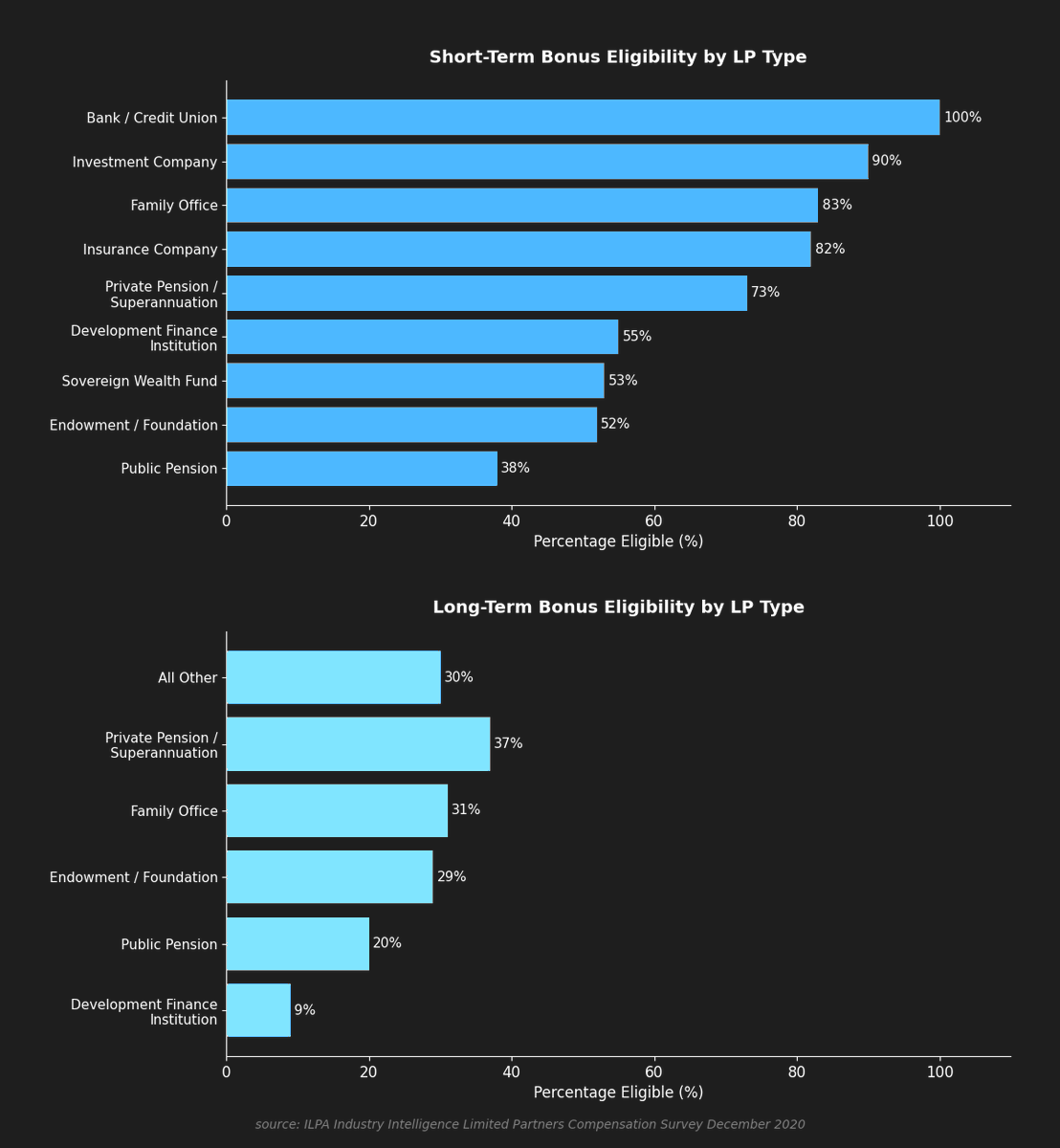
The structure of bonus compensation varies significantly across the different categories of LP. Short-term bonuses are driven by total fund performance in 60% of cases, and/or specific PE/VC strategy performance in 39% of cases (which will be unevenly distributed across LP types). Typically, this is based on the past 12 months of (unrealised) performance. Long-term bonuses function more like carried interest, looking at profits achieved beyond a particular hurdle (with or without "lookback") and deferred payments (usually over 3 years). Typically, this is based on a 3–4 year rolling average of (realised) performance. (Data as of 2020, from the "ILPA Industry Intelligence Limited Partners Compensation Survey")
Dan Gray tweet media
philippe@philippenyssen

@credistick @davemcclure What is the share of LPs with incentives tied to paper NAV rather than actual liquidity? I suspect it's quite high.

English
2
2
11
1.7K
Philipp von dem Knesebeck
Philipp von dem Knesebeck@philippvdk·
How to present performance metrics in VC - the dos and don'ts: *Don't make up metrics like 'Net MoIC' and 'Forecast Gross MoIC'.*  These are useless for LPs that wish to employ valuation benchmarks to compare performance across funds on a like for like basis. Most funds show more standard metrics like Net TVPI or actual MoIC (which is generally considered a gross metric showing the underlying performance of investments).  *Do show the individual performance of underlying investments, especially when hard mark-ups are still limited.* Revenue growth, customer adoption, and other major milestones are arguably more useful data points for LPs to assess the potential of a portfolio than paper mark ups. Admittedly, not all LPs focus on this, but it's a much more genuine presentation and demonstration of a fund's potential.
English
0
0
3
102
Philipp von dem Knesebeck
Philipp von dem Knesebeck@philippvdk·
An LP asking for the loss ratio can also be about finding out if a GP is taking enough risk. Enough to make the power law work.
English
0
0
2
90
Philipp von dem Knesebeck retweetledi
Semil
Semil@semil·
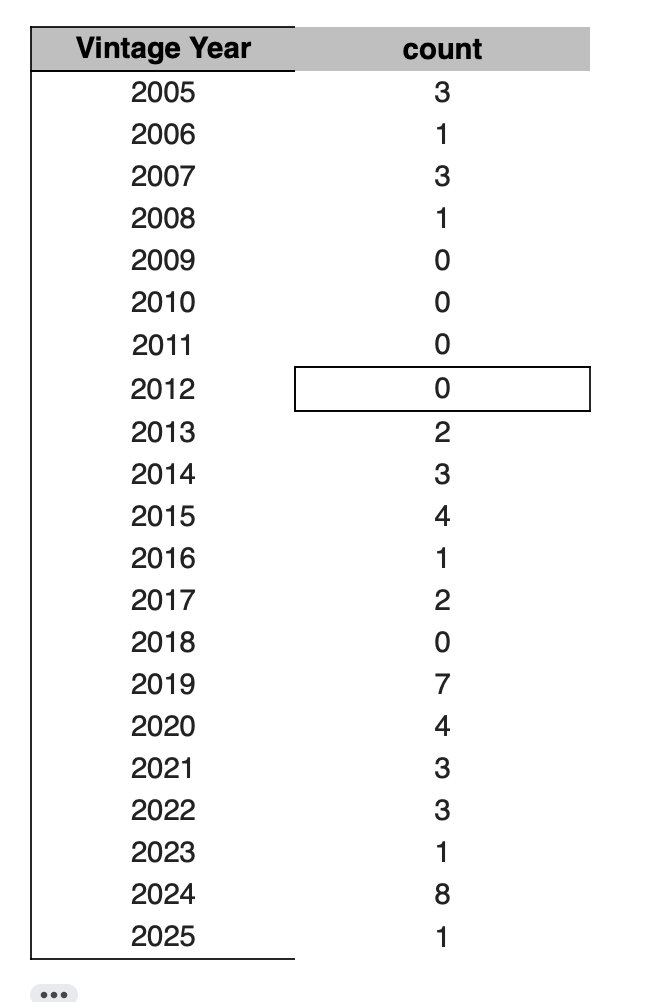
Institutional LPs rarely add new managers. As VC industry has grown w/ opportunity set, so have # of new funds. Ofc, hard to land a new institutional LP. This is from LP friend re: new funds they added/year, and this group is more active than the median institutional LP.
Semil tweet media
English
11
6
108
16.5K
Philipp von dem Knesebeck
Philipp von dem Knesebeck@philippvdk·
@joshephraim True, it's only a problem with low returning funds. A 1.25x MoIC on 80 cents of investable capital per dollar committed due to aggregate management fees still only amounts LP money being returned. Anything lower and LPs loose money.
English
0
0
1
353
Philipp von dem Knesebeck
Philipp von dem Knesebeck@philippvdk·
@jmj Solid advice, although it is possible to run a venture fund without building a fully fledged firm behind it. The Solo GP model with an outsourced CFO works for some. But for the vast majority of aspiring VCs your point is 100% true!
English
1
0
7
778
Jeff Morris Jr.
Jeff Morris Jr.@jmj·
There is a very big difference between running a venture fund and building a venture firm. I get a lot of aspiring venture capitalists who ask me about starting their own firm, and the quick thing I tell them is that they have to love company building & operations as much as they love investing. At the end of the day, so much of your time is spent on fundraising, recruiting, and back office. You have to really love that stuff early on (or it least be good at it) when nobody is there to help you out. If you don’t love the non-investing stuff or have enough self-awareness to know you're not good at it, you should definitely consider joining a platform. I have friends who are amazingly talented who have decided they only want to focus on investing, and they are very happy & many make a ton of money too. Easy to run a fund. Much harder to build a firm.
English
25
23
206
25.5K
Philipp von dem Knesebeck retweetledi
OpenLP
OpenLP@Open_LP·
Raising a Fund I is *hard.* This checklist from @sydecario is a helpful resource with tips for emerging managers looking to sharpen their pitch. 📝 ✔️Clarify your investment thesis ✔️Build your narrative ✔️Show your track record ✔️Tailor your pitch for different LPs ✔️Establish a credible digital presence ✔️Iterate… and iterate again. ✔️Be strategic about your GP commit Guide with tactical advice here: sydecar.io/guide/emerging…
English
0
2
5
391
Philipp von dem Knesebeck retweetledi
Endowment Eddie
Endowment Eddie@endowment_eddie·
How to create a sense of urgency with your fundraise: 1) You don’t. This is reserved for the top 2% of funds. Very, very few firms are capable of driving LPs to 4-week close. 2) If LPs don’t have a prior relationship, they need to go through a process. They need multiple meetings, references etc. Any good LP is going to give you til Fund 3/4 and their capital acct will be upside down for a decade plus. Give them time. 3) LPs can be a flock. Generally, this isn’t because of any one or two anchors you may secure. The dynamic changes quickly as you get to 50% of your target and if you start deploying and companies see strong follow-on and revenue traction. 4) Discount any advice from GPs who got off the ground in 2020/21 5) If you aren’t an exited founder or spinning out with an institutional track record, recognize that many meetings, which are still worthwhile, are greasing the skids for Fund 2/3 conversations. Both sides should be open and transparent to this.
English
7
7
241
29.5K
Philipp von dem Knesebeck
Philipp von dem Knesebeck@philippvdk·
Venture does scale, but returns tend to mean revert with increasing fund sizes. The problem is that mean returns (let alone median returns) are not attractive in Venture relative to other asset classes on a risk-adjusted basis. In Venture allocators should really target alpha, which is generated with non-scalable niche strategies. In fact alpha is generated with niche strategies in most asset classes.
English
0
0
2
248
Meghan Reynolds
Meghan Reynolds@MeghanKReynolds·
“Venture is not an asset class, asset classes scale…Venture doesn’t scale with more money” Reminds me of a quote from a longtime endowment LP “Venture is not an asset class - it’s a strategy. And the single biggest predictor of a venture capital investor’s success is tenacity”
Jack Altman@jaltma

This was an exceptionally cogent articulation from Roelof about the state of venture capital. "There's a lot more talent than really interesting companies to be built. And I think we're spreading a lot of that talent thin right now." "Venture is a return-free risk."

English
10
16
161
29.5K
Philipp von dem Knesebeck
Philipp von dem Knesebeck@philippvdk·
What you describe is how it should be. You would be surprised, however, how many family offices dabble in early stage investing first, get burnt and then adopt that strategy later. And many never get there at all... (To be fair the above strategy requires a certain sized allocation to VC per year, as it still requires a competent team. Smaller FOs should outsource to funds who run that strategy).
English
0
0
1
40
Steph from OpenVC
Steph from OpenVC@StephNass·
Do Family Offices invest in tech startups? Here's the pattern I see most: 1. FO invests in VC funds as a LP. Easier to screen GPs and manage relationships when you don't have deep market/tech/industry expertise. Also, built-in diversification. 2. Then, FO co-invests in the later rounds of the 1-2 clear winners of these VC funds they had invested in, in particular when the GPs cannot follow but has pro-rata rights. So they effectively use VC funds as "scouts" to feed their pipeline. In my (limited) experience, FOs rarely go direct at very early-stage UNLESS the principal has a deep experience in that specific industry/market or is a tech founder. For example, @Xavier75 in France. 3. Finally, FO investing in secondaries of SpaceX, xAI, etc. But that's a different game IMHO.
English
4
0
3
388