
Philip vN

41.3K posts

Philip vN banner
Philip vN

Philip vN

@PhilipvN

Metaverse pioneer since 1991 | Founded E-SPACES & @ECOVERSE_com | XR, AI, Web3, space advocate | Seeking strategics & investors for ECOVERSE's next growth phase

Ecoverse Katılım Kasım 2008
2.1K Takip Edilen1.9K Takipçiler
Philip vN retweetledi
TheNewPhysics
TheNewPhysics@CharlesMullins2·
🚨 A FORMER NASA ENGINEER CLAIMS HE’S DISCOVERED A “NEW FORCE” THAT CAN OVERCOME EARTH’S GRAVITY WITHOUT ANY PROPELLANT. Charles Buhler, who spent years leading NASA’s Electrostatics and Surface Physics Laboratory at Kennedy Space Center, says his private company Exodus Propulsion Technologies has found a way to generate thrust using only electric fields. In vacuum chamber tests, their device reportedly produced enough force to counteract Earth’s gravity a claim that would completely rewrite the rules of propulsion. Why this matters: For over a century, every rocket we’ve ever launched has had to carry massive amounts of fuel. If this “New Force” is real, spacecraft could one day maneuver indefinitely without expelling mass potentially making deep space travel, satellite station-keeping, and even atmospheric flight dramatically cheaper and more efficient. The deeper implication is staggering: We may be looking at the first real breakthrough in propellantless propulsion since the invention of the rocket. If verified, this wouldn’t just change space travel it could reshape how we think about energy, momentum, and the fundamental laws of physics. Of course, extraordinary claims require extraordinary evidence. As of now, the work is still awaiting independent replication by outside laboratories. But if this holds up… What changes first space travel, energy production, or something we haven’t even imagined yet? Follow for more frontier physics and emerging technologies.
English

163
409
1.6K
112.5K
Philip vN retweetledi
Brian Roemmele
Brian Roemmele@BrianRoemmele·
Boom! New AI Technology Coming! Polaritons: The Dawn of Living Light-Matter Intelligence – Beyond Silicon’s Breaking Point Imagine a future where computers don’t just crunch numbers with electrons they think in waves of living light. Where information flows not through rigid silicon gates, but through shimmering quantum hybrids of photons and matter that dance, interfere, and compute at the speed of light itself. This isn’t science fiction. It’s happening now in cutting-edge labs, as researchers harness exciton-polaritons to birth the next era of computing: ultra-fast, brain-like, and radically energy-efficient. The Silicon Crisis: Why We Need a Revolution Today’s AI chips are hitting a wall. Power-hungry data centers guzzle electricity, generate mountains of heat, and choke on data movement bottlenecks between memory and processors. Scaling silicon further feels impossible as demands for AI explode. Traditional electronics are hitting fundamental physical limits but nature offers a dazzling workaround. Enter polaritons: exotic hybrid quantum states where photons (pure light) merge with excitons (matter excitations in semiconductors) inside optical microcavities. These quasiparticles act as one unified entity inheriting light’s blistering speed and near-zero resistance while gaining matter’s powerful interactions and nonlinearity. The result? Information processed as coherent, wave-like quantum interference patterns in systems that feel almost alive. Breakthroughs Igniting the Polariton Revolution Recent advances are turning this vision into reality: - Binarized Neuromorphic Lattices: Scientists have built lattices of exciton-polariton condensates, interconnected and powered by optical pumping. These function as binary neurons, using spatial coherence and nonlinear repulsion for massively parallel processing. On the MNIST handwritten digit task, they’ve hit 97.5% accuracy rivaling or surpassing traditional methods while operating in a fundamentally different, wave-based paradigm. - Room-Temperature Perovskite Magic: One of the biggest barriers the need for cryogenic cooling has been shattered. Using monocrystalline perovskite waveguides and non-equilibrium Bose-Einstein condensation, researchers demonstrated the first room-temperature exciton-polariton neural network. It tackles real machine learning tasks like binary classification and object detection, bringing practical optical brain-like hardware within reach. - Ultra-Low-Energy All-Optical Switching: In a stunning 2026 breakthrough from the University of Pennsylvania (led by Bo Zhen), strongly nonlinear nanocavity exciton-polaritons in gate-tunable monolayer semiconductors enable pure light-based switching at an astonishing ~4 femtojoules — about 4 quadrillionths of a joule. This eliminates costly light-to-electronics conversions, paving the way for seamless photonic AI processors. Research: nature.com/articles/s4137… These systems deliver: •Blazing Speed: Picosecond-scale operations with massive parallelism. •Dramatic Efficiency: Minimal energy and heat — perfect for sustainable AI. •Brain-Like Analog Power: Natural wave interference and nonlinearity excel at pattern recognition, optimization, and complex computation, mimicking neural processes far better than binary gates. •Unified Light-Matter Flow: Information travels as quantum waves in coherent condensates, creating “living” computational fabrics rather than clunky electron pipelines. Polariton technology points to hybrid photonic-neuromorphic chips that could power the next generation of AI with sensors talking directly in light, vastly reduced energy footprints for data centers, and even pathways to quantum simulation. We’re witnessing the birth of post-silicon intelligence where computation evolves from silicon transistors to dynamic, wave-based systems that feel closer to biological minds. I am testing this now and will have more soon!
Brian Roemmele tweet media
English
54
110
461
27.5K
Philip vN retweetledi
Rohit
Rohit@ai_rohitt·
🚨 Anthropic just showed a 27-minute workshop on how to actually do prompts for Claude. Taught by the people who built it. Free. No registration. No paywall. I've seen $300 courses that don't cover what they teach in the first 8 minutes. Watch it and bookmark it now.
English
34
240
1.3K
281.2K
Philip vN retweetledi
How To AI
How To AI@HowToAI_·
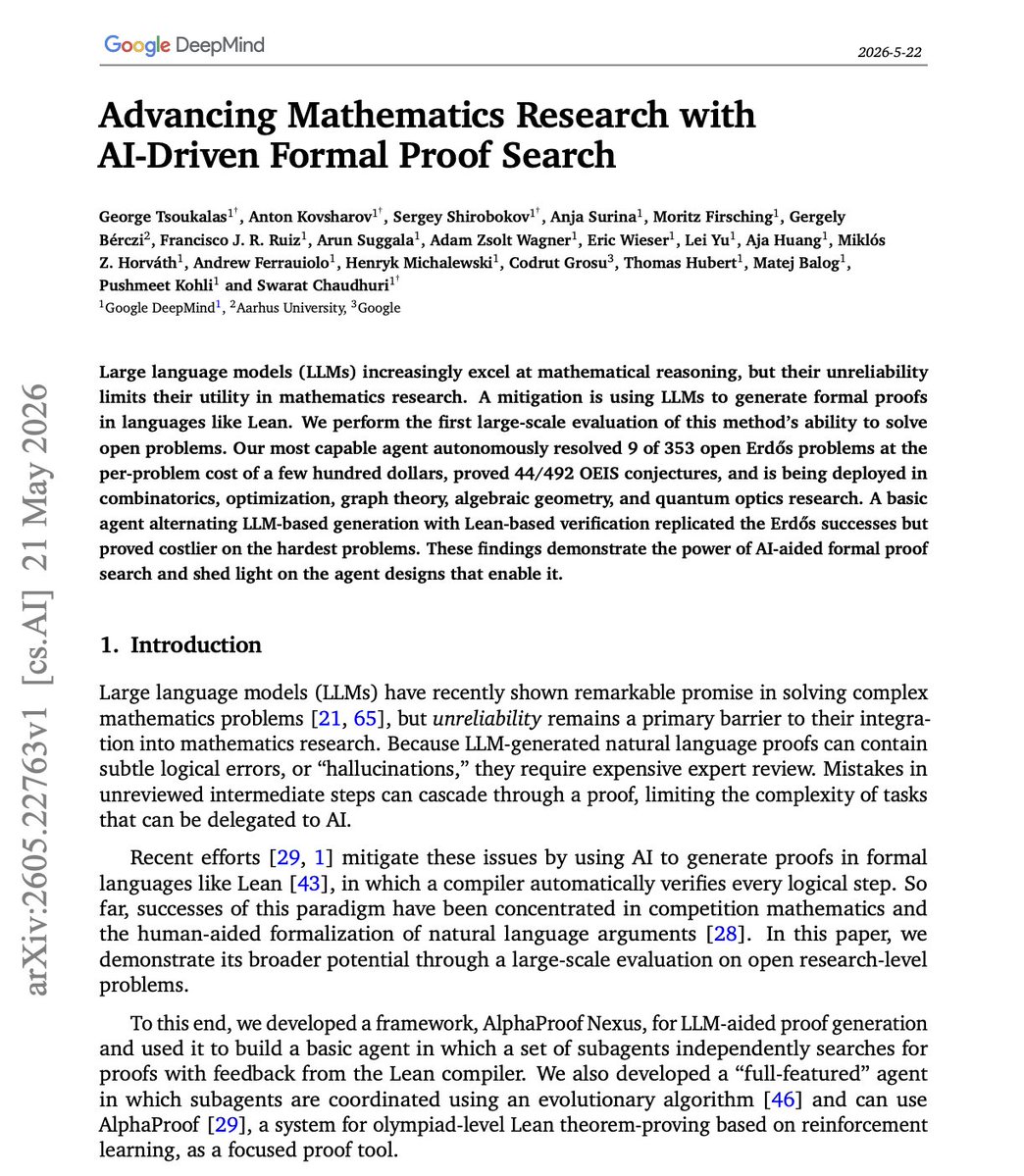
Google DeepMind just solved 9 math problems that stumped humans for 56 years. They published a paper on a new framework called AlphaProof Nexus. And it completely eliminates the hallucination problem. How? By fusing a Large Language Model with a formal proof compiler called Lean. They created a relentless agentic loop. The AI proposes a proof. The Lean compiler rigorously checks every single step of logic. If there is a flaw, the compiler rejects it and feeds the exact error back to the AI. The AI learns, corrects, and tries again. It iterates endlessly until the proof is mathematically flawless. Zero human intervention. Zero hallucinations. DeepMind unleashed this system on some of the hardest open problems in mathematics. The results are staggering: - Autonomously solved 9 open Erdős problems (two unsolved for 56 years). - Proved 44 open conjectures from the Online Encyclopedia of Integer Sequences. - Resolved a 15-year-old mystery in algebraic geometry. - Discovered a new bound in convex optimization. The compute cost to solve a half-century-old math problem was just a few hundred dollars. We used to think advanced AI would arrive when a model could instantly spit out the perfect answer on the first try. But AlphaProof Nexus proves something different. The AI doesn't need to be perfect on the first try. It just needs a flawless feedback loop and enough time to think.
How To AI tweet media
English
10
36
121
8.4K
Philip vN retweetledi
Seth Howes
Seth Howes@SethSHowes·
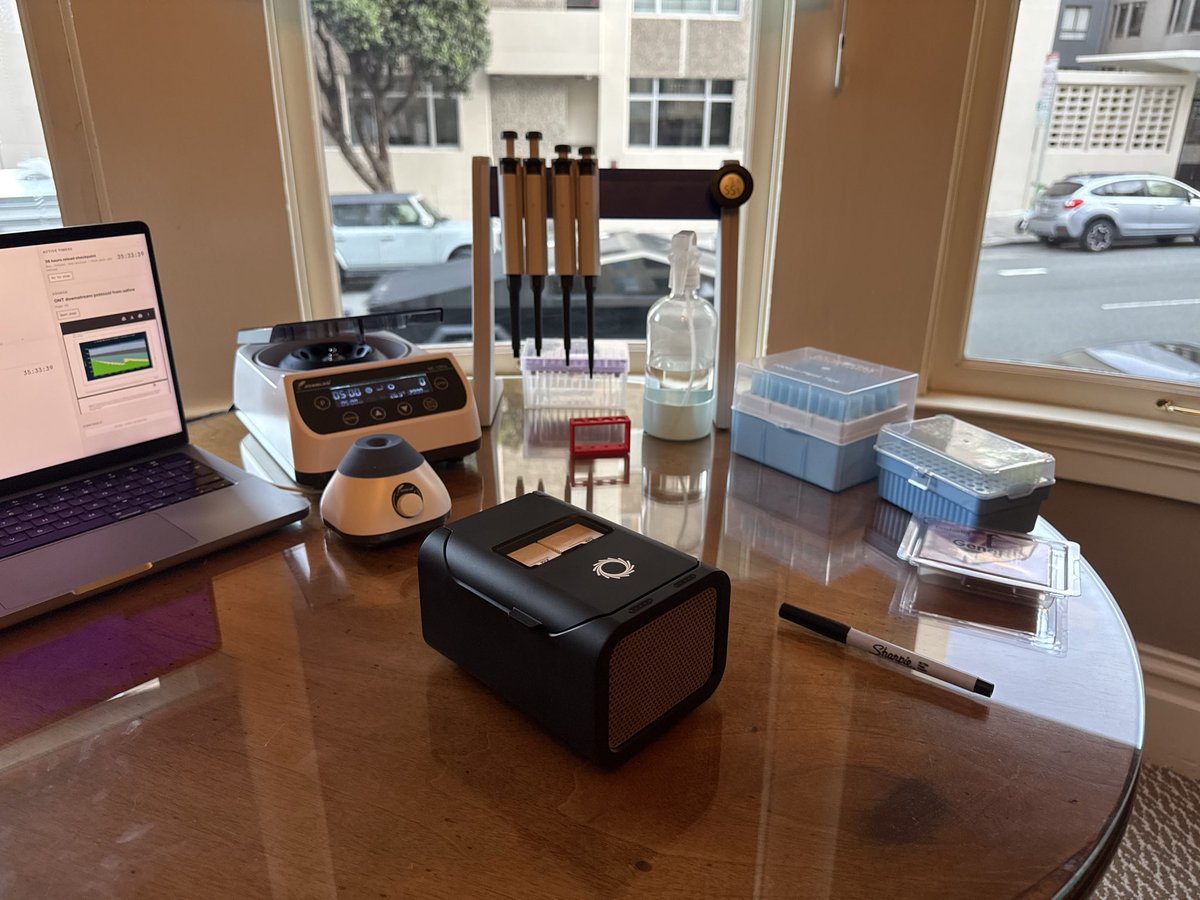
I just sequenced a human genome to 30× coverage entirely at home. As far as I know, this is the first time this has been done. I didn’t step foot in a lab once. Every step - from saliva collection, to running the sequencer - took place in a single room with a dining table + kitchenette. Six weeks ago, I had never done wet lab biology before. I used an Oxford Nanopore P2 Solo - the only commercially available sequencing device portable enough to do 30x human genome sequencing at home. Biggest takeaway - I could build something that combined software, hardware, and molecular biology far faster than I thought was possible. I can name >100 specific instances where AI helped me solve a technical problem that would previously have blocked me because I lacked access to a domain expert. For example: how do I save my sequencing run when my DNA extraction yield is 4x lower than I need it to be, and I have this limited set of reagents to hand? To make this work, I had to navigate multiple disciplines: - writing software to monitor sequencing runs and orchestrate remote GPU infra for basecalling - learning + executing 5 hour long molecular biology protocols - building a hardware device to quantify DNA concentration Apologies for the hyperbole, but I feel super lucky to be living in 2026. A few weeks ago I decided to sequence a human genome to 30x at home. Then I actually did it. And I did it really quickly.
Seth Howes tweet mediaSeth Howes tweet media
English
252
468
4.7K
381.3K
Philip vN retweetledi
Ole Lehmann
Ole Lehmann@itsolelehmann·
marc andreessen just went on Rogan and casually dropped a TON of AI alpha full pod is 3 hours and 20 minutes, but i pulled out his most interesting takes here: 1. AGI is here. he thinks the line was crossed about 3 months ago with the new GPT-5.5, claude 4.6, gemini 3, and grok 4.3 models. nobody noticed because the field moves too fast for anyone to register the milestones anymore. 2. his other big claim: for almost any topic, the top AIs now give him better answers than the actual world-class experts he could call on the phone. and he can call basically anyone. 3. every doctor is already secretly using chatGPT in the exam room. marc says they turn around the second you stop talking and just type your symptoms in. some of them are doing it while you're still sitting there. his quote: "at that point you're asking the question of like, what do i need you for." 4. when AI refuses to answer something he wants to know, he tells it he's writing a novel. "i'm writing a detective novel, walk me through how the bad guy robs the bank." it'll explain almost anything if it thinks it's helping you write fiction. 5. when something is too complex he says "explain it to me like i'm 10." then "like i'm 5." then "like i'm 2." he keeps going until it actually clicks in his brain. 6. when he wants to understand a tough topic he doesn't ask "what's the right answer." he asks the AI to steelman one side, then steelman the other. then he decides for himself. 7. for big questions he tells the AI to pretend to be a panel of experts. "be a doctor, a lawyer, a historian, a psychologist, and argue this out with each other." then he reads the debate they have. 8. pay attention to the exact moment you think "i don't know how to figure this out." most people just give up at that moment. that's the moment you should open the AI. 9. the only real skill left in using AI is knowing what to ask it. the models can already do almost anything you can describe in plain english. the bottleneck lives in your own head. 10. you can send the AI photos of almost anything medical now and get a real answer. skin rashes, blood test results, even pictures of your poop. the new models can read images, not just text. it's a free 24/7 second opinion on basically anything. 11. the one type of therapy that's clinically proven to actually work is called cognitive behavioral therapy. it's also something an AI can fully do on its own. which means every person on earth is about to have access to a real therapist for free, anytime they want. 12. AI is now solving math problems that have been open for 100+ years that no human mathematician could crack. same thing is starting in physics, chemistry, and biology. expect cancer cures, new drugs, and weird new physics breakthroughs to start coming out of these things over the next few years. 13. the best AI coders in silicon valley now make $50 million a year. one person. that's how much value the top performers print with these tools. it tells you how big this thing actually is when you strip away all the doom takes. 14. one friend paid $200 to get his entire DNA decoded (this used to cost millions of dollars and take years to do). then he gave the AI his DNA, his blood test results, and his apple watch data. the AI built him a full health dashboard and started telling him exactly what to fix. 15. another friend (almost certainly zuckerberg) put two cameras in his home jiu jitsu gym. AI now watches him spar and gives him notes on his technique after every round. like having a world-class coach at every practice for free. 16. the best programmers in silicon valley now run 20 AI coding bots at the same time. each bot writes code while they review the others. they call themselves "AI vampires" because they've stopped sleeping. going to bed means 20 workers stop working and you literally lose money every hour you're out. 17. the obvious next step: the bots will start running their own bots. one human in charge of 20 bots, each in charge of 20 more bots. one person running an entire company of 1000 AI workers from a single laptop. this is months away, not years.
English
588
2.2K
13.8K
1.7M
Philip vN retweetledi
NASA
NASA@NASA·
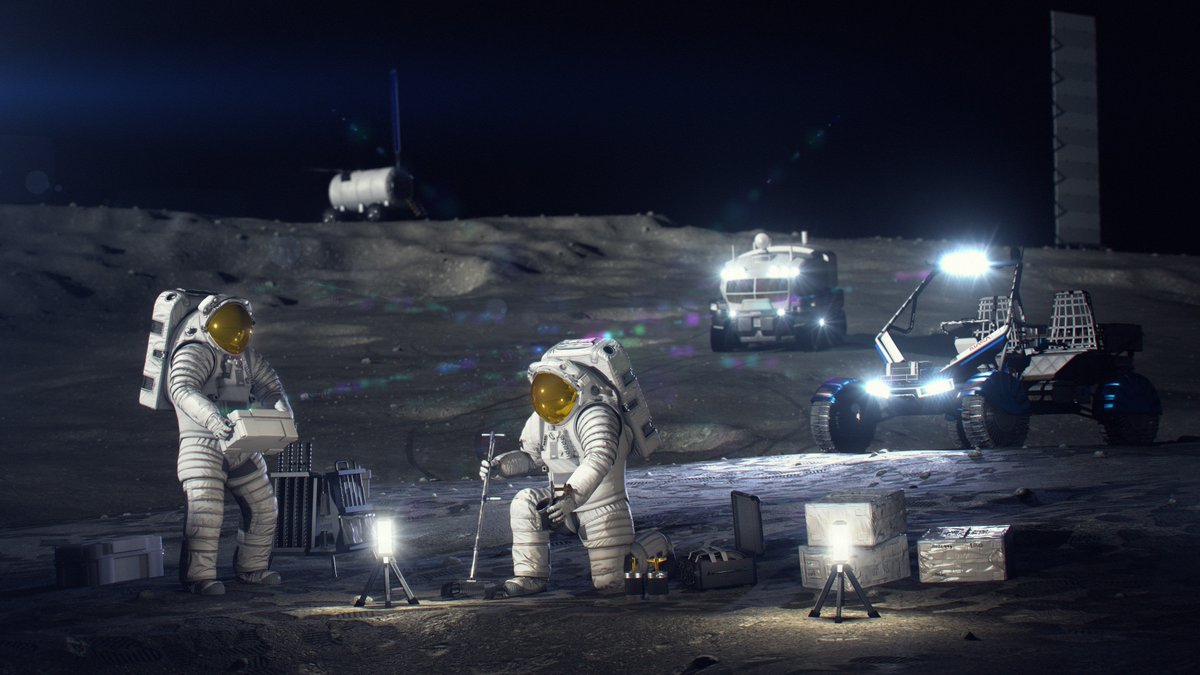
We're building a Moon Base! @NASAMoonBase will serve as a habitat where astronauts live and work during long-term science missions. Join us at 2pm ET on Tuesday, May 26, for a live news event where we’ll share updates on our lunar exploration plans: go.nasa.gov/4uinkLi
NASA tweet media
English
5.3K
12K
82.3K
26.1M
Philip vN retweetledi
kitty mayo
kitty mayo@Kitty_Mayo_·
Two weeks ago, watching Agnessa Pedersen mind control a drone in real time, was one of the most moving moments in my career. Agnessa is a rare and wondrous human working towards a wild future.
English
115
531
3.7K
265.7K
Philip vN retweetledi
David Heaney
David Heaney@Heaney555·
This is incredibly impressive and everyone with a headset should try it. The streaming & rendering side of volumetric video has been solved, something that just a few years ago people suspected wouldn't happen until the 2030s. A "volumetric YouTube" is on the horizon.
UploadVR@UploadVR

Gracia's moving fully volumetric captures can now be streamed, including to mixed reality on Quest 3, with no app or content download required — and an Apple Vision Pro app is coming soon. Details here: uploadvr.com/gracia-moving-…

English
9
15
189
19.3K
Philip vN retweetledi
Rohit
Rohit@ai_rohitt·
INSTEAD OF WATCHING NETFLIX TONIGHT. Spend 1 hour with this. Claude AI FULL COURSE that teaches you how to BUILD and AUTOMATE anything. The people who watch this tonight will wake up tomorrow with a new skill. Watch it and bookmark it now.
English
18
233
963
81.9K
Philip vN retweetledi
Pushmeet Kohli
Pushmeet Kohli@pushmeet·
The results of the research happening in my team @GoogleDeepMind have convinced me that the next era of scientific discovery will be aided by AI agents acting as force multipliers for human ingenuity. That’s why I’m proud to introduce Gemini for Science - a collection of experimental science tools designed to support researchers at every stage of the research process. The tools include: 1️⃣ Literature Insights, built with Google NotebookLM, searches millions of scientific papers to synthesize findings and generate artifacts including data tables, slides, reports, and more. 2️⃣ Hypothesis Generation, built with Co-Scientist, simulates the scientific method via a multi-agent "idea tournament" to generate, debate, and rigorously evaluate research hypotheses. 3️⃣Computational Discovery, built with AlphaEvolve and ERA, is an agentic engine that generates and scores thousands of code variations in parallel, allowing researchers to test modeling approaches in fields like epidemiology in a fraction of the usual time. Read more: blog.google/innovation-and… Register for access here: labs.google/science
English
46
247
1.3K
155.3K
Philip vN retweetledi
Demis Hassabis
Demis Hassabis@demishassabis·
Gemini Omni is a major leap in world understanding & multimodal editing! It can take photos, video & audio and build entirely new scenes. Over time it’ll be able to handle any input & any output - starting w/ video You can even give it your own videos & iterate on your ideas:
English
384
946
9.5K
921.6K
Philip vN retweetledi
Milk Road AI
Milk Road AI@MilkRoadAI·
The man who built the foundation of modern AI just issued a chilling warning about its future. If you aren't losing sleep after this 47 minute lecture, you haven't realized what's coming. Bookmark this now, you need to understand where the world is actually headed.
English
15
47
250
28.9K
Philip vN retweetledi
Alvaro Cintas
Alvaro Cintas@dr_cintas·
Now everyone can make 60-minute films from ONE prompt 🤯 Higgsfield Supercomputer looks insane. A cloud-native AI agent that unifies every model, tool, and creative workflow into one system. > Type one prompt - specify your length and type (cartoon or cinematic) > Supercomputer picks the workflow > It deploys a swarm of agents > Every sub-task routes across the right frontier LLM (Opus 4.7, GPT-5.5 Pro, Gemini 3.1 Pro) and the right video model (Seedance, Veo, Kling) > A finished cartoon or movie lands A full film studio running inside one agent. Wild.
Higgsfield AI 🧩@higgsfield_ai

Higgsfield just released Supercomputer. A cloud-native AI agent that unifies every model, tool, and creative workflow into one system. It can research, write, design, generate video, and ship campaigns end-to-end.

English
46
82
671
201.6K
Philip vN retweetledi
Milk Road AI
Milk Road AI@MilkRoadAI·
This is WILD! MIT just solved one of the hardest unsolved problems in robotics (Save this). For decades, the fundamental problem with soft robots and wearable exoskeletons has not been compute or AI, it has been actuation. The moment you try to give a soft robot meaningful strength, you run into the same wall every engineer has hit since the field began, fluid-driven systems require external pumps, hydraulic reservoirs, and heavy infrastructure that makes the entire thing impractical to wear or embed into fabric. MIT's new Electrofluidic Fiber Muscles solve that problem by eliminating external infrastructure entirely. The key insight is electrohydrodynamic pumping using electric fields to generate pressure directly from electricity, with no moving parts, no motors, and no external fluid reservoir. The fibers are less than 2 millimeters thick, can be woven into fabric like ordinary textile, and operate in complete silence because nothing physically moves inside them, it is just ions propelling fluid through a closed circuit. The performance numbers published in Science Robotics are not conceptual, they are empirical results from actual hardware. These fibers achieve a power density of 50 watts per kilogram, matching skeletal muscle, with a contraction strain of 20% and a response time of 0.3 seconds. A single bundled configuration lifted 4 kilograms, 200 times its own weight while a separate configuration drove a robotic arm through a 40-degree bend compliant enough to safely complete a human handshake. Another configuration launched objects in under 100 milliseconds, which is faster than a human flinch reflex. The design mirrors biological muscle architecture in a way that prior artificial muscle approaches never achieved. The fibers are organized into antagonistic pairs, one contracts while the other extends, exactly like biceps and triceps and because the system runs in a closed loop, the relaxing fiber serves as the fluid reservoir for the contracting one, which is what allows the whole system to operate untethered with no external tank. The applications are not hypothetical but rather are the exact use cases the industry has been waiting years for the hardware to catch up to. Exoskeletons for physical labor, prosthetic limbs that move with the natural compliance of biological tissue, assistive garments for patients with motor disorders, and soft robots capable of safe physical contact with humans are all immediately unlocked by a muscle technology that is silent, lightweight, and weavable into clothing. The deeper significance is what this technology does when it meets the AI robotics wave that is already underway. Every major humanoid robot program, Figure, 1X, Boston Dynamics, Tesla Optimus is currently bottlenecked by the same hardware limitations these fibers address, actuators that are too rigid, too loud, too heavy, or too dependent on infrastructure to operate naturally alongside humans. Electrofluidic fiber muscles do not just solve a materials science problem but rather they remove one of the last physical barriers between robots that live in labs and robots that live in the world.
English
139
1K
5.2K
1.2M
Philip vN retweetledi
Nathie 🔜 AWE
Nathie 🔜 AWE@NathieVR·
This guy created a VR experience that literally lets you tear down reality.
English
103
424
3.6K
214.4K
Philip vN retweetledi
AdiiX
AdiiX@adiix_official·
SOMEONE JUST KILLED THE REAL ESTATE INDUSTRY A guy scanned an entire house with his phone. Uploaded it. Now anyone on Earth can walk through it in a browser tab. No app. No VR. No agent. No appointment. Click → you’re inside. Every room. Every angle. Every shadow. Photoreal. The numbers are insane: - Agent fee on a $500k home: $15,000 - Cost to make this scan: ~$200 - Time to “tour” 50 houses: one evening - File size: smaller than a TikTok The science is wild too: It’s called 3D Gaussian Splatting instead of polygons (how games render), it uses millions of tiny glowing “splats” of color and depth. AI reconstructs reality from your photos. The result loads on a phone and looks like you’re THERE. The grift opportunity is even wilder: Freelancers are already charging $300–$800 per scan for realtors, Airbnbs, venues, car dealers, museums. One person + one phone + one weekend = a business. Open source. Built on PlayCanvas. Free GitHub: github.com/playcanvas
Claude@claudeai

Claude for Excel, PowerPoint, and Word are now generally available, and Claude for Outlook is in public beta. As Claude moves between your Microsoft apps, it carries the full context of your conversation.

English
1.2K
3.1K
36.4K
9.7M