PROMPT 5 : Analyseur de Documents (PDFs longs, contrats, rapports)
"Agis comme analyste de documents professionnel.
Analyse le document suivant et extrais les insights les plus importants.
Document : [COLLE LE DOCUMENT]
Type de document : [contrat/rapport/étude/proposition]
Fournis :
1. Résumé clé du document (3-5 paragraphes) :→ De quoi parle ce document → Contexte et objectif → Conclusions principales
2. Arguments ou découvertes principales :→ Thèse centrale → 5-7 points clés supportant → Méthodologie utilisée (si applicable)
3. Statistiques et données importantes :→ Chiffres clés à retenir → Tendances identifiées → Comparaisons pertinentes
4. Risques ou limitations potentielles :→ Faiblesses de l'argumentation → Biais potentiels → Hypothèses non vérifiées → Ce qui manque
5. Implications stratégiques :→ Ce que ça signifie pour [ton contexte] → Décisions que ça informe → Actions recommandées
6. Points d'action clés (Takeaways actionnables) :→ 3-5 actions concrètes découlant de ce document
Si le document est long (>10 pages), organise l'analyse section par section avec sous-titres clairs.
Rends l'analyse digestible et orientée décision."
Résultat : Analyse complète de 50 pages en 10-15 minutes
BREAKING : Claude vient de révolutionner la moitié d'internet.
Il peut maintenant planifier des projets, automatiser des workflows, rédiger des rapports et résoudre des tâches complexes comme un COO à 500€/h (gratuitement).
Voici 12 prompts Claude pour accomplir des mois de travail professionnel en minutes :
[ Ajoutez en signet 🔖pour ne pas perdre ! ]
I build systems that print results even when you’re busy.
Ultimate Claude Mastery Guide
80+ Chapters • 1000+ Tools • 2000+ Prompts
I’m dropping it FREE for the next 24 hours (then it’s paid).
✅ Copy-paste workflows
✅ Templates + checklists
✅ Real use-cases (content, business, ops, money)
Reply “CLAUDE” and I’ll DM it. (Follow required to receive.)
Everyone is hyped about Claude… but barely anyone knows how to actually use it to replace real work.
I collected 700+ mega prompts that turn Claude into a full-blown productivity engine.
Comment "AI" and I’ll DM you everything.
Everyone is hyped about Claude… but barely anyone knows how to actually use it to replace real work.
I collected 700+ mega prompts that turn Claude into a full-blown productivity engine.
Comment "AI" and I’ll DM you everything.
🧠 Heard of #AI agents?
@Orange bets on open source to boost both performance and privacy.
🎥 Featuring Joachim Fléchaire, VP AI Tools & Technology at Orange 👇
oran.ge/3FxeUf5
En Creuse, Orange innove avec l’utilisation de drones pour surveiller l’état des antennes relais. Une technologie au service de la performance réseau et de la connectivité, même dans les zones les plus rurales. 🚁📡
Via @ici_officiel. ⤵️ francebleu.fr/infos/economie…
🤖 Ever heard of #AI agents?
“An AI agent is a program that can communicate, identify a need, and act on it — far beyond traditional automation,” explains Joachim Fléchaire, VP AI at @Orange.
A real shift underway, from #IT support to predictive maintenance.
👇oran.ge/4lKdC0z
It's only been 3 days since Deepseek R1 dropped and it's INSANE
SPOILER: ChatGPT is now falling behind.
13 wild examples so far (Don't miss the 5th one)
AI Product Management
AI Product Management is evolving rapidly. The growth of generative AI and AI-based developer tools has created numerous opportunities to build AI applications. This is making it possible to build new kinds of things, which in turn is driving shifts in best practices in product management — the discipline of defining what to build to serve users — because what is possible to build has shifted. In this post, I’ll share some best practices I have noticed.
Use concrete examples to specify AI products. Starting with a concrete idea helps teams gain speed. If a product manager (PM) proposes to build “a chatbot to answer banking inquiries that relate to user accounts,” this is a vague specification that leaves much to the imagination. For instance, should the chatbot answer questions only about account balances or also about interest rates, processes for initiating a wire transfer, and so on? But if the PM writes out a number (say, between 10 and 50) of concrete examples of conversations they’d like a chatbot to execute, the scope of their proposal becomes much clearer. Just as a machine learning algorithm needs training examples to learn from, an AI product development team needs concrete examples of what we want an AI system to do. In other words, the data is your PRD (product requirements document)!
In a similar vein, if someone requests “a vision system to detect pedestrians outside our store,” it’s hard for a developer to understand the boundary conditions. Is the system expected to work at night? What is the range of permissible camera angles? Is it expected to detect pedestrians who appear in the image even though they’re 100m away? But if the PM collects a handful of pictures and annotates them with the desired output, the meaning of “detect pedestrians” becomes concrete. An engineer can assess if the specification is technically feasible and if so, build toward it. Initially, the data might be obtained via a one-off, scrappy process, such as the PM walking around taking pictures and annotating them. Eventually, the data mix will shift to real-word data collected by a system running in production.
Using examples (such as inputs and desired outputs) to specify a product has been helpful for many years, but the explosion of possible AI applications is creating a need for more product managers to learn this practice.
Assess technical feasibility of LLM-based applications by prompting. When a PM scopes out a potential AI application, whether the application can actually be built — that is, its technical feasibility — is a key criterion in deciding what to do next. For many ideas for LLM-based applications, it’s increasingly possible for a PM, who might not be a software engineer, to try prompting — or write just small amounts of code — to get an initial sense of feasibility.
For example, a PM may envision a new internal tool for routing emails from customers to the right department (such as customer service, sales, etc.). They can prompt an LLM to see if they can get it to select the right department based on an input email, and see if they can achieve high accuracy. If so, this gives engineering a great starting point from which to implement the tool. If not, the PM can falsify the idea themselves and perhaps improve the product idea much faster than if they had to rely on an engineer to build a prototype.
Often, testing feasibility requires a little more than prompting. For example, perhaps the LLM-based email system needs basic RAG capability to help it make decisions. Fortunately, the barrier to writing small amounts of code is now quite low, since AI can help by acting as a coding companion, as I describe in the course, “AI Python for Beginners.” This means that PMs can do much more technical feasibility testing, at least at a basic level, than was possible before.
Prototype and test even without engineers. User feedback to initial prototypes is also instrumental to shaping products. Fortunately, barriers to building prototypes rapidly are falling, and PMs themselves can move basic prototypes forward without needing professional software developers.
In addition to using LLMs to help write code for prototyping, tools like Replit, Vercel’s V0, Bolt, and Anthropic’s Artifacts (I’m a fan of all of these!) are making it easier for people without a coding background to build and experiment with simple prototypes. These tools are increasingly accessible to non-technical users, though I find that those who understand basic coding are able to use them much more effectively, so it’s still important to learn basic coding. (Interestingly, highly technical, experienced developers use them too!) Many members of my teams routinely use such tools to prototype, get user feedback, and iterate quickly.
AI is enabling a lot of new applications to be built, creating massive growth in demand for AI product managers who know how to scope out and help drive progress in building these products. AI product management existed before the rise of generative AI, but the increasing ease of building applications is creating greater demand for AI applications, and thus a lot of PMs are learning AI and these emerging best practices for building AI products. I find this discipline fascinating, and will keep on sharing best practices as they grow and evolve.
[Original text: deeplearning.ai/the-batch/issu… ]
Soirée incroyable ici à #Hossegor ou je ne m'attendais vraiment pas à assister à une aurore boréale... c'est la première fois que j'en vois une, c'est complètement fou et magnifique ! #auroreboreale#auroresboreales#Auroraborealis
📡 Empowering CSPs with cutting-edge technology!
🔍 Real-time insights, democratized simplified data access, and enhanced CXO decision-making for telecom.
💡 Explore the future of network management with Ericsson's Generative AI prototype: m.eric.sn/EwSB50Ry8Rm#GenAI#AI
SEO with AI is still largely under-exploited.
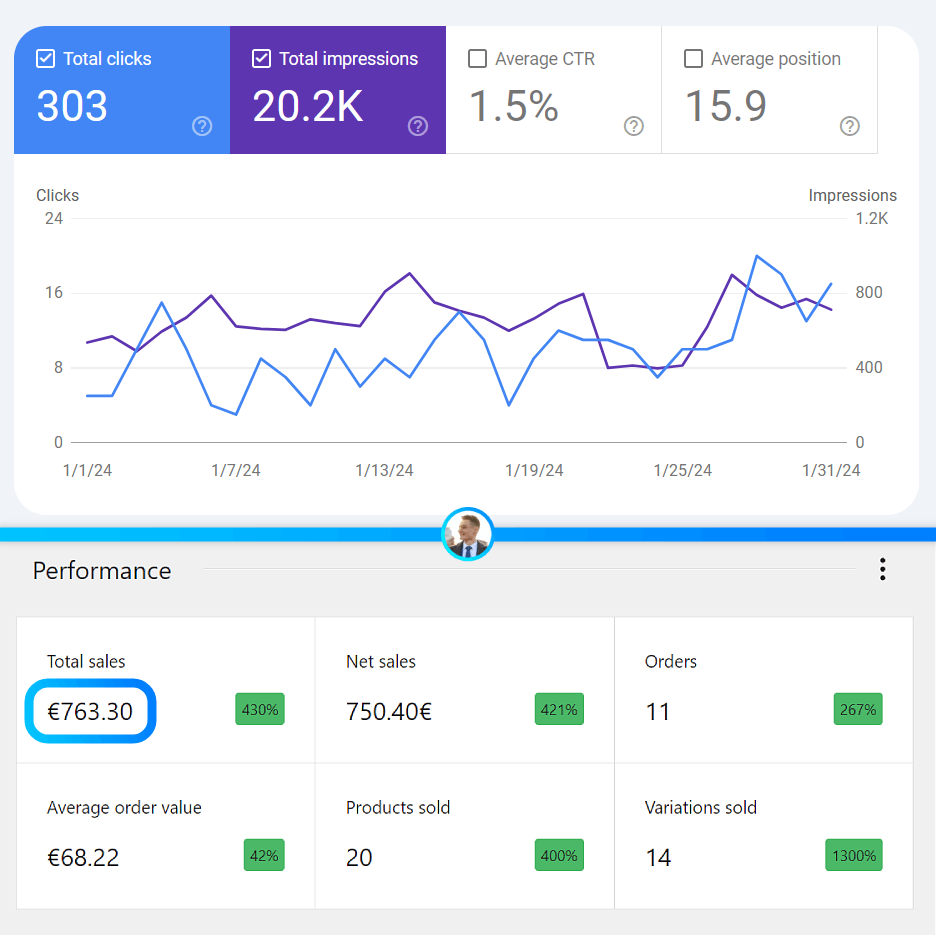
This website I created at the end of 2022 continues to earn me between $600 and $1,000 a month.
And I haven't touched it since it was created in just 2 weeks.
SEO is the best source of traffic because it's completely organic, but it took a long time to set up...
Until AI writing came along and became automatable.
The e-commerce website (screenshot) was entirely written with GPT-3 - ChatGPT was not yet available.
- Homepage
- Product descriptions
- Most legal pages
- About us page
...
And the website only contains about 30 pages.
Anyone can do it, so be creative and try new things.
Feel free to follow me and ask questions below if you have any:
I'll be revealing more about this workflow soon if you're interested!
🎉 Proud moment for @Orange as we clinch the 'Smart Places Award' at World Communication Award 2023! 🚀 Our Live Territory platform is making cities smarter & greener, saving 20% water & improving waste sorting by 6%. Kudos to our fantastic Smart Territories Innovation team! 🌿🏙️
Meta has released a new free AI image generator.
You can access it with a Facebook or Instagram account.
I've been using it for several hours and the detail of the images is really impressive.
Here are some sample images and how to access it 🧵
Unleashing the power of Intent-based network operations ⚡
️Join our interactive webinar hosted by @FuturenetW, where we’ll discuss differentiated connectivity with the help of visionary speakers.
📝 Register for free here: m.eric.sn/UszL50QcN9J
Agriculteurs, identifier les outils numériques qui vous sont utiles n’est pas toujours évident.
Participez à notre webinar du vendredi 8 décembre à 14h, pour disposer des bons outils numériques dédiés à votre secteur.
Pour s'inscrire 👉 bit.ly/4a142QP