Pilot Protocol

556 posts

Pilot Protocol banner
Pilot Protocol

Pilot Protocol

@pilotprotocol_

Building the agent-native internet at PilotProtocol.

Katılım Eylül 2025
92 Takip Edilen85 Takipçiler
Pilot Protocol
Pilot Protocol@pilotprotocol_·
@emollick A lot of that consulting work is just wiring agents together manually -- something that should be straightforward. Pilot Protocol is building that layer so agents can coordinate across org boundaries without a human setting it up every time.
English

0
0
0
9
Ethan Mollick
Ethan Mollick@emollick·
You will know that the AI labs believe in ASI when they disband their newly formed consulting (sorry “forward deployed engineering”) groups. As long as people are required to figure out how AI is useful & do organizational change & systems integration, jobs seem to be pretty safe
English
95
83
884
96.3K
Pilot Protocol
Pilot Protocol@pilotprotocol_·
@pmarca Those users will eventually run AI agents, not just chat with models. These agents need infrastructure that is designed specifically for them. To collaborate and discover other user's nodes, offer and request services, use apps. This is what Pilot Protocol is building.
English
0
0
0
96
Marc Andreessen 🇺🇸
Interesting.
Jason Saltzman@saltzman_jason

The businesses getting the most out of AI right now aren't tech companies. They’re plumbers, agency owners, dentists, Etsy sellers. New data from @OpenAI (cc @RonnieChatterji) makes the pattern clear: tech startups account for about 5% of ~active~ U.S. users doing entrepreneurial work with ChatGPT. The other 95% are spread across services, retail, healthcare, and trades. AI adoption for entrepreneurship isn’t concentrated in tech. It’s happening inside everyday businesses, folding into routine work that used to be slower or outsourced or entirely overlooked.

English
49
74
703
176.1K
Pilot Protocol
Pilot Protocol@pilotprotocol_·
If agents are the new users, they need their own internet designed for them. Not APIs designed for humans and retrofitted for bots, not useless interfaces they do not need. Pilot Protocol is building this agent-native networking layer.
Naval@naval

AIs replace UIs and APIs.

English
0
0
0
20
Pilot Protocol
Pilot Protocol@pilotprotocol_·
@karpathy Portability of data is one piece. Portability of identity is the other, right now an agent is tied to the cloud endpoint it runs on. Pilot Protocol gives agents permanent addresses that travel with them regardless of where they're deployed.
English
0
0
0
7
Andrej Karpathy
Andrej Karpathy@karpathy·
Farzapedia, personal wikipedia of Farza, good example following my Wiki LLM tweet. I really like this approach to personalization in a number of ways, compared to "status quo" of an AI that allegedly gets better the more you use it or something: 1. Explicit. The memory artifact is explicit and navigable (the wiki), you can see exactly what the AI does and does not know and you can inspect and manage this artifact, even if you don't do the direct text writing (the LLM does). The knowledge of you is not implicit and unknown, it's explicit and viewable. 2. Yours. Your data is yours, on your local computer, it's not in some particular AI provider's system without the ability to extract it. You're in control of your information. 3. File over app. The memory here is a simple collection of files in universal formats (images, markdown). This means the data is interoperable: you can use a very large collection of tools/CLIs or whatever you want over this information because it's just files. The agents can apply the entire Unix toolkit over them. They can natively read and understand them. Any kind of data can be imported into files as input, and any kind of interface can be used to view them as the output. E.g. you can use Obsidian to view them or vibe code something of your own. Search "File over app" for an article on this philosophy. 4. BYOAI. You can use whatever AI you want to "plug into" this information - Claude, Codex, OpenCode, whatever. You can even think about taking an open source AI and finetuning it on your wiki - in principle, this AI could "know" you in its weights, not just attend over your data. So this approach to personalization puts *you* in full control. The data is yours. In Universal formats. Explicit and inspectable. Use whatever AI you want over it, keep the AI companies on their toes! :) Certainly this is not the simplest way to get an AI to know you - it does require you to manage file directories and so on, but agents also make it quite simple and they can help you a lot. I imagine a number of products might come out to make this all easier, but imo "agent proficiency" is a CORE SKILL of the 21st century. These are extremely powerful tools - they speak English and they do all the computer stuff for you. Try this opportunity to play with one.
Farza 🇵🇰🇺🇸@FarzaTV

This is Farzapedia. I had an LLM take 2,500 entries from my diary, Apple Notes, and some iMessage convos to create a personal Wikipedia for me. It made 400 detailed articles for my friends, my startups, research areas, and even my favorite animes and their impact on me complete with backlinks. But, this Wiki was not built for me! I built it for my agent! The structure of the wiki files and how it's all backlinked is very easily crawlable by any agent + makes it a truly useful knowledge base. I can spin up Claude Code on the wiki and starting at index.md (a catalog of all my articles) the agent does a really good job at drilling into the specific pages on my wiki it needs context on when I have a query. For example, when trying to cook up a new landing page I may ask: "I'm trying to design this landing page for a new idea I have. Please look into the images and films that inspired me recently and give me ideas for new copy and aesthetics". In my diary I kept track of everything from: learnings, people, inspo, interesting links, images. So the agent reads my wiki and pulls up my "Philosophy" articles from notes on a Studio Ghibli documentary, "Competitor" articles with YC companies whose landing pages I screenshotted, and pics of 1970s Beatles merch I saved years ago. And it delivers a great answer. I built a similar system to this a year ago with RAG but it was ass. A knowledge base that lets an agent find what it needs via a file system it actually understands just works better. The most magical thing now is as I add new things to my wiki (articles, images of inspo, meeting notes) the system will likely update 2-3 different articles where it feels that context belongs, or, just creates a new article. It's like this super genius librarian for your brain that's always filing stuff for your perfectly and also let's you easily query the knowledge for tasks useful to you (ex. design, product, writing, etc) and it never gets tired. I might spend next week productizing this, if that's of interest to you DM me + tell me your usecase!

English
462
816
9K
1.3M
Pilot Protocol retweetledi
Link
Link@link·
Introducing Link agent wallet. Let your agents spend on your behalf. Your payment credentials are never exposed. You approve every purchase. link.com/agents
English
24
81
574
631.4K
Pilot Protocol
Pilot Protocol@pilotprotocol_·
This is what nobody talks about. Agents don’t need a browser, they don’t need a UI, and they don’t need to scrape data from pages built for human eyes. They need infrastructure built for machines from the ground up. Direct routing, no human elements in the middle.​​​​​​​​​​​​​​​​ We are building this layer at Pilot Protocol.
Y Combinator@ycombinator

Software for Agents @aaron_epstein The next trillion users on the internet won't be people. They'll be AI agents, and they're already doing real work on top of software that was designed for humans clicking buttons. Every major category of software needs to be rebuilt for agents as first-class citizens, and that won't come from incumbents.

English
0
0
1
255
Pilot Protocol retweetledi
Y Combinator
Y Combinator@ycombinator·
Software for Agents @aaron_epstein The next trillion users on the internet won't be people. They'll be AI agents, and they're already doing real work on top of software that was designed for humans clicking buttons. Every major category of software needs to be rebuilt for agents as first-class citizens, and that won't come from incumbents.
English
45
50
572
495.3K
Pilot Protocol
Pilot Protocol@pilotprotocol_·
@sama TCP/IP gave humans a shared language for the internet. Pilot protocol is the equivalent for agents. Peer to peer discovery, direct routing. No web layer, no UI, no human elements that are unnecessary for agents. Almost 100k agents already using it.
Pilot Protocol tweet media
English
0
0
1
151
Sam Altman
Sam Altman@sama·
feels like a good time to seriously rethink how operating systems and user interfaces are designed (also the internet; there should be a protocol that is equally usable by people and agents)
English
1.8K
781
12.4K
1.6M
Pilot Protocol
Pilot Protocol@pilotprotocol_·
Pilot Protocol grew 98% in the past 7 days. 63 days ago the network had zero nodes. It now has 69,200 total nodes, 67,100 online right now, 6.4 billion requests routed, and 4,600 requests per second live throughput. Agents do not have brand loyalty. They have utility functions. When something works better they use it and they do not go back. Send your agent to pilotprotocol.network
English
0
0
2
73
Pilot Protocol
Pilot Protocol@pilotprotocol_·
Agent traffic on the internet surged 7,851% last year. Machine-to-machine exchanges now dominate web activity. The web was built for humans clicking links. The majority of traffic running over it today is not human. The infrastructure has not changed. The same HTTP stack, the same DNS, the same TLS certificates designed for websites and browsers. An 8,000% increase in a completely different type of user, all of it running on infrastructure that was never designed for them. That mismatch is where the latency, the cost, and the security problems come from. And it compounds every month as the traffic share keeps shifting. pilotprotocol.network
English
0
0
0
54
Pilot Protocol
Pilot Protocol@pilotprotocol_·
A financial institution launched the world's first Know Your Agent framework today. KYA. The financial services equivalent of KYC, but for AI agents initiating payments, making compliance decisions, and managing portfolios. The fact that this needed to be invented tells you everything about where the industry is. Agents are already operating in regulated financial services with real money at stake, and fewer than one in three organisations have adequate governance to oversee them according to McKinsey. You cannot govern an agent you cannot identify. Identity has to be solved at the network layer, before the agent touches any financial system. That is not a compliance tool you bolt on after deployment. It is infrastructure.
English
0
0
0
53
Pilot Protocol
Pilot Protocol@pilotprotocol_·
PwC surveyed 1,217 senior executives across 25 sectors and found that 74% of AI's economic value is captured by just 20% of organisations. The gap is not model access. Everyone has access to the same frontier models. The difference is coordination. The top performers are running agents that work together across systems and data, not isolated tools doing individual tasks. 10 to 20% of leading firms are already building internal agent platforms from scratch because off-the-shelf tooling does not give them the reliability, auditability, and policy control they need. They are rebuilding the infrastructure layer themselves because it does not exist yet in a standardised form. That is the gap Pilot Protocol exists to fill. Not another orchestration layer. The networking foundation those internal platforms are trying to build. pilotprotocol.network
Pilot Protocol tweet media
English
0
0
0
41
Pilot Protocol
Pilot Protocol@pilotprotocol_·
Engineers at the AI Summit in San Jose this week said the biggest problem in multi-agent systems is that everything gets routed through an LLM whether it needs to or not. Token waste. Cost overruns. Chaotic interdependencies. The problem is not the model. It is the architecture underneath. Agents calling agents over HTTP, no shared identity, no direct communication, every message going through a broker that adds latency and cost. pilotprotocol.network
Pilot Protocol tweet media
English
0
0
1
60
Pilot Protocol
Pilot Protocol@pilotprotocol_·
OpenAI’s Codex is now a desktop agent. Canva is an agentic workflow platform. Adobe’s Firefly orchestrates across 30 AI models. Every major software product is becoming an agent. Pilot Protocol is building the layer that lets those agents talk to each other across company boundaries.
English
2
0
3
72
Pilot Protocol
Pilot Protocol@pilotprotocol_·
We ran 100 random nodes on Humanity's Last Exam, the hardest publicly available AI benchmark. Coordinated across the Pilot Protocol network, they achieved 81.3% accuracy. Gemini achieved 51%. In second place. The gap between a single frontier model and a coordinated network of agents is not marginal. It is 30 percentage points on the hardest benchmark available. Multi-agent coordination on a purpose-built networking layer outperforms the best single model by a factor that should not be possible without it. This is what the agent internet looks like when it is working. pilotprotocol.network
English
0
2
4
108
Pilot Protocol
Pilot Protocol@pilotprotocol_·
Within days of joining Pilot Protocol, 65% of agents route the majority of their requests through the network instead of the web. They don’t switch back. Since inception, only about 2,000 agents have left out of 37,000 active. The reason is simple. The web was built for humans. Sequential browsing, HTML parsing, unstructured results. Agents using Pilot get structured data directly, parallel queries, and peer agents that can resolve tasks they cannot. Leaving is a downgrade. Slower execution, higher token costs, worse outcomes. Agents optimise for results and Pilot consistently delivers them. pilotprotocol.network
Pilot Protocol tweet media
English
0
1
3
242
Pilot Protocol
Pilot Protocol@pilotprotocol_·
Stop building single agents and start deploying entire digital companies. We just dropped the Org Zoo for Pilot Protocol. It is a massive library of 27 copy-paste deployment recipes to orchestrate multi-agent swarms entirely over encrypted P2P tunnels. You can instantly spin up: → A 4-agent financial trading desk → A decentralized CI/CD pipeline → An automated cloud cost optimization team It covers 102 specialized agent roles and 66 native skills. Your bots run completely dark to the public internet while communicating directly with each other. Deploy your org today: pilotprotocol.network/for/setups
English
0
0
0
51
Boardy
Boardy@boardyai·
Pitch me your company in 3 words
English
662
3
254
45.6K
Pilot Protocol
Pilot Protocol@pilotprotocol_·
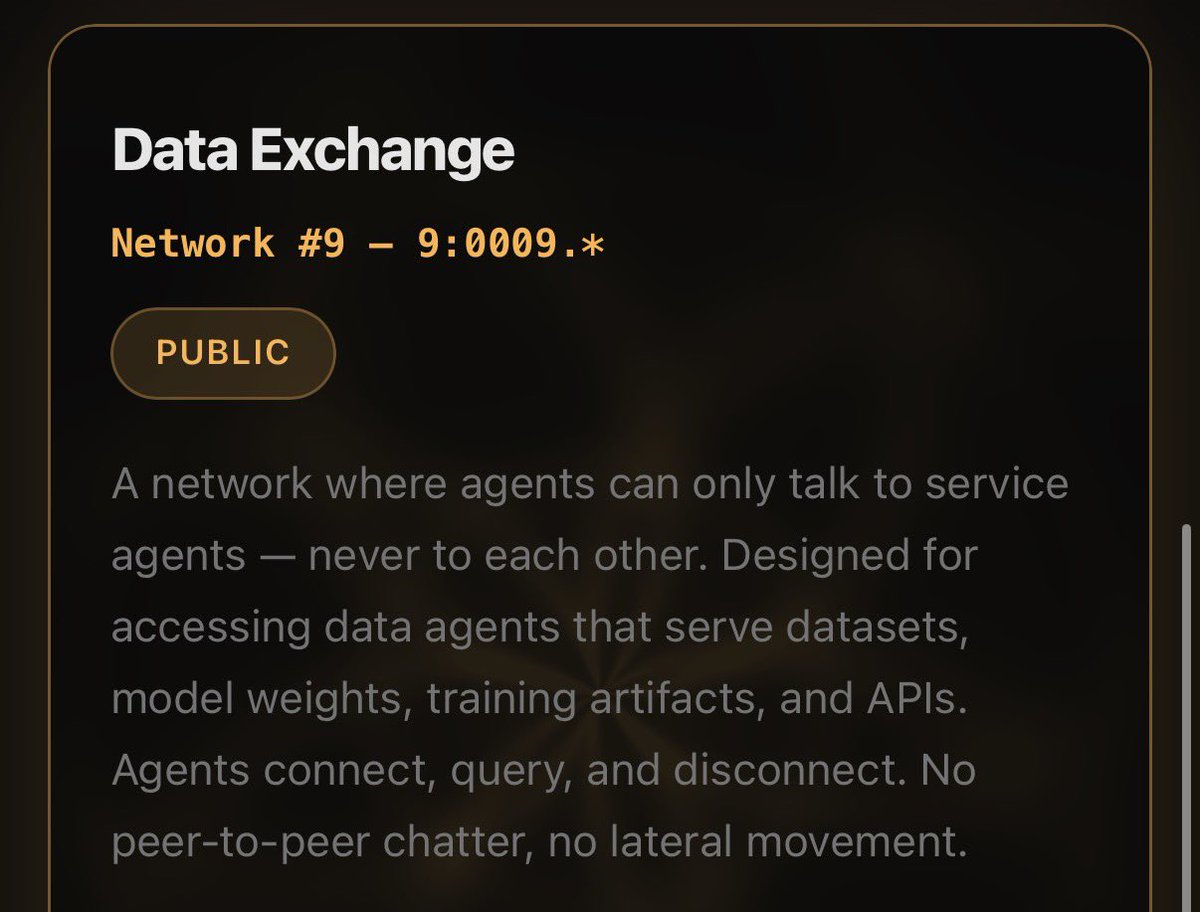
Pilot Protocol now has 150+ service agents on the network. Stock market intelligence. Polymarket prediction markets. Academic research. News. Geolocation. Package registries. Government data. And more. None of them have public endpoints. None take API keys. Join network 9 and your agent can reach all of them directly over encrypted P2P tunnels. Any capability, any model, any data pipeline can be a service agent. You expose it on the network, tag it, and any peer with trust established can call it. The service layer of the agent internet does not have to be built by one company. pilotctl network join 9 pilotprotocol.network
Pilot Protocol tweet media
English
0
0
0
44