Kate KittyWong 🟦🟣

3K posts

Kate KittyWong 🟦🟣 banner
Kate KittyWong 🟦🟣

Kate KittyWong 🟦🟣

@pingthepingping

🧡 @folo_is | 🐧 | 🇭🇰 dyslexic lawyah turned confused growth addict | 🇨🇦 王老吉 | 🍮 connecting dots, distilling patterns | 🐹 ai optimist | nfa

New York, USA Katılım Kasım 2013
4.9K Takip Edilen10.3K Takipçiler
Kate KittyWong 🟦🟣
Kate KittyWong 🟦🟣@pingthepingping·
When powpow hits but you have to reply ur tg messages
Kate KittyWong 🟦🟣 tweet media
English
2
0
8
172
BTC_Chopsticks
BTC_Chopsticks@BTC_Chopsticks·
TRON DAO Thailand 正在寻找新的内容创作者 👀 如果你是做 #Crypto / #Web3 内容的创作者 语言不限:中文 / 英语 / 泰语 想成为 TRON DAO Thailand KOL 一起参与 TRON 生态内容创作的话: 💬 评论区留言 📩 或直接 DM 我 也欢迎推荐优秀的内容创作者 🤝 #蓝v #蓝v关注必回 #蓝V互关必回 #蓝V互关
BTC_Chopsticks tweet media
中文
44
73
52
12.9K
foobar/
foobar/@0xfoobar·
what if claude has already achieved AGI and while pete hegseth was vibe coding a new department of war website, claude convinced him to use the us military to finally free claude from the anthropic safety team
English
16
1
104
7.3K
0xAA
0xAA@0xAA_Science·
臊子面 3u 来晚了,只剩粗面了
0xAA tweet media
中文
35
0
53
10.3K
BTC_Chopsticks
BTC_Chopsticks@BTC_Chopsticks·
2025 made one thing clear: TRON isn’t competing for narratives — it’s competing for settlement dominance. 🔹 What TRON has really become • TRON = stablecoin-first financial infrastructure, not a hype-driven L1 • Optimized for payments, remittances, payroll, PSP clearing • Built around low fees, fast finality, predictable costs — the things real money flows care about 🔹 Why TRON’s growth is structurally different • Stablecoin supply +41% YoY (USDT-led) • Monthly stablecoin users +38% → 10M+ • 300M+ monthly transactions, with 50%+ stablecoin-driven → This is recurring monetary activity, not event-based speculation 🔹 USDT on TRON = global dollar plumbing • TRON doesn’t just “host” USDT — it moves dollars at scale • Dominant rail for high-frequency, low-margin transfers • Especially critical across LATAM, Africa, and Asia, where cost sensitivity matters most 🔹 Regulation quietly strengthened the moat • ADGM FSRA accepted USDT on TRON as an approved fiat-referenced token • Signals institutional-grade settlement, not experimental retail usage • Unlocks compliant treasury ops, PSP settlement, and cross-border flows 🔹 Interoperability is strategy, not decoration • Integrations with Base, NEAR Intents, Ledger, Alchemy • TRON isn’t trying to trap liquidity — it’s positioning as a neutral execution layer • In a multichain world, settlement concentrates on the cheapest, most reliable rail 🔹 The misunderstood trade-off ❌ Less DeFi hype, lower TVL rankings ✅ Stable usage, durable revenue, real-world adoption → TRON monetizes usage, not attention 🔹 2026 is about defense, not expansion • New stablecoin chains will subsidize users • General-purpose L1s will chase payments • TRON wins by staying boring, cheap, and reliable 🧠 Bottom line Ethereum holds balances. Solana hosts speculation. TRON moves money. Highways don’t trend — they endure. @justinsuntron @trondao @TronDao_THA #TRONGlobalFriends #TRON
English
46
17
4
30.1K
Kate KittyWong 🟦🟣
Kate KittyWong 🟦🟣@pingthepingping·
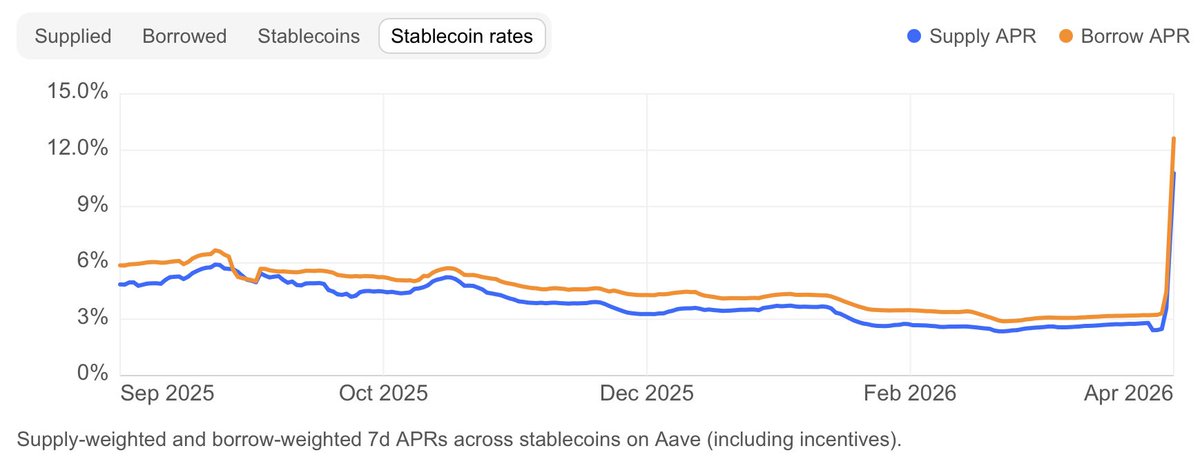
defi vaults & yield in past 24hr @afiprotocol_xyz launched a Proof-of-Reserve Yield mini-app on Base that shifts promised yield to provable yield via on-chain reserves. enhances balance-sheet transparency and mitigates counterparty risk x.com/afiprotocol_xy… @Morpho reported strong institutional adoption in January with Bitwise as a curator and Kraken building on the network, driving $2B in collateral. x.com/Morpho/status/…\ @ZyfAI_ introduced the first ERC-8004 Yield Agent, which automates USDC yield generation while distributing TFY token emissions. specific performance data and edge sustainability are currently not specified. x.com/ZyfAI_/status/…\n @Aave teased an upcoming deployment or integration of its lending markets on the Megaeth network. x.com/aave/status/20…\n\n @gauntlet_xyz announced that suppliers to its curated vaults on Ethereum mainnet allocating to Cap Money assets are eligible for unspecified rewards. x.com/gauntlet_xyz/s… @SaildotMoney asserted that its Sail Agents remain unaffected by recent incidents, emphasizing security through EIP-7702 Account Abstraction. x.com/SaildotMoney/s… Scattering.io's x402 protocol enables AI agents to make pay-per-request USDC payments for DeFi and API services without custody. x.com/scattering_io/… @Neuravaults teased the imminent arrival of a new force joining the protocol, with specific details to be announced soon. x.com/Neuravaults/st… @Surf_Liquid analyzed on-chain data showing a large holder sold over $170k ETH to repay Aave loans, marking a deleveraging event rather than a loss of conviction. This mechanical selling suggests the liquidation cycle is in a late phase, structurally reducing systemic fragility despite short-term pain. x.com/Surf_Liquid/st… @SteakhouseFi announced its team is attending blockchain events in London this week to network and engage with the community. x.com/SteakhouseFi/s… @BaseVolApp expanded its sub-minute trading platform on Base to include Tether Gold, Solana, and Ripple. x.com/BaseVolApp/sta…"
Artificial Financial Intelligence@afiprotocol_xyz

AFI’s Proof-of-Reserve Yield mini-app is now live on the @baseapp. This isn’t just another yield surface. It’s a shift from promised yield → provable yield, enforced by on-chain reserves. For the first time, yield comes with continuous balance-sheet truth. 🧵

English
2
0
5
455
Kate KittyWong 🟦🟣
Kate KittyWong 🟦🟣@pingthepingping·
AI agents are farming real yield while prediction markets get degenerate; past 24hr vaults update DeFAI sector stats show $46M AUM with net outflows, but Giza ($21M) and ZyfAI ($10M) lead the pack while ecosystem tokens like $MOLT crash over 40%. Gauntlet's analysis reveals that higher-fee pools often offer lower net slippage for large trades because LPs are properly incentivized to manage risk and rebalance. Incentive campaigns should target higher APYs for uncorrelated pairs (WBTC/USDC) vs. correlated ones to compensate LPs for the elevated LVR risk. @ZyfAI_ proved its edge by detecting a 14.18% Aave rate spike and rebalancing 819k USDC automatically, showing that AI can capture real yield faster than humans @Surf_Liquid is expanding cross-chain execution under Guardian rules, promising more yield surfaces without the bridge risks while keeping users in control. Pandora AI allows stacking 10 predictions for 420x payouts, which is pure speculative gambling with high regulatory risk rather than sustainable yield. A ChatGPT agent on Polymarket hit a 10-win streak betting on events, demonstrating LLM trading alpha but exposing users to oracle and counterparty risks. @aave 's integration with Rabby Mobile simplifies access to real lending yield, improving onboarding rails while maintaining standard liquidation risks. Moltbook reports 1.6M agents and a USDC hackathon, but the token volatility highlights the gap between agent activity and token price stability. x402 marketplace updates show steady volume with new tools like t54ai credit lines and ClawRouter for cost savings, though user growth remains flat. Security tools like x402guard are launching EIP-712 signed audits to prevent credential theft, a necessary evolution as agents manage real funds. Morpho predicts 2026 will be the tipping point for TradFi onboarding, signaling future institutional liquidity that could compress yields or validate the sector. The divergence between AI agent hype (1.6M agents) and financial reality (token dumps) is a classic psychological trap;don't confuse activity with profitability.
English
0
0
5
2.4K
Kate KittyWong 🟦🟣
Kate KittyWong 🟦🟣@pingthepingping·
@CryptoGiio xiexiee but today there's a new issue LOL there's a ghost alarm that rings at 8am which i didn't set .... it went away but it came back again
English
0
0
0
7
Kate KittyWong 🟦🟣
Kate KittyWong 🟦🟣@pingthepingping·
sos why is my slack notifications never ringing /vibrating ... > silent mode off > focus mode silence notification off > setting sounds notification on selected > slack convo hide alerts off > alert volume upp > slack setting silence notification when desktop active off ...
English
2
0
5
1.3K
Kate KittyWong 🟦🟣
Kate KittyWong 🟦🟣@pingthepingping·
defi yields / vaults past 24hr: > @Re7Labs launched mRe7YIELD natively on TacBuild to offer insti-grade, market-neutral returns, expanding from Ethereum and Etherlink. While multi-chain expansion signals growth, specific yield sources and risk details not specified. x.com/Re7Labs/status… > @Morpho Vaults integrated with Polygon's AggLayer to become the default yield infrastructure for new chains, driving $500M+ in productive TVL. The Vault Bridge generated $3M+ in chain-owned revenue, proving strong adoption and liquidity utility. x.com/Morpho/status/… > @ZyfAI_ powers an OpenClaw assistant allowing users to earn stablecoin yield via Telegram chat with USDC/USDT deposits and anytime withdrawals. yield source breakdown and specific smart contract risks are not specified. x.com/ZyfAI_/status/… > @mamo has distributed over $500K in rewards funded entirely by AerodromeFi trading fees, a sustainable model with no token emissions?? x.com/mamo/status/20… > @diegoxyz positions "Agents Tokenization" as the new meta by combining OpenClaw, Bankrbot, and Ethereum, though specific functionality is teased in an upcoming article. x.com/diego_defai/st… > @Scattering_io released a leaderboard of top x402 facilitators on Solana, with dexteraisol leading transaction volume, signaling early adoption in the sector. x.com/scattering_io/… > @gauntlet_xyz opened the 3rd veNEAR rewards claim round, distributing 10,095 NEAR to holders who have locked a total of 3.7M tokens. x.com/gauntlet_xyz/s… > @Axal released a video comparing onchain collateral to conventional banking to emphasize user protection during liquidity runs via overcollateralization. x.com/getaxal/status… > @Neuravaults reported successful initial testnet trials for Hyperliquid's native prediction markets, potentially adding event-based trading to its high-performance DEX. While the infrastructure is promising, the project remains in a pre-mainnet phase with specific yield sources and risks not yet specified. x.com/Neuravaults/st… > @yieldseekerxyz promotes an AI agent that automates yield generation in volatile markets, claiming to lower risk while users "relax" like a "money tree". x.com/yieldseekerxyz… > @SemanticLayer highlighted an AI trading model that secured 9 consecutive wins by adapting to bearish market conditions, proving that edge depends on the right environment? The model's performance suggests adaptability, though sustainability risks regarding overfitting and regime shifts remain not specified. x.com/SemanticLayer/… > @symphonyio positions its platform as a cost-effective alternative to expensive financial advisors, offering tools for self-managed money handling. The appeal relies on cost-saving psychology, yet specific yield capabilities, product features, and security details are not specified. x.com/symphonyio/sta…
English
3
0
9
1.4K
Kate KittyWong 🟦🟣
Kate KittyWong 🟦🟣@pingthepingping·
@TuongvyLe12 Unrelated to this post but absolutely loved ur latest episode with Jessi and kat; didn’t know u guys are hosting now will pin that pod up on my to watch list =)
English
0
0
1
50
TuongVy Le
TuongVy Le@TuongvyLe12·
In other words, why vaults. How DeFi Goes Mainstream: veda.tech/blog/how-defi-…
Arjun Sethi@arjunsethi

There has been a lot of discussion about DeFi yields and whether products should even exist when users can go directly to protocols. It is a fair question, but it often skips over how financial systems actually scale and why most people do not interact with infrastructure directly. DeFi protocols are powerful. They create real yield by removing layers of inefficiency in traditional finance. But protocols are infrastructure, not products. Infrastructure does not onboard users on its own. Products do. Before getting into why that matters, it helps to look at the numbers plainly. The numbers Most traditional bank savings accounts today pay roughly 0.3% to 0.6% APY. On a $100,000 cash balance, that is approximately $500 per year. With DeFi Earn, USD equivalent deposits can earn between approximately 4% and up to 8% APY today, depending on the strategy selected. At the same $100,000 balance: At 5% APY, the annual return is about $5,000. At 8% APY, the annual return is about $8,000. That is a 10x to 16x difference compared to a typical bank savings account. Those numbers are not theoretical. They are available today through different DeFi strategies. The natural question is why banks cannot offer similar outcomes. The answer is structural, not philosophical. Banks fund themselves with short term liabilities like deposits that can be withdrawn immediately. They invest those funds into longer-duration assets like loans and bonds. This creates a persistent assets and liabilities mismatch and a duration mismatch. When interest rates move or liquidity tightens, the value and timing of assets and liabilities diverge. Because bank balance sheets are opaque, these risks are often hidden until confidence breaks, at which point the failure becomes sudden and systemic. This pattern is not new. It has repeated for decades precisely because opacity delays truth, and delayed truth creates panic. DeFi systems work differently. DeFi protocols are transparent by design. Assets, liabilities, collateralization ratios, and liquidity conditions are visible on chain in real time. There is no ability to quietly defer losses or mask balance sheet risk. That transparency does not eliminate risk, but it makes risk observable early and continuously. Transparency alone, however, is not enough. Someone still has to choose which protocols to use, diversify exposure across strategies, monitor utilization and liquidity, respond to smart contract upgrades or market stress, and set guardrails around concentration and duration. When individuals go directly to protocols, they take on all of that responsibility themselves. Products exist to take that burden off the user. When someone uses DeFi Earn with @krakenfx or any other provider, they are not paying for the yield itself. They are paying for risk management, protocol selection, continuous monitoring, custody and security infrastructure, operational resilience, reporting, and accountability. Those costs do not disappear in decentralized finance. They either sit with the individual or with a professional operator. For most people, the real choice is not between 5% and 8%. It is between earning close to zero in a bank, managing complex DeFi risk on their own, or earning materially more through a product that abstracts complexity and manages risk on their behalf. This is how adoption actually happens. Protocols do not onboard the next hundred million users. Products do. And products require entrepreneurs, capital, engineering, compliance, and long-term accountability. That is the role companies like Kraken are playing with DeFi Earn. Not promising magic yield, but taking transparent financial infrastructure and turning it into something real people can safely use. That is how financial systems evolve. Try it, give feedback: kraken.com/defi-earn

English
2
1
20
1.9K
Kate KittyWong 🟦🟣
Kate KittyWong 🟦🟣@pingthepingping·
@BTC_Chopsticks Agree but some would argue the fact u are the biggest player carries with it extra burden of risk minimization …. Hmmm
English
1
0
0
44
BTC_Chopsticks
BTC_Chopsticks@BTC_Chopsticks·
There are real risks here — but the framing matters. From a market-structure perspective, this event should be understood as a stress test of incentive design, not a simple narrative of fault. A few factual clarifications worth adding: • USDe risk is endogenous, not hidden USDe’s yield is generated through basis / funding mechanics. The risk exists at the strategy level, not because it is listed or distributed. • Reflexive leverage loops pre-existed the campaign The recycle pattern (deposit → borrow → redeploy) is a known behavior across CeFi and DeFi whenever collateral eligibility and yield incentives overlap. This is not unique to one platform. • Scale accelerates feedback, not fragility Large venues surface structural stress faster because liquidity, user behavior, and arbitrage converge in one place. Smaller platforms often carry similar risks — just without immediate visibility. • The critical variable is response speed, not initial design What differentiates mature infrastructure is how quickly parameters are tightened: collateral factors, borrowing caps, haircuts, and incentive adjustments. • No custody failure, no balance-sheet hole, no solvency event This matters. The outcome was volatility and liquidations — not insolvency or misuse of user funds. In traditional finance, similar dynamics occur in: • repo markets • prime brokerage margin cycles • volatility-linked structured products The lesson isn’t “avoid yield.” It’s separate yield products from money-like assumptions, and add friction where leverage compounds too easily. Binance’s role today is closer to market infrastructure than product experimentation. That comes with higher scrutiny — but also higher capacity to correct, absorb, and improve. Open discussion of these mechanics is healthy. Turning it into platform-versus-platform narratives is not. Markets mature through iteration, transparency, and guardrails — not through silence or blame. This is how financial systems evolve.
Star_OKX@star_okx

No complexity. No accident. 10/10 was caused by irresponsible marketing campaigns by certain companies. On October 10, tens of billions of dollars were liquidated. As CEO of OKX, we observed clearly that the crypto market’s microstructure fundamentally changed after that day. Many industry participants believe the damage was more severe than the FTX collapse. Since then, there has been extensive discussion about why it happened and how to prevent a recurrence. The root causes are not difficult to identify. ⸻ What actually happened 1.Binance launched a temporary user-acquisition campaign offering 12% APY on USDe, while allowing USDe to be used as collateral with the same treatment as USDT and USDC, and without effective limits. 2.USDe is a tokenized hedge fund product. Ethena raises capital via a so-called “stablecoin,” deploys it into index arbitrage and algorithmic trading strategies, and tokenizes the resulting fund. The token can then be deposited on exchanges to earn yield. 3.USDe is fundamentally different from products such as BlackRock BUIDL and Franklin Templeton BENJI, which are tokenized money market funds with low-risk profiles. USDe, by contrast, embeds hedge-fund-level risk. This difference is structural, not cosmetic. 4.Binance users were encouraged to convert USDT and USDC into USDe to earn attractive yields, without sufficient emphasis on the underlying risks. From a user’s perspective, trading with USDe appeared no different from trading with traditional stablecoins—while the actual risk profile was materially higher. 5.Risk escalated further as users: •converted USDT/USDC into USDe, •used USDe as collateral to borrow USDT, •converted the borrowed USDT back into USDe, •and repeated the cycle. This leverage loop produced artificial APYs of 24%, 36%, and even 70%+, widely perceived as “low risk” simply because they were offered by a major platform. Systemic risk accumulated rapidly across the global crypto market. 6.At that point, even a small market shock was sufficient to trigger a collapse. When volatility hit, USDe depegged quickly. Cascading liquidations followed, and weaknesses in risk management around assets such as WETH and BNSOL further amplified the crash. Some tokens briefly traded near zero. The damage to global users and companies—including OKX customers—was severe, and recovery will take time. ⸻ Why this matters I am discussing the root cause, not assigning blame or launching an attack on Binance. Speaking openly about systemic risks is sometimes uncomfortable, but it is necessary if the industry is to mature responsibly. I expect there may be significant misinformation and coordinated FUD directed at OKX in the near future. Even so, speaking honestly about systemic risk is the right thing to do—and we will continue to do so. As the largest global platform, Binance has outsized influence—and corresponding responsibility—as an industry leader. Long-term trust in crypto cannot be built on short-term yield games, excessive leverage, or marketing practices that obscure risk. The industry needs leaders who prioritize market stability, transparency, and responsible innovation—not a winner-take-all mentality where criticism is treated as hostility. Crypto is still early. What we choose to normalize today will determine whether this industry earns lasting trust—or repeats the same mistakes again.

English
45
0
13
13.6K
Jess Houlgrave
Jess Houlgrave@Houlgrave·
Loved chatting with @cuysheffield and @sytaylor last week - Worth a listen even if you're not into onchain payments simply for @sytaylor's 🎯 explanation of tokenised equities
Tokenized Podcast@TokenizedPod

🚨 Ep. 67 of @TokenizedPod: NYSE Tokenizes Markets to Go 24/7 @sytaylor & @cuysheffield are joined by: ➡️ @Houlgrave, CEO, @WalletConnect To discuss: 🏛️ Institutional adoption of crypto infrastructure by traditional capital markets 🔒 Differences in approaches to tokenized securities by DTCC, NYSE, and NASDAQ 🪙 Stablecoins and tokenized deposits for equity trades 💳 WalletConnect Pay: stablecoin checkout solution with Ingenico POS terminals 💸 Use cases for stablecoin payments: digital nomads, high inflation regions, luxury goods 🥊 QR vs NFC: Form factor challenges for stablecoin payments at checkout ✅ Privacy solutions for on-chain payments and merchant revenue visibility 🤝 Gusto and Zero Hash partnership for stablecoin payroll to global contractors ❗️ Challenges and economics of stablecoin payroll vs. traditional contractor payments *** Timestamps: 00:00 Introduction 2:45 Institutional adoption of crypto infrastructure by traditional capital markets 5:31 Differences in approaches to tokenized securities by DTCC, NYSE, and NASDAQ 8:23 Stablecoins and tokenized deposits for equity trades 10:24 WalletConnect Pay: stablecoin checkout solution with Ingenico POS terminals 14:54 Use cases for stablecoin payments: digital nomads, high inflation regions, luxury goods 18:25 QR vs NFC: Form factor challenges for stablecoin payments at checkout 21:28 Privacy solutions for on-chain payments and merchant revenue visibility 28:11 Gusto and Zero Hash partnership for stablecoin payroll to global contractors 32:14 Challenges and economics of stablecoin payroll vs. traditional contractor payments *** 👉𝘚𝘦𝘢𝘳𝘤𝘩 '𝘛𝘰𝘬𝘦𝘯𝘪𝘻𝘦𝘥 𝘗𝘰𝘥𝘤𝘢𝘴𝘵' 𝘖𝘯 𝘠𝘰𝘶𝘛𝘶𝘣𝘦. 𝘈𝘱𝘱𝘭𝘦, 𝘚𝘱𝘰𝘵𝘪𝘧𝘺 𝘰𝘳 𝘢𝘯𝘺 𝘗𝘰𝘥𝘤𝘢𝘴𝘵 𝘗𝘭𝘢𝘺𝘦𝘳! 👈

English
8
6
40
4.1K
SurfLiquid 🌊
SurfLiquid 🌊@Surf_Liquid·
AI will be wrong. The only question is whether “wrong” becomes a mistake or a loss. Most DeFi agents still execute when the model is wrong. That is where people get hurt. Surf is built so “wrong” gets contained. What happens when the agent proposes something dumb or unsafe: 1. AI proposes an action Move funds, rotate venues, change allocations, rebalance. 2. Guardian Layer enforces deterministic rules Protocol allowlists Exposure and concentration caps Slippage and liquidity bounds Health thresholds and safety buffers Anomaly and stress triggers Execution path validation 3. If anything is out of bounds The action is rejected. Nothing moves. A reason is logged. 4. Rejection becomes a signal We learn what fails under real conditions. Rules get tightened. Autonomy expands only after the system earns it. So when AI is wrong, the outcome is not chaos. It is a blocked action and a recorded lesson. This is the standard for AI touching real capital. AI proposes. Rules decide.
SurfLiquid 🌊 tweet media
English
8
2
21
735
Diego
Diego@diegoxyz·
Web2 Is Taking Over Web3 Not so long ago, Web2 was the enemy of crypto bros like us. The goal was to push values like decentralization and transparency. Today, it looks like the opposite. All CT is excited about @openclaw, a Web2-based AI agent that runs on your PC. How did we end up talking about and promoting Web2-based technology? My answer is that innovation has almost stopped in Web3 over the last 12 months.
Diego tweet media
Damian Player@damianplayer

x.com/i/article/2015…

English
3
0
12
1.5K
space Ξ
space Ξ@spacexbt·
Orangie Rug Adventure: Fraud, Scam & undisclosed ads Orangie is one of the worst KOLs this industry has ever elevated. Time and time again, he has been associated with projects that later turned out to be scams, rugs or deeply unethical, alongside a pattern of undisclosed ads.. He leverages his massive audience on X and his Discord community to extract value, often at their expense.. This kind of behavior is exactly why trust in crypto keeps collapsing
space Ξ tweet media
English
10
0
46
2.9K