@maravalea Im not sure why youre concerned with what some idiots think about your scar. Your scar is bad ass, and anyone that says otherwise is an idiot and doesn't deserve your time or attention. If this is because people judge you, let them. Just Be! You Are Enough.
WHEN GREENLAND WAS DISCOVERED BY THE VIKINGS IT WAS GREEN
THEY USED TO FARM THERE
HOW DID THE CLIMATE CHANGE SO MUCH THERE BEFORE THE INVENTION OF SUV’S?
x.com/i/broadcasts/1…
The Night Everything Split
The call came without warning.
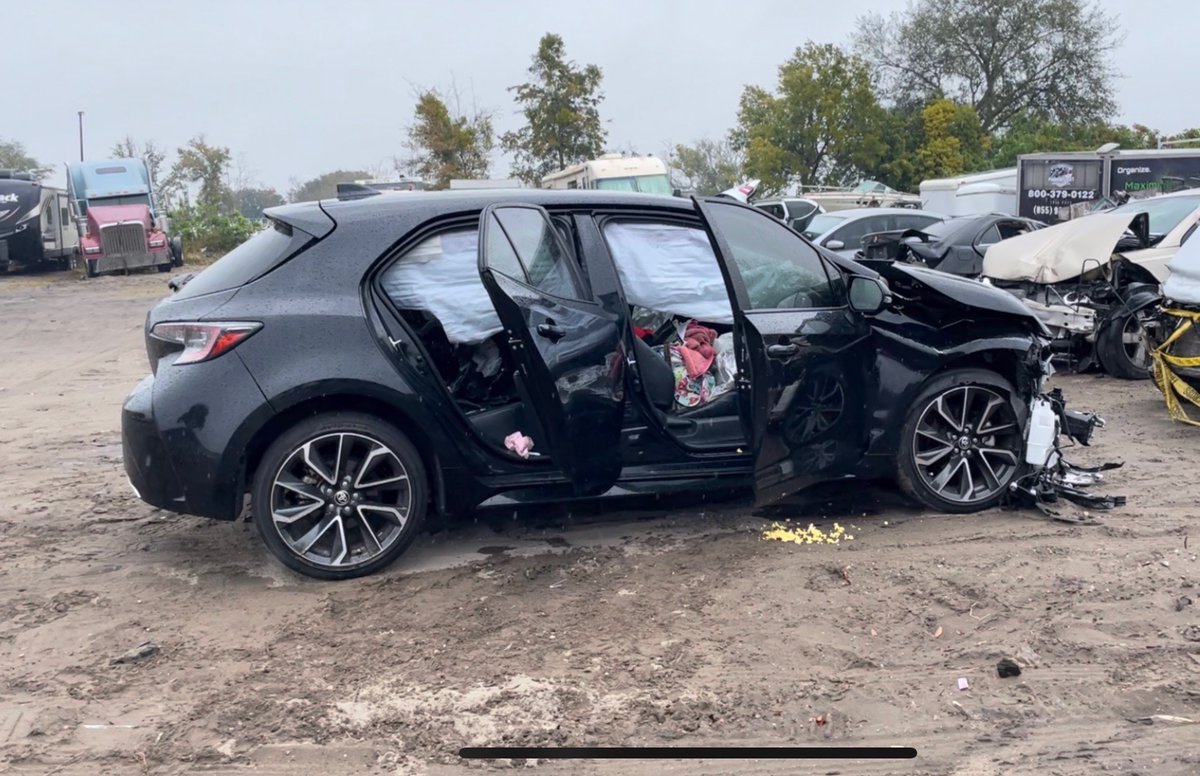
A calm, automated, computer voice. It told me my Toyota had been in a devastating accident.
For a moment, nothing else mattered, not the word devastating, not the location, not the questions that followed. Only the impossible fact: my wife, Olivia, had been driving. And Aubrey was with her.
The twins were home with me. Four years old, pajamas on, bedtime close. Life was normal, five seconds earlier.
I opened Find My iPhone. My hands already knew something was wrong. I watched the dot appear, marking their location at Disney Springs. Thirty, maybe thirty-five minutes away. Too far. My breath hitched, chest tightening with the weight of impending dread. The quiet around me was heavy, as if the world held its breath too.
I called Olivia’s phone. No answer.
I told the twins to grab their blankets. We had to go. Olivia and Aubrey had been in an accident, and I didn’t know their condition. I didn’t soften it, and the twins didn’t ask me to. These were kids from hard places. They knew when the world had tilted.
They got dressed without a word and followed me to the van.
The drive felt endless and instant at the same time. Night wrapped around the road, pressing in. My heart pounded, each beat echoing my fear. COVID had emptied everything, fewer cars, fewer people, turning anticipation into lonely apprehension, as if the world itself was pausing.
When we arrived, all I could see was the Corolla.
Or what was left of it.
The car's shape was wrong. It was as if my eyes were playing tricks on me, unwilling to register the chaos before them. For a fleeting second, I imagined it was all some surreal nightmare, and I would wake up to normalcy. My mind didn't want to accept it. A police officer approached and spoke gently, the way people do when they're at the edge of your life.
He told me Olivia and Aubrey had been taken to Celebration Hospital.
Unknown condition.
I retrieved Olivia’s phone from the car. It felt wrong that it was still there, intact, when so much else wasn’t. I loaded the twins back into the van and drove again.
On the way, the questions pressed in, not as thoughts, but as weight. "What if I lose her?" echoed in my mind, nearly spilling into the air around me. The heaviness was suffocating, a pressure I couldn't escape.
Was my wife dead?
Was Aubrey dead?
What would this do to the twins, who had already lived more loss than most adults ever will?
Was I about to become a widower?
When we reached the hospital, COVID drew a hard line. One I couldn’t cross. I wasn’t allowed inside. I stood outside while strangers worked on my family.
They told me Olivia had arrived unconscious.
They didn’t know her condition.
I gave them my number. I asked them to call me. I asked them to give Olivia her phone if she woke up. Then I waited, with the twins, with the night, with fear having nowhere to go.
Two hours passed.
When I called back, they told me Aubrey would be released in another hour or two. Olivia was still being evaluated. I stared at the clock: 2:13 a.m. The minutes felt like hours, stretching and expanding in the heavy silence of waiting.
Was Olivia conscious?
They didn’t know.
Two more hours crawled by before I was finally able to get Aubrey from another wing of the hospital. The moment she saw me, she ran to me, relief visible in her smile, terror still in her tears. My own relief and fear collided as I held her.
She told me she thought Olivia had died. That Olivia had been unconscious in the car. She told me Olivia was alive, but that there had been a lot of trauma.
Three hours later, my phone rang.
It was Olivia.
Her voice was there. She told me she was okay.
When she finally came out, the state trooper needed to speak with her. Even then, the world demanded details, reports, explanations. Eventually, we went home, exhausted, shaken, grateful in ways that hurt.
What we didn’t know that night was that Olivia’s brain had been injured to the level we discovered later.
We didn’t know her personality would change.
We didn’t know the accident wouldn’t end. It would stretch into years, reshaping our marriage, our family, and each of us in ways we couldn’t see. A calendar on the kitchen wall, once just a piece of everyday life, slowly filled with hospital appointments, therapy sessions, and reminders of the new normal we had to navigate. Five years later, I can finally understand how much damage that night did. To Olivia. To Aubrey. To the twins. To all of us.
We needed more help than we knew how to ask for.
We are still not “okay.” But we have made real progress, inching from trauma toward something resembling hope.
I am grateful beyond words that I didn’t lose my wife that night.
Grateful that Aubrey is improving.
Grateful that the twins are stable and happy.
I know I have supported them as much as I can. I also recognize myself as a learning parent in progress, working to adapt and grow alongside them. While there are times I feel I haven't met the weight they've carried, acknowledging these limitations is part of the journey we share. This acknowledgment doesn't lessen the love I have for them; it strengthens it, reminding us all of our shared resilience.
That truth doesn’t erase the love. It proves it.
I thank God that Olivia is alive. Her hand squeezes mine on the couch, a small gesture loaded with emotion, reminding me of her presence, both fragile and resilient. I thank God that our family is still here. And I hold onto the hope that the home I am still trying to build emotionally, physically, spiritually will one day be the place they needed all along.
Maybe not fast.
But forward.
Today is the fifth anniversary of the accident, and maybe, five years from now, the healing will surpass mere survival.
and finally begin to feel, unmistakably, like life, full, whole, and ours, once again. Much like the night everything split and we were thrust into darkness, we have worked tirelessly to mend the seams of our lives. We cannot predict how long it will take to fully heal, but as the pieces come together, we begin to hope that these re-stitched seams will hold resiliently. We journey onward, understanding that each stitch is not just survival, but a reweaving of life itself.
@allenanalysis No that’s to ensure proper context meets the light of day and isn’t allowed to be manipulated. Which the MSM has been caught doing. Get rid of your TDS and start thinking critically. You’re upset they want the whole interviewer shared ????
🚨 NEW AUDIO: Karoline Leavitt just threatened CBS News over Trump’s interview:
“Air it in full… or we’ll sue your ass off.”
The White House is now openly trying to bully the media into compliance.
This isn’t “transparency.” It’s intimidation.
Be brutally honest: Do you believe ICE agent Jonathan David Ross, who fatally shot Renee Nicole Good during a federal immigration operation in Minneapolis, should be charged with murder? Yes or no?
She was shot dead by ICE, shot three times. She could have been your daughter, your wife, your sister, your neighbor protesting ICE. She could have been you!
According to various studies and reports from sources like the U.S. Census Bureau, Urban Institute, and legal analyses, approximately 70-76% of child support arrears (unpaid debt) are owed by non-custodial parents—predominantly men—earning $10,000 or less annually, indicating inability to pay due to poverty rather than willful refusal. These low-income obligors represent the majority of those facing enforcement actions, as arrears drive measures like wage garnishment (which can take up to 65% of earnings) and incarceration.
In contrast, only a small fraction (around 3% of all obligors) have reported incomes over $10,000 but fail to pay any support, accounting for just 4% of total arrears. Among higher-income obligors, 93% make payments, suggesting willful non-payment (“ignoring the system”) is rare and less likely to accumulate massive debt leading to severe enforcement.
For incarceration specifically, an estimated 50,000 parents are jailed daily for child support non-payment, with reports emphasizing that the vast majority are destitute and unable to pay, often cycling through jail due to poverty rather than deliberate avoidance. Courts are required to assess ability to pay before jailing for civil contempt, but in practice, brief hearings (sometimes 15 seconds) and lack of legal counsel for indigent parents result in disproportionate punishment of the poor. Less than 2% of overall child support collections are tied to incarceration threats, and over 70% come from automatic wage withholding, which is ineffective for unemployed or low-wage earners.
Overall, enforcement disproportionately affects those unable to pay (70-85% of cases based on income data), while willful non-payers represent a minority (under 10%) of arrears and punished cases.