Porter

428 posts

Porter banner
Porter

Porter

@porterdotrun

Easiest way to deploy on AWS/Azure/GCP. A @ycombinator company. Old account: @getporterdev
your own cloud Katılım Mayıs 2023
13 Takip Edilen2.1K Takipçiler
Sabitlenmiş Tweet
Porter
Porter@porterdotrun·
Heroku runs on AWS. Vercel runs on AWS. Render runs on AWS. Everything is an AWS wrapper. So you might as well deploy to your own AWS account and use your cloud credits. porter.run/for-seed-stage…
English
108
271
3.6K
6.4M
Porter
Porter@porterdotrun·
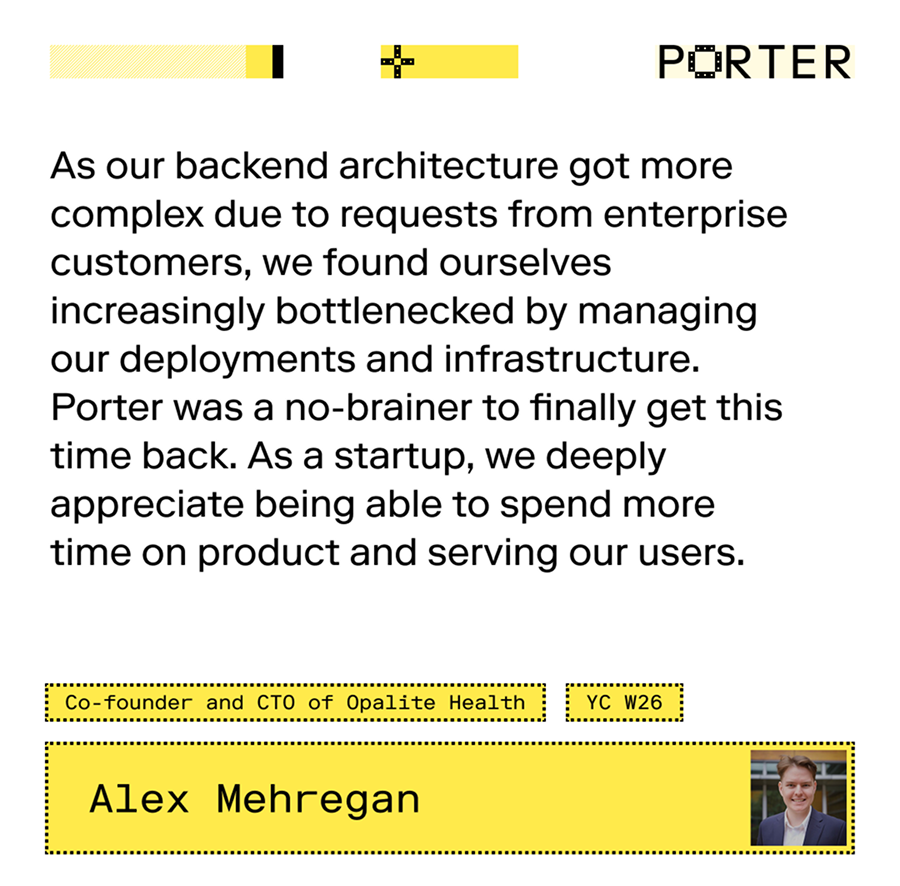
Opalite Health (YC W26) co-founder and CTO @akmehregan uses Porter to ship product for enterprise customers without DevOps overhead. Looking to deploy with your AWS/Azure/Google Cloud credits? Redeem the Porter startup deal: porter.run/for-seed-stage…
Porter tweet media
English
1
0
2
179
Porter
Porter@porterdotrun·
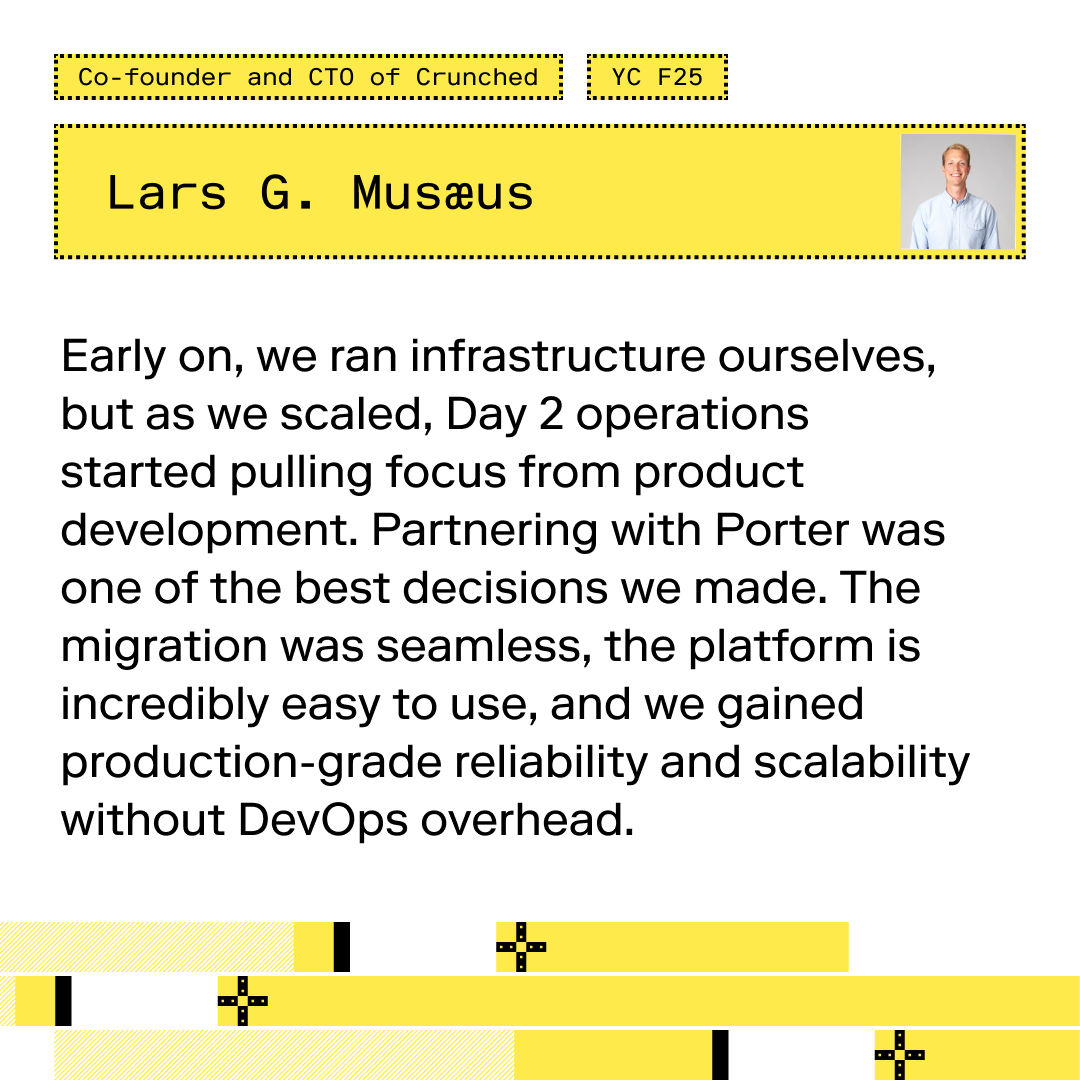
YC F25's @usecrunched chose Porter for the reliability and scalability of EKS with the simplicity of a PaaS. Looking to deploy with your AWS/Azure/Google Cloud credits? Redeem the Porter startup deal: porter.run/for-seed-stage…
Porter tweet media
English
1
2
2
289
Porter retweetledi
Justin Rhee
Justin Rhee@rheejust·
There are only 2 types of founder advice here on X/Twitter. One is valuable. The other is almost worthless. Here's how to tell the difference: Let me say this out loud: I deeply discount founder advice. Yes, I'm fully aware of the irony of saying that as a founder who (sometimes) shares advice on X. Here's why I feel this way: for every founder who made it and is now dispensing wisdom from a position of success, there is a long tail of people who said the exact same things, followed the exact same playbook, and crashed. The advice was identical. The outcome was completely different. And even the founders who are currently winning, who knows where their companies will be in five years - there's so much luck involved, so much random chance, so many invisible variables that the signal-to-noise ratio on most prescriptive founder advice is extremely low. But I think there's a nuance here that matters quite a bit, and it's the thing I'd want any early-stage founder to internalize: Put all founder advice into two buckets before you decide how much weight to give it. Bucket 1: "Here's what I actually did." This is a founder telling you the specific story of how they handled a real situation. What they tried, what worked, what didn't. That's a genuine data point. You can collect those from many founders, aggregate them yourself, and draw your own conclusions. That has real value. Bucket 2: "Here's what you should do." This is a founder projecting their experience onto your situation and telling you the right answer. What they'd do in your shoes. How they'd solve your specific problem. This is shaped by survivorship bias, by luck, by a thousand variables they don't understand about your context. Heavily, heavily discount this. The distinction seems small but it's everything. Counterfactuals like “what I would have done differently” and “what I think you should do” are almost worthless because they're untested hypotheticals dressed up as wisdom. I try to stay in Bucket 1. You should hold me to that.
English
1
1
2
202
Porter retweetledi
Justin Rhee
Justin Rhee@rheejust·
YC W26 Demo Day is six weeks away, and we're halfway through the batch. As a previous YC S20 founder, I wanted to give my shoutout to the 132+ founders publicly accepted! Here’s a sector breakdown and some of the companies we’ve got our eyes on: The B2B section dominates with 50+ companies including: → AI/ML Infrastructure: o11 (YC W26) , Chasi (YC W26) , Arcline (YC W26) → Sales & GTM Tools: Martini , @shofoai (YC W26), SideKit (YC W26), Constellation Space (YC W26) → DevTools: Oximy (YC W26) , @carettaso (YC W26) , Samora AI (YC W26) → Vertical SaaS: Booko (YC W26), Corelayer (YC W26), Arzule (YC W26), Polymath (YC W26) Fintech: → SpotPay (YC W26), Grade (YC W26), Sequence Markets (YC W26) → Forum (YC W26), Maywood → Fenrock AI (YC W26) → Kita (YC W26), Panta (YC W26) Industrials: → Energy: Human Archive (YC W26), @axionorbital (YC W26), Voxel Energy → Manufacturing/Hardware: HLabs, DAIVIN! (YC W26), GrazeMate (YC W26), Squid (YC W26), OctaPulse (YC W26) → Deep tech: Beyond Reach Labs (YC W26), Verdex (YC W26), RoboDock (YC W26), @arcprize, @gru_space (YC W26) Personally, I’m a huge fan of Srihan B. and Abhisheik Sharma from Protent (YC W26) , Gatik Trivedi, Gavin Brennen and Caleb Chan of Lance (YC W26), and Alex Mehregan and @KuoCathleen, MD of Opalite Health (YC W26). They were also the first few in their batch to run on Porter 😏 Image credits to Eric Lay at Virio!
Justin Rhee tweet media
English
7
6
66
5.9K
Porter retweetledi
Justin Rhee
Justin Rhee@rheejust·
San Francisco has been leading the AI charge for 5+ years now. While the rest of the Valley debates what AI agents could do, SF companies are already running them in production for DoorDash, Upwork, Patreon, and regulated banks. Here's some of the top Series A+ companies from SF within a few blocks of each other: 1. @GigaAI: agents that handle customer support workflows autonomously, including lAIive delivery issues and compliance checks. Founders: @varunvummadi and @eshamanideep 2. @BrettonAI: agents that automate AML, KYC, and sanctions reviews for banks and fintechs. Founders: @Will_LawrenceTO and @iamAlexJin 3. Safety Kit: agents for fraud detection, content moderation, and risk investigations. Founders: Alex Rosenblatt, Steven Guichard, and @graunked 4. @console__: platform that autonomously resolves IT support requests in Slack and Teams. Founders: @Andrei_Serban and @ChandraNeal 5. @HyperboundAI: sales training platform that analyzes real sales calls and creates practice scenarios. Founders: @Sguduguntla11 and Atul Raghunathan 6. @conversionai: AI-native marketing automation platform with intelligent lead scoring and multichannel workflows. Founders: @NeilTewari and @James__Jao2c 7. Alex AI: recruiting platform that conducts live interviews with candidates over video and phone. Founders: @rnjnwng and @Johnnrytel Other SF companies worth watching: → @getfreedai: Medical AI scribe used by 20K+ clinicians (transcribes visits, generates notes) → @the_superbill: Voice AI for healthcare that automates insurance verification and claims calls → @get_sphere: AI-powered tax compliance across 100+ global jurisdictions → @Macroscope: Code analysis platform from ex-Periscope founders ($40M Series A) SF is shipping tools and agents that handle real workflows, sign real contracts, and solve problems that pencil out financially today. P.S: What SF AI companies am I missing?
Justin Rhee tweet media
English
0
2
8
812
Porter retweetledi
Justin Rhee
Justin Rhee@rheejust·
Our Series A pitch deck was made in 45 minutes the night before the partnership meeting. The reason? We care about our product, not some fancy pitch deck. Trust me, it wasn’t because I procrastinated, but rather because I don’t think pitch decks are the important part of fundraising. Here's the thing about fundraising that most people get wrong: The deck is not why you get funded. You get funded because: → Your business is performing → You've built trust with the investors → The market opportunity is real → Your team can execute The deck is just documentation of those facts. I've talked to too many founders who spend weeks perfecting their pitch deck, obsessing over fonts and animations and storytelling arcs, while their product is mediocre and they have no existing relationships with investors. That's backwards. Build a good product. Get real traction. Develop relationships with investors over time (we spent over a year building trust with FirstMark before we raised). Then, when it's time to pitch, the deck is easy because you're just showing them what's already true. Our deck has all the important stuff - charts, growth metrics, market analysis, team background. Some of the sensitive numbers are scrubbed out, but you can see the structure. Is it the most beautiful pitch deck ever made? No. Did it work? We raised our $20M Series A, so I believe so. Comment "DECK" below and I'll send you the cleaned up version. --- Listen, I really don’t want you to follow what we did here. It’s not some masterclass in pitch deck design. It’s not a template you should follow, especially for new companies. What you should follow? Build a great product, get real traction, and just show investors what is already true.
Justin Rhee tweet media
English
2
2
9
450
Porter retweetledi
Justin Rhee
Justin Rhee@rheejust·
Excited to announce that we’ve OFFICIALLY moved into our new office here in New York. Are there any pool tables? No. Ping pong tables? Definitely not. Every startup magazine article will tell you the same thing: Ping pong tables = fun culture = happy employees = work life balance. Startup founders need to realize what this actually means: you’re encouraging people to spend their break time … still at the office … playing ping pong … with their coworkers … during hours they could be experiencing the city they live in. We’re in New York. One of the most vibrant cities in the world. If you want to play ping pong, there are FAR better options than our office. If you want to shoot pool, go to any of the TOP pool halls in the country. If you want to grab drinks, go to one of the thousand incredible bars in this city. The office is for work. We aren’t saying we’re some dystopian grind culture that doesn’t value our team’s wellbeing. We’re saying that real work-life balance means ACTUALLY having a life outside of work. When you're here, you're working on genuinely hard problems with exceptionally smart people. It's energizing, and exactly what we've built this space for. When you’re not here, we want you living an actual life: seeing friends, exploring the city, doing things that have nothing to do with Porter. The “fun office” thing has always felt like a trick to me. Almost like companies are trying to make the office so comfortable and entertaining that you never feel the need to leave. That’s not balance. It’s just work with extra steps.
English
5
2
13
1.5K
Porter retweetledi
Justin Rhee
Justin Rhee@rheejust·
RIP @heroku. One of the most loved developer platforms of all time was effectively deprecated today. Heroku's CPO just announced that no new features will be pushed and new Enterprise contracts will no longer be offered to Heroku customers. Despite everything, I actually want to give them their flowers: It's no secret that @porterdotrun has migrated a lot of Heroku Enterprise users over the years. We might genuinely have a more intimate understanding of their recent decline than anyone. But what a lot of people neglect to discuss is that Heroku nailed one thing from the very beginning: the product. The abstraction they made for developers was essentially perfect. A decade and a half since its launch and over a decade since its acquisition by (and stagnation under) Salesforce, Heroku is still best-in-class at developer experience. It's why despite the insane outages, inert product, and obscene pricing, developers still universally talk about the "Heroku experience." It's a fond and slightly distant memory for many of us, but it's still the reference point. Whether we like to admit it or not, the modern PaaS generation has, at best, mimicked the Heroku app experience: Render, Railway, Fly - even Porter. The remaining innovation is to solve the graduation hurdle that Heroku could never fully overcome as companies inevitably moved to the hyperscalers. That's what we obsess over at Porter, but make no mistake: they nailed the DevX. Heroku is dead. Long live Heroku.
Justin Rhee tweet media
English
3
2
24
1.8K
Porter retweetledi
Justin Rhee
Justin Rhee@rheejust·
Porter just raised a $20M Series A with ZERO salespeople. Here's why: There are two schools of thought post Series A: School 1: Open every channel. Sales, marketing, paid ads, content, partnerships. Throw money at everything. School 2: Find the one channel that's already working and max it out until it returns diminish. Then add new channels. We're strictly camp 2. Our one channel: bottoms-up startup adoption, word of mouth, organic growth in YC, and product-led growth. Right now? It’s working. Hundreds of companies have moved away from Render, Heroku, Vercel and Railway without us having to hunt them down. Could we get positive ROI from sales? Probably. But to quote Pedro from Brex: "All growth is about alpha." At Series A, our view is that the primary game is identifying the one channel where there's maximum alpha and exploiting it completely. You put all your chips on red and go after it. Saturate it, max it out, and do everything you can until it's depleted. ONLY when marginal returns start to taper do you mix in new channels like sales and paid ads. But not before. Focus is the most important thing a startup can have. We're not ready to dilute attention across five growth channels. We're still extracting massive value from the one that works. When we see it plateau, we'll dive deep into sales and marketing.
Justin Rhee tweet media
English
2
3
17
1.3K
Porter retweetledi
Justin Rhee
Justin Rhee@rheejust·
Silicon Valley gets all the Series A funding. But have you seen what’s being built in New York? Here are the companies I’m closely watching …make sure to keep your eye on them: @TennrOfficial – AI automation for healthcare referral workflows processing 10M+ documents/month @outtake_ai – Agentic AI that detects and removes phishing attacks and identity fraud @ModelML_ – AI that generates pitch decks and investment memos in under 3 minutes @Traba_Work – Labor marketplace for light industrial temp workers with 95%+ fill rates @FINNYAI – AI prospecting platform for financial advisors with automated outreach @flip_cx – Voice AI automating 90%+ of customer service calls @retirable – Retirement planning platform with fiduciary advisors for middle-income retirees @tidalwave_ai – AI mortgage platform with instant pre-approvals via Fannie Mae/Freddie Mac @hifortunahealth – Medicaid enrollment platform reducing coverage churn by 15% @warpdotdev – AI-powered terminal for modern software development workflows @draftwiselegal – Contract intelligence platform using firm precedent and AI @ExtendHQ – Extended warranty platform resolving 98% of claims in 90 seconds @rallyuxr – User research CRM automating recruitment and scheduling @crosbylegal– AI law firm reviewing contracts in under an hour @AmbrookAg – Farm accounting software with Schedule F integration Let me know if I’m missing any!
Justin Rhee tweet media
English
1
5
11
864
Porter retweetledi
Justin Rhee
Justin Rhee@rheejust·
We put together our $20M Series A video in less than 2 days. Every agency we talked to quoted us 45/60 days minimum. Here's our story: We recorded/edited our Series A announcement video in less than 18 hours. Not because we’re production geniuses (we’re engineers). Because every agency we talked to quoted us 45/60 days minimum. I started reaching out to agencies 2-3 weeks ago, and every single one told me the same thing: “We’ve done fundraising announcement videos for YC companies in the past, and you can expect 45 to 60 days for edits, revisions, and overall feedback.” We weren't willing to wait that long for our Series A announcement. So I took things into my own hands: I grabbed some camera equipment one night the week before the announcement and just started filming. No professional lighting, no camera crew. Just me, some B-roll of the team, and whatever lighting we could rig up in the office that day. The next morning, I popped open Premiere Pro to whip together an edit and jerry-rig some passable motion graphics. The animations you see? Courtesy of a Youtube tutorial and some green tea. The music? The first royalty-free song I found usable enough to download to my laptop. Was it the most polished, professional looking fundraising video ever? Absolutely not. Was it good enough? Absolutely. Here's what I've learned: when you're building a company, there are two types of work: Things that directly impact your product and users (obsess over these) Everything else (make it good enough and ship it) A Series A announcement video falls squarely in category 2. If you need a professionally produced video and you have 60 days, hire an agency. They're great at what they do. But if you need something tomorrow and you're only willing to spend one night filming and one day editing, you can ship something that works. The fastest video of all time wasn't the prettiest. But it got the job done. We take care of our product and customers first. Everything else? Simply an afterthought.
English
5
2
22
2K
Porter retweetledi
Justin Rhee
Justin Rhee@rheejust·
At Porter, we killed leetcode and take-home assignments. Our hiring process is two 30-minute calls and a 2-day trial. No coding interviews. No leetcode. No take-home assignments. 18 people on our team. Every single engineer hired this way. WHY IT WORKS 99% of companies have their hiring process backwards. They put candidates through 6 rounds of interviews, coding challenges, and panel discussions. All designed to help the company de-risk the hire. We flip it. OUR PROCESS 30-minute call with myself 30-minute call with David (our most tenured founding engineer) 2-day in-person trial at the office That’s it. During those initial calls, we might ask technical questions. We're not testing if you memorized sorting algorithms - we're trying to understand how you think and if you'd be excited to work here. If those conversations go well, we fly you out to New York. We’ll put you up in a hotel, cover your meals, everything. Then you’ll work on actual Porter stuff. The exact work you’ll be doing if you joined tomorrow. Our reasoning is this: the best people have options, and joining any startup is a leap of faith. This is what the majority of companies get wrong: for the very best candidates, they need to de-risk you, not the other way around. Our 2-day trial lets them see if they can actually imagine working here. They meet the team. They experience our office space. They really get a feel for what it’s ACTUALLY like. We truly believe that we’ve built something special: a killer team, all working in an office in New York that we’re genuinely proud of. You can’t communicate that in a Zoom call. WHY THIS WORKS When you hire incredibly smart, disciplined people and then trust them to work on real problems from day one, they can tell immediately if it's the right fit. The interview theater that most companies do? It selects for people who are good at interviews. We prefer to select for people who are good at the actual work. If you’re interested in joining a company building infra for the top startups around the world, send me a DM, and let’s get you to New York.
Justin Rhee tweet media
English
51
10
241
16K
Porter retweetledi
Justin Rhee
Justin Rhee@rheejust·
Last week we announced our $20M Series A. After years of grinding for our customers, we wanted to take a second to appreciate our users for getting us here: Most companies do the Series A announcement and then throw a big internal party. You usually see champagne, speeches - the whole works. We aren’t like other companies. We had our users who were in SF swing by from 5-10pm. We catered some food and chatted with them about what they’re building. It wasn’t even close to a formal event and there was no official agenda. Just people who use @porterdotrun coming to hang out. Because here’s the thing: the Series A isn’t about us at all. It’s validation that we’re building something that people actually want to use. And those people (our users) are the entire reason any of this matters. Over the next few weeks, we'll be highlighting some of these teams. It’s what we want to ACTUALLY celebrate. Not the funding round itself, but what the round represents: a bunch of really intelligent and driven people building killer companies, choosing to build on our infrastructure. This week, we’re doing another one with our users here in NYC. So much better than a $150 bottle of champagne.
Justin Rhee tweet media
English
2
2
31
2.6K
Porter retweetledi
Sumanyu Sharma 🍫
Sumanyu Sharma 🍫@sumanyu·
Congrats to @rheejust and @porterdotrun on the $20M Series A. Most infrastructure tools promise simplicity. Porter actually delivers it. We've been using Porter since the early days. What would normally require a dedicated DevOps team (scaling clusters, managing multi-cloud deployments, handling the endless AWS/GCP/Azure complexity) just works. Our engineers ship products, not infrastructure configs. The best tools disappear into the background. Porter does exactly that. It's rare to find a company that serves seed-stage startups and IPO-track companies equally well. It's genuinely hard to build something that scales down and up at the same time. Excited to see what's next. Well deserved.
English
1
3
12
1.1K
Porter retweetledi
Justin Rhee
Justin Rhee@rheejust·
Here's the exact playbook I used to raise Porter's Series A: There’s a big misconception among founders when it comes to fundraising: most think the process starts when the business could use more money. It doesn't. It starts 18-24 months before you need any additional cash. Here's what your playbook should be: STEP 1: START CONVERSATIONS BEFORE YOU RAISE When investors reach out, don't always dismiss them because "we're not raising right now." If you see potential down the line, take the meeting. Build the relationship. @DavidWaltcher at FirstMark reached out to me long before we were ready to raise. I told him we weren't interested in fundraising at that point. But we kept talking over many months. The goal isn't to pitch. It's to let them watch you build. Let them see your thinking evolve. Let them understand how you view the business, where you're going, and what problems you're solving. STEP 2: ACCEPT INVITATIONS THAT ADD VALUE David invited me to FirstMark's programming well before we were a portco. I got to meet @severinhacker, the CTO of Duolingo. @armon, the founder of HashiCorp. Technical leadership at other portfolio companies. This was all before FirstMark invested in us. They were extending an olive branch, showing what working together could look like. These weren't pitch conversations. Just genuine discussions about the problem space and opportunities to learn from experienced operators. That's the relationship you want to build. STEP 3: WHEN READY TO RAISE, FOLLOW A DILIGENT PROCESS Even if you have a strong relationship with one firm, you owe it to yourself to run a proper process. You need to understand your market value. The only way to do that is to have multiple things in motion at the same time. It's almost exactly like recruiting: you want options so you can actually compare. I followed up with past investors from our seed. Other avenues through YC. We talked to multiple firms properly. By the time we officially started fundraising with FirstMark, it felt like a formality. The relationship was there. The trust was built. But running the process gave us confidence we were making the right choice. STEP 4: MOVE FAST FirstMark came back the fastest with an incredibly competitive offer. They were willing to compromise on some things and meet in the middle. Because we'd built up this trust over two years, because they'd been so speedy, because I appreciated that they'd supported us even before investing... First conversation → Signed term sheet in 10 days. STEP 5: CONSIDER GEOGRAPHY AND CULTURE FIT FirstMark being in New York mattered to me. Most of our team is here. I split my time in SF, but it's where I'm also based out of. Having investors who understand the market you're operating in, who can meet in person when it matters, and who are embedded in the same ecosystem you're building in? That compounds over time.
English
2
3
22
1.8K
Porter retweetledi
Justin Rhee
Justin Rhee@rheejust·
2021: 2.5k GitHub stars, Discord community, zero revenue focus. 2026: Series A, 30% of recent YC batches on Porter, hundreds of customers deploying daily. How did we build Porter from "fresh out of YC" to where we are today? 1) We stopped optimizing for surface-level adoption Early on, we had hundreds of Discord members, GitHub stars were climbing, and developers were talking about us everywhere. We thought social proof meant we were winning. The reality? None of it translated to real usage. Not all social proof is created equal, as Discord community size doesn't mean you have something real. One customer deeply integrated with Porter beats a hundred people who think it's "cool" but never deploy. 2) We pivoted from enterprise-first to following the usage Initially, we focused solely on white-glove migration, mostly Heroku Enterprise users that wanted to be on AWS with the developer experience of a PaaS. Bigger contracts, multi-month sales cycles. We thought this was the path to revenue. Then we noticed something: self-serve startups signing up were exploding past enterprise accounts we'd spent months chasing. Some self-serve customers ended up generating more usage than enterprise contracts that took half a year to close. 3) We went all-in on the self-serve startup motion For the last 2.5 years, we've focused entirely on self-serve adoption from early-stage companies. We were initially ignoring startups because we didn't think they were worth the effort. Then we saw some of them explode and grow to be massive. The startups knocking on our door were going to become our best customers, we just had to let them in. 4) We built for developers, not just decision-makers We stopped pitching executives and started shipping for the people actually deploying infrastructure. If we could build better docs with faster onboarding, the result would be a better developer experience all around. The bottoms-up motion only works if your product sells itself to the person using it. 5) We measured what actually matters We stopped tracking GitHub stars and Discord members. We started tracking resources managed, customer growth, and revenue. The companies that matter aren't the ones talking about infrastructure on Twitter, they're the ones shipping on it every day. – The shift from 2021 to 2026 wasn't a product pivot. It was understanding which signals meant real traction and ruthlessly focusing on those. Vanity metrics will lie to you. Deep usage from companies that are actually growing won't.
English
3
2
21
1.3K
Porter retweetledi
Justin Rhee
Justin Rhee@rheejust·
I’m excited to announce that @porterdotrun has raised a $20M Series A to provide effortless app infrastructure in any cloud provider. Our round was led by @FirstMarkCap with participation from @ycombinator and strategic angels including @daltonc and @ROWGHANI. When we started Porter, we had one simple goal: allow startups to stop thinking about cloud infrastructure. Today, the fastest-growing AI companies from the seed-stage to IPO use Porter to manage hyper-growth infrastructure across AWS, Google Cloud, and Microsoft Azure. Our users scale individual clusters in each cloud provider to hundreds of machines and terabytes of RAM without DevOps overhead. We’ve more than doubled headcount over the past few months and are aggressively expanding the surface of what our platform can manage. We are on a mission to make using the public cloud utterly seamless. I’d like to thank our users, investors, and most importantly, the Porter team. As all of them know, we are only getting started. We’re actively hiring with offices in NY and SF, so if you’re interested in managing core infrastructure for the next generation of public companies or tackling the hardest devX problems, shoot me a DM.
English
79
64
652
1.2M
Porter retweetledi
Justin Rhee
Justin Rhee@rheejust·
We just hired another engineer at Porter. And honestly, it’s someone I never expected to work with again. Let me explain: Ben Greenberg just joined Porter. Rewind a few months - we were actively looking for every route possible to hire more top notch engineers at Porter. We tried a few recruiting firms, and one sent over a profile where I immediately recognized the name. Ben was my formal logic TA at Penn. We were both students, took a few classes together, and he had taught me how to break down complex logical systems into their core components. It turns out that Ben had gone into software engineering after graduation, had worked at a few startups, and was genuinely interested in infrastructure as a problem space. He went through our interview process and was obviously just incredibly sharp. Everything I remembered about how he approached problems in formal logic (the systematic thinking, the attention to edge cases, the ability to explain complex systems clearly) translated perfectly to how he thinks about the problems we're solving at Porter. Still surreal that my formal logic TA is now helping us build the infrastructure that powers hundreds of startups.
English
1
2
8
878
Porter retweetledi
Justin Rhee
Justin Rhee@rheejust·
People romanticize founder schedules. The 4am wake-ups. The "I haven't slept in 3 days" posts. The endless grind masochism. Here's what my actual day as the founder of @porterdotrun looks like: 8:30 AM: WAKE UP I'm not a morning person. I definitely don't like waking up hours before the sun rises. I quit caffeine completely almost two years ago (it was messing with my sleep), but now I’ve started having one cup of green tea in the morning. That’s it. 9:00 AM: THE COMMUTE Typically I’ll read on the NY subway over to the office. Rarely anything directly related to Porter. Mostly papers that I’m interested in or whatever book I’m reading at the moment. Giving my brain something different to process each day is helpful. Personally, I find it beneficial to revisit problems after a brief reset instead of thinking about things for 16 hours straight. 9:30-10 AM: ARRIVE AT THE OFFICE Our official policy at Porter is everyone should be in the office by around 10am. This idea is mostly to give people accommodation, as we have a lot of night owls on the team. We don’t force people to get in at “9am sharp on the dot”. But we are an in-person culture, and we need to get things started. FIRST THING: WRITE DOWN WHAT I'M GOING TO GET DONE TODAY This is the part I've become religious about. At the start of each day, I have a notebook where I write down exactly what I'm going to get done that day. And I measure if I ever miss. I try not to overdo it and I treat this list as sacrosanct. This is also the time I take to think instead of naively carrying forward yesterday's momentum. I’ll take 40-60 minutes at the start of the day if I need to, just to make sure I'm actually sure about what I'm gonna do. Spending this extra time has probably been the most important input in terms of my personal productivity. EVENING: WORK LATE (SEASONAL) Lately, I have been in the office until 9-10pm on most days. We try to avoid a performative grind culture at Porter, but it's a startup and there's a lot to get done per head. Everyone is usually around in the evenings, but we trust people to freely attend to their own plans. I won't pretend I'm one of these founders who's working from 5am-12am every single day. I will, however, default to putting in 12 hours, especially recently. We do take weekends as a team (with the obvious exception of critical incidents for customers), and unless something is truly irresolvable without someone's input, we respect PTO. If my family’s in town, I’ll get dinner with them. If it’s my best friend's birthday, I’m going to go. I believe we've built a culture that exemplifies personal responsibility. By default, we work really hard, but we trust each other to be disciplined and to know what's best for our own long-term productivity. THE LESSON Productivity isn't solely about hours logged. For me, it's mostly about knowing what actually matters, focusing on that, and trusting myself to execute.
Justin Rhee tweet media
English
1
2
10
1.2K