Postgres First

501 posts

Postgres First

Postgres First

@postgresnx

Postgres advocate redux; Postgres First!

New York Katılım Mayıs 2023
616 Takip Edilen76 Takipçiler
Postgres First retweetledi

Nik Samokhvalov
Nik Samokhvalov@samokhvalov·
FOSS like Postgres killed Oracle's grip on the enterprise. AI is about to do the same to RDS in the cloud. Spent an hour today with a customer moving ~100 Postgres clusters off RDS. Backups and HA aren't the hard part anymore. What's needed is an AI observability + intelligent ops layer -- to keep the fleet healthy at scale, and dev velocity high and safe. The data layer is repatriating.
English

3
4
41
9.6K
Postgres First retweetledi
Postgres FM
Postgres FM@PostgresFM·
New episode: "pg_flight_recorder" Nik and Michael are joined by David Ventimiglia to discuss pg_flight_recorder, a new tool he created for monitoring a Postgres database from within. 🎧 postgres.fm/episodes/pg_fl… 📺 youtu.be/UirSQIY8_M0
YouTube video
YouTube
Postgres FM tweet media
English
0
3
12
1.9K
Postgres First retweetledi
Nik Samokhvalov
Nik Samokhvalov@samokhvalov·
pg_flight_recorder is a great new observability tool for Postgres primary nodes: github.com/dventimisupaba… What I think about it: - It's like pg_ash, but goes beyond ASH (wait events) data -- it also records stats from pg_stat_* (including pg_stat_statements for query analysis) - It's an "anti-extension," my new favorite way to extend Postgres -- meaning it works everywhere, because it's just SQL + PL/pgSQL! (for fans of CREATE EXTENSION, the pg_tle path is also an option) - It also ticks on pg_cron -- just like pg_ash and PgQue - You can think of it as "lightweight, AI-friendly self-monitoring" that costs just a few MiB in your Postgres -- no need to provision separate monitoring or pay for SaaS tools, ideal for smaller (<10 TiB) databases I actually used both pg_ash and pg_flight_recorder when benchmarking PgQue -- it's so easy to ask Claude Code to inject them as you iterate on benchmarks, then have it save the output and visualize the results. And of course, if an incident happens, it's good to have this "flight recorder" running in your Postgres -- it can be really helpful for RCA.
English
1
4
41
2K
Postgres First retweetledi
Mitchell Hashimoto
Mitchell Hashimoto@mitchellh·
@SergiiShymko As the famous saying goes, culture is who you hire, who you fire, and who you promote. And product is equal parts what you choose to build and what you refuse to build. Without the power to unilaterally control all of that, you cannot succeed.
English
6
119
1.1K
40.9K
Postgres First retweetledi
Ajay Kulkarni
Ajay Kulkarni@acoustik·
Agents are here. Built on Ghost. Today's spotlight: HEARTH, an "OS for your home", which last week won the Agentic Engineering Hackathon at the SF AWS Build Loft. HEARTH was inspired by a simple problem that many of you probably face: Home maintenance is fragmented, reactive, and expensive for homeowners. Also, service providers deal with inefficient demand and scattered jobs. For homeowners, HEARTH acts like an operating system for the home: tracking assets, predicting repairs and replacements, and automating the contracting process. For service providers, HEARTH unlocks bundled demand: pre-qualified, geographically clustered homeowners who need the same service at the same time. HEARTH uses Ghost to spin up a second Postgres instance for domain isolation, separating system state from the core app. Why Ghost? Because it requires almost no setup. No infra, no provisioning, just one connection string. And with time-series support built in (yay TimescaleDB), things like asset timelines and event logs just work. Ghost. The database for agents. @ghostdotbuild
English
1
2
7
628
wangbin579
wangbin579@wangbin579·
Beyond PostGIS, pgvector, TimescaleDB, and Citus, which Postgres extensions are truly worth tracing next?
English
8
4
93
12.2K
Postgres First retweetledi
Crunchy Data
Crunchy Data@crunchydata·
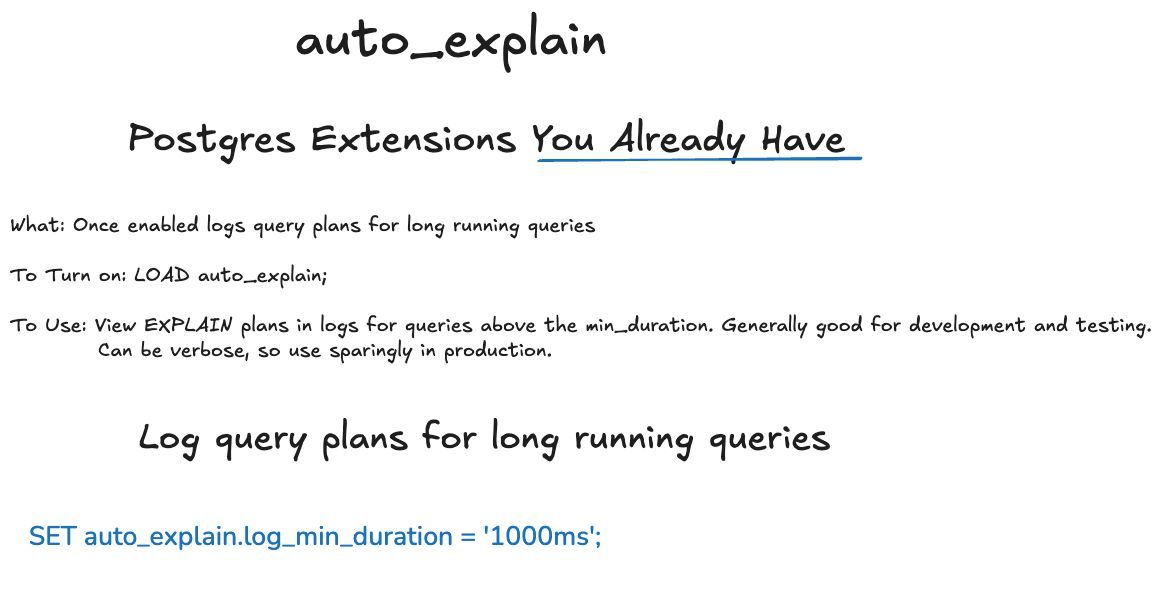
Postgres extension you already have: auto_explain. This will log query plans above your minimum duration. Great for testing and debugging, can be quite noisy so use sparingly in production.
Crunchy Data tweet media
English
0
2
10
869
Postgres First retweetledi
Gergely Orosz
Gergely Orosz@GergelyOrosz·
How have the fundamentals of building large, distributed software systems changed the last decade? A conversation with Martin Kleppmann (author of Designing Data-Intensive Applications) - given that the second, updated edition of the book was just released. Timestamps: 00:00 Early career 05:46 Building Rapportive 10:47 Working at LinkedIn 14:09 Writing Designing Data-Intensive Applications 23:00 Reliability, scalability, and repeatability 26:24 DDIA: the second edition 30:50 Tradeoffs of using cloud services 39:02 How the cloud changed scaling 42:53 The trouble with distributed systems 49:02 Ethics for software engineers 52:45 Formal verification 1:00:12 Academia vs. industry 1:03:50 Local-first software 1:09:50 Computer science education 1:18:32 Martin’s current research and advice Brought to you by: • @statsig  – ⁠ The unified platform for flags, analytics, experiments, and more. statsig.com/pragmatic • @SonarSource – The makers of SonarQube, the industry standard for code verification and automated code review. Check out Sonar's new architecture management capabilities that ensure both humans and AI agents respect your system’s blueprint. sonarsource.com/solutions/arch… • @WorkOS – Ship enterprise features – SSO, directory sync, RBAC, audit logs – in days, not months. workos.com Three things worth considering, as discussed with Martin, in this episode: 1. Multi-region and multi-cloud are risk/cost trade-offs, not best practices. Martin does not believe that there is a “best practice” in deciding whether to go multi-region or multi-cloud. This decision is a tradeoff between risk and costs. It’s a business decision to be made. Designing Data-Intensive Applications gives engineers the vocabulary to articulate the tradeoffs, not to dictate answers. 2. Replication for fault tolerance is more relevant for most engineers these days than sharding. Though the book has a full chapter on sharding, Martin said that the cloud has reduced the need for manual sharding for the majority of teams. This is also because machines are increasingly bigger, and more workloads fit on a single machine. Sharding across machines is increasingly a specialist concern; replication for fault tolerance, however, is still relevant at every scale. 3. Knowing system internals as a superpower for application developers. Martin maintains that Designing Data-Intensive Applications is not a book for people who build databases or even infrastructure, but it’s helpful for application developers to develop an intuition for making good design decisions and debugging performance issues we will eventually encounter.
English
9
67
514
79.2K
Postgres First retweetledi
Nik Samokhvalov
Nik Samokhvalov@samokhvalov·
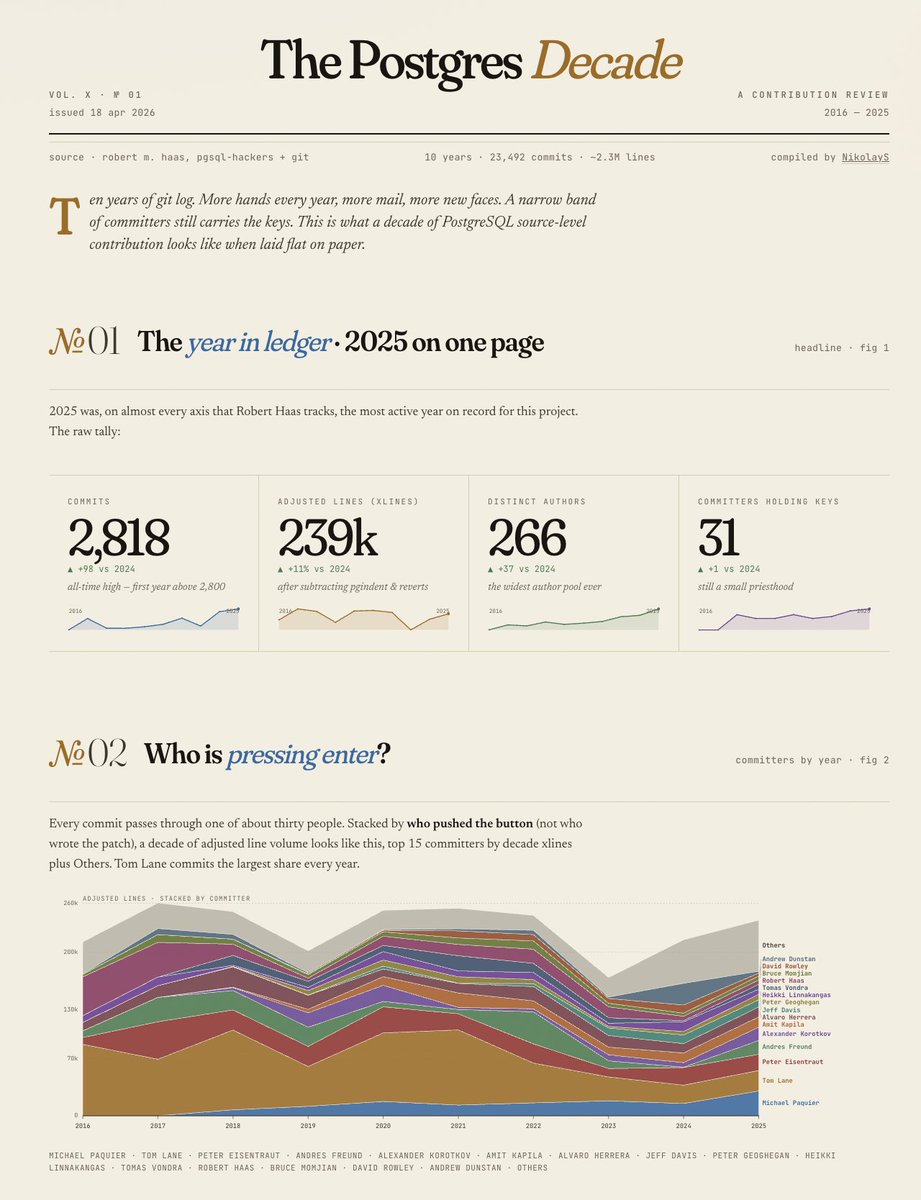
10 years of PostgreSQL development, on one page. nikolays.gitlab.io/postgres/ 23,492 commits. 2.3M lines. 266 authors in 2025 (widest pool ever). 31 committers. Built this after reading Robert Haas' latest contribution review: #37002654a18921541a9554dda88348bb" target="_blank" rel="nofollow noopener">postgresql.org/message-id/fla… The shape of the project is stable: more contributors every year (contributors), narrow team (committers) holds the keys. Bonus – part 2 (beyond original Robert's data): nikolays.gitlab.io/postgres/part2…
Nik Samokhvalov tweet media
English
2
15
156
7.8K
Postgres First retweetledi
Nik Samokhvalov
Nik Samokhvalov@samokhvalov·
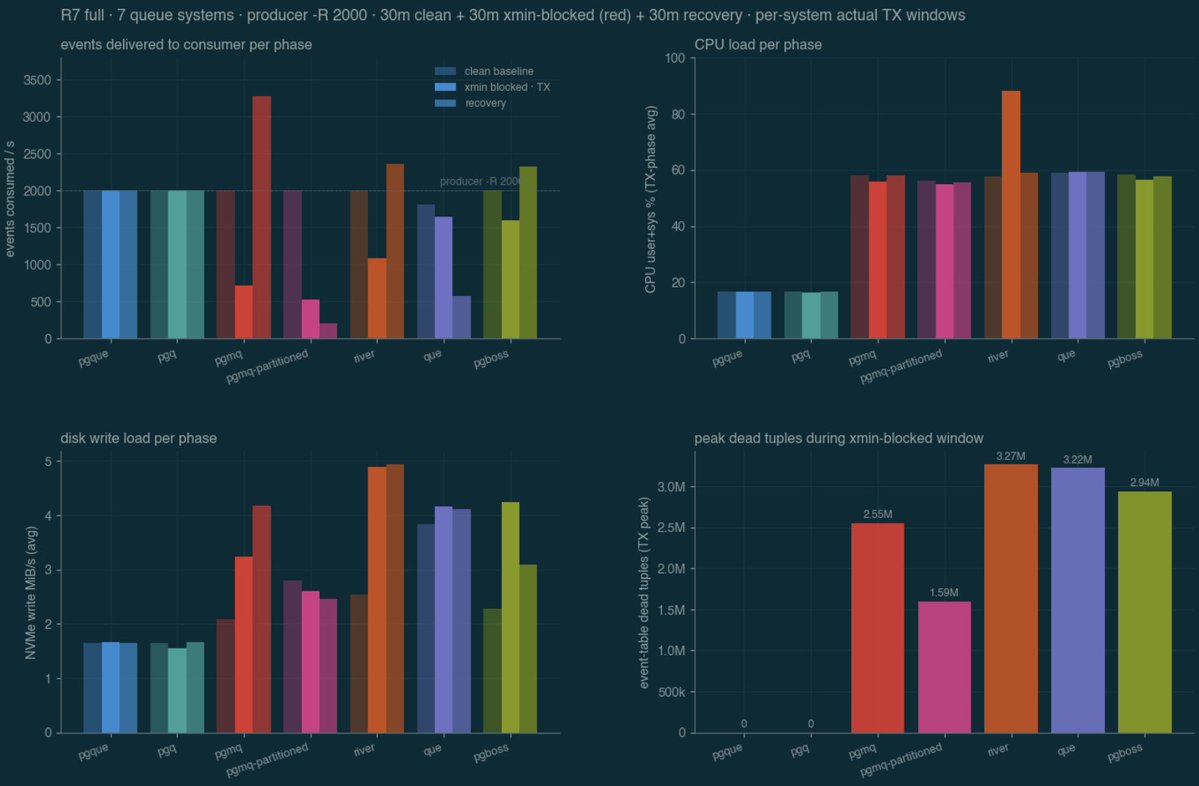
as I keep saying, most new "queue in Postgres" implementations took a wrong turn and Skype's PgQ had it right in 2007 full post with all the data soon
Nik Samokhvalov tweet media
English
1
5
76
4.3K
Postgres First retweetledi
Fernando
Fernando@Franc0Fernand0·
Even though this book is about 20 years old, it's still a good starting point for anyone who wants to learn how to build databases. It just took me a couple of weeks to go through it. For the interested folks, the link is here: dsf.berkeley.edu/papers/fntdb07…
Fernando tweet media
English
3
87
649
26.5K
Postgres First retweetledi
Stormatics
Stormatics@StormaticsTech·
From obscurity to total dominance: See how Postgres conquered the database world. Marc Linster and Umair Shahid dive into its evolution and future in modern tech stacks. #Postgres #Database #TechTrends #CloudComputing
English
0
1
1
30
Postgres First retweetledi
Xata 🦋
Xata 🦋@xata·
Xata is now open source. Apache 2.0. Postgres platform with Copy-on-write branching at the storage layer. Copy a TB-sized database in seconds. Inactive copies scale to zero automatically. 100% vanilla Postgres. Two use cases driving this: • Preview and testing environments with real production data • Platforms provisioning per-user Postgres at scale Built on CloudNativePG + OpenEBS. Runs on Kubernetes. What's in the release: • SQL gateway, responsible for routing, IP filtering, waking up scaled-to-zero clusters, serving the serverless driver over HTTP / websockets, etc. • Branch operator managing all resources related to a branch. • Clusters and projects services for the control-plane and REST APIs • Auth service, based on Keycloack for API keys • CLI that makes use of the REST API • Scale-to-zero CNPG plugin for automatically hibernating branches on inactivity This is the first of several announcements. More next week.
English
5
17
147
54.7K
Postgres First retweetledi
DuckDB
DuckDB@duckdb·
We are happy to release DuckLake v1.0, a production-ready lakehouse format specification. Its reference implementation, the ducklake DuckDB extension, is available as of today in DuckDB v1.5.2. Since releasing the DuckLake manifesto in May 2025, we have seen massive adoption, with DuckLake deployed in production at multiple organizations, third-party clients supporting DuckLake, and even an upcoming O'Reilly book. DuckLake v1.0 ships many new features (inlining, partitioning, bucketing, type system improvements) and guarantees backwards-compatibility in the specification.
DuckDB tweet media
English
5
74
401
30.9K
Postgres First retweetledi
Ben Dicken
Ben Dicken@BenjDicken·
Flamegraphs are a great way to narrow in on performance issues + broadly to explore program execution. I built a custom viewer for Postgres queries, inspired Jan Nidzwetzki's excellent blog on the subject. Highly recommend analysis tools like this for learning query execution.
English
15
50
875
47.8K
Postgres First retweetledi
gleb / AdShot
gleb / AdShot@adshotco·
@ThePrimeagen github is now the worlds largest graveyard for mass produced AI code that nobody will ever read, debug, or run in production. at least when humans wrote bad code they had the decency to be embarrassed about it
English
2
5
144
22.2K
Postgres First retweetledi
Mike Freedman
Mike Freedman@michaelfreedman·
When Cactos, a Finnish "battery energy as a service" provider, outgrew Amazon RDS, they needed a next-generation data platform built for scale. They chose @TimescaleDB over alternatives like ClickHouse, and the results were significant: improved performance and more than 50% reduction in costs after migrating 15TB of production data. Read their story: tigerdata.com/blog/how-cacto…
English
1
5
15
1.7K