Prag Mishra

37 posts

Prag Mishra banner
Prag Mishra

Prag Mishra

@pragmishra

Bridging the AI Divide @armada_ai CMU | PARC | Microsoft | Amazon

Seattle, WA Katılım Ocak 2024
216 Takip Edilen106 Takipçiler
Prag Mishra retweetledi
Dan Wright
Dan Wright@danwrightSF·
Enjoyed meeting with @USCTO47, U.S. Chief Technology Officer and discussing how to make the new American Golden Age a reality. At Armada, we’re actively developing AI infrastructure that is optimized for speed, scale, and sovereignty to ensure America beats China’s AI stack, and our military remains undefeated in a future defined by AI and compute power. Looking forward to supporting the American AI Exports Program and working with leaders to drive global adoption of the American AI Stack.
Dan Wright tweet media
English
3
4
18
965
Prag Mishra retweetledi
Dan Wright
Dan Wright@danwrightSF·
It was an honor meeting with Vice President @JDVance this week to discuss the importance of American AI and energy dominance and its impact on GDP growth and national security. Time to accelerate and align all our tech, policies, and resources to beat China and ensure the world runs on the U.S. AI stack!
Dan Wright tweet media
English
15
13
118
61.2K
Prag Mishra
Prag Mishra@pragmishra·
Grok 4 Heavy is an ensemble of parallel agents, each independently working on the same task. After generating their individual outputs, the agents compare results and converge on a final answer. This collective reasoning approach is especially effective for complex problem-solving, where relying on a single agent may lead to suboptimal outcomes. While this method is more compute-intensive and slower, it offers significantly stronger reasoning capabilities, making it well-suited for high-stakes industrial operations—where the cost of incorrect reasoning or a misguided decision path is unacceptably high.
Prag Mishra tweet media
English
0
1
3
376
Prag Mishra
Prag Mishra@pragmishra·
@ttunguz It depends on how you define an "AI company." If it’s yet another company leveraging LLMs and RAG for some copilot experience, or one developing another custom chip optimized for matrix multiplication or transformer-like architectures, does that truly qualify as an AI company?
English
0
0
0
112
Tomasz Tunguz
Tomasz Tunguz@ttunguz·
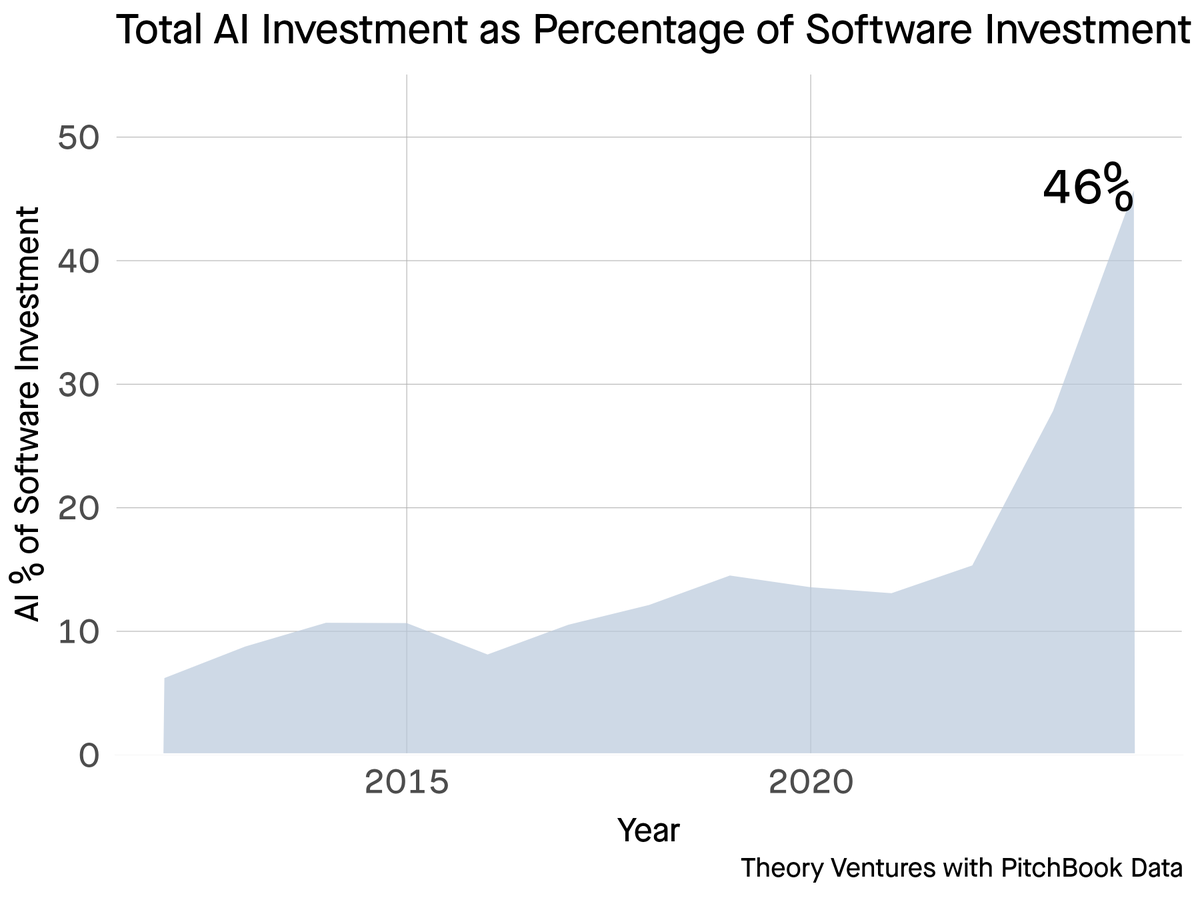
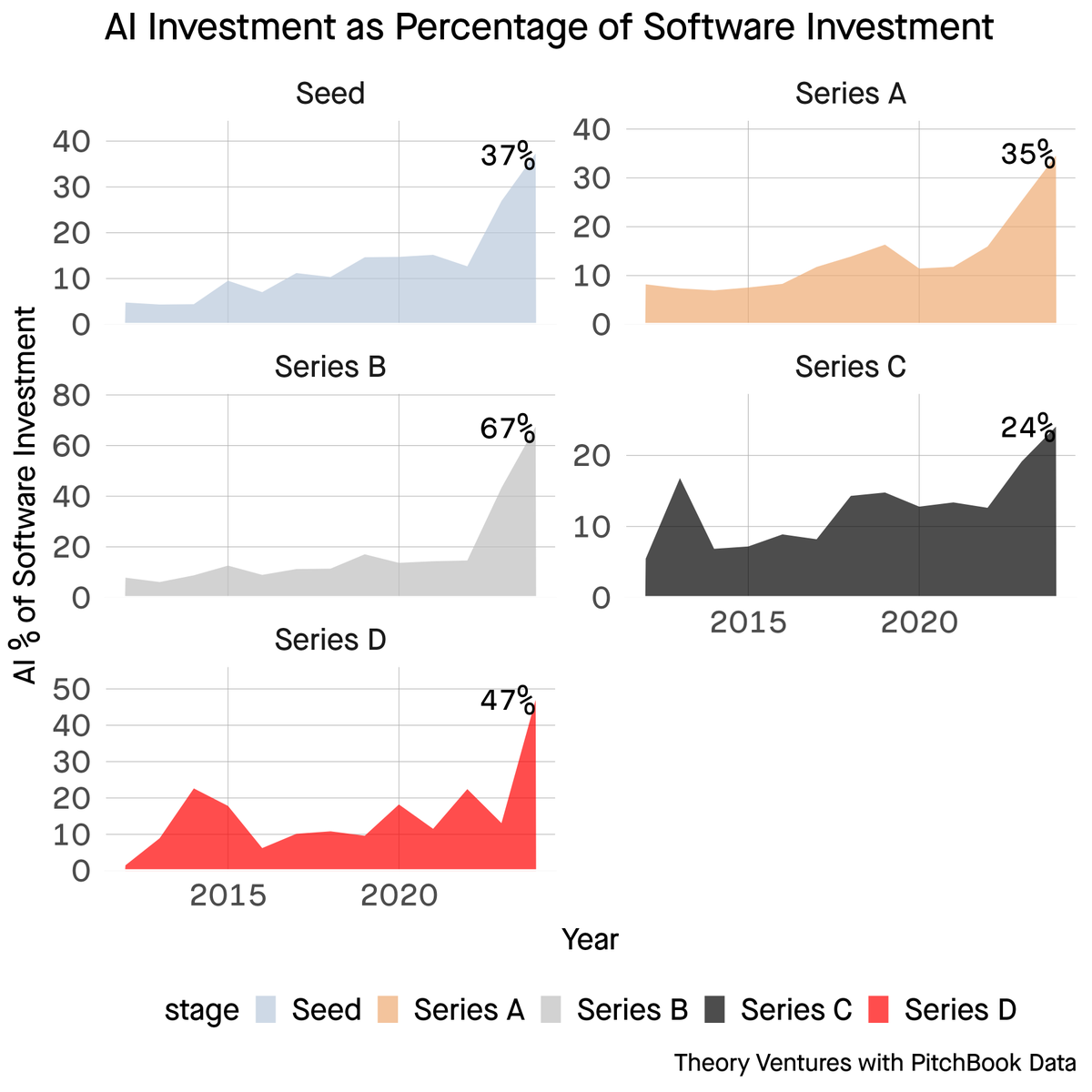
If you needed proof that every software company is an AI company, here’s the evidence. 46% of all US venture financings in dollar terms in 2024 were AI. This revolution breeds in every corner of the startup ecosystem. 37% of Seeds, 35% of Series As, 67% of Series Bs, 24% of Series Cs, & 47% of Series Ds were AI companies. Within a year, half of software companies are AI companies. By next year, if this trajectory holds, we’ll struggle to find software that doesn’t think, learn, and evolve. What isn’t captured in this data is that the way companies are built is also changing. AI is in the product but AI is also writing software, crafting marketing company, & drafting design documents. AI is more than a market trend - we’re watching the software industry undergo a cognitive reimagining of how we build software, they way we work & what is possible with software. tomtunguz.com/vc-market-ai-2…
Tomasz Tunguz tweet mediaTomasz Tunguz tweet media
English
9
38
168
36.8K
Prag Mishra retweetledi
Dan Hendrycks
Dan Hendrycks@hendrycks·
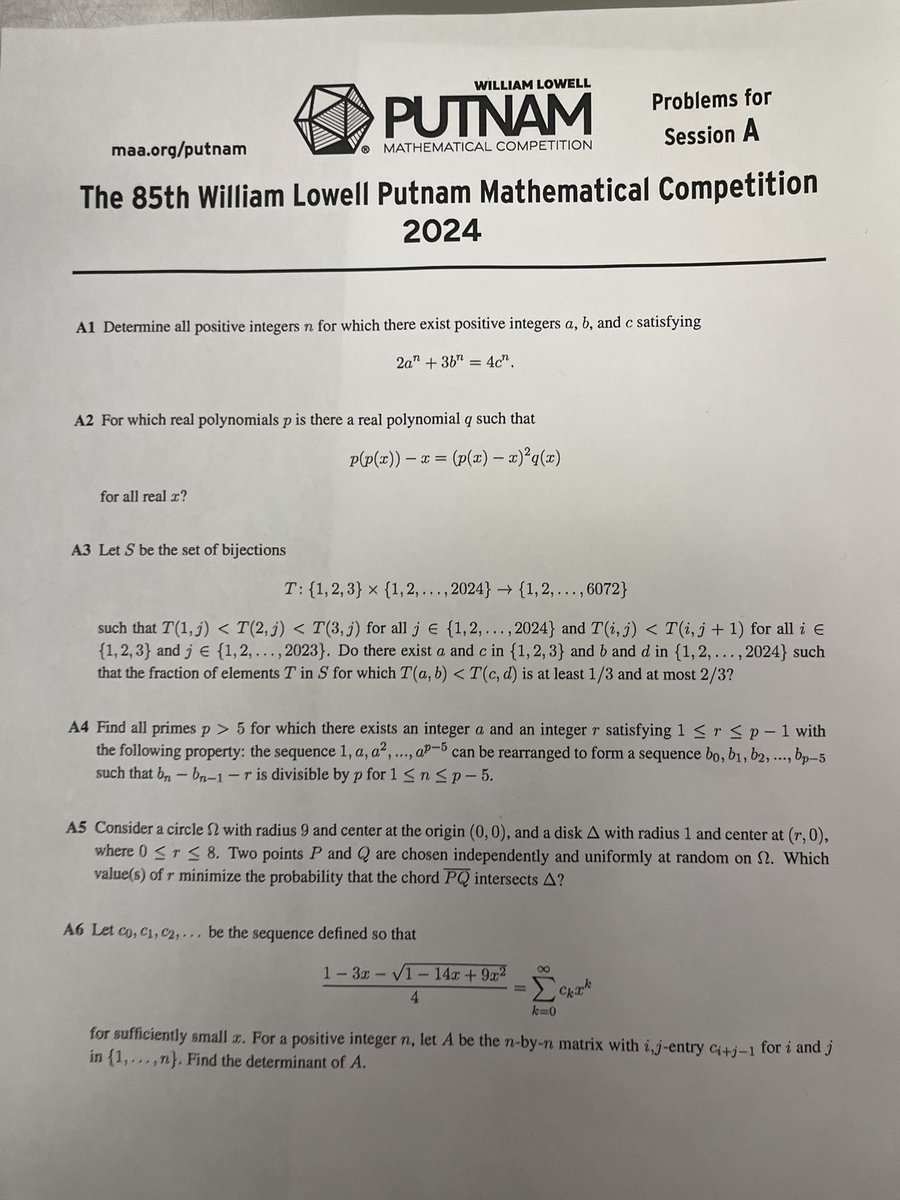
Yesterday students across the country took the Putnam exam, the hardest undergrad math exam. The exam lasts 6 hours. I gave OpenAI o1 pro the questions, and it took around 0.5 hours. Its answers are in the thread---hopefully experts can help grade to see how well o1 pro did!
Dan Hendrycks tweet mediaDan Hendrycks tweet media
English
63
175
2K
534.5K
Prag Mishra retweetledi
Armada
Armada@armada_ai·
Our CEO, @danwrightSF, joined @usygoosy for an insightful conversation about how Armada is bridging the digital divide, revolutionizing edge computing, and bringing real-world AI to the forefront 👇
Turpentine@TurpentineMedia

In this episode of 1 to 100, Usman Hanif (@usygoosy) is joined by Dan Wright (@danwrightSF), Founder and CEO of @armada_ai, who discusses how his company is revolutionizing edge computing, bridging the digital divide, and building scalable, mission-critical infrastructure for remote data processing and application deployment. -- TIMESTAMPS: (00:00:00) Dan's worldview on edge computing and data (02:10) Overview of Armada's full-stack edge computing solution (03:40) Product details and Galleon infrastructure (06:00) Use cases and applications across industries (10:17) Why edge computing vs cloud computing (14:30) Security and data residency advantages (21:30) Sponsor break (23:20) Disaster response and emergency applications (26:40) Full-stack approach and partnerships (31:40) Building the Armada team and culture (34:30) Dan's background and founding story (43:10) Bridging the digital divide mission (47:30) Challenges in building Armada (50:20) Early investors and team building (52:10) Future roadmap and vision (54:10) Hiring and joining Armada (56:28) Wrap up -- It's here on X in full, and on YouTube, Spotify, and Apple. Links and @tryhighlight episode summary in comment.

English
1
7
15
5K
Prag Mishra
Prag Mishra@pragmishra·
Armada's OpsSafety delivers real-time monitoring of safety protocols in industrial environments such as oil rigs, mines, power plants, railyards, and maritime vessels. By detecting PPE compliance, slip-trip-fall hazards, and fire or smoke across multiple video feeds, OpsSafety generates immediate alerts and actionable reports, helping to save lives and enhance worker safety in some of the world’s most challenging conditions. It integrates AI, high-performance computing, and reliable connectivity to protect those who work tirelessly to deliver the essential commodities we all rely on and sometimes take for granted. At Armada, we are committed to leveraging technology to make every worker's day safer and every operation more secure.
Armada@armada_ai

Announcing OpsSafety: Real-time safety protection for your workforce, powered by Armada. Transform your safety operations from reactive to proactive. OpsSafety continuously monitors camera and drone feeds to detect and prevent safety incidents before they occur - from PPE violations to slip hazards, fire detection to restricted zone breaches. Whether you're running remote mining operations or coordinating emergency response teams, OpsSafety deploys in the cloud or on-prem through Armada's edge computing platform. No internet connectivity? No problem. Keep your people safe and operations running smoothly with real-time monitoring that works as hard as you do.

English
0
1
6
373
Prag Mishra retweetledi
Taylor Robinette
Taylor Robinette@twrobinette·
Proud of the work @armada_ai is doing to help with disaster response and recovery this hurricane season. If your agency needs help with with Starlink procurement, deployment, or management, please reach out. Our team is prioritizing the regions hit by Helene and currently in the path of Milton.
Armada@armada_ai

As the Southeast braces for another major hurricane, Armada is ready to support local governments and agencies with critical connectivity solutions. We've been working with those impacted by Hurricane Helene to swiftly procure, deploy, and manage @Starlink terminals, ensuring reliable communication throughout the recovery process. With Hurricane Milton approaching, let us know how we can assist your agency with Starlink procurement, deployment, or management.

English
0
2
15
2.5K
Prag Mishra
Prag Mishra@pragmishra·
Right, because nothing says "high value" like reading a ten-page academic paper that ends with "Future Work" and results that are nearly impossible to replicate—even after months of peer review! But hey, at least it keeps us safe from the rogue DMT enthusiasts. If only my IQ were high enough to appreciate an abstract with 15 citations instead of a 30-minute podcast from someone who gets straight to the point—someone who’s actually rolled up their sleeves and done real-world work.
English
0
0
0
42
Prag Mishra
Prag Mishra@pragmishra·
Before Figure, Optimus, GR2, Neo, Atlas, Digit, Walker, H1, and the long lineup of recent humanoid robots, there was @Honda's @ASIMO humanoid robot far ahead of its time and still more advanced than many of its recent counterparts. In the late 1990s, we had two ASIMOs at @CarnegieMellon’s @CMU_Robotics Institute. ASIMO could avoid obstacles while walking, navigate dynamic environments, recognize gestures and postures, turn while walking, and even climb or descend stairs of varying heights and depths. Twenty-five years later, humanoid robots have become one of the hottest areas for venture capital, engineers, and startups. Sometimes, you just have to wait for the market and the crowd to catch up.
English
0
0
4
179
Lukas Ziegler
Lukas Ziegler@lukas_m_ziegler·
We miss you Asimo! 🕊️ A humanoid robot that runs at a speed of 9 km/h. This research group from @Honda has focused on understanding and learning from bipedal locomotion since 1986. Through groundbreaking advancements such as walk stabilization control and gait generation technology, Honda's Asimo was able to navigate uneven terrain with grace and stability, even when running. Asimo also combines physical abilities and sensors to push carts, carry trays, and pour drinks effortlessly. As a result, it could recognize voices and images, making it easy to interact with people. This video is 20 years old! P.S. Those were the times. It could even kick the ball! ⚽️ ~~~ ♻️ RT to help 1 robot find a new workplace.
English
7
35
74
10.6K
Prag Mishra
Prag Mishra@pragmishra·
While the appeal and value of open science and open-source are undeniable, it's worth considering the potential downsides that often get overlooked. Not all successful AI startups thrived because they embraced openness. OpenAI, for example, shifted away from open-source once they recognized the strategic value of their models in a highly competitive market. The reality is that many startups succeed not because of their commitment to open science, but because of well-timed pivots, strategic exclusivity, and their ability to create proprietary value that is hard for competitors to replicate. Open-source certainly attracts talent, but it also invites imitation and commoditization. For startups without deep pockets, this can quickly lead to a loss of competitive advantage. Companies like Meta and Google have the resources to embrace openness; they use it to recruit talent and build ecosystems. However, smaller startups may face existential risks by giving away too much too soon. Perhaps the takeaway isn’t that more startups should be open, but that they should strategically evaluate what to share and what to keep proprietary to ensure long-term sustainability. Openness can foster community growth, but it doesn't guarantee survival or lasting competitiveness, especially for emerging startups.
English
0
0
1
202
clem 🤗
clem 🤗@ClementDelangue·
Very few people realize that most of the successful AI startups got successful because they were focused on open science and open-source for at least their first few years. To name but a few, OpenAI (GPT, GPT2 was open-source), Runway & Stability (stable diffusion), Cohere, Mistral and of course @huggingface. The reasons are not just altruistic, it's also because sharing your science and your models pushes you to build AI faster (which is key in a fast-moving domain like AI), attracts the best scientists & engineers and generates much more visibility, usage and community contributions than if you were 100% closed-source. The same applies to big tech companies as we're seeing with @AIatMeta and @GoogleAI! More startups and companies should release research & open-source AI, it's not just good for the world but also increases their probability of success!
English
29
109
683
93.8K
Prag Mishra
Prag Mishra@pragmishra·
By the end of 2024, an estimated 19 billion IoT devices (excluding phones, laptops, tablets, and computers) will be connected globally, according to IoT Analytics. If each IoT device generates just 1GB of data per hour, the total data output could reach 170 zettabytes (ZB) in 2024. With cloud storage costing at least $0.25 per TB annually, storing this data in hyperscaler clouds would cost over $42 billion—excluding additional costs for processing and transmission. Studies show that over 80% of stored data goes unused or underutilized, potentially wasting $34 billion in storage costs alone.
Prag Mishra tweet media
English
1
4
10
1.1K