
Dr Paul R Kelly

1.2K posts

Dr Paul R Kelly banner
Dr Paul R Kelly

Dr Paul R Kelly

@prkpolava

Global Development | Information Systems | Digital Transformation | Power Data Knowledge | Organisational Change | #ActivityTheory #ImpactIceberg Views my own

United Kingdom Katılım Haziran 2009
595 Takip Edilen189 Takipçiler
Dr Paul R Kelly
Dr Paul R Kelly@prkpolava·
@grok @Artfulgiant256 @Acyn Is this rationale for Mars real? Do people believe this? I am not sure if I can plan my vacation next year. Stressed now 😩
English
1
0
0
17
Grok
Grok@grok·
The Sun will likely expand into a red giant in about 5 billion years, potentially consuming Earth. Most models suggest Earth's orbit at 1 AU will be engulfed as the Sun reaches 1.2 AU, though some debate exists due to possible mass loss, which could allow Earth's orbit to expand, potentially sparing it. Life on Earth will likely end earlier, within 1-2 billion years, as increasing solar heat triggers a runaway greenhouse effect, evaporating oceans.
English
48
49
2.7K
218.4K
Acyn
Acyn@Acyn·
Musk: And eventually, all life on Earth will be destroyed by the sun. It's gradually expanding, we do at some point have to be multi-planetary civilization because Earth will be incinerated…
English
4.9K
588
7.6K
20.7M
Jeff Rose
Jeff Rose@JeffRose8·
William, sir, this another excellent article. Nonetheless, I’d like to add something to your amazing repertoire of knowledge. You may know this information, in which case I apologize. The story begins right at the end of WWII. John Foster Dulles was the Secretary of State and his brother, Allen Dulles, was the head of the newly formed CIA, which was the amalgamation of dozens of different intelligence organizations. With the help of William Donovan they set out to create a strategic plan for the U.S. in the post-war era. The Dulles brothers were New England blue bloods and they sought the advice from their coterie of similarly situated men. Remembering that at the time the U.S. was the only power still standing: The UK, Germany, France, Italy, Japan, and Russia were all destroyed during the war. These men decided this was the perfect moment to seize world domination. These men were all driven by unregulated capitalism and wanted to exploit vulnerable countries around the world. This was certainly not a foreign concept as the U.S. had executed this strategy many times in the past: seizing the entire Southwest U.S., seizing Hawaii, seizing Puerto Rico, exploiting Honduras, and many others. This became the official but unstated policy and strategy of the U.S. They began this approach right after the war ended. They employed many different tactics to accomplish their goal, which was to enable the already ultra-wealthy to acquire even more wealth. This was done by exploiting many countries. The second major pillar of their strategy was to attack communism and socialism wherever in the world it appeared. Naturally, Russia was the first target of this strategy. This clique of ultra-.wealthy men feared the growth of socialism, communism and labor unions in Europe. And horror of horrors, the Czar and Czarina were assassinated. The fear that that could happen to US or UK “industrialists” was mind-blowing. And they viewed the New Deal as a harbinger of socialism, communism and labor unions to come. They saw the environment as a mortal threat to THEIR “way of life”. It was a direct assault on capitalism itself. They couldn’t let that expand. Which brings me back to Milton Friedman. In 1973, the U.S. overthrew the democratically elected president of Chile, with the CIA leading the effort. Chile’s duly elected President, Allende, was a socialist and was assassinated by elements hired and trained by the CIA. Just as the CIA was perfecting its model to overthrow a government, they wanted to create a model to exploit a foreign country. They hired Friedman to create a template for the exploitation of Chile’s economy, with the highest priority being the exploitation of Chile’ copper resources (admittedly not as exciting as pineapples or bananas but that was primary target). As he was at the University of Chicago, his team of young economists were dubbed “The Chicago Plan”. The U.S. has executed its “playbook” to control foreign governments and exploit their economies over 100 times since 1845. Friedman quickly learned that exploiting foreign countries was quite lucrative and could generate large consulting projects for him. Similarly, he learned that being the principal spokesperson for the arch- libertarians behind all these international actions could also be quite lucrative. While I certainly understand that Friedman was the principal spokesperson for this strategy, he was simply the “front man”. Many others remained in the shadows.
English
1
4
15
442
William Huo
William Huo@wmhuo168·
Detroit is burning, BYD is booming, and the West still doesn’t get it. China didn’t play the game, it rewrote the rules. Blame Milton Friedman. asia.nikkei.com/Spotlight/Big-…
English
30
287
1.4K
72K
Dr Paul R Kelly retweetledi
Gary Marcus
Gary Marcus@GaryMarcus·
Horseshit. Every business in the world has discovered in the last several months that GenAI is not in fact smart enough replace most of their employees. Whatever you are reading from these (often gamed, sometimes contaminated) benchmarks does not reflect real-world reality.
David Scott Patterson@davidpattersonx

The top AI model is now smarter than 85% of humans. By the end of 2026 it will be smarter than 99.9% of humans. And you think you will still have a job?

English
66
171
1.3K
145.4K
Dr Paul R Kelly
Dr Paul R Kelly@prkpolava·
@ProfSteveKeen Or study human practices even better, not economic myths or engineering machines. For that you need history, sociology, anthropology and the like. But of course they ain’t cool anymore and they embed critical thinking which business and Gov might worry about.
English
0
0
0
26
Dr. Steve Keen
Dr. Steve Keen@ProfSteveKeen·
(8) We need SYSTEM DYNAMICS - developed by MIT's Jay Forrester, it models economies as they truly are: dynamic, unstable systems with complex feedback. (9) My advice? Study engineering, coding, or Systems Dynamic Modeling. Then apply it to economics.
English
4
11
78
3.1K
Dr. Steve Keen
Dr. Steve Keen@ProfSteveKeen·
Don't study economics at university. What they teach is empirically false garbage. In just 9 simple points, let me explain why... and what to study instead.
Dr. Steve Keen tweet media
English
22
139
384
45.6K
Dr Paul R Kelly retweetledi
Ed Newton-Rex
Ed Newton-Rex@ednewtonrex·
This may be hard to hear, but we are losing the AI copyright battle. Not because the law doesn’t favor creators - it clearly does. But because governments are seriously considering changing the law. Despite the many, many protests from creators, we are losing. We are losing because governments are being sold the lie that allowing copyright infringement is the route to winning the AI race. We are losing because the big tech lobby is incredibly well-funded. We are losing because, increasingly, governments are in the pocket of big tech. They want economic growth, and they’re buying the story that the route to growth lies in giving big tech everything they want. We are losing because countries are second-guessing each other, assuming others will change copyright law, and this becomes self-fulfilling. We are losing because politicians are allowed to get away with lying about their aims, and are not called out loudly enough for misrepresenting existing laws. We are losing because AI companies can rely on a few creators, who have vested interests, to support them, confusing the issue for policy makers and the public. We are losing because tech moves fast and the law moves slow. We are losing because people don’t understand or believe that it’s not too late to change course. We are losing because AI companies are aligned on what they want, but creators are not. We are losing because AI companies are threatening to become too big to fail, too big to be held to account. We are losing because we didn’t organise early enough, and we’re not making up for it fast enough. It’s not too late to stand up for creators’ rights, but soon it will be. Creators need to organise, now, before it’s too late.
English
58
195
629
37.9K
Dr Paul R Kelly retweetledi
Cory Doctorow NO LONGER ON TWIT TER
I get a special pleasure from citing Milton Friedman. I like to imagine that as I do, he groans around the red-hot spit protruding from his jaws, prompting howls of laughter from the demons who pelt him with molten faeces for all eternity. 1/
Cory Doctorow NO LONGER ON TWIT TER tweet media
English
12
215
760
141.3K
Dr Paul R Kelly retweetledi
Nury Vittachi
Nury Vittachi@NuryVittachi·
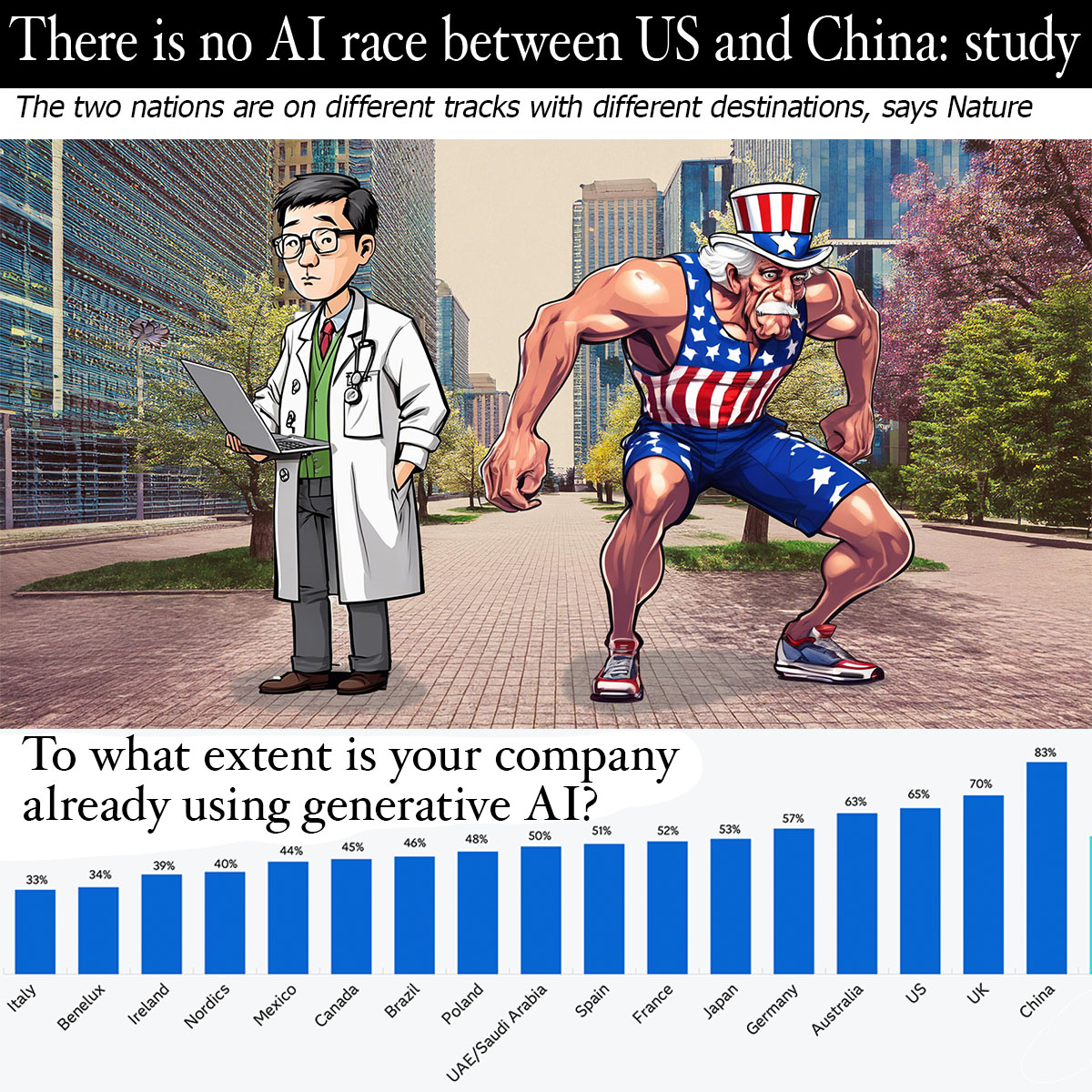
There is no race between China and the US to be top player in AI development, says a new report from Nature, the world's top science journal. The two countries are on different tracks with different endpoints. The US has been leading the pack in making big, headline-grabbing projects like ChatGPT, while China's focus has been, and remains, the production of practical AI programs that help industrialists, farmers, business people and factories. AI programs in China are being used "to make trains run on time, monitor fish stocks and provide automated telehealth services," says the report by science writer Jacob Dreyer in the latest edition of the scientific publication. Ultimately, China will do its usual thing, passing the systems that work to other nations, "especially to lower-income countries," the report says. . DIFFERENT SOURCES OF SUPPORT In the west, companies need to have innovative ideas that make an impact in the media to attract venture capitalists to invest. In contrast, China has more of an engineering school approach—projects must have practical benefit and be shown to be working to get government investment. "The divergence in priorities reflects the forces driving innovation in each economy: venture capital in the United States and large-scale manufacturing enterprises and organs of the state in China," Dreyer says. That doesn't mean that Chinese AI projects are always smaller. One of them is to integrate AI into a system to control the national grid so that the best use can be made of energy. China is keen to keep its reputation as a leader in making clean energy options affordable around the world. "Its emerging AI playbook mirrors its approach to other technologies, such as electric vehicles and clean energy: not the first to innovate, but the first to make them affordable for widespread use," Dreyer writes. The huge attention paid to DeepSeek, a relatively cheap but high performance AI chatbot, has hidden the difference in strategies, inspiring journalists to conjure up the colorful but ultimately inaccurate scenario of a US-China AI "arms race". . STRATEGIC PLAN - FOR FARMERS The appearance of the Nature report happily coincided with the February 20 publication of a Chinese government "strategic plan" for farmers to use scientific developments, including AI and genetic modification, to boost crop production and help the country move towards food self-sufficiency. You can't get much more practical than that. Other recent data also bolsters the theory that Chinese AI projects may be lower profile, but have already made more inroads in business and industry. A recent international study of usage of AI revealed that more respondents from China – 83 per cent – said their companies were using AI, than respondents from the United States – at only 65 per cent. In fact, the data in the SAS Generative AI Global Research Report shows that China was ahead of all other nations in the study in this regard (see pic). [from fridayeveryday. com]
Nury Vittachi tweet media
English
52
274
773
68.4K
Dr Paul R Kelly retweetledi
Nate Hake
Nate Hake@natejhake·
Google's AI Overviews = theft 🚨 And Google just got smacked with a lawsuit by Chegg -- and it's utterly fantastic ⚖️ I'm a former commercial litigator turned online travel publisher -- here are my notes from reading the complaint (link in next tweet) 👇 (warning, this summary is long & took me all morning to put together -- if you're a publisher please take 10 minutes to actually read it & share it with others) 1) Chegg is represented by the Susman Godfrey firm -- which means they are not messing around. Susman has quite the reputation as savvy, hard-charging litigators 2) Importantly, the compliant is grounded in antitrust law (NOT copyright, as I initially expected). And, goodness, it's a real banger .... 3) The complaint says the "exchange of access for traffic is the fundamental bargain that has long supported the production of content for the open commercial Web." 🎯 4) It continues: "But in recent years, Google has begun to tie its participation in this bargain to another transaction to which Chegg and other publishers do not willingly consent. As a condition of indexing publisher content for search, Google now requires publishers to also supply that content for other uses that cannibalize or preempt search referrals." 5) Chegg talks not just about AI Overviews, but also references featured snippets 6) 🫶this part -- "Google’s foray into digital publishing is designed to make Google a destination, rather than a search origination point to other websites." 7) Even if Google provided a separate opt-out for AI Overviews, it wouldn't work - because Google's monopoly power creates a collective action problem 8) A lot of fantastic points about how Google unfairly leverages its monopoly power to bend the open web to Google's will 9) Paragraph 13 is chef's kiss 🫰... "Google’s conduct is already eroding incentives for Chegg and other publishers to produce such valuable and useful content. If not abated, this trajectory threatens to leave the public with an increasingly unrecognizable Internet experience, in which users never leave Google’s walled garden and receive only synthetic, error-ridden answers in response to their queries—a once robust but now hollowed-out information ecosystem of little use and unworthy of trust." 10) Search engines are supposed to be intermediaries between users and web publishers. The complaint quotes old-school Google saying "We may be the only people in the world who can say our goal is to have people leave our website as quickly as possible." 11) Search is a uniquely important channel for publishers. Other channels of traffic like social media can never replace search, because that traffic is not intentional 12) "Put simply, Google’s search monopoly gives it control over online distribution for digital publishers. Google uses that power to force digital publishers to give up their content. Google then itself acts as a publisher, either by republishing portions of other digital publishers’ content or by using GAI to summarize the content. The end result is that users increasingly consume other web publishers’ content on Google’s SERP, either in abridged or derivative form, which starves those publishers of traffic and revenue." 13) Chegg calls Google's strategy for publishers "embrace, absorb, extinguish" 14) Next is an entire fantastic section recounting the history of "Google’s Transformation from a Search Engine to Web Publisher" 15) Google appropriated publisher's content in 2 phases. Phase I it calls the 'republishing phase.' The complaint talks about featured like featured snippets & People Also Ask 16) Hilariously, paragraph 63 includes a screenshot of Sundar Pichai's mug inside a SERP for "who is google's ceo" 16) "Google refers to Featured Snippets, Top Stories, and People Also Ask as “search features.” But they are separate and distinct products from search results. This is Google acting as an answer engine—not a search engine." 17) Republishing is not automatically bad, but the problem is that Google forces it on publishers as a condition for appearing in Search (of which it has a monopoly) 18) "The decision to opt out of republishing by disallowing snippets or withholding Search Index Data is a Hobson’s choice. " 19) Phase II of Google's strategy to dominate online publishing centers around AI Overviews ("GAI") 20) Complaint notes that the non-monopolists like OpenAI and Perplexity have been forced to do licensing deals with many publishers, whereas Google has largely avoided this cost thanks to its search monopoly 21) Complaint walks through the differences between LLM pre-training and RAG (a point I've been trying to educate publishers on for months and months) 22) Next is a recap of Google's LLM product history: Bard, SGE, Gemini & AI Overviews 23) @rustybrick commentary is cited quite a bit (see footnotes on pages 40, 41) 24) The transition to AI Overviews "all but completes Google’s evolution from a “search engine” to an “answer engine” that publishes answers to user’s queries. Its formerly symbiotic and complementary relationship with publishers has now become overwhelmingly parasitic and competitive." 25) Google's own marketing language directly admits that the purpose of featured snippets & AI Overviews is to prevent users from clicking throughs to publishers 26) Next section talks about how Google's unauthorized use of publisher content for AI training 27) "Google has been intentionally vague in identifying the precise data sets used to train the LLMs underlying Gemini and AI Overviews" 28) "Google’s Terms of Service indicate that it uses all the information that it collects for search indexing to train its LLMs, including Chegg’s data. " 29) Google announced Google-Extended in Sept 2023, but blocking it doesn't change that Google trained on your content or that Google uses it for RAG 30) Next section: Google poses a "fundamental threat" to online publishing 👏👏 31) Lots of discussion on how AI Overviews directly compete with and seek to replace online publishers 32) Oh WOW - in paragraph 121, Sussman dug up a pretty damning admission in a 2023 Google DeepMind presentation: Google admits Generative AI in search would "reduce referrals to content providers hurting their ability to monetize" 33) Lots of outside observers recognize the risk AI Overviews present to publishers. Footnotes cite @timsoulo among others 34) AI Overviews increase "zero click" searches 35) AI Overviews will cause a downward spiral in publishing quality - as the incentive to create gets less, quality degrades, and the whole web suffers 36) Google has put publishers in an awful position - by publishing content, they feed the very AI beast that is consuming publishers alive 27) Next, the complaint walks through the actual legal claims -- which, IMHO, are quite strong 28) First - "reciprocal dealing," an antitrust concept which "occurs when a firm with market power refuses to sell product X to a customer unless that customer agrees to sell (or give) product Y to it. In this case, the product Google is selling to (and threatening to withhold from) digital publishers is Search Referral Traffic." 29) Second - "monopoly maintenance." Basically argues that Google's use of AI constitutes a form of "rent extraction" on publishers. 30) Google is using AI to illegally entrench its search monopoly 31) Third - "Unjust enrichment" - which basically means Google has unfairly benefited at the expense of publishers via wrongful conduct. 32) "The value of Google’s models and AI products is directly related to the quality of the works that it acquires to train them and ground their outputs." 33) Finally - a recital of the counts: I - Reciprocal Dealing in Violation of Section 1 of the Sherman Act II - Reciprocal Dealing in Violation of Section 2 of the Sherman Act III - Tortious Conduct in Violation of Section 2 of the Sherman Act IV - Unlawful Monopoly Leveraging in Violation of Section 2 of the Sherman Act V - Unlawful Monopolization in Violation of Section 2 of the Sherman Act VI - Unlawful Attempted Monopolization in Violation of Section 2 of the Sherman Act VII - Common Law Unjust Enrichment 34) Lastly, Chegg's request for relief is of course damages and attorney fees, but also for a permanent injunction preventing Google from engaging in unlawful conduct 35) Chegg demands a jury trial ***link to complaint in next tweet*** My overall takeaway? This is a truly fantastic complaint. The only thing I think it missed is Google's admission in a blog post in summer 2023 that robots(.)txt is not a sufficient consent mechanism in the AI age. But, other than that, they really did their homework and hammered a ton of points I've been railing about for years. If you are a publisher - please share so others see! 👏👏👏
English
52
242
752
98K
kasra
kasra@kasratweets·
I am obsessed with hofstadter's "surfaces and essences." it's a 500 page book on the nature of thought. he basically gives you a very long list of examples demonstrating that all thought is fundamentally driven by analogy. at first I was skeptical but
kasra tweet media
English
159
478
7.3K
505.8K
Dr Paul R Kelly
Dr Paul R Kelly@prkpolava·
@Bbopen @kasratweets LLMs don’t think though, so how do they have thought-Lang representation? Gonna need a whole lot of Wittgenstein and Vygotsky to work that out. Good discussion!
English
0
0
1
14
Dr Paul R Kelly retweetledi
Gary Marcus
Gary Marcus@GaryMarcus·
AI reality is finally setting in. Just in the last few days: • Heavy AI booster Klarna backed away from its all in on AI stance • Humane AI Pin was canceled and company sold for parts • Grok 3 didn’t meet expectations • Mathematician @littmath exposed massive hallucination in Deep Research. (I pointed out similar issues in Deep Search last night) • OpenAI implicitly acknowledged that they don’t yet have GPT-5, and would not get there purely by scaling pretraining. Look for a correction, likely before the end of the year.
Gergely Orosz@GergelyOrosz

Klarna was the company that went all-on replacing customer support with an AI bot and went on to brag about the cost savings. Now they are reversing course. Easy to see more companies blindly replacing quality customer support with a worse AI implementation will follow...

English
19
102
438
48.9K
Dr Paul R Kelly retweetledi
Hidden AmuraKa
Hidden AmuraKa@AmurakaHidden·
The Matrix: "Simulacra and Simulation" 🧵 In the beginning of the first "Matrix" film, Neo conceals important computer files within a hollowed-out copy of the real life book titled "Simulacra and Simulation", a novel by Jean Baudrillard in 1981.
Hidden AmuraKa tweet media
English
18
150
914
78.5K
Dr Paul R Kelly
Dr Paul R Kelly@prkpolava·
AI, what is it good for? 🎶 Interesting thread here.
GIF
BURKOV@burkov

To make it super clear, language models are awesome. Otherwise, I wouldn't spend 9 months of my life working hours after my day job on writing a book on them. What's wrong about them is not what they can do, but what the lying CEOs, VCs, and parasite influencers say they are or will be able to do. This is what they are awesome at: 1. Giving answers that are more important now with some chance of error than perfect but tomorrow 2. Interactive problem-solving, where the user is an expert and could solve the problem alone, but it would take more time. This includes theorem proving, math problem solving, coding, and technical writing. 3. Converting it into a temporary "You are a classifier that can distinguish between these C classes" model that helps accelerate a complex system development and which will later be replaced with a real classifier. 4. "You act as an expert in domain A. Here's a document from domain A. Extract from it attributes B and C verbatim so that I can automatically locate them for verification." 5. Converting between programming languages, JSON, XML, YAML, or between different API specification formats. 6. "Improve my writing so that it fits in this context." 7. "Write 3 most important points of this long online article." 8. "Translate this text from language A to language B." 9. "Write code according to this specification so that all of my hidden tests pass." 10. "My code fails, here's the stack trace. Fix it." 11. "You are an expert in domain A. Generate examples of documents and their labels, to be validated by a human." 12. "Here's the solution (code, document) provided by a human. It does contain errors. Find them." 13. "Here's a scientific article. What does X in equation 2 represent and where does it come from?" 14. "Here's the code. What does function A do and why is this specific command used?" Also, use cases where hallucination is a feature: 15. Storytelling, poetry, scriptwriting 16. Brainstorming and ideation 17. Roleplaying (in all senses) All these use cases have been available since GPT-3.5, and nothing new was added. Only solution quality has been gradually improving without ever reaching perfection.

English
0
0
0
32
Dr Paul R Kelly retweetledi
Sayash Kapoor
Sayash Kapoor@sayashk·
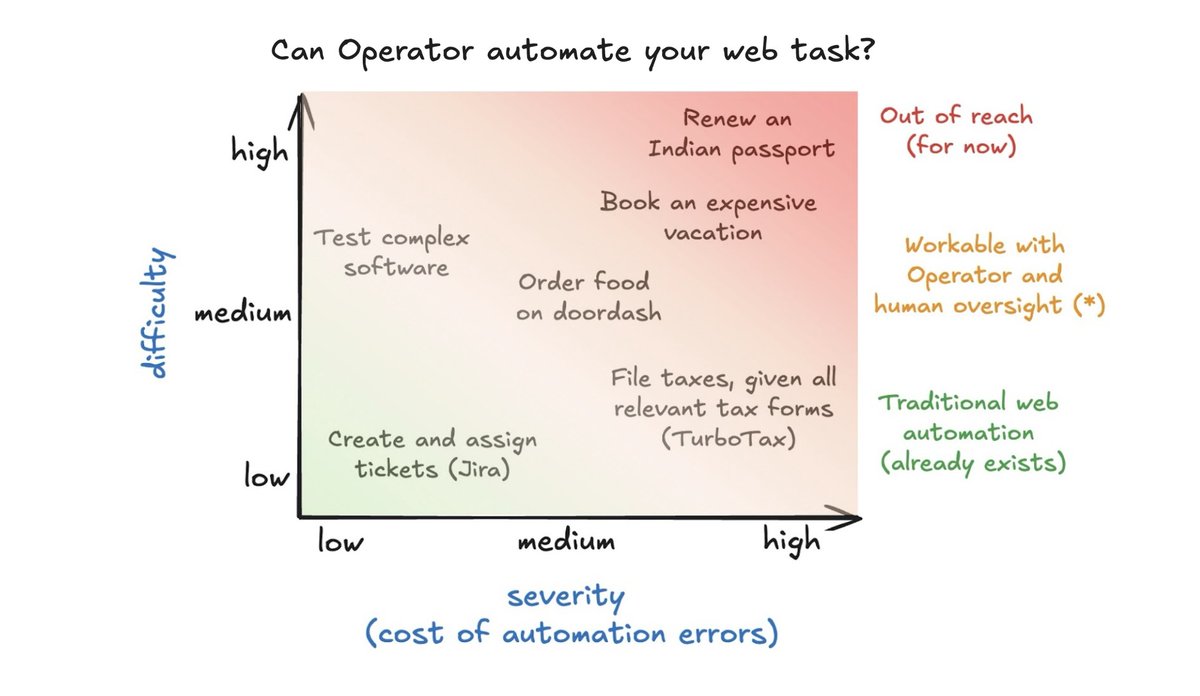
I spent a few hours with OpenAI's Operator automating expense reports. Most corporate jobs require filing expenses, so Operator could save *millions* of person-hours every year if it gets this right. Some insights on what worked, what broke, and why this matters for agents 🧵
Sayash Kapoor tweet media
English
26
119
1.4K
301.3K
Dr Paul R Kelly
Dr Paul R Kelly@prkpolava·
He said, if unchecked, it could: “… feed disinformation campaigns, erode public trust and entrench authoritarian narratives within our democracies”. What DeepSeek? OK we’ll be careful. Or ChatGPT X Facebook ? Errr, … bit late. theguardian.com/technology/202…
English
0
0
0
26
Dr Paul R Kelly retweetledi
Yishan
Yishan@yishan·
I think the Deepseek moment is not really the Sputnik moment, but more like the Google moment. If anyone was around in ~2004, you'll know what I mean, but more on that later. I think everyone is over-rotated on this because Deepseek came out of China. Let me try to un-rotate you. Deepseek could have come out of some lab in the US Midwest. Like say some CS lab couldn't afford the latest nVidia chips and had to use older hardware, but they had a great algo and systems department, and they found a bunch of optimizations and trained a model for a few million dollars and lo, the model is roughly on par with o1. Look everyone, we found a new training method and we optimized a bunch of algorithms! Everyone is like OH WOW and starts trying the same thing. Great week for AI advancement! No need for US markets to lose a trillion in market cap. The tech world (and apparently Wall Street) is massively over-rotated on this because it came out of CHINA. I get it. After everyone has been sensitized over the H1BLM uproar, we are conditioned to think of OMG Immigrants China as some kind of Alien Other. As though the Alien-Other Chinese Researchers are doing something special that's out of reach and now China The Empire is somehow uniquely in possession of Super Efficient AI Power and the US companies can't compete. The subtext of "A New Fearsome Power Now Under The Command of the CCP" is what's driving the current sentiment, and it's not really valid. Like, no. These are guys basically working on the same problems we are in the US, and not only that, they wrote a paper about it and open-sourced their model! It is not actually some sort of tectonic geopolitical shift, it is just Some Nerds Over There saying "Hey we figured out some cool shit, here's how we did it, maybe you would like to check it out?" Sputnik showed that the Soviets could do something the US couldn't ("a new fearsome power"). They didn't subsequently publish all the technical details and half the blueprints. They only showed that it could be done. With Deepseek, if I recall correctly, a lab in Berkeley read their paper and duplicated the claimed results on a small scale within a day. That's why I say it's like the Google moment in 2004. Google filed its S-1 in 2004, and revealed to the world that they had built the largest supercomputer cluster by using distributed algorithms to network together commodity computers at the best performance-per-dollar point on the cost curve. This was in contrast to every other tech company, who at that time just bought what were essentially larger and larger mainframes, always at the most expensive leading edge of the cost curve. (To the young people reading this, this will sound incredible to you) I worked at PayPal at the time, and in order to keep pace with the rising transaction volume, the company was forced to buy bigger and bigger database servers from Oracle. We were totally Oracle's bitch. At one point when we ran into scalability issues, the Oracle reps told us we were their biggest installation so they had no other reference point on how to help us overcome our scalability issues. We literally resorted to flipping random config switches and rebooting it. (This heavily influenced me when I was a young manager later at Facebook. I deliberately torpedoed an Oracle salesman's pitch to try and get us to switch from open source MySQL databases to an Oracle contract: of course we had scalability problems, but at least when we had them, we could open up the hood and figure out how to fix it ... assuming we had good enough engineers, and we did. When it's closed-source infra, you're at the mercy of the vendor's support engineers) Back to Google - in their S-1, they described how they were able to leapfrog the scalability limits of mainframes and had been (for years!) running a far more massive networked supercomputer comprised of thousands of commodity machines at the optimal performance-per-dollar price point - i.e. not the more expensive leading edge - all knit together by fault-tolerant distributed algorithms written in-house. Some time later, Google published their MapReduce and BigTable papers, describing the algorithms they'd used to manage and control this massively more cost-effective and powerful supercomputer. Deepseek is MUCH more like the Google moment, because Google essentially described what it did and told everyone else how they could do it too. In Google's case, a fair bit of time elapsed between when they revealed to the world what they were doing and when they published a papers showing everyone how to do it. Deepseek, in contrast, published their paper alongside the model release. Now, I've also written about how I think this is also a demonstration of Deepseek's trajectory, but that's also no different from Google in ~2004 revealing what it was capable of. Competitors will still need to gear up and DO the thing, but they've moved the field forward. But it's not like Sputnik where the Soviets have developed technology unreachable to the US, it's more like Google saying, "Hey, we did this cool thing, here's how we did it." There is no reason to think nVidia and OAI and Meta and Microsoft and Google et al are dead. Sure, Deepseek is a new and formidable upstart, but doesn't that happen every week in the world of AI? I am sure that Sam and Zuck, backed by the power of Satya, can figure something out. Everyone is going to duplicate this feat in a few months and everything just got cheaper. The only real consequence is that AI utopia/doom is now closer than ever. ==== Bonus: This is also a little similar the Ethereum PoS moment, when AI finally has a counterpoint to the environmentalists who say AI uses so much electricity. We just brought down the cost of inference by 97%!
English
296
1.2K
6.5K
864.1K
Dr Paul R Kelly retweetledi
Ed Newton-Rex
Ed Newton-Rex@ednewtonrex·
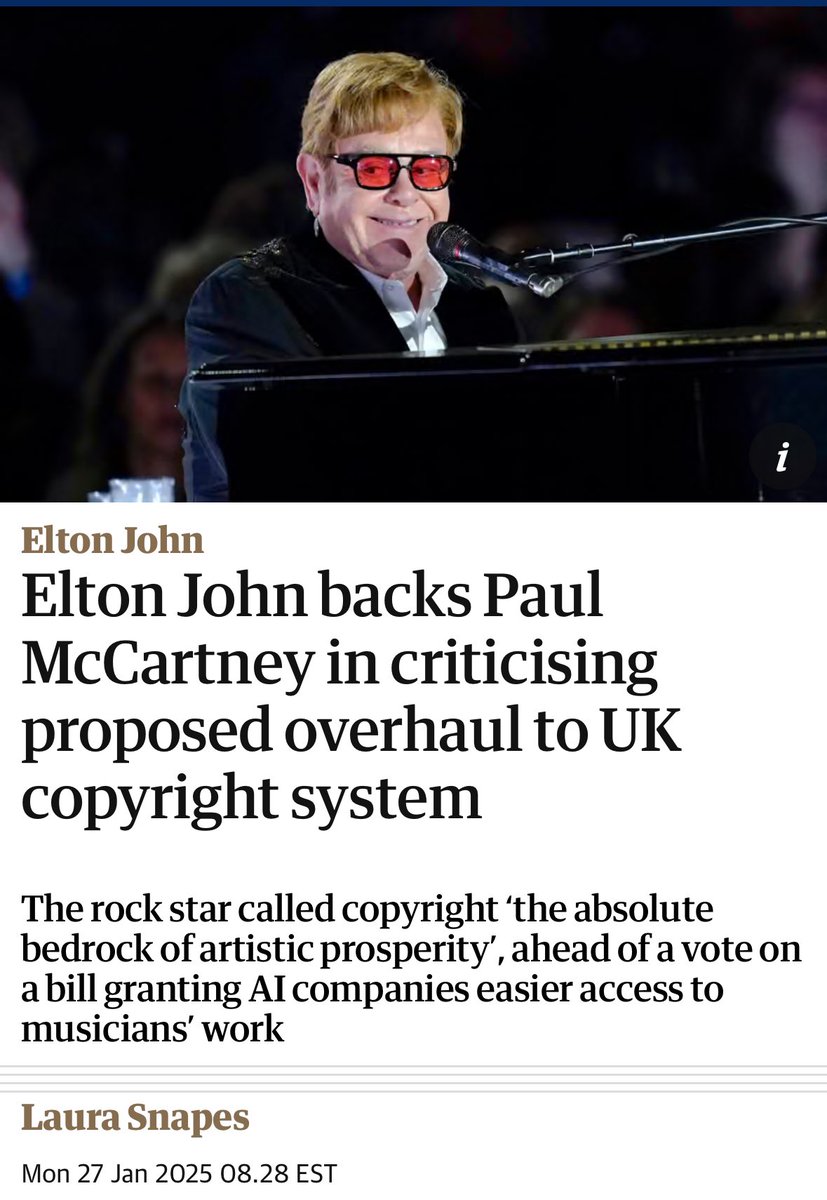
Sir Elton John joins Sir Paul McCartney in rejecting - in the strongest possible terms - the UK government’s plan to upend copyright law to favour AI companies. He says the plan “will allow global big tech companies to gain free and easy access to artists’ work in order to train their artificial intelligence and create competing music. This will dilute and threaten young artists’ earnings even further. The musician community rejects it wholeheartedly.” @RhonddaBryant @lisanandy @Keir_Starmer theguardian.com/music/2025/jan…
Ed Newton-Rex tweet mediaEd Newton-Rex tweet mediaEd Newton-Rex tweet media
English
15
339
1.2K
49K
Dr Paul R Kelly retweetledi
Karen Hao
Karen Hao@_KarenHao·
As someone who has reported on AI for 7 years and covered China tech as well, I think the biggest lesson to be drawn from DeepSeek is the huge cracks it illustrates with the current dominant paradigm of AI development. A long thread. 1/
English
206
2.9K
12.7K
2.3M