Joseph Bulbulia

1.5K posts

Joseph Bulbulia banner
Joseph Bulbulia

Joseph Bulbulia

@prof_joe_

Psych Prof Victoria University NZ | New Zealand Attitudes & Values Study | causal inference

Wellington City, New Zealand Katılım Nisan 2009
494 Takip Edilen593 Takipçiler
Joseph Bulbulia
Joseph Bulbulia@prof_joe_·
@jayvanbavel Pay reviewers and the problem vanishes. It is amazing the works has been unpaid.
English
0
0
1
111
Jay Van Bavel, PhD
Jay Van Bavel, PhD@jayvanbavel·
The peer review system is cratering. I've heard a ton of stories like this at many, many journals. Even prestigious, high impact journals are having trouble getting reviewers. The review process is getting longer and less reliable. My guess is that AI will make this much worse unless something changes. In the meantime, the best hope is to share pre-prints and circulate them widely.
Hudson Golino@GolinoHudson

DO NOT SUBMIT PAPERS TO Nature Scientific Reports @SciReports unless you want to undergo our #unfair treatment too. We submitted our manuscript on July 29 2025 and yesterday, after 8 MONTHS and no first round of feedback, despite suggesting twice additional reviewers, we discover no Editor is currently handling our manuscript. 🤐 Our TILLMI paper describes a 10K$ experiment including a new instrument measuring#trust in #LLMs (arxiv.org/abs/2502.21028) and it received even a few citations despite still being a preprint. This paper does not deserve being halted for 8 months with no feedback whatsoever. 👆 The system is indeed overwhelmed and it is difficult to find reviewers, I know this very well being myself an Editor in a good journal too. 👇 But this disservice, halting a paper for 8 months, cannot be accepted. Not in a journal venue where the whole process is covered by an APC, where editors and reviewers keep being exploited for free. Journal authors are treated like nothing. It is time to #complain and #change. 😢 @MassimoSt @gaveltri

English
5
4
39
9.8K
Joseph Bulbulia
Joseph Bulbulia@prof_joe_·
Thanks Frank. It’s not a particular clear paper. But I think the authors try to deal with this point in section 3.7. To avoid your valid concern, we need to include indicators of all common causes of the treatment and outcome. Practically this means including the same data that physicians and patients use when deciding whether to initiate into treatment. This in turn requires rich and accurately measured time-series data. Setting this data challenge aside, we cannot guarentee the exchanability assumption, so we should do sensitivity analyses (e.g how much unmeasured confounding would explain a result away). I would have liked to see the authors discuss this need in more detail. Another practical challenge the authors could have discussed in more detail relates to the positivity assumption. To emulate a trial you need it that the treatments to be compared are observed at every level of covariate needed to satisfy the conditional exchangeability assumption. In many settings, such overlap will be sparce and unconvincing. And you can check this with data. Perhaps a different way of putting the worry is that once you adjust for confounding “by indication” — a special case of confounding by unmeasured common causes of treatment and outcome — even very large data sets will often fail you. Often but not always… we do our best, including when reporting challenges and uncertainties. Finally the authors raise important concerns about generalisations, which apply to RTCs too, and the paper overall is worth reading I reckon.
English
2
1
3
347
Joseph Bulbulia
Joseph Bulbulia@prof_joe_·
@theo I don’t like this OS much, but I kinda like the rounding.
English
0
0
0
2.2K
Joseph Bulbulia retweetledi
Edward Slingerland
Edward Slingerland@slingerland20·
Please consider contributing an entry or using this poll as a tool for cross-cultural research. All DRH data is grounded in space and time and tagged with language, religious tradition and other data, enabling large-scale analysis in a way that was never before possible.
Edward Slingerland tweet media
English
1
1
6
347
Joseph Bulbulia
Joseph Bulbulia@prof_joe_·
@ryancarson Totally 👍. It feels like the titanic just after hitting an iceberg — some puzzlement, a few creaking sounds, but the band plays on, and things seem mostly normal. The semblance of normality lasts longer than you’d think, but the ship’s fate is certain.
English
0
0
0
29
Ryan Carson
Ryan Carson@ryancarson·
Prediction: I think a large number of leading-edge devs will stop using IDEs in the next 12 months. I've always used an IDE because I like the UI, but I find that for agentic coding, there's now a huge amount of cruft in the IDE UI that just slows me down and slows the agent down. I'm moving to just using CLI agents + gitui + a couple terminal panes and I'm way faster. Curious to hear everyone's thoughts. I think we're starting to see the beginning of SDLC 2.0 This also means it's time for GitHub 2.0 to emerge.
English
195
59
960
184.8K
Joseph Bulbulia
Joseph Bulbulia@prof_joe_·
@sama what’s a week/month/year in the grand scheme? can’t be too careful.
English
0
0
1
1.3K
Sam Altman
Sam Altman@sama·
we planned to launch our open-weight model next week. we are delaying it; we need time to run additional safety tests and review high-risk areas. we are not yet sure how long it will take us. while we trust the community will build great things with this model, once weights are out, they can’t be pulled back. this is new for us and we want to get it right. sorry to be the bearer of bad news; we are working super hard!
English
2.3K
1.1K
18.8K
3.5M
Alex Albert
Alex Albert@alexalbert__·
We’re rolling out more updates to Claude Code. First, the GitHub Actions integration is now available to Pro and Max plan users (in addition to pay-as-you-go API users).
English
70
88
1.7K
177.2K
Joseph Bulbulia
Joseph Bulbulia@prof_joe_·
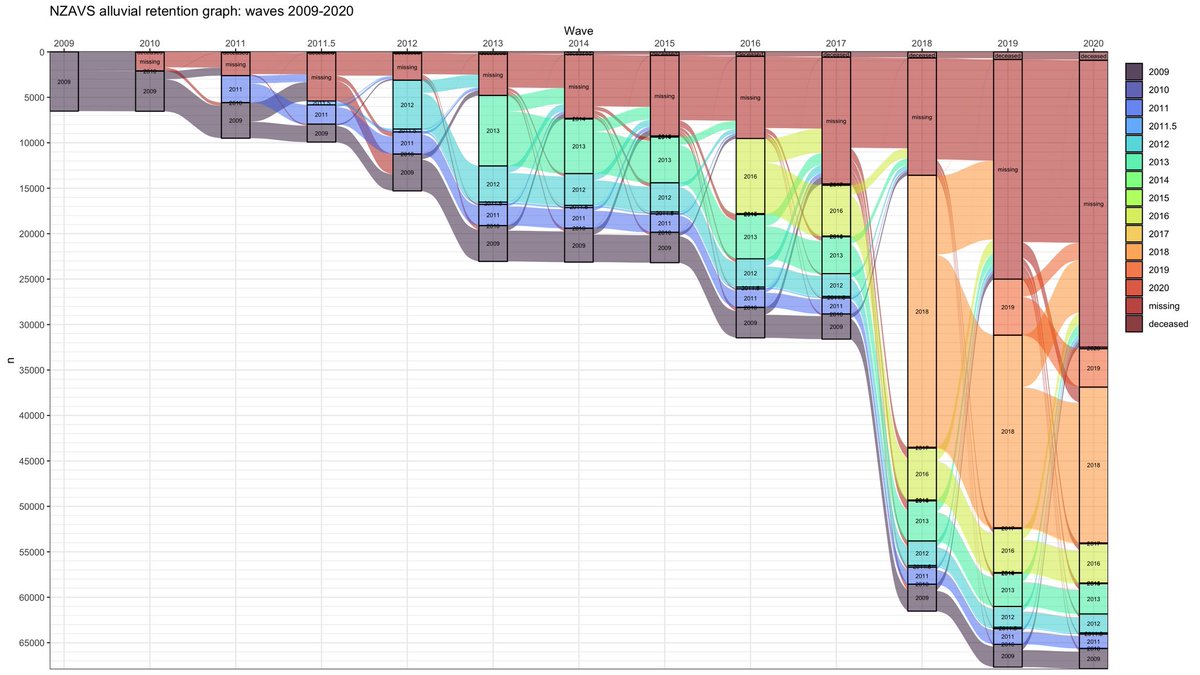
Hey AJ, love your work & value your opinion. A few years ago a collaborator asked me to make an alluvial plot to show sampling and retention in a panel study we’re involved with. I prob could have done better. To my eyes, though, it nicely conveyed magnitudes of annual boosters, dynamics of attrition/retention, and the interest in recovery of lost participants (or did so for me). But maybe there’s a better way…
Joseph Bulbulia tweet media
English
1
1
4
171
Joseph Bulbulia
Joseph Bulbulia@prof_joe_·
@alexalbert__ It is so reliable now. And for the first time, i experience an Ai that is capable of looking ahead to potential problems, and opportunities, in ways I’d not seen myself. I love Claude’s personality. You folks have done amazing work. Thank you 🙏
English
0
0
1
219
Alex Albert
Alex Albert@alexalbert__·
It's been a week since Claude 4 launch. Tell me everything you like and don't like about the new models so we can keep pushing on it or fix it in the future!
English
685
37
1.5K
445.9K
Joseph Bulbulia
Joseph Bulbulia@prof_joe_·
@alexalbert__ Claude 4 is not just the biggest news in Ai this year. It’s the only news. So. Darn. Helpful!
English
0
0
0
117
Alex Albert
Alex Albert@alexalbert__·
Since Claude 4 launch: SWE friend told me he cleared his backlog for the first time ever, another friend shipped a month's worth of side project work in the past 5 days, and my DMs are full of similar stories. I think it's undebatable that devs are moving at a different speed now. You can almost feel it in the air that this pace is becoming the default norm.
English
181
155
2.9K
977.3K
Joseph Bulbulia
Joseph Bulbulia@prof_joe_·
@SCP_Hughes Thanks Samuel, this is fascinating. History clarified that minimal bound of what is possible for us.
English
0
0
2
1.2K
Joseph Bulbulia retweetledi
Samuel Hughes
Samuel Hughes@SCP_Hughes·
London is famous for its garden squares, laid out by private developers in the eighteenth and nineteenth centuries. Why did they do this? A short thread.
Samuel Hughes tweet mediaSamuel Hughes tweet mediaSamuel Hughes tweet media
English
22
213
2.2K
205.5K
Joseph Bulbulia
Joseph Bulbulia@prof_joe_·
We must start with a clear question. What would be the differences in average weight on some contrast scale (e.g. the difference scale) for some target population (e.g. people who have not exercised for at least four weeks prior) if everyone were to pursue some or another regime specified by a protocol. We randomly assign to one of four arms (we prob want a control condition) and a pair-wise contrast on the difference scale give us the causal effects of one intervention compared to another in terms of population average weight were everyone to undertake one regime or another. We typically don’t get the contrasts of interest from pre/post differences within arms of a trial.
English
1
0
1
208
Joseph Bulbulia
Joseph Bulbulia@prof_joe_·
It looks like a Simpson’s Paradox. Districts don’t commit crimes, individuals do. High crime individuals will stop at a higher rate than low-crime individuals, e.g. because they tend more to get caught, lose interest, discover opportunities, exhaust opportunities, or whatever… so the high crime individuals might strongly contribute to both the incidence of crime and the decline in crime in districts over time. I can’t access this paper (and have no expertise on this issue) — my comment relates to Simpson’s Paradoxes which trip people up everywhere, and might be worth considering here.
English
0
0
1
408