private_fox

3.3K posts

private_fox banner
private_fox

private_fox

@prvtfox24

Investing for fun. Nothing I say should be construed as financial advise

Katılım Aralık 2023
1.4K Takip Edilen350 Takipçiler
private_fox retweetledi
mon
mon@moninvestor·
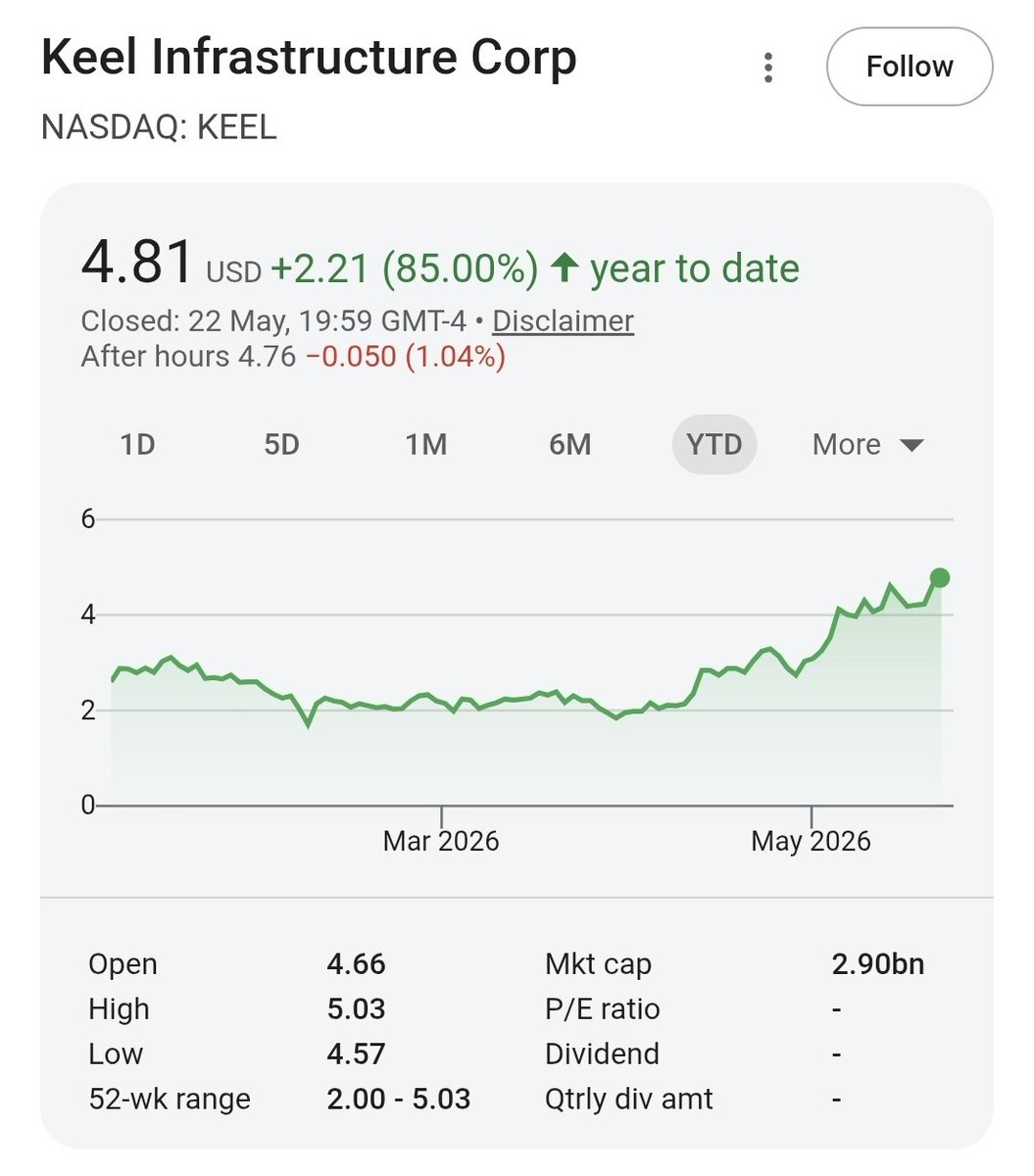
$KEEL is a very interesting stock. - Market cap around $2.9 billion. - Up 85% year to date. - Leopold increased his positions. Two near-term catalysts: 1 - CEO Ben Gagnon has committed to signing 3 leases by year-end, one for each site. 2 - Set to join the Russell 3000 in the June reconstitution. The portfolio is over three sites: 1 - Panther Creek, PA, 350 MW, with a path to 400-430 MW and a load study supporting 500+ MW long term. 2 - Sharon, PA, 110 MW (30 MW operational, 80 MW under development). 3 - Moses Lake, WA, 18 MW pilot site. There's currently a massive gap between KEEL and the rest of the neocloud space, but that gap is deceiving. It exists solely because KEEL hasn't yet landed a hyperscaler deal, and just one deal is all that's required to start closing it.
mon tweet media
English
29
54
399
33.5K
private_fox
private_fox@prvtfox24·
@franklee6924T Great post! It did not occur to me that Anthropic made deploy Claude clusters within IRENs data factories for use by other tenants. Brilliant.
English
0
0
4
409
franklee6924x
franklee6924x@franklee6924T·
$IREN & Anthropic, Part II: The Greatest Catalyst Comes from Extreme Efficiency and Optimal Cost The first part of this theme primarily analyzed the significance of IREN’s uniquely neutral positioning to Anthropic. This article is the second part, examining the fundamental factor truly driving the cooperation between the two sides. Let me begin with the conclusion: IREN’s Sweetwater will become an essential site for Anthropic’s hyperscale training and inference operations, and NVIDIA is the most likely active facilitator behind this deal. The core force truly binding Anthropic and IREN together comes from exceptional efficiency and optimal cost — the most fundamental element that any company aspiring to become a top-tier enterprise simply cannot avoid. The cooperation between NVIDIA and IREN is aimed precisely at this element. Among the creators of this advantage, IREN provides the optimal cost structure, the fastest response speed, the best operational management, and the most secure long-term electricity supply capacity. NVIDIA provides overall operational planning and maintenance, full-stack technological support for the DSX system, and jointly builds with IREN the flagship standard for DSX AI intelligent factories. The numerical embodiment of this standard is extreme efficiency. To use numbers as an analogy, the integrated flagship DSX system they are building could allow 1GW of electricity to generate the equivalent token output of 2GW or even 8GW. In today’s energy-constrained real world, this carries incomparable significance. Maximum efficiency and optimal cost naturally become the first choice for the strongest models — the “brains.” They will become enhanced validations of each other’s greatest strengths: the strongest models become even stronger, producing higher output, thereby proving that this system of extreme efficiency and optimal cost can become a universally deployable standard. The AI intelligent factory standard led by NVIDIA and co-built with IREN, through deployment by Anthropic’s leading models, will radiate capability outward from the NVIDIA ecosystem to the four hyperscale companies currently cooperating with Anthropic. Through comparative advantages, these hyperscalers will be compelled to consider moving closer to NVIDIA’s AI intelligent factory model. Anthropic can therefore completely break free from the awkward dynamic of simultaneously cooperating and competing with the four hyperscalers, gaining far more strategic initiative. For Anthropic, this is the best possible path with no true alternative — increasing its autonomy while gaining a clear advantage in its competition with OpenAI. At the same time, validation through top-tier model deployment creates top-down momentum that helps promote the flagship DSX intelligent factory standard itself. Extreme efficiency and optimal cost are the universal keys to success for any enterprise. Using them as the analytical link connecting IREN, NVIDIA, and Anthropic is by far the most convincing explanation. Claims such as “someone’s girlfriend works as an executive at Anthropic, so he massively increased his IREN holdings” are merely street gossip and cannot serve as a basis for judgment. A large part of Tesla’s success came from extreme cost efficiency. IREN became the only consistently profitable company in the Bitcoin mining industry for the same reason. Now, in the AI world, the role of IREN’s extreme cost advantage is even greater, and the difficulty is far higher. During the Bitcoin mining era, it was sufficient to secure grid power, establish peak-balancing agreements with utilities, choose remote locations, and maintain ample redundancy. The vertically integrated model of building data centers did not demonstrate particularly obvious importance or moat value in the Bitcoin business. But in the AI era — especially in the stage of AI intelligent factories under the DSX framework — full-process, vertically integrated control becomes enormously significant for achieving extreme cost efficiency. NBIS’s recent forced decision to spend $2.6 billion turning to BE in search of power resources is the best possible illustration of IREN’s extreme cost advantage. On this point, @Enduciot1nvest has provided extremely detailed data analysis. After running the calculations, you realize how enormous the gap truly is. The capital markets have clearly made a major mistake: they have almost completely reversed the pricing of certainty versus extreme uncertainty. As for optimal efficiency, there are two layers of meaning. The first is the improvement brought by the design and integration of hardware infrastructure. This is exactly what NVIDIA, Dell, Lenovo, and IREN are jointly researching at IREN’s 60MW Childress site in Texas, and what will gradually be reflected in the flagship DSX intelligent factory to be established at IREN’s SW1 site. The second layer of optimal efficiency is what IREN has consistently emphasized: what kind of data center it intends to build and operate. On this point, I will quote research material provided by Germany-based @IdeaLDeFi. His material strengthens and complements this article, and I appreciate his contribution. The italicized section below is quoted from his content: At Sweetwater, what IREN and NVIDIA are building is not a data center custom-designed for one specific client, but a massive AI factory capable of hosting multiple enterprises simultaneously. It resembles a never-stopping digital racetrack: the infrastructure is provided by IREN, the compute engine is powered by NVIDIA’s DSX architecture, and who gets to use the racetrack depends entirely on demand at any given moment. Anthropic is merely one tenant, leasing part of the space to train Claude; at the same time, large corporations, banks, and research institutions are training their own medical AIs, financial models, or image generators in different sections of the same factory. All tenants share the same physical infrastructure while operating their software and data in completely isolated environments. This model is known as a multi-tenant compute factory. The genius of this factory lies in the fact that it is itself a system capable of autonomous operation, autonomous measurement, and continuous optimization. IREN’s power and cooling systems must operate at full load 24 hours a day, meaning any compute vacancy is immediately filled. If Anthropic temporarily reduces demand after completing one stage of Claude training, the spare capacity is instantly absorbed by a bank’s risk models, a hospital’s medical imaging training, or an automaker’s autonomous driving systems. Compute is never wasted, and utilization remains close to the theoretical limit at all times. Meanwhile, Mirantis’s software layer ensures complete data isolation between all tenants. Even if a bank’s workloads and Anthropic’s workloads run on the same batch of NVIDIA superchips, they can never access each other’s data. Every client enters the factory with its own models, software, and data, without any points of contact between them. For Anthropic, the scalability enabled by this model is nearly decisive. If it wants to catch up with Google or Microsoft, building its own data centers, power systems, and cooling infrastructure would require hundreds of billions of dollars in investment. But inside IREN’s factory, this infrastructure is already deployed in advance. Anthropic only needs to continue extending new NVIDIA racks into adjacent machine halls in order to scale training without shutting the system down. If tomorrow it decides to train a new model twice the size of Claude 4, it does not need to wait for a new campus to be constructed, nor does it need downtime testing. NVIDIA’s DSX architecture can use digital twin technology to simulate the thermal, electrical, and networking changes brought by expansion before deployment, allowing the entire factory to remain stable during scaling. In a sense, IREN resembles the world’s most advanced skyscraper: it provides the foundation, electricity, cooling, and structural framework; NVIDIA provides the top-tier office equipment and technological systems; and Anthropic becomes the flagship tenant occupying the top floors, performing its model “magic” within it. Other enterprises occupy their own floors in the same building, training their own models and running their own applications without overlap. Automotive companies train autonomous driving systems, banks train financial models, research institutions run medical simulations, and some enterprises even directly deploy open-source models such as Llama or Mistral. All of this occurs simultaneously within the same factory, without interference. Once you connect all of these elements together, you realize the true nature of this AI factory: it is not built for any single company, but for the entire AI era. It is a digital racetrack that is always running, always expanding, and always optimizing — and Anthropic is merely one race car pushing the track to its limit. The true protagonist is the infrastructure itself: a platform capable of hosting countless models, countless enterprises, and countless future possibilities. Excellent. He emphasized the enormous appeal and capability of the never-shutting-down digital racetrack jointly built by IREN and NVIDIA. If you understand IREN, you will know that this vision of a multi-tenant compute factory has always been $IREN’s ambition. I even believe the implementation of this function represents IREN influencing NVIDIA. It opens up an even broader development space for extreme efficiency. Achieving this truly requires the coordinated operation of multiple top-tier enterprises; it goes far beyond the narrow technical meaning of merely designing and assembling server racks. Now let us return to the theme of this article: what does this mean for Anthropic? What additional value can this kind of environment bring to NVIDIA, IREN, and Anthropic? For the NVIDIA–IREN intelligent factory system: Anthropic occupies a unique position. It is the “flagship race car” that pushes the entire racetrack to its limits. Its existence creates a structural driving force for the factory itself: the scale of its training workloads, the complexity of its models, and its extreme requirements for network latency and thermal management continuously force IREN and NVIDIA to raise the standards of the factory. Anthropic’s training tasks themselves become stress tests for the factory — the driving force behind continuous upgrades of the entire system. In a system where not a single second of compute downtime is tolerated, every tenant can obtain exactly what they need inside the isolated environments created by Mirantis, all while achieving maximum efficiency. Although there is no overlap whatsoever at the data layer between tenants, a kind of “physical-layer resonance” still exists. This resonance is not information sharing, but mutual reinforcement at the infrastructure layer. When a bank trains risk models, it fills the temporary compute vacancies left unused by Anthropic, allowing the factory to remain fully loaded. When a hospital trains medical imaging models, it keeps IREN’s power systems operating under stable thermal loads. When an automotive company trains autonomous driving models, it continuously validates NVIDIA’s network architecture under high-concurrency conditions. None of these activities are related to Anthropic’s business, yet invisibly they make the entire factory more reliable, more efficient, and more mature. And it is precisely within such a continuously “polished” environment that Anthropic trains Claude. What it enjoys is an infrastructure that is always fully loaded, always stable, and always optimized — and the maturity of this infrastructure comes precisely from the existence of those other tenants that have nothing to do with it. There is no direct cooperation between them, yet they form a remarkable kind of “infrastructure symbiosis.” For Anthropic: First, it no longer needs to worry about infrastructure; it only needs to focus on the models themselves. Second, its training environment becomes stronger, more stable, and more efficient because of the presence of other tenants. This is a form of “passive benefit.” Third, within the ecosystem established inside this factory, it gains enormous additional advantages. The larger this ecosystem becomes, the better its training conditions become and the greater its returns become. What truly changes inside an AI factory operating within the same physical campus is the relationship between compute resources themselves. Traditional cloud systems depend on public internet transmission, where model invocation is an expensive, slow, and friction-filled API request. But inside the factory, all models, databases, and inference engines are placed on the same high-speed interconnected backplane. APIs are no longer “network requests”; they become “internal process calls.” Latency falls from milliseconds to microseconds. Data no longer crosses borders, no longer requires encryption, and no longer incurs bandwidth fees. All computation is completed within the campus intranet, as naturally as scheduling different threads within the same machine. This physical proximity eliminates the resistance created by “data gravity,” transforming tasks that once required multiple network hops into local calls. Once the distance between models is compressed to this degree, business logic undergoes a qualitative transformation. In the past, banks needed to package, encrypt, and upload internal data, call Claude’s API, wait for results, and then hand them back to internal risk-control models for processing. Under the factory model, however, the bank’s risk-control models and Claude’s inference replicas function as though installed on the same motherboard. A trigger from the database can directly invoke Claude’s real-time analysis, whose output is then returned within milliseconds to the risk-control system for final decision-making. The entire chain becomes a computational assembly line, automatically orchestrated into a continuous sequence of actions, as though all components were simply different modules of the same software. Anthropic never touches the bank’s data. It merely deploys Claude’s inference clusters into certain cabinets within the campus, while other tenants access these replicas through internal high-speed gateways. All traffic flows within physically isolated intranet environments, never leaving the campus and never passing through public internet encryption. For the first time, enterprises can simultaneously possess the security of private deployment and access to the world’s most advanced models, without having to make painful trade-offs between the two. And for Anthropic, the significance of this system extends far beyond merely “selling models.” It is no longer simply a provider of application programming interfaces. Instead, it becomes the intelligent foundation layer of the factory itself — an “intelligence source” that all tenants can invoke at any time. Claude’s role here resembles electricity or water: an always-available production resource capable of real-time response and extraordinary efficiency due to physical proximity. As more and more enterprises embed their business logic into this internal compute assembly line, Anthropic’s models become foundational intelligent components of the entire campus, deeply integrated into the computational pathways of every enterprise. When inference evolves from a “consumer product” into a “means of production,” and when collaboration between models becomes automatically orchestrated within millisecond-level timeframes, the speed at which enterprises build applications becomes the new competitive frontier. Since everyone effectively “lives in the same building,” a new form of homogeneous compute collaboration may emerge in the future. For example, an autonomous driving company could invoke Claude’s inference capabilities through the factory’s ultra-high-speed internal network, or a bank could perform model fine-tuning directly within the factory, leveraging the underlying data-flow architecture validated by Anthropic. This geographic proximity — where physical distance is compressed into millisecond-level latency — creates a “compute ecosystem park” effect. For Anthropic, this means its growth speed, model iteration capability, training cost structure, and scalability will all be amplified by this ecosystem. It does not need to depend on other tenants, yet it benefits from their existence. It does not need to cooperate directly with them, yet the compute ecosystem park effect greatly increases its own value. The situation described above is the best real-world illustration of what Daniel referred to in his long essay on “three layers of structure and a continuously compounding advantage”: resources become locked in, customers become bound, operational records become entrenched, supply chains become occupied, and the industry landscape becomes rapidly fixed into place within a short period of time. Once such a system emerges, its competitiveness becomes extraordinarily powerful. It represents the integration of multiple layers of excellence. The improvement in efficiency and output is no longer several isolated points operating in parallel, but the coordinated collaboration of an entire industrial cluster. Every participant in the process is elevated dramatically. At this point, it can be said that multiple logical threads have completed mutual validation. Under the guiding principles of extreme efficiency and optimal cost, it becomes only natural for top-tier enterprises to come together, because they will reinforce and strengthen one another. This is jointly determined by three major forces: the limitations of social resources, the efficiency principles driving industry development, and the pursuit of capital returns through cost control. Please stay tuned for Part III — How IREN and Anthropic May Ultimately Cooperate.
English
12
24
192
30.6K
private_fox
private_fox@prvtfox24·
@AlphaTrader00 Seems Hedgie is a bit bearish. I take it you are in the camp that enterprise spend is about to go even more parabolic. What are the knock-on effects? Cutting spend across other internal business segments, reduction in benefits (401k match), RIFs, etc.?
English
1
0
0
87
Archimedes
Archimedes@AlphaTrader00·
I'm proud to announce that Archimedes has once again revised his H2 2026 forward return estimates higher Wish me luck!
Hedgie@HedgieMarkets

🦔Microsoft canceled its internal Claude Code licenses this week after token-based billing made the cost untenable, even for a company with effectively infinite cloud resources. Uber's CTO sent an internal memo warning the company burned through its entire 2026 AI budget in just four months. American AI software prices have jumped 20% to 37%, and GitHub (owned by Microsoft) is dropping flat-rate plans for usage-based billing across its products. My Take The AI subsidy era is ending in real time. The same company that put $13 billion into OpenAI and built the Azure infrastructure powering most of Anthropic's compute just looked at the bill from a competitor's coding tool and decided it was not worth paying. That is not a productivity failure on Anthropic's end. Token-based pricing is forcing every enterprise customer to confront the actual cost of running these models at scale, and the number turns out to be far higher than the flat-rate experiments suggested. This ties directly to my Gemini Flash post yesterday. Anthropic, OpenAI, and Google all raised effective prices in the last six months. Enterprises that built workflows assuming AI costs would keep falling are now watching annual budgets evaporate in months. Two outcomes look likely from here. Either enterprises scale back AI usage to fit budgets, which slows the revenue ramp the labs need to justify their valuations ahead of IPOs, or the labs cut prices and absorb the losses, which makes the unit economics worse at exactly the wrong moment. Both paths land in the same place, the numbers stop working, and somebody has to take the writedown. Hedgie🤗

English
1
0
4
4.2K
Kerdos Capital
Kerdos Capital@kerdoscapital·
Comparing the $IREN and $NBIS investments from $NVDA Seen a lot of poor takes on this so wanted to lay out the facts of the two investments. NBIS bulls will tout that NVDA invested directly in them and did not in IREN. This is true but is not clearly depicting all the information: NVDA directly invested $2B in NBIS and in return they recieved 21M shares with an exercise price of $0.0001 per Class A ordinary share. What NBIS gave NVDA were pre-funded warrants which are essentially near zero cost call options. NBIS got the cash upfront while the share issuance was deferred until NVDA chooses to exercise (there was a 6 month lockup period). Essentially that means that there's still 21M shares of dilution yet to come from this investment. Effective price per share works out to ~$94.94 (~$2B / 21.065M), which was roughly where NBIS was trading pre-announcement (~$24B market cap). IREN also gave NVDA warrants but the structure of their deal was much different. IREN gave NVDA the right to purchase up to 30M shares at an exercise price of $70 which comes out to roughly $2.1B What IREN did though is instead of taking NVDA's cash up front and giving them warrants at market value they gave them up at a premium and in addition made them conditional on GPU delivery. Dan Roberts confirmed this on the earnings call "Their rights to invest only vest as NVIDIA GPU infrastructure is deployed across our campuses, and only fully vest upon deployment of 600,000 GPUs. NVIDIA's capital is directly tied to execution. That's not a passive financial investment. NVIDIA is a partner who wins as we deliver." Essentially NVDA receives 50 warrant shares per GPU delivered. (Although it will obviously be broken down into tranches something like 100,000 GPUs = 5,000,0000 warrants) This aligns incentives. NVDA is incentivized to deliver GPUs to IREN on schedule as well as funneling customers their way because as NVDA delivers to IREN they receive an increasing stake in the company and as NVDA helps IREN grow that stake increases in value exponentially. In my opinion it's pretty obvious who got the better deal...
English
19
16
164
10.5K
Just Another Pod Guy
Just Another Pod Guy@TMTLongShort·
Seeing concern now that this Karpathy move indicates Anthropic already won and is therefore bearish for the other labs. My take is this indicates that we are close to RSI and therefore an accel in model IQ increases. In that scenario the value of compute is going to explode as supply chain scale ups are linear while demand-creation is non-linear. Anyone with compute is sitting pretty regardless of lab talent. Full stop. Every GPU will explode in value. If you can run a million Von Neumann in a datacenter we will quickly have AI inventing use cases for token consumption faster than we can supply them. New fields of science. Reverse aging. The goonasphere. It all gets pulled forward and it will all require compute.
English
39
27
681
59.1K
private_fox
private_fox@prvtfox24·
@SylentTrade Acqui-hiring going on here. I am assuming there are some talented brand management folks who will be able to protect and grow IRENs reputation as political env heats up
English
0
0
0
349
private_fox retweetledi
nic carter
nic carter@nic_carter·
"AI is hiking your energy bill" is the most popular political talking point of 2026. The data doesn't support it. A thread:
nic carter tweet media
English
112
321
1.9K
273.4K
Mario
Mario@Mario20253035·
aschenbrenner's q1 13f filed today. this isn't "long the AGI theme" — it's surgical rotation inside a $5.5B book. trims: • $BE common: 10.1M → 6.5M shares (-35%). took ~$480M off his biggest winner near the highs. • $CORZ: -9.5% (he holds 9.4% via 13D — a real trim, not a rebalance) • $INFY: dumped -24%. IT services isn't the trade. new builds in the miner basket: • $CLSK: +648% shares (1.6M → 12.3M). massive new conviction. • $BITF: +188% shares • $RIOT: +86% shares • $BTDR: +92% shares top-tier AI host adds: • $IREN: +34% shares → $401M position • $CRWV: +18% shares → $556M position • $APLD: +19% shares he kept the $BE calls. 408,500 contracts, +55% value q/q. converted appreciated common into pure optionality. still long the power thesis, just asymmetric now. the cleanest signal: $CORZ -9.5% while $IREN +34%. inside the top tier of miner-pivot names, he picked $IREN as the relative winner. owns $CRWV bigger in dollars but $IREN got the bigger % add. the playbook: 1. sell common from biggest winner near the highs 2. keep optionality via calls 3. recycle proceeds into laggards in the same thesis 4. pick relative winners inside each basket ($IREN > $CORZ) not chasing. compounding. that's the discipline behind a $5.5B AGI book.
English
5
6
77
15.1K
Just Another Pod Guy
Just Another Pod Guy@TMTLongShort·
Every day that I gain conviction in the mania that will follow the labs going public and ramping a massive infra buildout I worry a little more that my BTC is going to dump as a source of liquidity as being an AGI-maxi becomes consensus If I didn’t live in a high-tax state and if my funds PA policy wasn’t so restrictive I’d already have full ported bottleneck plays instead but alas I am destined to be poor
English
43
8
287
48.6K
₿en Gagnon AKA Hashoveride
₿en Gagnon AKA Hashoveride@hashoveride·
Good morning Keel Mates! Just want to do a quick followup from our Q1 call Monday with the key takeaways: 1. Continued progress on permitting and zoning secured 2. Confident on getting 3 leases signed this year 3. Increasing investor interest with twice as many attendees on our Q1 call than normal and 63 investor meetings in the last 3 days. For those of you who missed it, links below: Q1 Webcast: ir.keelinfra.com/events/event-d… Q1 Power Analysis: youtube.com/watch?v=r_OOoF…
YouTube video
YouTube
McNallie Money@McnallieM

"When we say we're going to get 3 leases signed this year, we're going to get three leases signed this year" @hashoveride CEO @keelinfra_ 👀👀👀 Seriously, give this a watch and try not to be BULLISH!!! $KEEL

English
32
46
319
29.8K
private_fox
private_fox@prvtfox24·
Microsoft Copilot is down. They don’t have the compute to serve this tool consistently. LOL $IREN
English
0
0
2
205
private_fox
private_fox@prvtfox24·
$cifr is still severely under valued at $21.
English
0
0
0
49
Dak Nakamoto
Dak Nakamoto@daknakamoto·
The amount of knowledge @hashoveride has in this industry and is willing to openly share is incredible. This doesn’t just help $KEEL shareholders, it’s valuable insight that can be applied across the entire sector. Well done. These interviews with Ben are basically turning into TED Talks at this point. 🫱🏾‍🫲🏼
McNallie Money@McnallieM

"When we say we're going to get 3 leases signed this year, we're going to get three leases signed this year" @hashoveride CEO @keelinfra_ 👀👀👀 Seriously, give this a watch and try not to be BULLISH!!! $KEEL

English
2
3
42
2.4K
Just Another Pod Guy
Just Another Pod Guy@TMTLongShort·
Idk who needs to hear this but revenue per GW for the labs increases non-linearly as model capabilities climb and pass critical tipping points. The more compute is brought online *if* scaling laws are still holding the more capacity the labs have to throw at training and research which in-turn accelerates model capabilities. This confounds the usual laws of supply-demand dynamics in economics and throws boomer PMs for a loop because they are incapable of thinking abstractly since they have tee time at their local golf course to worry about. The real constraints on lab revenue in theory are enterprise adoption rates, marginal rate of invention (model creativity), and the consumers marginal propensity to spend. In reality because we operate in a reflexive system where the people running the labs also have the happy coincidence of being some of the highest IQ people in our society they will preemptively structure go-to-market approaches to accelerate past these constraints. That will include incubating competitors in-house, co-opting existing distro systems like gov/PE/consulting firms, introducing game theory by whitelisting partners for exclusive access and advocating for things like UHI. Everything is downstream of scaling laws holding. Everything.
English
17
12
263
20.1K
Sylent Capital
Sylent Capital@SylentTrade·
I still have an adrenaline rush from $IREN earnings. That was the craziest move I’ve ever seen. 1 minute candle from $57 to $72 was brilliant. We will get many more of those in the near future.
English
6
5
227
12K
Mike Alfred
Mike Alfred@mikealfred·
Starting to slowly average up in SLNH. Tyler Page's comments on Tuesday really solidified my view that behind the meter power generation is going to be a key part of the long term story here. SLNH is well positioned for this at a very low market cap. High asymmetry possible.
English
73
80
993
128.3K
Elliott Chart
Elliott Chart@ElliottChart·
$IREN — Quantum Model Projection Bullish Outlook | Extension Underway📈 IREN has surged 33.55% on the week, advancing through the initiating impulsive phase of Intermediate Wave (3), projected to develop as an extension. As previously highlighted, Primary Waves ⓵ and ⓷ developed with comparable magnitude. From an analytical standpoint, this reinforces the potential for an extension in Primary Wave ⓹. The newly illustrated converging resistance Q-Structure λ₁ now points toward a Q-Target ➤ $133.33💫 projected along the July 6 timeline. 🔖 Outlook is derived from insights within the Quantum Models framework. Within this methodology, Q-targets are high-probability projections generated by the convergence of equivalence lines. These Quantum Structures also function as structural anchors, shaping the model’s internal geometry and guiding the evolution of alternative paths as price action unfolds. $CryptoStocks $CryptoMining #QuantumModels
Elliott Chart tweet media
Elliott Chart@ElliottChart

$IREN — Quantum Model Projection Bullish Outlook | Projected Extension Underway IREN has advanced 62% since late March, firmly supported by the convergent Q-Structure λₛ, as projected—reinforcing the Primary degree extension in Wave ⓹ now underway. Wave Analysis This impulsive advance in Intermediate Wave (1) characteristically indicates a broader extension into Primary Wave ⓹. As illustrated on the chart, a retracement at Intermediate degree is expected to follow as Wave (2) from current levels—aligning with $BTC ’s projected corrective phase in Int (2). 🔖 Outlook is derived from insights within the Quantum Models framework. Within this methodology, Q-targets are high-probability projections generated by the convergence of equivalence lines. These Quantum Structures also function as structural anchors, shaping the model’s internal geometry and guiding the evolution of alternative paths as price action unfolds. $CryptoStocks $CryptoMining $QuantumModels

English
5
4
49
20.1K