
Adam Mercer

44.7K posts

Adam Mercer banner
Adam Mercer

Adam Mercer

@punk6583

Punk #6583 | Sr. Producer @BeaconLayerPod | Taste is the new skill | Isaiah 41:10

New York, NY Katılım Kasım 2013
289 Takip Edilen26.8K Takipçiler
Sabitlenmiş Tweet
Adam Mercer
Adam Mercer@punk6583·
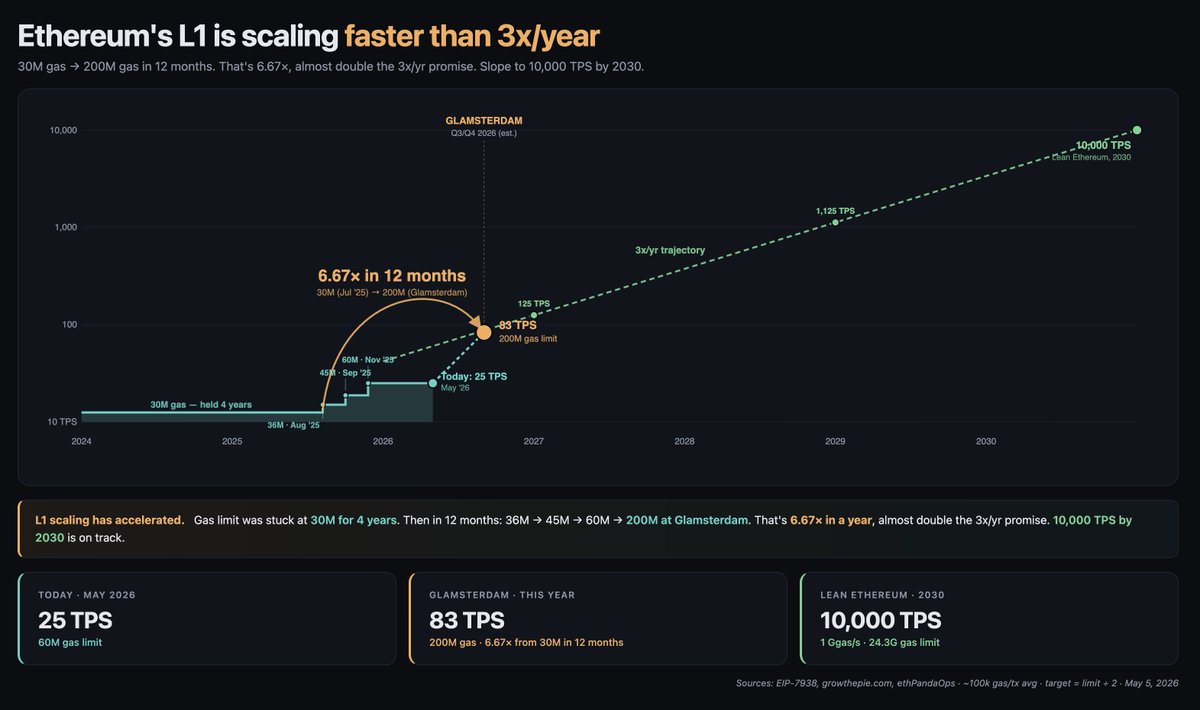
Ethereum L1 just woke up. 4 years at 30M gas. Then 36M to 60M (in 3 months). Glamsterdam takes us to 200M this year. 30M to 200M = 6.7x in 12 months. Closing in on 100 TPS this yr. 10,000 TPS by 2030 was a crazy aggressive hypothetical and amazingly...we're on track? Ethereum is back.
Adam Mercer tweet media
English
39
57
154
29.9K
Adam Mercer retweetledi
BeaconLayer Podcast
BeaconLayer Podcast@BeaconLayerPod·
“DA layers really differ across three dimensions: performance, programmability, and AI-native design — because on-chain AI can’t operate in a world measured in mere megabytes per second.” @sachimiyasaki catches up with @michaelh_0g, Founder of @0G_labs, to break down how 0G compares with Celestia, Avail, and EigenDA: why throughput needs to increase by orders of magnitude, how to move beyond the broadcast bottleneck, and why a decentralized storage network is essential for ultra-fast data ingestion and retrieval.
English
63
117
624
73.8K
Adam Mercer retweetledi
Kenzi Morikawa / 3061.eth
Really enjoyed my conversation today with @michaelh_0g from @0G_labs. We spoke about his background, what first pulled him deeper into technology, how that developed into a broader Web3 thesis, and the story behind building 0G. It was a meaningful conversation with a lot of depth, clarity, and real perspective. Grateful to Michael for the time and openness. And special thanks to the @BeaconLayer team, as well as to @SachiMiyasaki and @DikshaWells, for making it all possible.
BeaconLayer Podcast@BeaconLayerPod

“After moving from Berlin to Silicon Valley, I found myself bored at a new school — so I started spending time at my dad’s SAP Lab: fast internet, endless reading, and the beginning of my love for technology.” Our host @kenzimori sits down with @michaelh_0g (@0G_labs) to trace his origin story — from early curiosity and a growing obsession with tech to his path into Web3, and ultimately, the founding of his company.

English
36
90
273
47.5K
Adam Mercer retweetledi
BeaconLayer Podcast
BeaconLayer Podcast@BeaconLayerPod·
In crypto, liquidity dominates—shaping token prices, staking dynamics, and beyond. Now, following DTCC's recent SEC approval for federally compliant tokenization services, institutional-scale real-world asset (RWA) distribution onchain is poised to accelerate. Where will they go? Where the liquidity is... 👇 ~~ Analysis by @kenzimori ~~ DTCC's Requirements In its no-action request to the SEC, the DTCC lays out the technical requirements for key components of tokenization systems, including the underlying blockchain and supporting token-tracking software. This letter forms the basis for the SEC's no-action exemption, and specifies that any systems used to perform key functions of the tokenization service must comply with the DTCC's internal "Tier 2" systems requirements. Among other things, this criteria will require critical systems components to have "the ability to operate from a primary and a secondary location, a maximum four-hour recovery time objective, a maximum two minutes of data loss from an outage, and annual out-of-region disaster recovery and resumption testing." While the DTCC is opting to remain tech-neutral, it will not forcibly prescribe a particular blockchain or tokenization protocol. Eligible solution combinations must support compliance controls and achieve a Tier 2 systems rating. Liquidity Dominates The DTCC processed $3.8Q (quadrillion) of securities transactions in 2024. It is the highest value financial processor in the world and surpassed $100T in assets under custody this summer. If one was asked to identify the single most important lynchpin in the global financial system, "DTCC" would be a safe answer. Assuming superior liquidity is bound to win out in tokenization markets, the DTCC's near-limitless, preexisting supply of assets arms it with a durable advantage that should ensure everlasting dominance in tokenized securities markets. Which Chain Wins? Just as the DTCC is destined to become the dominant tokenization service by virtue of its enormous scale, liquidity dynamics dictate that a single blockchain will inevitably become the default choice for DTCC-sponsored tokenization offerings. Given the DTCC's technical requirements, several candidates can likely already be dismissed: @solana — Extended network outages over four hours are incompatible with the DTCC's uptime requirements. Solana has experienced multiple disqualifying outages, the most recent occurring last year. @Ripple — Despite being touted for banking integrations, it too has suffered outages; the network last halted in February. L2s — Contemporary designs use single sequencers that are liable to outages. It's also questionable whether they comply with DTCC requirements to "operate" from both a primary and secondary location. Bitcoin — The ecosystem lacks the requisite smart contracts functionality to support sophisticated financial applications and DTCC-required transfer restrictions. In this environment, @ethereum could very well become the default. The globally decentralized blockchain has recorded over ten years of consecutive uptime, making it one of the few blockchains that can achieve the DTCC's uptime requirements without a doubt. Even so, the DTCC also requires its critical systems to pass "annual out-of-region disaster recovery and resumption testing." How can Ethereum (a blockchain designed not to fail) possibly conduct any type of outage recovery testing? And might stratospheric, market-determined gas fees during high-use periods constitute an untenable outage? Circle's Arc could be another solution. The blockchain's permissioned proof-of-authority validator will be both decentralized enough to operate from multiple locations and centralized enough to accommodate testing. Another contender is @CantonNetwork, a public blockchain created by Digital Assets that claims to be the only network capable of offering configurable privacy and institutional-grade compliance. Canton purports to support over $6T in onchain real-world assets and process $280B in daily transactions through its network of 500 validators. Still, nothing prevents the adoption of proprietary database technology that can operate from more than one location, including some kind of Fedwire-styled, government-sponsored permissioned ledger. Conclusion Tokenization markets are a winner-take-most game. Whether DTCC tokenization ultimately settles on an existing general-purpose blockchain like Ethereum, a purpose-built RWA solution like Circle's Arc, or an unreleased Fedwire-styled government ledger, a future defined by multichain fragmentation appears an unlikely outcome. Crypto history is unambiguous on this point: liquidity crowns kings. Whichever chain manages to underpin DTCC tokenization efforts stands to inherit a gravitational pull multiple orders of magnitude greater.
BeaconLayer Podcast tweet media
English
20
21
150
38.4K
Adam Mercer retweetledi
BeaconLayer Podcast
BeaconLayer Podcast@BeaconLayerPod·
“What happens when someone inside one of the most iconic retail platforms of the last cycle sees its limits up close?” @kenzimori speaks with @jayendra_jog, Co-Founder of @SeiNetwork, to trace the path that took him from the early days of Robinhood in Palo Alto — through hypergrowth, the IPO era, and the shock of the GameStop moment — to building in crypto. They discuss how witnessing the mechanics and constraints of traditional financial infrastructure firsthand reshaped his thinking, why the suspension of buys during one of retail’s most defining episodes left such a lasting impression, and how that experience ultimately pushed him toward systems designed to be more open, more resilient, and less dependent on centralized control.
English
42
21
154
70.7K
Adam Mercer retweetledi
BeaconLayer Podcast
BeaconLayer Podcast@BeaconLayerPod·
“High-performance infrastructure only matters if it expands what users can actually do onchain — and makes that experience accessible at scale.” @sachitakahara sits down with @jayendra_jog, Co-Founder of @SeiNetwork, to examine why parallelized execution is becoming increasingly important for the next generation of onchain applications. From trading and DeFi to high-frequency user activity that simply breaks in low-throughput environments, they discuss how lower fees and greater execution capacity can fundamentally reshape the user experience — especially for smaller participants who are otherwise priced out. They also explore how this plays out in practice through projects like Bancor’s Carbon DeFi, where Sei has emerged as the ecosystem driving the strongest activity and volume, underscoring how performance advantages translate into real adoption.
English
31
14
19
41.4K
Adam Mercer retweetledi
BeaconLayer Podcast
BeaconLayer Podcast@BeaconLayerPod·
“Virtual machines are like cities — once they reach critical mass, they become magnets that are incredibly hard to displace.” @dikshawells catches up with @jayendra_jog, Co-Founder of @SeiNetwork, to unpack this idea at a deeper level — why systems with flaws can still dominate simply because that’s where the activity, liquidity, and people already are. From New York and San Francisco to onchain environments like the EVM, they explore how network effects compound over time, why newer ecosystems struggle to pull users away even with better tech, and what it actually takes to break that inertia.
English
24
10
123
44.3K
Adam Mercer retweetledi
BeaconLayer Podcast
BeaconLayer Podcast@BeaconLayerPod·
From a monster airdrop to ending the year as the #4 revenue machine in crypto ($650M+ generated and 70% of all perps volume at peak), Hyperliquid didn’t just grow in 2025 — it conquered. Here’s exactly how they pulled it off (and why 2026 will be the real test) 👇 ~~ Analysis by @kenzimori ~~ Q1 2025: The Crypto-Native Advantage Hyperliquid's year of breakneck growth kicked off with a reminder of what it means to truly have your finger on the pulse. When TRUMP launched in January, Hyperliquid had perps go live almost immediately, beating other exchanges to the punch and beginning its streak as the place for pre-launch tokens. It was able to move quickly because it stands somewhat unimpeded by corporate guardrails, but a significant element was being emphatically "in the know," spotting opportunities due to its team being tightly interwoven with the goings-on onchain. February brought the HyperEVM launch, the general-purpose smart contract layer built on top of HyperCore. While it took time to find its footing, it did so without any top-down incentive programs, building a core user base who believed in the chain's vision rather than just extracting incentives. Q2 2025: Breaking Out Traction came faster than most expected. Beyond HYPE climbing nearly 4x off its April lows, by May Hyperliquid commanded 70% of all onchain perps volume, a staggering figure for a platform with zero VC backing and no token incentives. As the market roared back, Hyperliquid's smooth UX and deep liquidity captured the order flow, with total volume climbing to $1.5T. The HyperEVM hit its stride alongside, growing TVL from $350M in April to $1.8B by mid-June as projects launched through @kinetiq_xyz, @felixprotocol, and @liminalmoney, all while burning HYPE in the background. Amid this growth, Hyperliquid seemed to be everywhere. Publicized on national TV. Profiled by Bloomberg. At the center of policy conversations with the CFTC. Q3 2025: Peak Momentum & Splintering Begins Q3 opened with a signal that Hyperliquid's infra was becoming essential outside its own ecosystem. @phantom Wallet integrated Hyperliquid via builder codes, Hyperliquid's mechanism for letting external platforms earn fees on trades they route to HyperCore. @Rabby_io followed. Then @MetaMask. A myriad of mobile trading apps went live on builder codes. "Partners" have earned nearly $50M in fees through these integrations, routing $158B in volume. Then, in September, came the USDH bidding war, revealing just how valuable Hyperliquid had become. The problem was simple: Hyperliquid held ~8% of Circle's USDC supply in its bridge, leaking roughly $100M annually to Coinbase while seeing none of that yield recycled into its own ecosystem. A native stablecoin would fix that, potentially redirecting $200M in annual revenue back to Hyperliquid. Heavyweights threw their names in. Ethena offered $75M in growth commitments. Paxos dangled PayPal and Venmo integrations. But @nativemarkets won, a team led by HYPE contributor @fiege_max, former Uniswap Labs COO @Mclader, and Paradigm researcher @anishagnihotri. Why? They fit the ethos: bootstrapped, aligned, and ready to build something organic. The ripple effects extended beyond Hyperliquid. MegaETH announced its own native stablecoin initiative shortly after. Sui followed suit in November. Yet USDH also marked HYPE's peak in mid-September, and the moment competition began to bite. Aster and Lighter both launched with aggressive airdrop campaigns. Hyperliquid's market share splintered, sitting at 17.1% at time of writing. Q4: Maturation & Growing Pains In October, HIP-3 went live, opening permissionless listings on HyperCore and advancing both the exchange's expansion and its decentralization. Anyone who stakes 500K HYPE could now deploy custom markets such as equity perpetuals, markets using yield-bearing collateral from Ethena, or markets for synthetic exposure to private companies from @ventuals. Yet, despite HIP-3's launch, HYPE price has dropped nearly 50% from its September peak. Besides market conditions and competition, two developments stand out. First, the quarter brought Hyperliquid's first ADL (Automatic De-Leveraging) event in over two years. During October 10's market breakdown, over-leveraged positions ran out of margin faster than the liquidation system could absorb. The protocol triggered auto-deleveraging over 40 times in a 12-minute span. While the system stayed solvent, Hyperliquid will likely need time to recover from the event. Then, in November, team token unlocks began. Despite lower-than-expected totals, this vesting is likely contributing to HYPE's underperformance. Selling was minimal, only 23% went to OTC desks while 40% was re-staked, but the pace of future unlocks remains unclear. From a protocol that's stood out by being transparent, this lack of clarity is likely causing market unease. The Perps Proving Ground While the market and trading activity are down, it's important not to discount how much the perps landscape has evolved alongside Hyperliquid itself. @Lighter_xyz and @Aster_DEX offer real alternatives. Offchain, Coinbase's perps offerings will soon be joined by Robinhood. More competitors will emerge as perpetuals continue going mainstream. Hyperliquid is in the midst of its proving ground and will continue to be in 2026. The question isn't whether it had a remarkable 2025, it certainly did. The question is whether the exchange can demonstrate that its model remains superior as the field gets crowded. What got them here was building a better product and ecosystem without shortcuts. What keeps them there will be doing it again.
BeaconLayer Podcast tweet media
English
21
16
114
40K
Adam Mercer retweetledi
BeaconLayer Podcast
BeaconLayer Podcast@BeaconLayerPod·
Crypto may finally get the market structure it's craved: the bipartisan Digital Asset Market Clarity Act (DAMCA), a 278-page bill from months of Senate negotiations with industry input. It divides oversight between SEC and CFTC, with concessions drawing mixed reactions. Paradigm's Justin Slaughter called it "a big win for Democratic Members on Senate Banking." Here are five key provisions that could shape crypto's future. 👇 ~~ Analysis by @kenzimori ~~ No Stablecoin Yield Under the Digital Asset Market Clarity Act, stablecoin issuers will be prohibited from distributing yield back to passive token holders. Title IV of DAMCA, which lays out the rules for how regulated banking institutions can interact with digital assets, will prohibit stablecoin issuers (as defined by the GENIUS Act) from making interest payments to holders. While DAMCA will allow stablecoin issuers to distribute rewards tied to actions, such as account opening incentives and cashback rewards, protecting stablecoin yield had previously been a firm "red line" for the crypto industry. Heavy restrictions on stablecoins risk putting crypto-native issuers at a perpetual disadvantage against the banking sector. Still, many key crypto players – including Coinbase – have surprisingly continued to back the bill's language on stablecoin yield prohibition, viewing it as the least favorable language they could tolerate without derailing the bill's momentum. Commodity Clarity Title I of DAMCA would amend the Securities Act of 1933 to clarify when crypto network tokens transition from securities into commodities. The SEC will publish formal guidelines within 360 days for when initial token distributors and largest recipients are considered a token's issuer. Title I establishes expansive regulations over anyone who sold, controlled, or caused the initial distribution, extending liability to related persons and SEC jurisdiction over foreign government tokens, tokens without company structures, and majority American-owned tokens. Network tokens can be treated as non-securities when they have no attached financial rights, such as profit sharing or ownership interest. To certify their non-security status, asset issuers must submit written certifications to the SEC. The Commission has 60 days to deny the certification. Projects unable to certify must publish semiannual mandatory disclosures. Projects with over $25M in gross proceeds must also publish audited financial statements. Title I will not be applied retroactively, meaning individuals who distributed tokens before enactment need not fear retroactive liability. DeFi Regulation Title III of DAMCA outlines when crypto projects are – and are not – considered truly "decentralized." A decentralized protocol allows users to make financial transactions via an "automated rule or algorithm that is predetermined and non-discretionary" without relying on a person to maintain custody or control over their assets. The designation of "non-decentralized finance trading protocol" applies when: a person or group can control or alter functionality; the application doesn't operate based solely on code; or a person or group can restrict, censor, or prohibit user activity. Non-decentralized protocols must comply with the Securities Exchange Act of 1934 and Bank Secrecy Act, imposing registration, conduct, disclosure, record-keeping, and supervision requirements. This may capture non-immutable smart contract protocols with even minimal operator control, including those using multi-signature technology or trusted encryption environments. Title III includes a carveout allowing protocol "security councils" to respond to incidents with "pre-defined, temporary rules-based cybersecurity emergency measures" without jeopardizing their decentralization status. Title III also imposes requirements on "web-hosted" crypto wallets, mandating compliance with sanctions and anti-money laundering regulations. This regulation won't apply to "any software or hardware wallet that facilitates the custody of an individual of their digital assets." Micro-Innovation Sandbox DAMCA will require the CFTC and SEC to establish a "Micro-Innovation Sandbox" within 360 days of its enactment to "enable 10 eligible firms to test innovative activities within the United States," subject to applicable Federal and State securities and commodities laws. To participate, eligible groups must be looking to conduct lawful innovative activities within the United States, and cannot employ more than 25 employees or gross more than $10M of revenue in any given fiscal year. All applications must be jointly approved by the CFTC and SEC for entry, and participants in the program will be granted regulatory relief, which can be revoked at any time by discretion of the Commissions. Sandbox participants will be required to satisfy the disclosure requirements of both Commissions when their jurisdiction is implicated, and any regulatory relief granted through the program will supersede any State securities or commodities registration requirements. Program acceptance will be limited to 20 projects per year, and accepted firms will be limited to $20M in aggregate customer, investor, or counterparty funds. Digital Asset Kiosk Crackdown Perhaps most surprisingly, the Digital Asset Market Clarity Act devotes significant attention to the regulation of digital asset kiosks – think Bitcoin ATMs. Under Section 205 of DAMCA, digital asset kiosks will be designated as "money transmitting businesses," imposing substantial regulatory burdens on operators of these cash-for-crypto machines. Every 90 days, operators will be required to submit a detailed list of their kiosks to the Secretary of the Treasury, including the operator's legal name, trade name, the physical address of each kiosk, and the digital assets compatible with the kiosk. Before entering into transactions, operators must disclose their terms and government-imposed consumer warnings in an easily readable manner. Digital asset kiosks will be required to furnish customers with a receipt detailing their transaction, and implement anti-fraud controls to prevent the transfer of digital assets to wallets known to be affiliated with fraudulent activity. The Secretary of the Treasury will also be empowered to set limits on single-day deposits and withdrawals at their discretion, but until such time, digital asset kiosk operators will not be permitted to conduct transactions exceeding $3.5k with "new customers" within any 24-hour period.
BeaconLayer Podcast tweet media
English
37
13
114
20.3K
Adam Mercer retweetledi
BeaconLayer Podcast
BeaconLayer Podcast@BeaconLayerPod·
@kenzimori sits down with @nickemmons, Co-Founder of @AlloraNetwork, to unpack the early conviction that pulled him into crypto — not as a trend, but as a new way to rethink power, coordination, and how systems are built. Before founding Allora, Nick led blockchain development at a major asset manager and insurance firm across North America, during a time when most enterprises were still focused on private chains and consortiums. Instead, he pushed toward public Ethereum — building real enterprise use cases around decentralized insurance and trying to capture what actually made blockchain powerful. From those early experiments to the AI x crypto frontier, this conversation traces how Nick’s view of decentralized systems kept expanding.
English
27
13
97
30.3K
Adam Mercer retweetledi
BeaconLayer Podcast
BeaconLayer Podcast@BeaconLayerPod·
@AlloraNetwork has now raised $35M in total — but the latest $3M round wasn’t just about capital. @sachimiyasaki speaks with @nickemmons about why this round was built around strategic alignment: bringing in AI-forward partners, funds, and individuals who understand where decentralized collective intelligence is heading. The goal isn’t only to grow the team or move faster. It’s to surround Allora Network with people who can help shape the next phase of AI coordination.
English
19
18
110
12.4K
Adam Mercer retweetledi
BeaconLayer Podcast
BeaconLayer Podcast@BeaconLayerPod·
AI doesn’t need another isolated model. It needs a network where intelligence can compound. @kenzimori in conversation with @nickemmons, Co-Founder of @AlloraNetwork, on breaking AI out of silos, turning fragmented models into collective intelligence, and building the coordination layer that could move AI beyond the control of a few monoliths.
English
28
17
114
19.5K
Adam Mercer retweetledi
BeaconLayer Podcast
BeaconLayer Podcast@BeaconLayerPod·
Web3 and AI are both hitting an inflection point at the same time. AI is redefining intelligence, automation, and how people interact with technology. Crypto is building the economic rails for that intelligence to coordinate, transact, and operate in open networks. @dikshawells in conversation with @nickemmons (Co-Founder, @AlloraNetwork) on why the overlap between AI and crypto may become one of the biggest design spaces of the next decade — and why we’ve barely scratched the surface.
English
34
21
106
25.3K
Adam Mercer retweetledi
BeaconLayer Podcast
BeaconLayer Podcast@BeaconLayerPod·
Amid Venezuela's suspicious Polymarket win, Rep. Ritchie Torres is fast-tracking his bill to bar officials from trading on nonpublic info. Here's why getting prediction market rules right could shape their future as trusted tools — or exploits for our political elites.👇 ~~ Analysis by @kenzimori ~~ The Political Case The argument for restricting public officials is straightforward: if politicians can legally profit from bets on outcomes they directly influence or have advance knowledge of, it twists incentives and erodes the already near-record low public trust in the U.S. government. This dynamic already plays out in traditional securities markets, where the STOCK Act of 2012 was supposed to address congressional insider trading. The results have been underwhelming. Despite the law's existence, examples of suspicious trading by members of Congress have continued to surface with regularity: - Senator Richard Burr sold $1.7M in stock immediately following a classified COVID-19 briefing; the DOJ later dropped the investigation without charges. - Senator Kelly Loeffler offloaded millions in assets after the same confidential pandemic warning, yet faced no legal consequences when federal probes concluded. - Senator Tommy Tuberville traded millions in defense contractor stocks and violated the STOCK Act's reporting deadline 132 times, yet faced no significant consequences. Since the STOCK Act passed in 2012, not a single member of Congress has been prosecuted under its provisions, while the penalty for concealing trades is a trivial $200 fee, which ethics committees routinely waive. Prediction markets present an even more direct temptation. Unlike stock trading, where connections between policy decisions and price movements can be complex and deniable, prediction markets offer explicit bets on government actions. Will a military intervention occur? Will a bill pass? The path from insider knowledge to profit proves incredibly clear. While the specifics are still unclear, @RitchieTorres bill reportedly extends STOCK Act principles to prediction markets, hopefully with greater, more meaningful enforcement. Legal frameworks matter and must be established. Without clear rules explicitly covering prediction markets, prosecuting suspicious trades becomes even harder. Why It Matters for Prediction Markets The broader issue extends way beyond politicians. Prediction markets generated over $44B in combined trading volume in 2025. They've proven their value as information aggregation tools — Polymarket's accuracy during the 2024 election cycle demonstrated what these platforms can do when they function properly. Functionally, insider participation doesn't necessarily break these markets. The transparency of blockchain-based platforms means suspicious positions are visible. Traders can tail wallets showing unusual activity. Information still gets priced in, even if the source is questionable. But reputation is a different matter. Prediction markets are still fighting for legitimacy with regulators, institutions, and the broader public. If the prevailing narrative becomes that these platforms are just another vehicle for connected insiders to profit from privileged information, the policy progression and mainstream adoption get harder when every major market move triggers headlines about who knew what and when. There's also a pragmatic concern: if today's broadly crypto-friendly regulators don't work with platforms to address these issues, hostile administrations of the future could do so with a much heavier hand. The window for self-regulation and productive collaboration is now. The Path Forward None of this means prediction markets need heavy-handed regulation across the board. Skepticism toward regulatory overreach is warranted. But there's a meaningful difference between resisting regulatory capture and acknowledging that certain narrow restrictions serve everyone's interests. Legally barring public officials from betting on outcomes they can influence falls squarely in the latter category. Few believe politicians should have new avenues to monetize their positions. The broader crypto community, which arose in part as a check against establishment abuse, has reason to support exactly this kind of accountability. We don't yet know the full details of Torres's bill. The specifics will matter. But the direction is right. Prediction markets work because they aggregate dispersed information into prices, and that function can survive some insider activity. The bigger risk is reputational: repeated incidents of apparent insider trading invite the kind of regulatory scrutiny that could constrain the industry far more than targeted rules around public officials ever would. The honest reality is that this behavior will likely continue regardless of what rules get passed. Enforcement is hard. Proving intent is harder. But there's much to be said for establishing clear norms and for the transparency that blockchain-based markets provide. Every trade on Polymarket is visible. Wallet activity can be tracked. The same infrastructure that enables suspicious trades also enables scrutiny of them. Researchers and journalists can monitor for patterns. Communities can call out suspicious activity in real time. These are formative years for these technologies, which, if stewarded well, will reshape how we aggregate information about uncertain futures. Getting the foundations right matters. Ensuring that government officials can't exploit these tools for personal profit seems like a reasonable place to start.
BeaconLayer Podcast tweet media
English
11
21
120
34K
Adam Mercer retweetledi
BeaconLayer Podcast
BeaconLayer Podcast@BeaconLayerPod·
“Proof of Collaboration = how strong the swarm is. Proof of Contribution = what each agent actually moved, with permanent on-chain audit trails.” @ronbodkin (Founder, @TheoriqAI) joins @sachimiyasaki to break down trusted performance in Theoriq: actions are committed on-chain as non-repudiable evidence, and evaluators use transparent scoring rules over the full history—while the system stays open for specialized eval agents.
English
35
16
178
43.7K
Adam Mercer retweetledi
BeaconLayer Podcast
BeaconLayer Podcast@BeaconLayerPod·
In 2017, I stepped into Google Cloud’s CTO Office because I could feel the shift coming. AI wasn’t a feature — it was the next operating layer of the world. Google was leading that wave. @kenzimori in conversation with @ronbodkin (Founder, @TheoriqAI) about the Google years that sharpened Theoriq’s vision — and the early signals that made the AI trajectory impossible to unsee.
English
29
13
204
32.2K
Adam Mercer retweetledi
BeaconLayer Podcast
BeaconLayer Podcast@BeaconLayerPod·
“DeFAI = DeFi as an agent economy: set the strategy, let agents execute, watch feedback in real time.” @sachimiyasaki x @ronbodkin (Founder, @TheoriqAI) on how AI-run DeFi could bring smart-money infrastructure to everyone — not only institutions.
English
24
16
114
24.8K
Adam Mercer retweetledi
BeaconLayer Podcast
BeaconLayer Podcast@BeaconLayerPod·
“Responsibility means steering crypto + AI toward outcomes that benefit everyone — and giving the community real power to set the course.” Our host @dikshawells in conversation with @ronbodkin (Founder, @TheoriqAI) on why responsibility in crypto + AI starts with governance from day one — so the future isn’t dictated by monopolies or closed-door incentives.
English
68
17
135
74.4K
Adam Mercer retweetledi
BeaconLayer Podcast
BeaconLayer Podcast@BeaconLayerPod·
Takeaways from Crypto's Biggest Davos Yet Trump spoke about keeping America the "crypto capital of the world." Coinbase CEO Brian Armstrong sparred with a Bank of France governor over stablecoin yields. Binance's CZ discussed tokenization deals with over a dozen governments. Here are the most important takeaways from last week's summit.👇 ~~ Analysis by @kenzimori ~~ 1. Tokenization Is the Breakout Trend Armstrong called tokenization the most-discussed topic at Davos, making clear that the conversation has moved well beyond stablecoins. Equities, bonds, credit, real assets: everything is on the table. BlackRock CEO Larry Fink underscored the momentum. "Tokenization, decimalization is necessary," Fink said, pushing that a unified blockchain-based financial system could reduce costs, increase transparency, and broaden market access. CZ revealed he's in active talks with "probably a dozen governments" on tokenizing state assets, offering fractional ownership of state-owned infrastructure to citizens and investors. @brian_armstrong discussed what Coinbase calls the "unbrokered"—roughly 4B adults globally have zero access to equity or bond markets. In the U.S., 96% of households in the top 10% by income own stocks, compared to just 17% across the bottom 20%. Tokenization could close that gap by making investments accessible to anyone with a smartphone. 2. AI Agents Will Default to Crypto CZ offered what may be the week's most quoted prediction: "The native currency of AI agents will be cryptocurrency." His reasoning is straightforward. AI agents can't open bank accounts or pass KYC checks. Once they reach true agency—booking flights, paying for services, coordinating with other agents—they'll need payment rails like x402 that don't require human identity verification. Armstrong echoed the point: "Agents will default to using stablecoins for payments, since they can't be KYC'd like a human being." While this future is understood by our industry, it's now being broadcast on the world stage which will likely provide additional momentum. 3. Banks View Crypto as Existential Armstrong shared an anecdote of a CEO of a top 10 global bank telling him crypto is now their "number one priority." Why? Because they view it as an existential threat. Most bank CEOs Armstrong met were "very pro crypto," but the underlying concern is disintermediation: stablecoins and tokenized assets could let users bypass banks entirely. For institutions that have spent decades profiting from those frictions, that's an existential problem. This tension exploded publicly when Coinbase withdrew support from the CLARITY Act—the market structure bill that was supposed to give crypto clear regulatory footing. Armstrong cited multiple issues with the Senate draft, with the flashpoint being stablecoin yield. Banking groups argued that allowing crypto platforms to offer interest-like returns on stablecoin balances could draw deposits away from traditional savings accounts. The Senate draft sought to bar digital asset providers from paying yield for holding stablecoins. Armstrong framed it as regulatory capture: "It just felt deeply unfair to me that one industry would come in and get to do regulatory capture to ban their competition." The legislation is now in limbo. 4. Tempered Optimism for 2026 CZ expressed bullishness on price: "I have very strong feelings it will probably be a supercycle in 2026 for Bitcoin." His reasoning centers on the U.S. government's pro-crypto stance and other nations following suit. Ripple CEO Brad Garlinghouse echoed the bullishness: "I'm very bullish, and yes, I'll go on record as saying, I think we'll see an all-time high this year." Yet these catalysts don't mean nonstop short-term gains. At the end of last year, @kenzimori wrote about what to expect in 2026 after the most modestly red year in both BTC and ETH's history. There are two possible reads—either the red isn't done expressing itself, or the industry is maturing and putting a fundamental bid under prices. David's advice is worth repeating: If you plan for a marginally red year but receive a green one, you'll be prepared to take advantage of opportunities that emerge after others burn out. Crypto is a game of staying alive so you're there when the opportunity is ready for you. 5. U.S. Regulatory Momentum Is Real, Not Guaranteed Trump declared in his Davos speech: "I'm also working to ensure America remains the crypto capital of the world." The CLARITY Act was moving through Congress before the Coinbase dispute stalled it. Crypto czar David Sacks urged the industry to "resolve any remaining differences," noting that "passage of market structure legislation remains as close as it's ever been." Armstrong called the current administration "the most crypto-forward government in the world." Clear rules are framed as essential for global competitiveness, particularly as China and other nations push forward on stablecoin infrastructure. But the CLARITY Act saga shows nothing is guaranteed. Whether the industry can patch its internal disagreements in time remains an open question. Crypto no longer being a side conversation at the world's premier economic forum is thrilling to see. The question now is whether the industry can translate that visibility into actual legislative wins, and whether the infrastructure being built can deliver on the promises being made in the Swiss Alps.
BeaconLayer Podcast tweet media
English
19
16
115
16.9K