ankit

1K posts

ankit banner
ankit

ankit

@pxthxk

Katılım Şubat 2011
65 Takip Edilen465 Takipçiler
ankit retweetledi
Siddharth
Siddharth@DearthOfSid·
Finally, we have official confirmation: 19.7L excess deaths in 2021 — 6 times the admitted COVID deaths. Scale of underreporting by Indian states: ▪️Guj: 33.6 times (highest) ▪️MP: 18.3 times ▪️WB: 15.1 times ▪️Bihar: 12.7 times ▪️UP: 7.1 times ▪️Kerala: 1.5 times (lowest)
Siddharth tweet media
English
38
617
1.8K
169K
ankit retweetledi
Jostein Hauge
Jostein Hauge@haugejostein·
A new paper published in Nature — one of the most respected science journals — finds that the world's wealthiest 10% are responsible for 67% of global warming. The rich are burning our planet.
Jostein Hauge tweet media
English
295
3.6K
8.2K
825.8K
ankit
ankit@pxthxk·
@AndyMitten Hope you enjoyed the Maltesers Andy, was nice meeting ya! My first time at Old Trafford, donno how I’ll top that 😭
English
3
0
6
2.2K
Andy Mitten
Andy Mitten@AndyMitten·
Good night. And it was.
Andy Mitten tweet media
English
47
261
8.2K
128K
ankit retweetledi
Hank Green
Hank Green@hankgreen·
Racists on Twitter love IQ as an objective measure of intelligence so much that looking at this graph actually makes them physically blind. They would need eclipse glasses to see it.
Hank Green tweet media
English
587
478
15.8K
1.2M
ankit retweetledi
Nicholas Fabiano, MD
Nicholas Fabiano, MD@NTFabiano·
Researchers paid $8.968 billion for their findings to be freely accessible. 🧵1/10
Nicholas Fabiano, MD tweet media
English
82
605
2.1K
498.2K
ankit retweetledi
Yatharth
Yatharth@thestrangerobot·
I have put together an open library on "Caste & Internet.". It includes all resources, books, and essays I referred to while working on my new report on Anticaste Publishing. Please feel free to bookmark, use, and share. zotero.org/groups/4884266…
Yatharth tweet media
English
12
319
958
37.4K
ankit retweetledi
Sid Zādéy
Sid Zādéy@RantingSid·
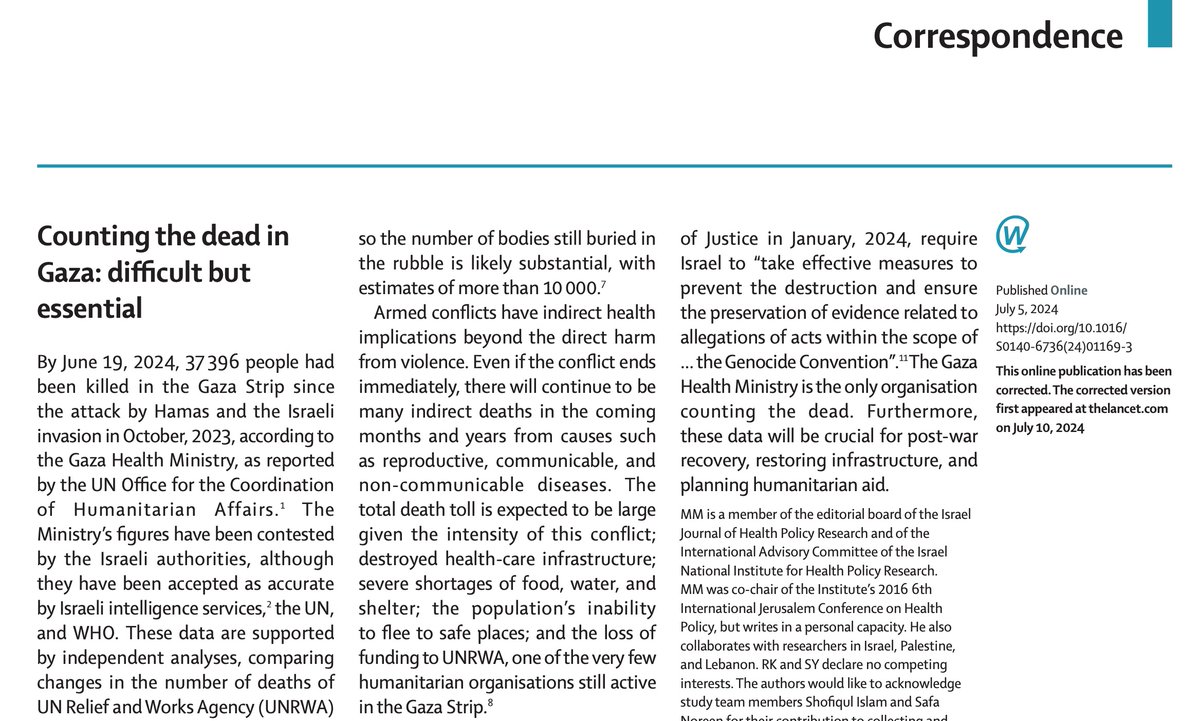
What an insane thing to have to write in the world's topmost medical journal. I feel terrible for these authors who have to defend their peer-reviewed empirical research work against some randos' vitriol-soaked misguided ill-informed political opinions.
Sid Zādéy tweet media
English
0
3
5
272
ankit retweetledi
Arnaud Bertrand
Arnaud Bertrand@RnaudBertrand·
Interestingly, while Americans debate how to make medicines more affordable, China is now debating the exact opposite problem: some worry their drugs are becoming too cheap. This is because China launched in 2018 a centralized procurement system officially called "group purchasing with guaranteed volumes" (国家集中带量采购) whereby, instead of letting individual hospitals negotiate prices, the government consolidates demand across entire provinces or the whole country, determines the total volume needed, and then conducts bulk purchases directly from manufacturers. Importantly, this policy explicitly targets only off-patent drugs and generics - new medicines are excluded from the program and instead go through separate negotiation channels, the so-called "national medical insurance drug catalog negotiation system" (医保目录谈判). Instead of competitive bidding, this parallel system involves one-on-one negotiations between insurance authorities and pharmaceutical companies for innovative drugs that are recently approved and typically produced by a single manufacturer. The process includes extensive expert evaluation of the drug's safety, effectiveness, and innovation value before price negotiations begin. This creates a two-track system: while bulk purchasing drives generic drug prices down through competition, the catalog negotiation system ensures innovative drugs can still command prices that sustain pharmaceutical R&D. The results have been quite insane. In the latest bulk purchasing round that just ended - the 10th since the program's inception - the price of 62 drugs were negotiated, with some dropping to less than 10% of their original cost. For instance a breast cancer drug - Palbociclib - that previously cost 200 yuan ($28) per pill now sells for just 15 yuan ($2). Similarly annual treatment costs for hepatitis B have plummeted from 4,000-5,000 yuan to 100-200 yuan ($14-$28). Since 2018 the program has covered 435 drugs, freeing up nearly 500 billion yuan ($70 billion) in healthcare spending. A single hospital reported saving 30 million yuan on cancer drugs alone. Some drugs are now even cheaper than water: enteric-coated aspirin, commonly used as a cardiovascular medication, now costs less than 0.04 yuan per tablet, meaning if you take 3 a day it costs you about 3.6 yuan a month (less than $0.5)! The price reductions have been so dramatic that the debate in China now centers not on whether drugs are too expensive, but whether some of them have become too cheap - with some people worrying about quality control and sustainable production at such low prices. A huge stark contrast to the American healthcare system, where high drug prices are a huge issue and national-scale bulk purchasing programs remain absent (despite some limited government purchasing for veterans and federal programs). I checked and the same Palbociclib tablet for breast cancer that's been negotiated at $2 in China costs a minimum of $227 a tablet in the U.S. (pharmacychecker.com/ibrance/), more than 100 times more expensive! This is actually an interesting counter-example to the argument that government intervention necessarily leads to market inefficiencies. By consolidating purchasing power and guaranteeing volumes, the Chinese government has effectively created a more efficient market - one that eliminates marketing costs, reduces uncertainty for manufacturers, and drives massive price reductions that wouldn't have happened without their intervention. It also refutes the notion that such government intervention necessarily reduces R&D because what China has put in place is a 2-track system: driving generic prices down through bulk purchasing while maintaining separate negotiations for innovative drugs that ensure R&D costs are rewarded appropriately. It doesn't mean the Chinese system is perfect - concerns about quality control and sustainable production at such low prices are legitimate. But it does show that with intelligent government intervention it's seemingly possible to achieve both affordability and innovation - goals that have long been deemed mutually exclusive in the U.S. healthcare system.
English
86
757
2.7K
183.4K
ankit retweetledi
Kiran Kumbhar
Kiran Kumbhar@kikumbhar·
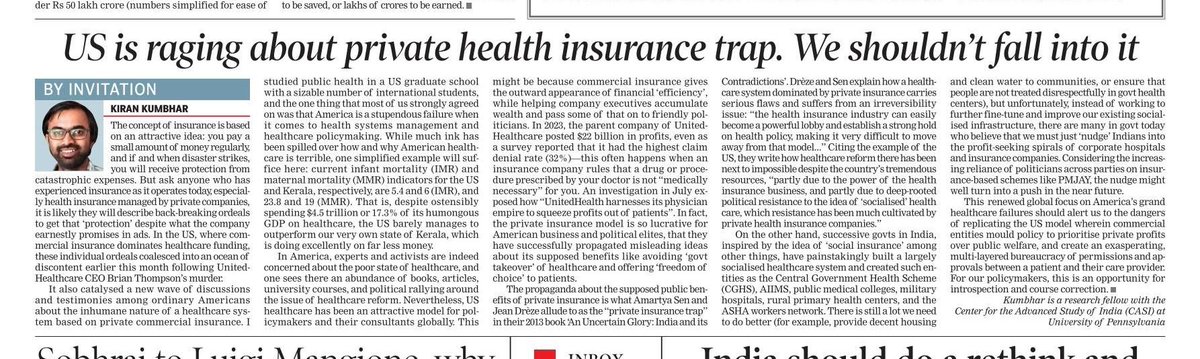
Glad that @timesofindia published this, reiterating many Indian experts' warnings about mimicking US's commercial health insurance model. Kinda sad that the same page carries a badly-argued oped that asks us to latch on to yet another absurd, elite-driven American idea - DOGE 🤦‍♂️
Kiran Kumbhar tweet media
English
7
62
171
10.1K
ankit retweetledi
Haaretz.com
Haaretz.com@haaretzcom·
"When you enter Gaza, you are God": Inside the minds of IDF soldiers who commit war crimes / Prof. Yoel Elizur haaretz.com/opinion/2024-1…
English
374
3.2K
6.2K
4.3M
ankit retweetledi
Rutger Bregman
Rutger Bregman@rcbregman·
How Americans responded in 1955 when the invention of the polio vaccine was announced.
Rutger Bregman tweet mediaRutger Bregman tweet media
English
353
6.1K
35.6K
1.7M
ankit retweetledi
🌙
🌙@bambaiyya__·
Bill Gates calling India a 'laboratory' is nothing new. Puerto Rican women's bodies were treated as a testing site for the birth control pill. Punjabi women in England were intentionally given radioactive food for a health study in the '90s.
English
1
464
2.2K
37K
ankit retweetledi
Sam Knowlton
Sam Knowlton@samdknowlton·
Recycling is a psyop to convince people that plastic can be used abundantly and sustainably without consequences. Of all the recyclable #5 plasticware waste generated in the US only 1% is recycled.
Sam Knowlton tweet media
English
144
2K
9.9K
733.6K
ankit retweetledi
Amnesty International
Amnesty International@amnesty·
Amnesty International’s new landmark report concludes that Israeli authorities have committed – and still are committing - genocide against Palestinians in the occupied Gaza Strip. Full report, out now. #EndGazaGenocide amn.st/6014Q6K9g
English
3K
14K
26.4K
7.1M