
Sabitlenmiş Tweet
Quantіan
72.6K posts

Quantіan
@quantian1
Voted “Most Likely To Appear on Wikipedia’s ‘List of Largest Trading Losses’” among graduating class
Katılım Ocak 2015
510 Takip Edilen97.7K Takipçiler

It’s good to know that if the war in Iran does eventually end Barak Ravid can still find work announcing new 1-week extensions of Fable access every Sunday
Claude@claudeai
We're extending Claude Fable 5 access on all paid plans, as well as keeping Claude Code’s weekly rate limits 50% higher, through July 19.
English
@AustenJ248855 Errors of commission are different than errors of omission. If Satoshi donated 10% of all bitcoin to MIT and they sold it that would be different from MIT neglecting to buy 10% of Bitcoin.
English

@quantian1 This is all very silly thought exercise.. Any university could have bought those shares in the open market. I could have bought 10% of the supply of bitcoin when it first launched.
English
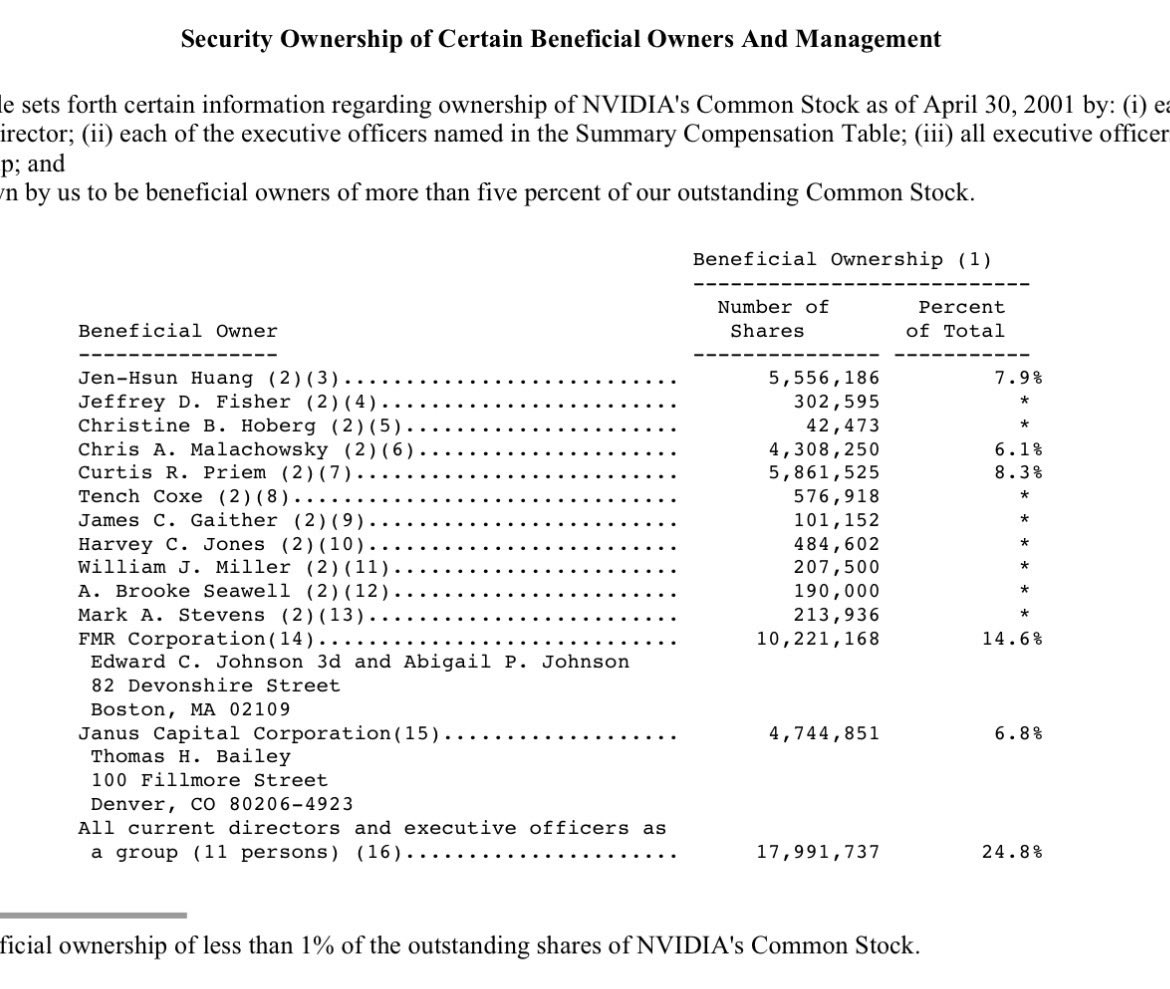
In 2001, Nvidia CTO Curtis Priem owned 8.3% of the company, more than Jensen Huang. When he retired, he gifted most of his shares to his alma mater, Rensselaer Polytechnic, who sold it.
Today, those shares would be worth $450 bn, or as much as the top 25 endowments combined.
English
@Ubertag90210 He donated it to a midsize engineering school in upstate New York…? You have cooked your brain on Twitter my friend
English

@quantian1 this is why you should not listen to cucks like Bill Gates, and you should instead keep your familial wealth within your family
He could have had generational wealth for his entire family.
instead, he donated it to some left wing NGOs that sent a portion of the cash to Africa
English

@quantian1 @citrini Banana or small pickle? Size matters here.
English

@UpslopeCapital Quality value? I didn’t invented it I’ve heard it used before.
English

@quantian1 Was qualue a typo or a neat new word I was unaware of (and will be using in the future)?
English
@UpslopeCapital I don’t see a line for “blow out of all your underperforming qualue longs at the nanotop to chase momo names”, will you be adding that next update?
English
Updated Upslope's "Consolidated Learnings" document -- marked and clean versions attached and linked below:
upslopecapital.com/s/Consolidated…


English
@fordoglunk Congrats on gooning time going from 8 hours per day to 16
English

100 something trading days to retirement
English
@sadvalueinvestr You should only throw stones if you’re better… maybe even better than the gods, if you think about it,,,
English
Job is really hard. Gotta figure out how to be in the second quintile as long as your mind can take it. Be humble, because the game will humble you. Try not to throw too many stones.
Citrini@citrini
The Fundsmith letter reminded me of this post from a few years ago. It’s much easier to pontificate about this stuff than put it into practice, though.
English
@toptickcrypto Except the DGX station sucks because only a quarter of that RAM is HBM so you can’t actually serve the model at high speeds. You’re better off buying a rack of RTX 6000s for the same price
English

Ah yes cost pushed to zero ($94,000) 😅
Tulip King 🌷@tulipking
local 1T parameter models are now only $94,000. I don't think we've ever seen a cost curve get pushed to zero as quickly as AI. We live in a prosperity era
English
@klbrkt @Hyeronimus_Lex They do win the restructuring, they don’t ever pay the money and get to borrow again in a few years
English

@Hyeronimus_Lex @quantian1 Yea, the way it's phrased and numbered, it seems like argentina wins every restructuring talk
English

@quantian1 Easy to dunk on him, but I’d challenge you to guess the CAGR of the S&P over the past 55 years…
If you guessed 11.23%, congratulations! Free markets rule :).
English
*assuming an 11% CAGR over the next 55 years and zero volatility drag
Another Chamath classic, everyone!
Chamath Palihapitiya@chamath
If you can choose where to work, work somewhere that will help invest in your Trump account. $5k/yr will leave you with $13M at 55. Sorry, but that’s a huge amount of money. If you have this choice but don’t want that because it’s called a “Trump Account”, you’re a retard. 100% irresponsible retard. That’s your kids speaking btw.
English
@quantian1 It’s like this all over again.
en.wikipedia.org/wiki/Fast_inve…
English
It’s funny that the solution to every memory question is to go find your local cracked retired boomer programmer and ask them “hey gramps how did you write code when 16kb of ram cost $100,000 and you had to physically spin a disk to access system memory” and they’ll just tell you
John Carmack@ID_AA_Carmack
Memory cost and capacity are significant issues for AI accelerators. Unlike game rendering, model inference can have a deterministic memory access pattern. You don’t need “random access memory” at all for model weights, and you could tolerate cold-start latencies in the multiple milliseconds, as long as continuous reads were delivered at the necessary bandwidth. NAND flash is over 100 times cheaper per GB than HBM, so there should be opportunity there, even after giving a flash controller a 1024 bit interface with HBM bandwidth. You could make a specialized pin protocol that just supported pipelined transfer of full 16KB+ pages from the flash to program-managed accelerator scratchpad memory and improve per-pin performance over HBM, but it might be more convenient to make it still look like a true random access memory with very fragile performance characteristics, where anything but sequential reads falls off a 1000x+ performance cliff. That has the advantage of automatically using existing cache hierarchies, and providing a natural path to update the flash memory with new model weights. With the stream-to-scratch interface, code has to be completely rewritten before it works at all, while the ram-emulation interface will start off just extremely slow, and you can incrementally sort out the changes for full performance. There may be cases where there isn’t enough scratchpad SRAM to hold the weights for a layer, which might force you to deploy the old optical drive optimization technique of duplicating data in multiple places on a sequential read to avoid seeking, but there would be capacity to burn. It might be possible to do something like cuda graph capture to record a memory access trace and have everything magically remapped to a linear sequence, but deploying programmer / agent elbow grease to manage transfers and access in a scratch ram ring buffer would be lower risk. A split memory system consisting of some channels of flash and some channels of HBM will probably be suboptimal compared to a uniform memory, but it could be much cheaper, and allow much larger models to be run. I think th case is strong for inference, but you have to stretch more for training. You can still linearize all the weight memory accesses, both reads and writes, but flash memory would quickly wear out from the writes, even if they were all perfectly page aligned. Replacing low-latency HBM with massively parallel cheap(er) DRAM at high latency might still be a worthwhile cost savings.
English
@nichochar He’s possibly the most uniquely qualified person on the planet for the specific question of “hey gramps how do I calculate exp(-1/2 ln x) without expensive calls to an exponential or logarithmic function”
English

@quantian1 carmacks as the "local cracked retired boomer" is a bold one
English
@gregfloyd42069 @imbalanced_flow This thread is burned into my brain in 72 point font (and was the instant I read it). I think I'm probably like half the QTs at this point
English

@imbalanced_flow @quantian1 I am p99 in remembering it -- having read it before they blew up and questioning my sanity at a medical level -- but it's still physically jarring every time I see it again
English
Millennium “index arb” team explaining how they made $3.7 billion last month:
Sam Trabucco@AlamedaTrabucco
And so we've slowly realized -- our ability to make good delta bets *is* like another super power, and it's one with a lot of $ on the table. So we've embraced it, and we make BIG bets. x.com/AlamedaTrabucc…
English
@DeepDishEnjoyer Yeah bro it was 24 years ago
English

absolutely crazy how "old" the 2002 us team photo looks like now. like it belongs in a history textbook

English