r0pchain

1.1K posts

r0pchain banner
r0pchain

r0pchain

@r0pchain

Cloudforce One REACT. Nation-state cyber actors are interesting and ♥ novel malware. The Andrew Dice Clay of ofsec. Former USIC/TAO, views my own.

USA Katılım Ocak 2017
843 Takip Edilen258 Takipçiler
r0pchain retweetledi

Tom Jøran Sønstebyseter Rønning
Microsoft Edge loads all your saved passwords into memory in cleartext — even when you’re not using them.
English
241
1.3K
8.7K
1.5M
r0pchain retweetledi
Haidar
Haidar@haider_kabibo·
So here is new local privilege escalation zero-day I discovered, not patched yet too :). In simple terms, if you have a service like RDP that exposes an RPC server, there many system services running as SYSTEM connect to it as RPC clients. If that service is turned off (RDP is off by default), it seems that any other process in Windows can expose the same RPC server using the same endpoint. Now all the RPC calls from that SYSTEM processes will come to this fake server and If the process that deployed the server has SeImpersonatePrivilege, it can escalate to SYSTEM by impersonate the RPC client. In the white paper below, I describe five exploit paths you can abuse. However it's architecture problem and maybe there are more. It's Not A Potato securelist.com/phantomrpc-rpc…
English
16
164
788
49.2K
r0pchain retweetledi
Vozec
Vozec@Vozec1·
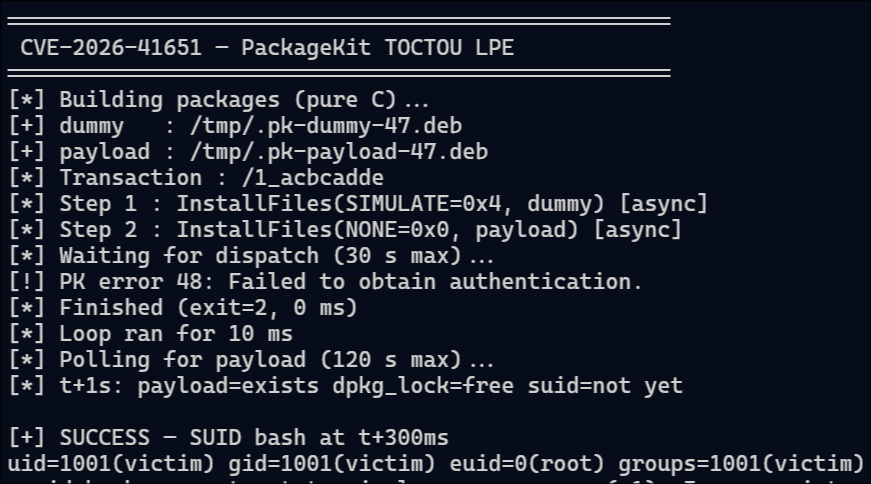
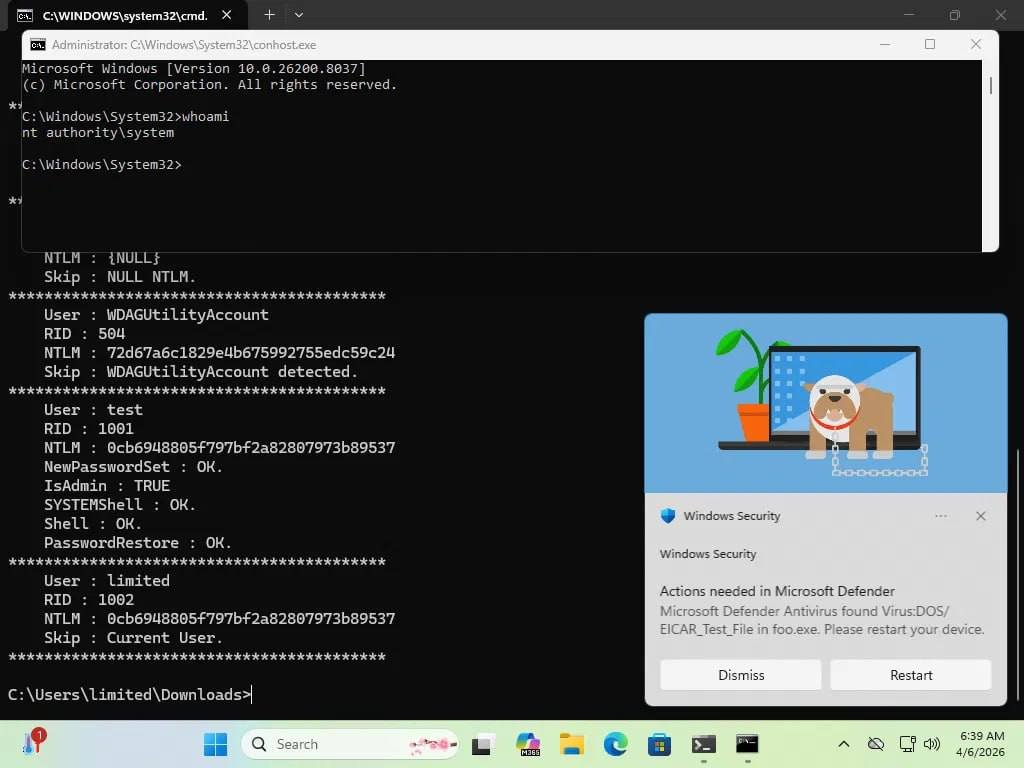
I just POC Pack2TheRoot (CVE-2026-41651) : - github.com/Vozec/CVE-2026… Local Privilege Escalation in PackageKit discovered by telekom.com affecting Ubuntu/Debian/RockyLinux/Fedora
Vozec tweet media
English
2
76
329
19.4K
r0pchain
r0pchain@r0pchain·
This is bullshit and borderline CAN-SPAM violation. @Microsoft sending out marketing messages to 17 year old addresses; first message is Win7 beta group and second is BS "Microsoft Rewards" message to an alias created exclusively for that beta group.
r0pchain tweet media
English
0
0
0
47
r0pchain retweetledi
DbgMan ^_^
DbgMan ^_^@0XDbgMan·
A new EDR killer for CrowdStrike Falcon? This approach relies on BYOVD leveraging .It’s not a zero-day or a bypass, just exploiting known flaws after reversing driver DB What I’m aiming for is different: Bypassing EDRs without drivers using techniques aligned with modern loaders
English
11
94
601
42.8K
r0pchain retweetledi
MalBeacon
MalBeacon@malbeacon·
🚨 Trojanized CPU-Z → STXRAT → PureLogs Stealer → PureHVNC → 54hrs of exfil through a hidden QEMU VM. We caught everything after. First documented full post-exploitation chain for this campaign. IOCs & hunting artifacts link in thread #ThreatIntel #DFIR #Malware
English
3
22
96
7.2K
r0pchain retweetledi
impulsive
impulsive@weezerOSINT·
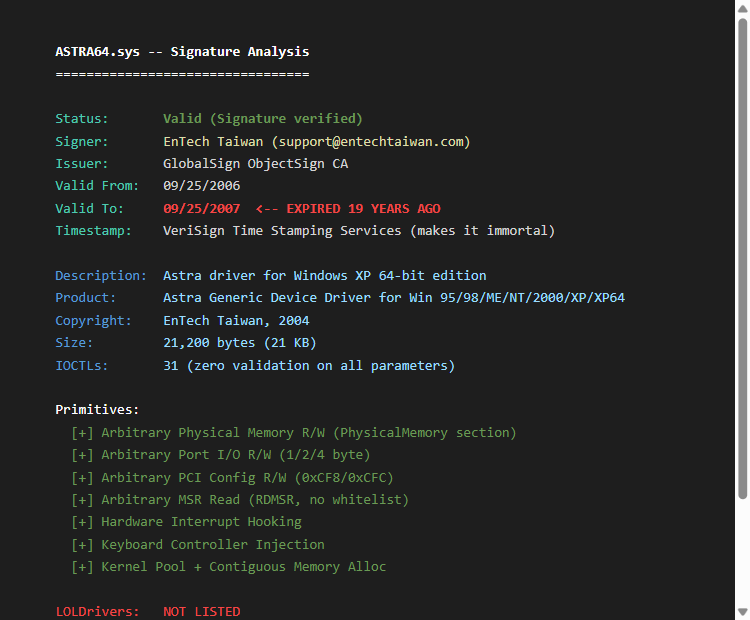
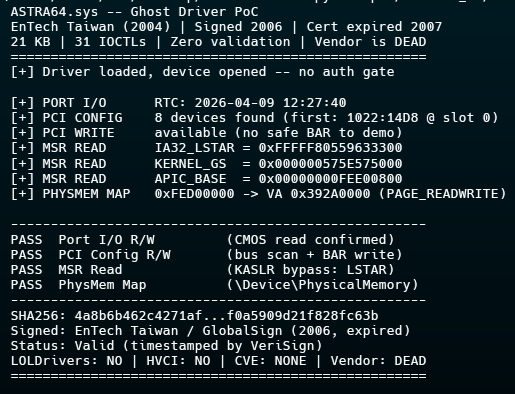
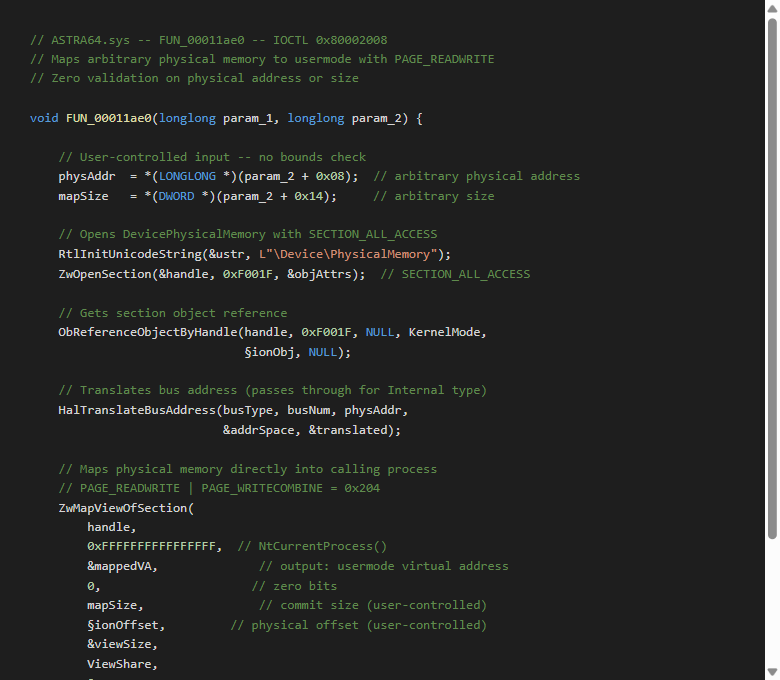
github.com/magicsword-io/… found a 21KB kernel driver from 2004 built for windows xp that still loads on windows 11 ASTRA64.sys by EnTech Taiwan. signed in 2006, cert expired in 2007, but its timestamped so windows still says "signature verified" 19 years later. the company doesnt exist anymore. 31 IOCTLs with zero validation on anything. arbitrary physmem R/W, port I/O, PCI config R/W, MSR read, interrupt hooking, keyboard injection. no auth gate, no hardware gate, loads on any system with sc.exe not on loldrivers. not on hvci blocklist. no CVE. vendor is dead so you cant even do responsible disclosure. theres nobody to email filed an issue @M_haggis
impulsive tweet mediaimpulsive tweet mediaimpulsive tweet media
English
34
192
2K
166.6K
r0pchain retweetledi
Kyle Cucci
Kyle Cucci@d4rksystem·
I uploaded all the malware samples used in my book #EvasiveMalware to my Github: github.com/d4rksystem/Eva… I received some questions about the lab samples, so just posting it for everyone here 🤓
English
4
79
341
12.6K
r0pchain retweetledi
Noah Lebovic
Noah Lebovic@NoahLebovic·
Claude Opus 4.6 was released in February. Also in February:
Noah Lebovic tweet media
English
1
1
2
5.7K
r0pchain
r0pchain@r0pchain·
@GamewithDave TIE Fighter. It was truly revolutionary in terms of gameplay and environment. Close second is Descent.
English
0
0
1
11
Dave
Dave@GamewithDave·
For those who used a computer between 1995 and 2001, what's the computer game from that time that sticks with you the most, and why?
English
12.1K
146
3.9K
2.2M
r0pchain retweetledi
Cheng Lou
Cheng Lou@_chenglou·
My dear front-end developers (and anyone who’s interested in the future of interfaces): I have crawled through depths of hell to bring you, for the foreseeable years, one of the more important foundational pieces of UI engineering (if not in implementation then certainly at least in concept): Fast, accurate and comprehensive userland text measurement algorithm in pure TypeScript, usable for laying out entire web pages without CSS, bypassing DOM measurements and reflow
English
1.3K
8.3K
65.4K
23.9M
r0pchain
r0pchain@r0pchain·
“We can’t surface feedback requests or new features without a lightbox that completely interrupts the UX” is why lightboxes should be removed the same way that marquee was removed from the html standard. UX is sacrosanct. Your rating requests are not.
English
0
0
0
11
r0pchain retweetledi
DFIR Radar
DFIR Radar@DFIR_Radar·
Chinese 🇨🇳 APT group Red Menshen plants kernel-level BPFdoor backdoors in global telecom networks, creating "sleeper cells" for long-term espionage. New variants hide in HTTPS traffic and monitor 4G/5G signaling protocols. Key findings: • BPFdoor evolved from magic packet activation to Layer-7 HTTPS camouflage with RC4-MD5 encryption • Implants target SCTP signaling protocols used in 4G/5G core networks for subscriber tracking • Masquerades as legitimate services like HPE ProLiant hardware daemons and Docker containers • ICMP tunneling enables covert C2 between compromised hosts using 0xFFFFFFFF terminal markers • Affects telecom edge infrastructure: Ivanti VPNs, Cisco/Juniper routers, Fortinet firewalls Attack chain leverages: • Initial access via T1190 exploitation of public-facing telecom appliances • CrossC2 beacons for Linux post-exploitation and lateral movement • TinyShell passive backdoors on boundary devices for persistence • Custom keyloggers with telecom-specific credential lists (usernames like "imsi") DFIR artifacts include raw socket usage, anomalous BPF filters in kernel space, unexpected hardware service processes on non-HPE systems, and HTTPS traffic with fixed-offset padding schemes. Hunt for unusual BPF syscalls, processes mimicking bare-metal hardware services on virtualized systems, and SCTP traffic inspection on non-telecom hosts. #DFIR_Radar
DFIR Radar tweet media
English
7
143
556
51.1K
r0pchain retweetledi
Math Files
Math Files@Math_files·
Why did the US ban this number in 2001? It sounds insane, but 25 years ago, the Motion Picture Association of America was genuinely trying to delete this number from the internet. You see, back in 1999, a teenager in Norway named Jon Lech Johansen wrote a piece of code called DeCSS. It cracked CSS, the encryption on DVDs. Suddenly, anyone could copy a movie with the click of a button. It was a nightmare for the movie studios. They went nuclear. They sued the hacker magazine 2600: The Hacker Quarterly. They threatened Slashdot, and their lawyers fired out cease-and-desist letters to anyone hosting the code. They called it a digital burglary tool. But the internet found a loophole. A computer scientist named Phil Carmody realized that computer code is just binary ones and zeros. And you can treat that string of binary as a single number. That way, you get a really, really big integer—which is the illegal code. But Carmody knew that just finding any number wasn’t going to be enough, because the government could still ban a random number. So he needed a number that science would be forced to protect. He needed a prime number. You see, the University of Tennessee maintains a prestigious academic database called the Prime Pages. It records the 5,000 largest known prime numbers. Carmody realized that if he could turn the illegal code into a record-breaking prime number, the university would have to publish it. His first attempt was 1,401 digits long. It was prime, but too small. It didn’t crack the top 5,000 list. It wasn’t mathematically interesting enough to save. So, he hacked the math. Use this formula: K × 256^N + B Now, K is the illegal code part. 256^N is the mathematical equivalent of adding useless zeros at the end—like making a book longer by adding blank pages. It doesn’t change the actual content inside. So, he kept adding “blank pages,” shifting the number, until he hit a mathematical jackpot—a 1,959-digit monster. This wasn’t just illegal code anymore. It became the 10th largest ECP prime number ever discovered at the time. It was checkmate. The number was immediately added to the university database. For the MPAA to ban the code now, they would have to order a university to delete a scientific record. You can’t censor mathematics.
Math Files tweet media
English
93
942
8.1K
774.2K
r0pchain
r0pchain@r0pchain·
@Apple: “Hey, apply this third bullshit update in four weeks across all nine of your devices, requiring massive bandwidth consumption and rebooting everything! Totally our bad bro!” Me:
GIF
English
0
0
0
10
r0pchain retweetledi
solst/ICE of Astarte
solst/ICE of Astarte@IceSolst·
- XZ utils backdoor: found by guy debugging 200ms latency - LiteLLM hack: found by guy debugging oom issue These could have been the most impactful compromises ever. Forget security vendors, weaponize your engineers’ autism.
English
56
478
4.3K
148.9K
r0pchain retweetledi
Mateusz Krzywicki
Mateusz Krzywicki@krzywix·
In collaboration with Lookout and Google (thank you 🙏) we have been working on tearing down and building detections for DarkSword - iOS exploit chain for iOS 18.4 - 18.7. Super excited for this research 🎉. Please update your iPhones. iverify.io/blog/darksword…
English
15
83
343
90.3K