Rahul Dhodapkar

109 posts

Rahul Dhodapkar

Rahul Dhodapkar

@rahuldhodapkar

physician-scientist, resident, computational biology, immunology, neuroscience, ophthalmology | MD @YaleMed | ex-software engineer @MongoDB

Katılım Temmuz 2014
134 Takip Edilen331 Takipçiler
Rahul Dhodapkar retweetledi
David van Dijk
David van Dijk@david_van_dijk·
C2S is now open for everyone. The biological LLM that learns the language of cells. Free for academic and commercial use. c2s.bio Join the growing community building with C2S. 🌱
English
11
44
192
27.6K
Rahul Dhodapkar retweetledi
David van Dijk
David van Dijk@david_van_dijk·
Exciting to see our collaboration with @Google highlighted here — using AI to generate and test new biological hypotheses!
Sundar Pichai@sundarpichai

An exciting milestone for AI in science: Our C2S-Scale 27B foundation model, built with @Yale and based on Gemma, generated a novel hypothesis about cancer cellular behavior, which scientists experimentally validated in living cells.  With more preclinical and clinical tests, this discovery may reveal a promising new pathway for developing therapies to fight cancer.

English
13
17
293
33.4K
Rahul Dhodapkar
Rahul Dhodapkar@rahuldhodapkar·
So proud to be a part of this groundbreaking effort - just the beginning of many discoveries, and new ways to improve health for us all
Sundar Pichai@sundarpichai

An exciting milestone for AI in science: Our C2S-Scale 27B foundation model, built with @Yale and based on Gemma, generated a novel hypothesis about cancer cellular behavior, which scientists experimentally validated in living cells.  With more preclinical and clinical tests, this discovery may reveal a promising new pathway for developing therapies to fight cancer.

English
0
0
6
287
Rahul Dhodapkar retweetledi
Sundar Pichai
Sundar Pichai@sundarpichai·
An exciting milestone for AI in science: Our C2S-Scale 27B foundation model, built with @Yale and based on Gemma, generated a novel hypothesis about cancer cellular behavior, which scientists experimentally validated in living cells.  With more preclinical and clinical tests, this discovery may reveal a promising new pathway for developing therapies to fight cancer.
English
543
3.2K
21.8K
6.9M
Rahul Dhodapkar retweetledi
David van Dijk
David van Dijk@david_van_dijk·
🚀 Beyond excited to announce our release of the #Cell2Sentence (C2S) API and new foundation models! 🎉 Our C2S API makes it incredibly easy to convert #singlecell data into cell sentences, perform inference with LLM-based C2S models, fine-tune them, and convert cell sentences back into expression data—all in one seamless workflow. 🧬 We're releasing powerful new 410M parameter models designed for diverse tasks, including cell type prediction, cell generation, cell annotation, and cell embedding! 🌟 But there’s more: We provide the first foundation model that can encode multiple cells in context, opening up completely new possibilities in single-cell analysis! 🦄 Check out our tutorials to get started, explore the models on Hugging Face, and read the manuscript for more details. We can’t wait to see the innovative applications the community will dream up with these new tools. Stay tuned—more updates are on the way! 🔗 github.com/vandijklab/cel… 📝 biorxiv.org/content/10.110… 🤗 huggingface.co/vandijklab
David van Dijk tweet media
English
7
62
245
37.7K
Rahul Dhodapkar
Rahul Dhodapkar@rahuldhodapkar·
Excited to share this work - a new way to apply foundation models to graph structured data. Please reach out if interested in bringing any of these techniques to your data or use case!
David van Dijk@david_van_dijk

💡 Want to leverage the power of foundation models in graphs? 🔥 Introducing Foundation-Informed Message-Passing (FIMP), a framework for applying any pre-trained transformer-based foundation model to Graph Neural Networks! arxiv.org/abs/2210.09475

English
0
0
3
510
Rahul Dhodapkar
Rahul Dhodapkar@rahuldhodapkar·
@ylecun @yaroslavvb The problem with this assertion is that there are many other places where information can be encoded in the zygote beyond germline sequence - e.g. the physical orientation of DNA within the nucleus, subcellular sequestration of premade proteins etc. These are >>8MB
English
0
0
0
20
Yann LeCun
Yann LeCun@ylecun·
Whatever pre-pre-training evolution has performed to make human use language, it has to squeeze into less then 8MB of genomic information. 8MB is an upper bound on the difference in information content between chimps and humans (1% of a genome with 3 billion pairs). That really not very much.
English
107
26
485
151K
Yaroslav Bulatov
Yaroslav Bulatov@yaroslavvb·
Humans learn faster than machines, but that's just the "fine-tuning" part of the human. Pre-training part is a billion years of evolutionary feedback data. So the question is how to transfer some of that "pretrained" knowledge.
English
19
24
351
137.2K
Rahul Dhodapkar
Rahul Dhodapkar@rahuldhodapkar·
It's been over a year now since I first proposed cell2sentence (biorxiv.org/content/10.110…) - a universal framework that allows *any LLM* to interface with single cell data. Now, together with @david_van_dijk and some incredibly talented students, I'm excited to share major progress
David van Dijk@david_van_dijk

Major Cell2Sentence update 🎉🔬! We’ve been thrilled to see the attention Cell2Sentence has received from the single-cell community. Now, we’re excited to release our first update of Cell2Sentence (C2S) - a framework to leverage LLMs to train foundational single-cell models, directly in text. What’s new & out: Updated preprint with latest results biorxiv.org/content/10.110… First full cell model available on the HuggingFace hub huggingface.co/vandijklab/pyt… Updated codebase for data transformation & training github.com/vandijklab/cel… We now fine-tune language models to generate entire cells, predict combinatorial cell labels, and generate textual data insights directly from cell sentences. We train GPT-2 and Pythia models on a large multi-tissue dataset containing 36M cells from @cellxgene as well as an immune tissue dataset containing 270k cells. C2S LMs achieve SOTA performance in single-cell data generation. C2S models trained for combinatorial label prediction settings excel in low-data regimes, outperforming single-cell foundation model baselines. We also show that C2S models benefit from natural language pre-training and always outperform models trained from scratch on cell sentences. C2S provides a straightforward approach to adapting LLMs for single-cell data analysis, leveraging their natural language capabilities to generate and derive insights from single cells. We are convinced that C2S’ approach of integrating data modalities through text is the way forward for single-cell foundation models, from representing multi-omics data to generating clinical insights, all in a human readable format. We’re excited to start building a community around Cell2Sentence! If you also think that C2S will be the framework for single-cell foundation models, and are interested in contributing, reach out to us! We welcome any collaborations and discussions. Huge thanks to our collaborator @aminkarbasi and the C2S team (@danielflevine, @sachalevy3, @SyedARizvi5688, @nazreenpm, Xingyu Chen, @dzhang03, @GhadermarziSina, Ruiming Wu, Ivan Vrkic, Anna Zhong, Daphne Raskin, Insu Han, @aho_fonseca, @josueortc) for their hard work on C2S! Special thanks to @rahuldhodapkar, who co-supervises this project.

English
0
0
5
541
Rahul Dhodapkar
Rahul Dhodapkar@rahuldhodapkar·
Some very cool insights here into the intersection between human labeling and other distance-based "unsupervised" approaches to classification! Exciting work!
Maria Brbic@mariabrbic

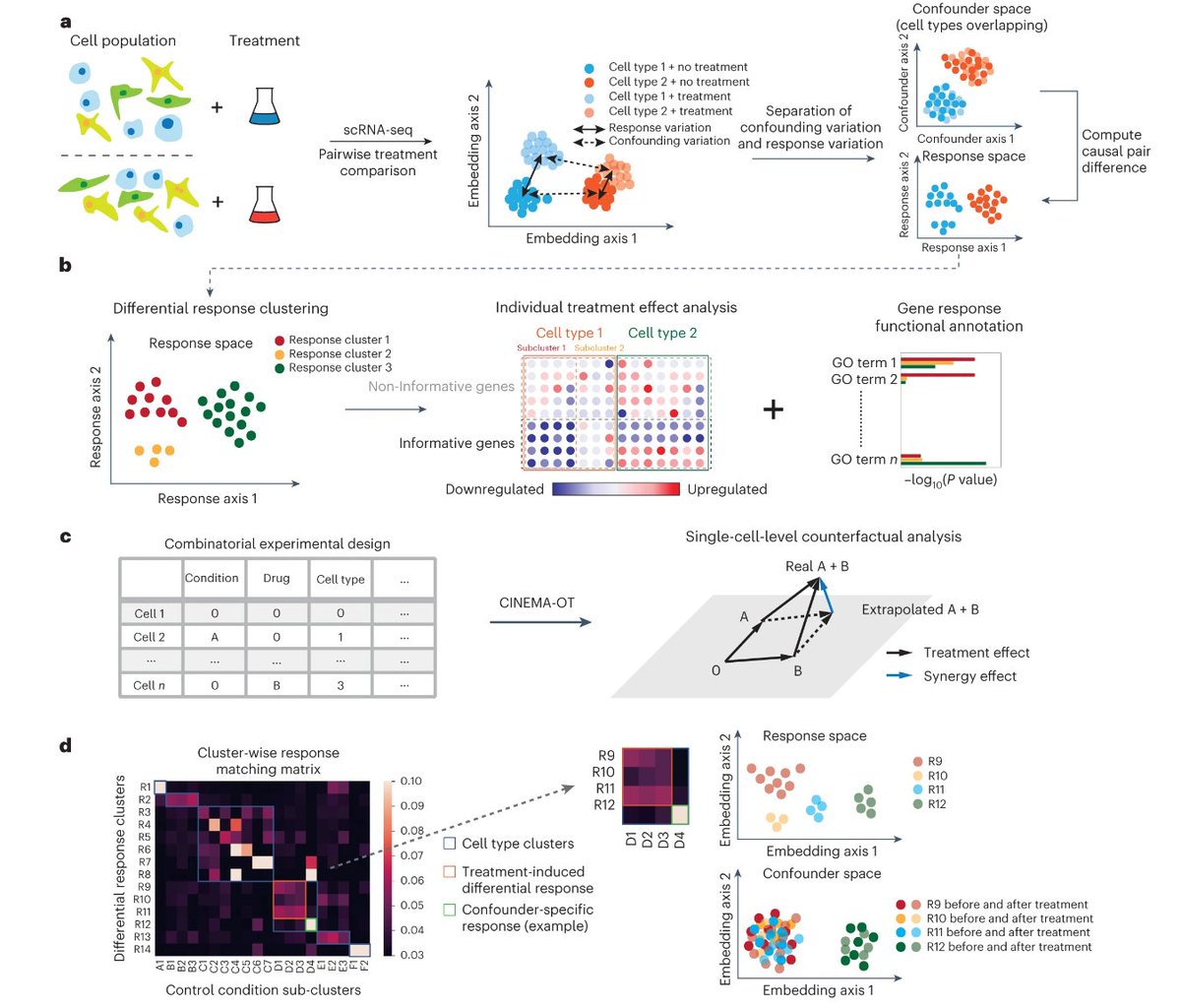
How to infer human labelling of a given dataset in a model-agnostic way? Check our new method HUME accepted at @NeurIPSConf as #spotlight!🌟 HUME provides a new view to tackle unsupervised learning. Kudos to my fantastic PhD student @artygadetsky! Paper arxiv.org/abs/2311.02940
English
0
0
1
339
Rahul Dhodapkar
Rahul Dhodapkar@rahuldhodapkar·
Extremely excited to share our work on #LongCovid, now out in #Nature! I'm honored to be part of an amazing team contributing to our knowledge of a disease affecting so many lives worldwide. Very clear that this disease has *objectively measurable* immune characteristics.
Prof. Akiko Iwasaki@VirusesImmunity

So pleased to report that our Mount Sinai-Yale long COVID (MY-LC) paper with @putrinolab & others is now published!! Proud of the hard work of all who contributed. We found biological signatures that can distinguish people with vs. without #longCOVID (1/) nature.com/articles/s4158…

English
0
12
71
13.7K
Rahul Dhodapkar
Rahul Dhodapkar@rahuldhodapkar·
Very proud to share this collaboration with @david_van_dijk and team, where we show a new fundamental approach that allows language-pretrained LLMs to be used *without architectural modifications* to learn from #singlecell data. Please check it out!
David van Dijk@david_van_dijk

Single Cells as text? We developed Cell2Sentence, a method that allows training of Large Language Models on single-cell data! biorxiv.org/content/10.110… With @danielflevine @SyedARizvi5688 @sachalevy3 @rahuldhodapkar @YaleSEAS @YaleMed #AI #ML #NLP #genomics #CompBio #singlecell

English
0
0
17
4.1K
Rahul Dhodapkar retweetledi
Rahul Satija
Rahul Satija@satijalab·
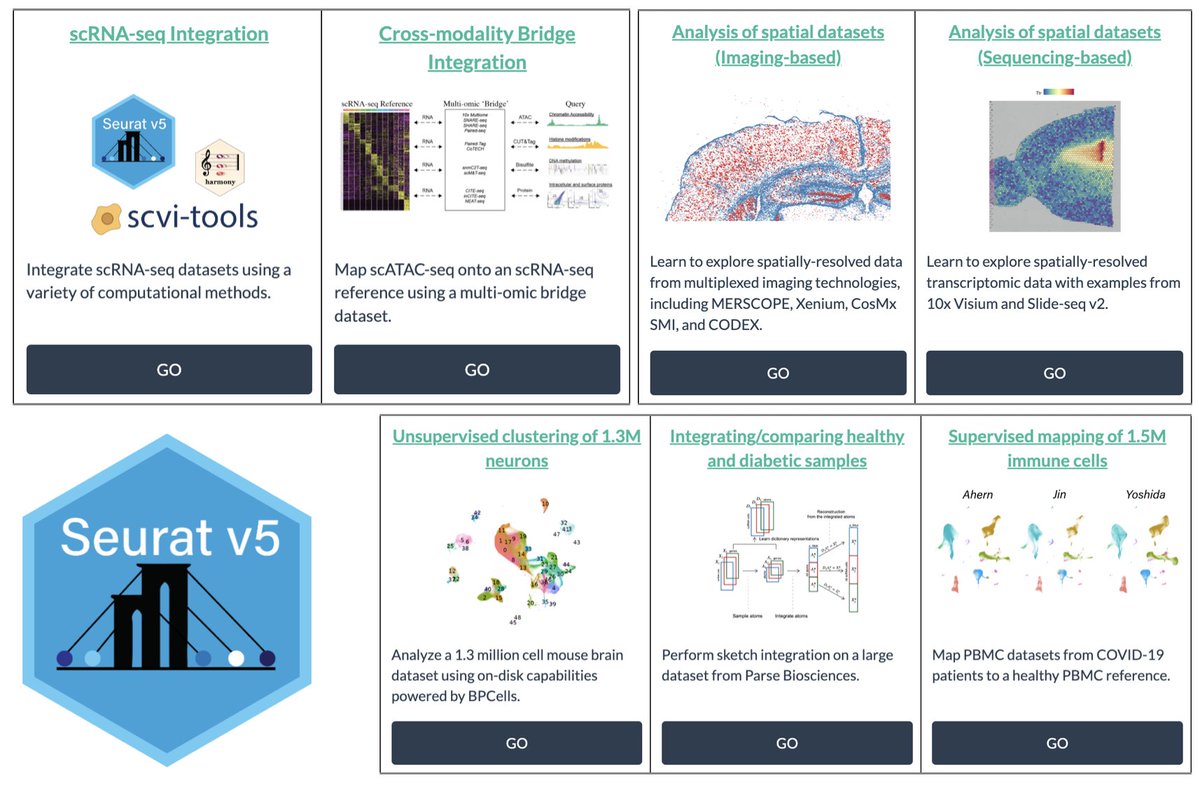
We are excited to release Seurat v5- with new methods for multimodal, spatially resolved, and massively scalable single-cell analysis. satijalab.org/seurat
Rahul Satija tweet media
English
7
269
1K
116.3K
Rahul Dhodapkar
Rahul Dhodapkar@rahuldhodapkar·
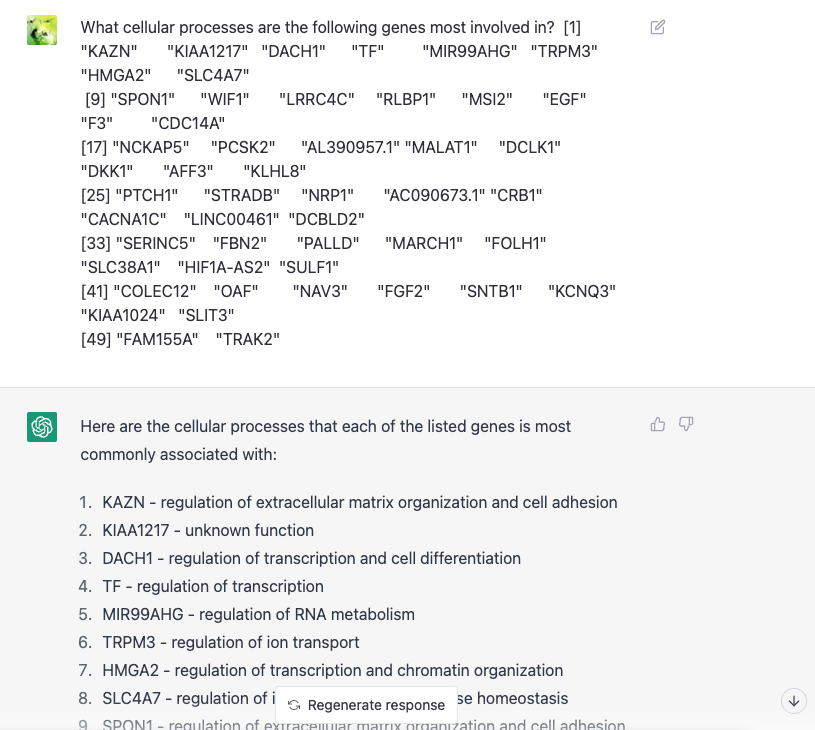
Perhaps this is a good way to avoid the bias of fixating on the genes we already "know" and the processes we are already familiar with!
English
0
0
1
118
Rahul Dhodapkar
Rahul Dhodapkar@rahuldhodapkar·
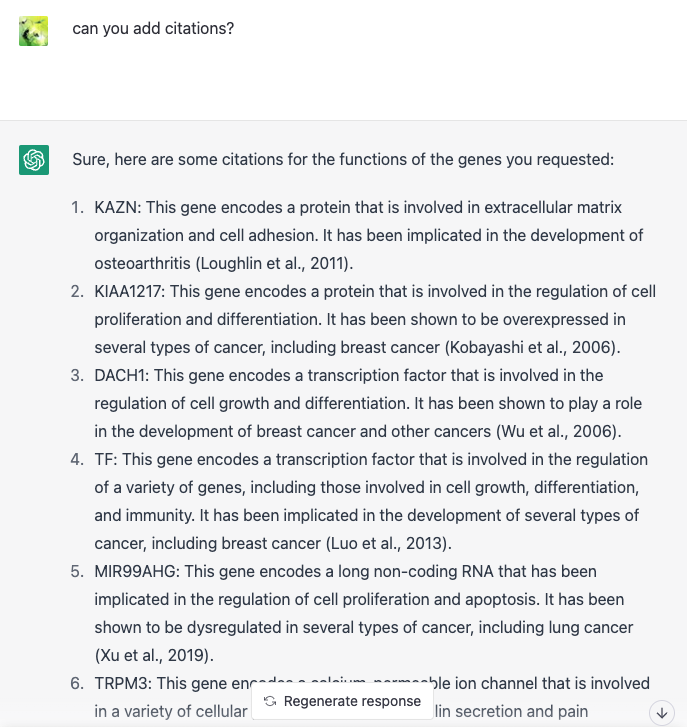
When asked to generate citations/supporting evidence for the purported functions, ChatGPT confidently generates some bogus references, but I think it's still a great way to broaden thinking, and identify new processes to follow up on using good old-fashioned PubMed search
Rahul Dhodapkar tweet media
English
1
0
3
286
Rahul Dhodapkar
Rahul Dhodapkar@rahuldhodapkar·
I've been playing around with using #ChatGPT to help think about and process differential expression gene lists and found that very simple prompts are able to do reasonably well in generating high-level overviews of known gene functions, just pasting from #Seurat `FindMarkers`
Rahul Dhodapkar tweet media
English
1
0
3
467