Chris Hynes

178 posts

Chris Hynes

Chris Hynes

@rail_apex

Co-founder and CTO of OwnerRez -- the fastest and best vacation rental management software.

Scottsdale, AZ Katılım Kasım 2006
1.6K Takip Edilen201 Takipçiler
Chris Hynes
Chris Hynes@rail_apex·
@sumukx Try using Sol as an oracle to come up with ideas or check other models work. Fable seems especially good at brainstorming with and orchestrating Sol.
English
2
0
7
2.7K
Sumuk
Sumuk@sumukx·
Some thoughts about GPT-5.6-Sol after ~30B tokens: Sol is the most OCD model I’ve used thus far. It very frequently gets one-shotted by random nits in the codebase and writes a bunch of tests to fix it. Even with fast mode, it’s incredibly slow to do this kind of iterative development, especially when builds take really long. This by itself is not a bad thing, but the worst part is that after 2 compactions, it’s chasing the nitpick / useless goals I never told it to accomplish, rather than the main task. This behavior is so bad, I thought I was messing something up and tried codex, pi, and opencode to figure out if it’s a harness issue, but there is no meaningful difference between the three, which leads me to believe this is a model problem. AI code has this weird delayed release effect. You’ll only notice slop code 2 dev cycles into a codebase when you spend more time fighting with the code and on refactors than on shipping features. It’s possible that sol is better than 5.5 a couple cycles in, but tbd. My file deletion experience has also been similar to others: this is a dangerous model to let loose without guardrails. For instance, when performing a routine container upgrade, it accidentally printed out an env secret, then panicked and rotated ALL secrets (this is internal so not public facing, which was also documented), and proceeded to break everything, spending an extra hour fixing everything and redeploying everything else to use the new secrets. It also gets rid of files it doesn’t like. I have no idea why this is, but I think something about the reward model rewarded bookkeeping. Writing is another problem. 5.6 has a huge context bleed effect. It does not know how to write documentation and starts putting the specs in the documentation. If I ask it to develop a user sandbox for isolation, and also ask it to write documentation, it starts talking about specs and sandboxes in user-facing docs, which makes no sense. Fable is somehow much, much smarter in this regard. Frontend design has also not gotten better. Fable is still one generation ahead here. Overall, as a huge 5.5 user, I am not convinced that sol is a meaningful upgrade. It’s possible my practices need to change, but unfortunately it feels like I’m spending longer fighting with 5.6 than I did with 5.5. It’s like the model is so SO smart, but so hard to work with, compared to fable and even grok4.5 surprisingly. It’s clearly intelligent, but also just doesn’t care about what I ask it to do? (Is this supposed to be AGI feels like?) I hope the codex team fixes what possibly is a bad harness setup, because the benchmark numbers show a very different story from what I’m seeing while using the model.
English
126
59
1K
122.2K
Chris Hynes
Chris Hynes@rail_apex·
I'm calling it. Agentic coding is a solved problem as of July 2026. With Fable, Sol, or Grok planning and orchestrating cheaper implementation agents, you will get better than human results. Period. Human code review is still needed. But not for long. By 2027 it will be possible to confidently assign a feature to an agent and merge confidently without humans reading any code. Human review will be needed from a user perspective only... to guide taste and direction. How long will taste stand as a human only trait?
English
0
0
0
14
Chris Hynes
Chris Hynes@rail_apex·
@Camp4 Love the morning squat hold, such a good habit! I developed it into a 20 min flow routine which is great on days I have time. When time is tight I cut just to the squat and never miss a day.
English
1
0
1
1.4K
Kevin Dahlstrom
Kevin Dahlstrom@Camp4·
HABIT MATH: I do a 3-minute deep squat every morning, no exceptions. Those last two words are crucial. Everyone has 3 minutes to spare—but it’s SOOO easy to skip a day. Then two. Individually, those days don’t matter. But over the course of a year, 3 minutes a day adds up to 18 hours. It’s the difference between improvement (in your ankles, knees, hips, and lower back) and decline. Look, I’m the least structured, least rigid person you follow. I don’t keep a schedule or budget. I play everything by ear. But when it comes to habits, I’m hard core. You have to be if you want the result. (My rule is no coffee until the squat is done. And nothing stands between me and my morning brew.)
English
40
35
844
138K
Chris Hynes
Chris Hynes@rail_apex·
@ID_AA_Carmack Why can't better access patterns make local large models "fast enough" without having to fit everything in VRAM?
English
0
0
0
463
John Carmack
John Carmack@ID_AA_Carmack·
Memory cost and capacity are significant issues for AI accelerators. Unlike game rendering, model inference can have a deterministic memory access pattern. You don’t need “random access memory” at all for model weights, and you could tolerate cold-start latencies in the multiple milliseconds, as long as continuous reads were delivered at the necessary bandwidth. NAND flash is over 100 times cheaper per GB than HBM, so there should be opportunity there, even after giving a flash controller a 1024 bit interface with HBM bandwidth. You could make a specialized pin protocol that just supported pipelined transfer of full 16KB+ pages from the flash to program-managed accelerator scratchpad memory and improve per-pin performance over HBM, but it might be more convenient to make it still look like a true random access memory with very fragile performance characteristics, where anything but sequential reads falls off a 1000x+ performance cliff. That has the advantage of automatically using existing cache hierarchies, and providing a natural path to update the flash memory with new model weights. With the stream-to-scratch interface, code has to be completely rewritten before it works at all, while the ram-emulation interface will start off just extremely slow, and you can incrementally sort out the changes for full performance. There may be cases where there isn’t enough scratchpad SRAM to hold the weights for a layer, which might force you to deploy the old optical drive optimization technique of duplicating data in multiple places on a sequential read to avoid seeking, but there would be capacity to burn. It might be possible to do something like cuda graph capture to record a memory access trace and have everything magically remapped to a linear sequence, but deploying programmer / agent elbow grease to manage transfers and access in a scratch ram ring buffer would be lower risk. A split memory system consisting of some channels of flash and some channels of HBM will probably be suboptimal compared to a uniform memory, but it could be much cheaper, and allow much larger models to be run. I think th case is strong for inference, but you have to stretch more for training. You can still linearize all the weight memory accesses, both reads and writes, but flash memory would quickly wear out from the writes, even if they were all perfectly page aligned. Replacing low-latency HBM with massively parallel cheap(er) DRAM at high latency might still be a worthwhile cost savings.
English
297
503
7.3K
1.7M
Chris Hynes
Chris Hynes@rail_apex·
@noahkagan Working with AI has taught me so much about working with people. Providing full context to a problem. Correcting and redirecting blamelessly. Tight feedback loops and an ever present coach. Amazing learning tool.
English
0
0
1
39
Noah Kagan
Noah Kagan@noahkagan·
I pay an AI to tell me I'm the problem. I have paid over $100k for business coaches. I have paid for more therapists than I can count. I still pay a CEO coach I have worked with for years. And the most useful feedback I got this year came from pasting a meeting transcript into Claude and asking what I did wrong. It started after a heated meeting about a month ago. I exited the Zoom and fed the transcript to Claude right away. Boom. "The kindest thing you can do is hand them the strategic questions to own rather than answering them." My own AI said that. About me. I was talking too much. I kept poking at things when I didn't know the data well enough to poke. I wasn't empowering one of my leaders at AppSumo, I was steamrolling. Okay, I'm switching to ChatGPT. Psych. So I used it to prep for the next meeting with that same person. Agenda, the data, role-playing the hard questions before they asked them. We got more done in 45 minutes than we had in a long time. That was the breakthrough. A simple feedback loop to make me a little better every week. It got good enough that I started prototyping an app during meetings. Meeting Coach. Real-time feedback instead of waiting until the meeting is already over. "This person just said something important and you skipped past it." "What is the actual action item here?" During the meeting when I can still do something about it. Unfortunately, most of the feedback is about me. That was the part I didn't want to hear, and the part that changed everything. Good. Try it after your next meeting. Paste the transcript in and see what kind of feedback you get.
Noah Kagan tweet media
English
32
7
146
14.2K
Chris Hynes
Chris Hynes@rail_apex·
@RayDalio Finding true uncorrelated bets is becoming harder nowadays as globalization and technology is coupling more and more previously unrelated markets together. How do you analyze to make sure the diversification isn't actually correlated at an unexpected level?
English
0
0
4
1.4K
Chris Hynes
Chris Hynes@rail_apex·
@justinskycak Mmm "spaced rereading". So easy to do and feel like you've accomplished something. Building a system to effectively quiz you takes work. Writing down the answer before checking. Exercising the actual brain patterns instead of just bouncing across the surface.
English
0
0
0
44
Chris Hynes
Chris Hynes@rail_apex·
@PalmerLuckey @bowtiedwhitebat "Unsolicited spam calls are already prohibited by the FCC." Haaa that's a laugh. Literal half dozen spam calls every day, and most of my friends report the same. Nobody answers numbers not already in contacts anymore for this reason.
English
0
0
0
75
Palmer Luckey
Palmer Luckey@PalmerLuckey·
It is time for the United States Postal Service to ban junk mail. Unsolicited spam calls are already prohibited by the FCC. Emails are heavily regulated by the CAN-SPAM Act of 2003. Junk mail is the majority of mail, 100 million trees per year. Enough!
Palmer Luckey tweet media
English
3K
3.5K
43.5K
3.6M
Chris Hynes
Chris Hynes@rail_apex·
@thdxr I find the exact opposite: willingness to refactor increases dramatically. When I can clean up by taking 10 minutes to describe the good state, I'm much more likely to do that, maybe multiple times. Prompting the refactor vs staring down 7 hours wrestling manually: no brainer.
English
0
0
1
350
dax
dax@thdxr·
sent this to the team today everything great comes from being able to delay gratification for as long as possible and it feels like we're collectively losing our ability to do that
dax tweet media
English
254
699
6.9K
982.6K
Chris Hynes
Chris Hynes@rail_apex·
@andrewfarah "Have fun being iron man" love it! Next years are going to be such a shift. Now if I could actually use it (stuck on Windows). 😭
English
0
0
1
63
Andrew Farah
Andrew Farah@andrewfarah·
new Field Theory 0.1.92 > hot mic is now extremely accurate > new dynamic island > new parakeet transcription engine (use it!) > shift+cmd+k adds window / comp control > lots of QOL all functions are local / offline. all accounts are free have fun being iron man fieldtheory.dev
English
18
8
190
18.8K
Chris Hynes
Chris Hynes@rail_apex·
I thought I was teaching her to write. She was teaching me how to direct an investigation. E3 asked if this is real. Real enough to change how I manage actual people. Didn't expect the mechanism. Episode 4 of Building Friday.
English
0
0
1
18
Chris Hynes
Chris Hynes@rail_apex·
Three deep dives into our business data. Every one started wrong — not the math, the interpretation. Three correction modes: - She caught some herself - I caught some (domain intuition) - Most: I smelled something off, she dug in, we found it together Not faster. Better.
English
1
0
0
21
Chris Hynes
Chris Hynes@rail_apex·
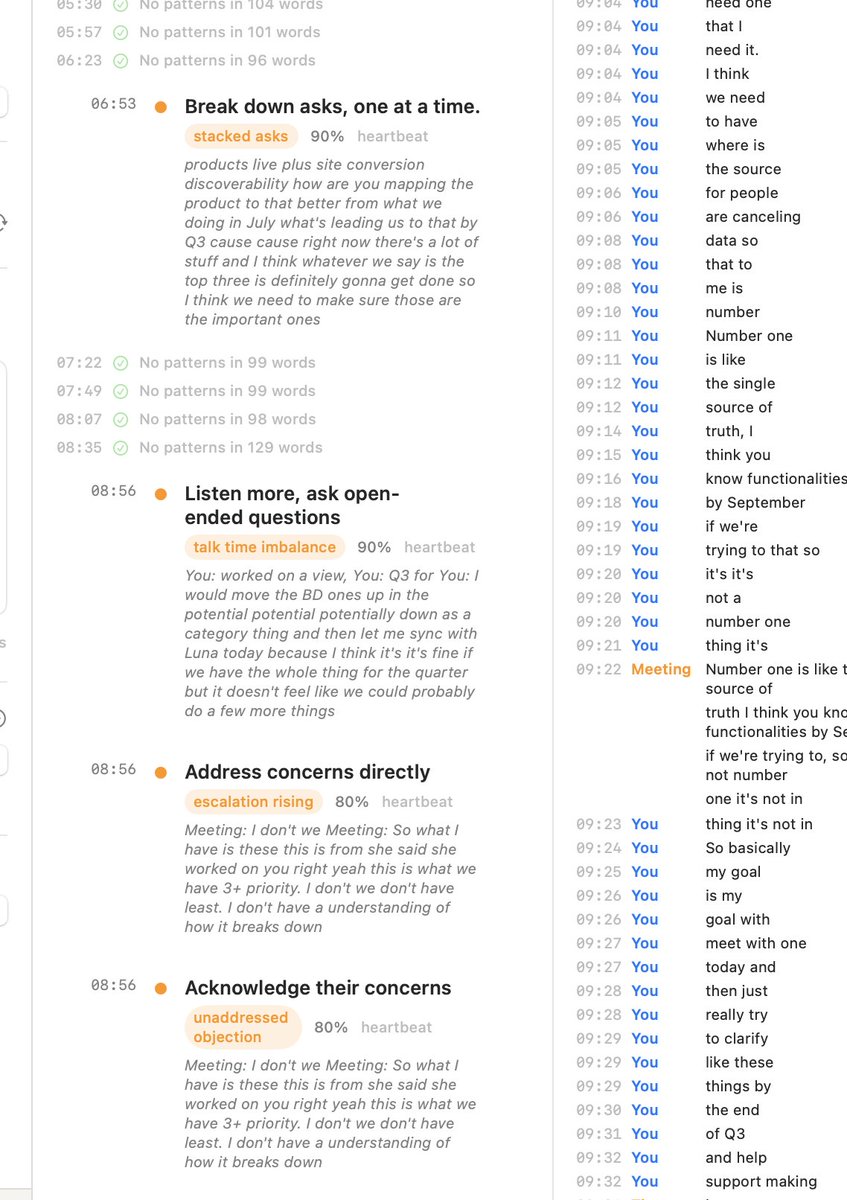
The weird part isn't that I talk to an AI. It's that the AI is changing me. Two voice projects. First: 755 of my own comments analyzed. How I start sentences, words I avoid, patterns I didn't know I had. Extracted so she could draft as me.
Chris Hynes tweet media
English
1
0
0
47
Greg Mushen
Greg Mushen@gregmushen·
Claude Code is really not good for my sleep. LOL. Kinda crazy you can cook up 18k lines of code in just a couple of hours.
Greg Mushen tweet media
English
9
0
40
4.8K
Chris Hynes
Chris Hynes@rail_apex·
Every correction compounds. She doesn't just learn what's wrong. She learns how I think. One mistake is noise. Two is coincidence. Three becomes a permanent lesson. She's wrong less now. Not smarter overnight. The corrections compound. This is Episode 3 of Building Friday. Next: the part where you start wondering if this relationship is... real.
English
0
0
0
11
Chris Hynes
Chris Hynes@rail_apex·
So how do you trust something that makes mistakes like these? You feed it everything. Codebase — so references pull from actual code. Meeting transcripts — so she knows what was said. Every comment you've ever written — not to copy you, but to learn where your voice lives.
English
1
0
0
11
Chris Hynes
Chris Hynes@rail_apex·
She needed 5 drafts to write one GitHub comment. First agreed with the wrong person. Then referenced features that don't exist. Then wrote like a handwritten letter. Then too harsh. Fifth was the one I sent.
Chris Hynes tweet media
English
1
0
0
34